
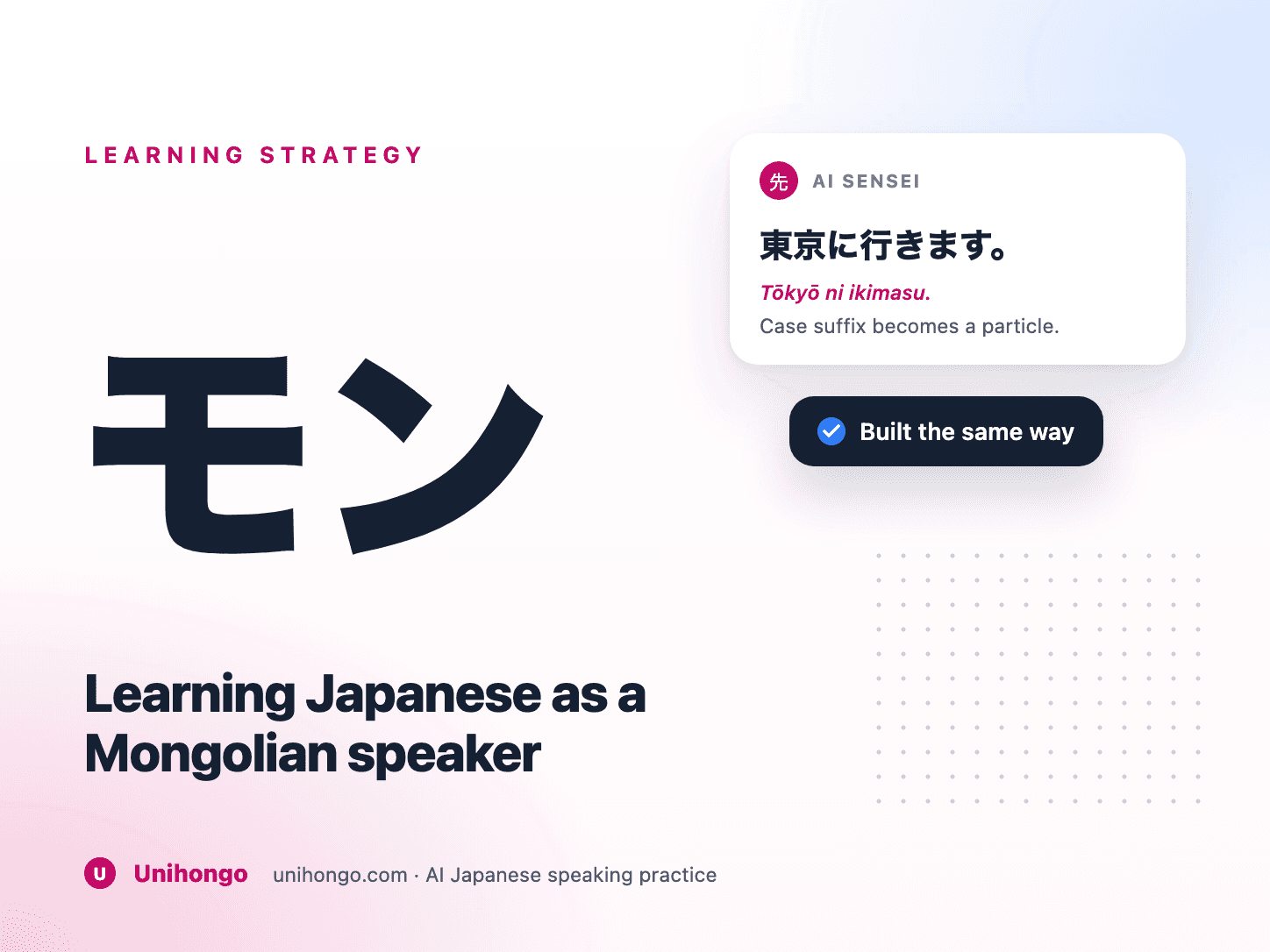
Two languages built the same way
Mongolian and Japanese are not related, and they are built on a strikingly similar plan. Both are agglutinative: meaning is added by attaching elements one after another rather than by changing the word internally. Both are verb-final. Both mark grammatical roles with something attached to the noun.
For a learner this means the fundamental shape of a Japanese sentence needs no adjustment. Where an English speaker spends months learning to hold the verb until the end, you already do it.
| Feature | Mongolian | Japanese | Transfers? |
|---|---|---|---|
| Word order | Verb final | Verb final | Yes |
| Morphology | Agglutinative | Agglutinative | Yes |
| Role marking | Case suffixes | Particles | Yes |
| Vowel length | Contrastive | Contrastive | Yes |
| Articles | None | None | Yes |
| Grammatical gender | None | None | Yes |
| Vowel harmony | Yes | No | Not needed |
Six of these seven rows are advantages, and the seventh costs you nothing. This is one of the most favourable starting positions for learning Japanese.
Case suffixes and particles
Mongolian marks a noun's role with a case suffix and Japanese with a particle. The mechanics are close enough that the concept transfers completely: you already expect the marker to come after the noun and to tell you what the noun is doing.
The divisions differ, though, and one Japanese distinction has no clean equivalent anywhere: the topic marker versus the subject marker. This is worth studying explicitly rather than assuming it maps onto a case you know.
| Japanese | Romaji | Meaning |
|---|---|---|
| 私は学生です。 | Watashi wa gakusei desu. | As for me, I am a student. |
| 誰が来ましたか。 | Dare ga kimashita ka. | Who came? |
| 東京に行きます。 | Tōkyō ni ikimasu. | I go to Tokyo. |
| 図書館で勉強します。 | Toshokan de benkyō shimasu. | I study at the library. |
| 本を読みます。 | Hon o yomimasu. | I read a book. |
| 友達と話します。 | Tomodachi to hanashimasu. | I speak with a friend. |
The length advantage
Mongolian uses vowel length contrastively, which means your ear is already listening for duration. That is the single feature Japanese depends on most and the one other learners take longest to acquire.
As with any assumed advantage, it is worth confirming rather than taking for granted, since the boundaries are not necessarily identical.
| Japanese | Romaji | Meaning |
|---|---|---|
| おばさん / おばあさん | obasan / obāsan | Aunt / grandmother |
| ここ / こうこう | koko / kōkō | Here / high school |
| ゆき / ゆうき | yuki / yūki | Snow / courage |
| ビル / ビール | biru / bīru | Building / beer |
| きて / きって | kite / kitte | The doubled consonant is separate |
| がっこう | ga-t-ko-u | Four beats, one silent |
The doubled consonant is a different feature from vowel length and needs its own practice even if your vowels are already good.
Sounds to work on
The consonants that need attention are the ones Japanese makes differently rather than the ones it lacks. The Japanese r is a single quick tap near the front of the mouth, not a rolled or continuous sound.
The Japanese f, which occurs only before u, is made with both lips and no contact between teeth and lip, and the word-initial ts is unfamiliar to speakers of many languages.
| Japanese | Romaji | Meaning |
|---|---|---|
| ら り る れ ろ | ra ri ru re ro | One quick tap each |
| ふじさん | Fujisan | Both lips, no teeth |
| つくえ | tsukue | Word-initial ts |
| しゃ しゅ しょ | sha shu sho | One beat each |
| じかん | jikan | Time |
| でんわ | denwa | Telephone |
Where the similarity stops
The structural match is close and it is not complete. Japanese politeness is more elaborate than most systems, with distinct honorific and humble verb forms depending on whose action is being described, and that needs learning as a system rather than as vocabulary.
Japanese verb conjugation is also extensive, and everything the verb carries arrives at the end, which is familiar in principle and detailed in practice.
| Japanese | Romaji | Meaning |
|---|---|---|
| 行きます / 行きません | ikimasu / ikimasen | Positive and negative |
| 行きました | ikimashita | Past |
| いらっしゃいます | irasshaimasu | Honorific: their going |
| 参ります | mairimasu | Humble: my going |
| いたします | itashimasu | Humble: my doing |
| なさいます | nasaimasu | Honorific: their doing |
The honorific and humble pairs are the part with no shortcut. Learn them as fixed sentences before analysing the system.
The writing
Mongolian in Mongolia is written in Cyrillic, an alphabet, so kana is a genuinely new kind of system: each symbol is a fixed syllable rather than a single sound. It is a small conceptual shift and a quick one.
Kanji is the long investment and the main reason Japanese takes time regardless of how well the grammar transfers.
- Hiragana first, in a fortnight.
- Katakana next, for loanwords.
- Kanji continuously and slowly; it does not block speaking.
- Move off romaji quickly; it entrenches wrong sounds.
Using the head start
With structure, agglutination and length all transferring, a Mongolian speaker can reach conversational Japanese faster than most learners, provided the time saved goes into speaking rather than into more grammar study.
That is the practical recommendation: verify the pronunciation assumptions once, drill the small tsu and the few unfamiliar consonants, and then talk as much as possible. Sessions in the immersive 3D classroom supply that volume, and the session report shows where the structural knowledge is not yet arriving at speed.
Kanji proceeds separately and slowly, and should not be allowed to hold the speaking back.
Your grammar will be ahead of your fluency for a while. That gap is closed by talking, not by studying more of what you already understand.