

Why topic groups beat alphabetical lists at N5
The N5 vocabulary section does not ask you to translate words in isolation. Every question puts a word into a short sentence and asks for its reading, its written form, or the word that fits the gap. That means the sentence context is doing half the work for you, if you have met the word in a similar sentence before. Alphabetical lists throw that advantage away.
Topic groups do the opposite. When you learn kyō, ashita and kinō together with the verbs that go with them, the words start to predict each other. See kinō and you expect a past tense verb; see raishū and you expect a plan. The test sentences are written by people who know these collocations, so learning them the same way is the most direct preparation.
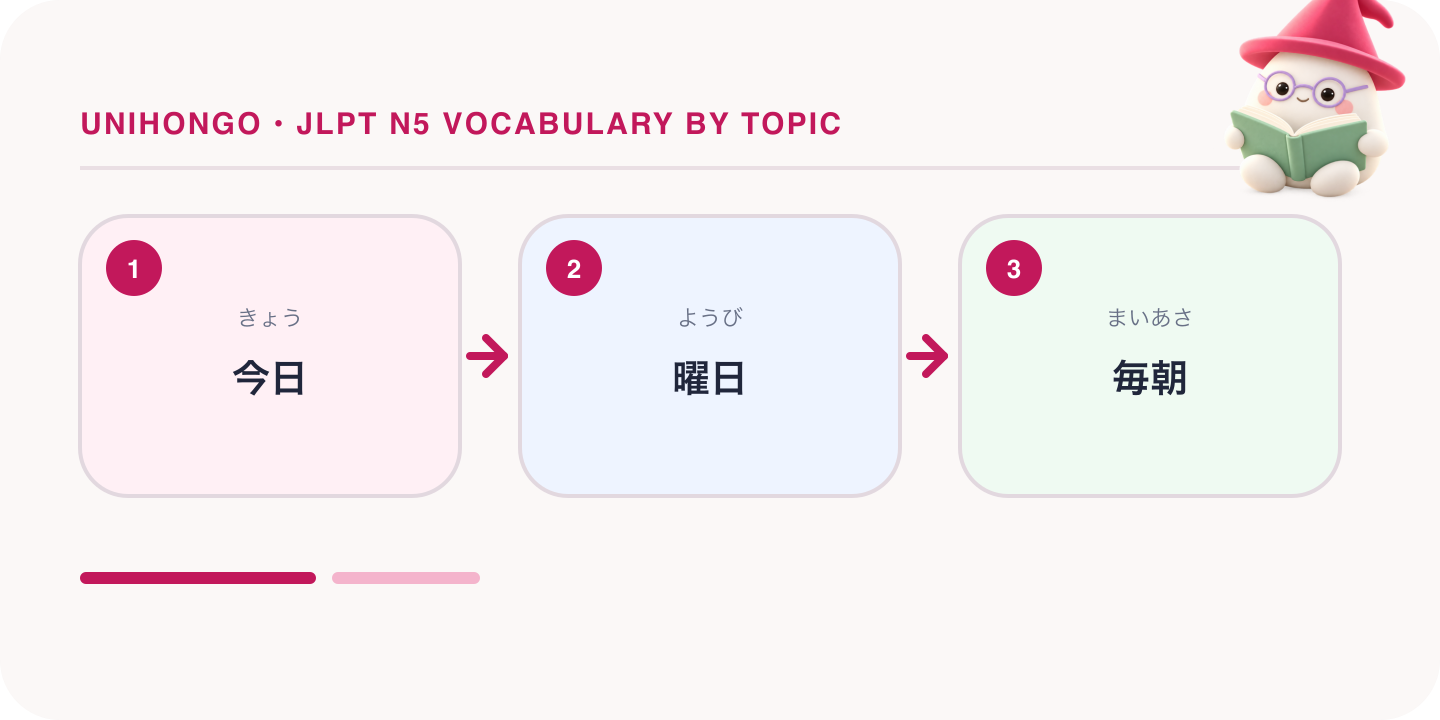
- Time and the calendar: days, weeks, months, the clock
- Family and people: your own family, other people's family, friends and teachers
- School, work and places: the buildings and rooms where daily life happens
- Food, drink and shopping: what you eat and how you buy it
- Core verbs: movement, senses, communication and exchange
- Adjectives: size, temperature, distance and feelings
Time words: days, weeks and the clock
Time words are the best place to start because they appear in almost every N5 sentence and they come in tidy sets. Today, tomorrow and yesterday form one set; this week, next week and last week form another; and the same prefixes kon-, rai- and sen- carry over to months, so konshū, raishū and senshū give you kongetsu, raigetsu and sengetsu for free. Years use kotoshi, rainen and the irregular kyonen.
| Japanese | Romaji | Meaning |
|---|---|---|
| 今日は何曜日ですか。 | Kyō wa nan-yōbi desu ka. | What day is it today? |
| 毎朝七時に起きます。 | Maiasa shichi-ji ni okimasu. | I get up at seven every morning. |
| 来週の土曜日は暇です。 | Raishū no doyōbi wa hima desu. | I'm free next Saturday. |
| 昨日は雨でした。 | Kinō wa ame deshita. | It rained yesterday. |
| 午後三時に会いましょう。 | Gogo san-ji ni aimashō. | Let's meet at three in the afternoon. |
| Word | Reading | Meaning |
|---|---|---|
| 今日 | kyō | today |
| 明日 | ashita | tomorrow |
| 昨日 | kinō | yesterday |
| 毎日 | mainichi | every day |
| 朝 | asa | morning |
| 夜 | yoru | night |
| 午後 | gogo | afternoon, p.m. |
| 今週 | konshū | this week |
| 来月 | raigetsu | next month |
| 去年 | kyonen | last year |
| 週末 | shūmatsu | weekend |
| 時間 | jikan | time, hours |
The clock and the days of the week are counted as vocabulary too. Hours use -ji with the irregular yo-ji, shichi-ji and ku-ji, and reading questions happily test them.
Family and people
Family words come in pairs, and the pairs are the trap. When you talk about your own family to someone outside it, you use the plain, humble forms: chichi for father, haha for mother, ani and ane for older brother and sister, otōto and imōto for younger ones. When you talk about someone else's family, or address your own parents directly, you use the polite forms with o- and -san: otōsan, okāsan, oniisan, onēsan. Younger siblings do not get a polite form, so otōto-san and imōto-san do the job.
Around the family sit the people words you meet at school and work: tomodachi, a friend; sensei, a teacher, which is also how you address doctors; gakusei, a student; and kaishain, a company employee. Counting people uses hitori, futari and then -nin, so kazoku wa yonin desu means there are four of us.
| Japanese | Romaji | Meaning |
|---|---|---|
| 家族は四人です。 | Kazoku wa yonin desu. | There are four people in my family. |
| 父は会社員です。 | Chichi wa kaishain desu. | My father is a company employee. |
| 母は毎日料理を作ります。 | Haha wa mainichi ryōri o tsukurimasu. | My mother cooks every day. |
| 兄が一人と妹が一人います。 | Ani ga hitori to imōto ga hitori imasu. | I have one older brother and one younger sister. |
| お父さんはお元気ですか。 | Otōsan wa o-genki desu ka. | Is your father well? |
| 友達と映画を見ました。 | Tomodachi to eiga o mimashita. | I watched a film with a friend. |
School, work and places
Place words at N5 are the buildings of a small town: gakkō, school; daigaku, university; kaisha, company; eki, station; ginkō, bank; byōin, hospital; toshokan, library; yūbinkyoku, post office; and mise, a shop. Inside them are rooms and things: kyōshitsu, classroom; tsukue, desk; isu, chair; and the study set of hon, a book; nōto, a notebook; shukudai, homework; and shitsumon, a question.
The grammar that carries these words is the existence pair arimasu and imasu, and the position words mae, ushiro, naka, ue and shita. Context questions often ask which position word fits a picture, so practise describing where things are in the room you are in.
| Japanese | Romaji | Meaning |
|---|---|---|
| 学校は九時に始まります。 | Gakkō wa ku-ji ni hajimarimasu. | School starts at nine. |
| 先生に質問があります。 | Sensei ni shitsumon ga arimasu. | I have a question for the teacher. |
| 図書館で宿題をします。 | Toshokan de shukudai o shimasu. | I do my homework at the library. |
| 会社まで電車で三十分です。 | Kaisha made densha de sanjuppun desu. | It's thirty minutes to the office by train. |
| 駅の前に銀行があります。 | Eki no mae ni ginkō ga arimasu. | There's a bank in front of the station. |
| 教室に学生が二十人います。 | Kyōshitsu ni gakusei ga nijūnin imasu. | There are twenty students in the classroom. |
Food, drink and shopping
Food words are the friendliest group because you can practise them three times a day. The core set is gohan, which means both rice and a meal; pan, bread; tamago, egg; niku, meat; sakana, fish; yasai, vegetables; kudamono, fruit; and the drinks mizu, ocha, kōhī and gyūnyū. The meals are asa-gohan, hiru-gohan and ban-gohan, and the restaurant verbs are taberu, nomu and chūmon suru.
Shopping adds the counters and the money words. Small things are counted hitotsu, futatsu, mittsu; thin flat things use -mai; long things use -hon. Prices use en, and the questions you will hear are ikura desu ka and nan-mai desu ka. Shop names add -ya to the thing sold: hon-ya, hana-ya, yao-ya.
| Japanese | Romaji | Meaning |
|---|---|---|
| 朝ご飯にパンと卵を食べます。 | Asa-gohan ni pan to tamago o tabemasu. | I eat bread and eggs for breakfast. |
| コーヒーを一つください。 | Kōhī o hitotsu kudasai. | One coffee, please. |
| この魚は新しくておいしいです。 | Kono sakana wa atarashikute oishii desu. | This fish is fresh and delicious. |
| 肉より野菜のほうが好きです。 | Niku yori yasai no hō ga suki desu. | I like vegetables more than meat. |
| 八百屋でりんごを三つ買いました。 | Yaoya de ringo o mittsu kaimashita. | I bought three apples at the greengrocer. |
| 水をもう一杯お願いします。 | Mizu o mō ippai onegai shimasu. | Another glass of water, please. |
Core verbs you will use every day
Verbs are where N5 points are won and lost, because a verb question tests the word and its form at the same time. The twelve below are the ones that appear most often in N5-style sentences. Learn each in the masu and dictionary forms, with one past and one negative sentence.
Three of them deserve a warning. Kuru, to come, and suru, to do, are irregular, so kimasu and shimasu do not follow the pattern of the others. Kaeru means to go home, not simply to return an object. And kiku means both to listen and to ask, so a sentence with sensei ni kikimasu means asking the teacher a question, not listening to them.
| Verb | Reading | Meaning |
|---|---|---|
| 行く | iku | go |
| 来る | kuru | come |
| 帰る | kaeru | go home, return |
| 食べる | taberu | eat |
| 飲む | nomu | drink |
| 見る | miru | see, watch |
| 聞く | kiku | listen, ask |
| 話す | hanasu | speak, talk |
| 読む | yomu | read |
| 書く | kaku | write |
| 買う | kau | buy |
| 会う | au | meet |
Add the daily routine set, okiru, neru, hataraku, benkyō suru and yasumu, and the exchange verbs ageru, morau and kasu, and you have the verbs that most N5-style sentences are built on. Note the particles: au takes ni, kau and taberu take o.
Adjectives and a six-week study order
N5 adjectives describe the physical world: ōkii and chiisai, atarashii and furui, takai and yasui, atsui and samui, chikai and tōi, and the feeling words tanoshii, omoshiroi, muzukashii and isogashii. On the na-adjective side you need shizuka, kirei, genki, hima and suki. The test likes the pairs, so learn opposites together and check that you can say both the past, samukatta, and the negative, samukunai.
The order below spreads the six topics across six weeks. Each week you add one group and keep the previous groups alive with sentences, so by week six you are mixing time words, people, places and food in the same conversation.
| Japanese | Romaji | Meaning |
|---|---|---|
| この部屋は広くて明るいです。 | Kono heya wa hirokute akarui desu. | This room is spacious and bright. |
| 今日は寒いですね。 | Kyō wa samui desu ne. | It's cold today, isn't it? |
| 駅はここから近いです。 | Eki wa koko kara chikai desu. | The station is close to here. |
| 日本語の勉強は楽しいです。 | Nihongo no benkyō wa tanoshii desu. | Studying Japanese is fun. |
| あの店は静かで、きれいです。 | Ano mise wa shizuka de, kirei desu. | That shop is quiet and clean. |
| この問題は難しくないです。 | Kono mondai wa muzukashikunai desu. | This question is not difficult. |
- Week 1: time words and the clock, with desu and the days of the week
- Week 2: family and people, with imasu and the counters for people
- Week 3: school, work and places, with arimasu and position words
- Week 4: food, drink and shopping, with kudasai and the small counters
- Week 5: core verbs in masu, past and negative, with the right particles
- Week 6: adjectives in pairs, then mixed sentences across all six topics
Mistakes that cost points at N5
The most common vocabulary errors at this level are not about unknown words but about known words used slightly wrongly. Family terms get the wrong politeness. Adjectives are conjugated as if all of them were i-adjectives, so learners write kirei-kunai instead of kirei ja nai. Readings that change inside compounds are missed, so 大きい is read correctly as ōkii but 大学 is guessed as ōgaku instead of daigaku.
The cure for each is the same: a sentence rather than a word. When you learn ani, learn it inside ani wa Tōkyō ni sunde imasu, and the politeness sorts itself out. When you learn atarashii, say atarashii kutsu o kaimashita, and you will not later reach for a noun form that does not exist. The four sentences below each contain one of the traps above used correctly.
| Japanese | Romaji | Meaning |
|---|---|---|
| 兄は東京に住んでいます。 | Ani wa Tōkyō ni sunde imasu. | My older brother lives in Tokyo. |
| 新しい靴を買いました。 | Atarashii kutsu o kaimashita. | I bought new shoes. |
| 昨日は忙しかったです。 | Kinō wa isogashikatta desu. | I was busy yesterday. |
| 明日、友達に会います。 | Ashita, tomodachi ni aimasu. | I'll meet a friend tomorrow. |