
Tell a Short Japanese Story With Mocchi Without Losing the Order

A short Japanese story needs a clear sequence more than a large vocabulary. Ask Mocchi to help you arrange a few events, keep references understandable, and add one relevant reason before polishing the language or expanding the paragraph.

Mocchi arranges three events into a short Japanese story with a clear sequence and reason
What you need to know

Tell a Short Japanese Story With Mocchi Without Losing the Order

When learners try to tell an interesting story, they may pack several events into one sentence or translate a complex first-language narrative. Start with three simple events in a fictional or ordinary scene. Decide what happened first, what followed, and why the ending matters. Mocchi can help identify a missing connection and show how a short expression changes the flow, while your own revision keeps the story a writing task rather than a supplied model.

Choose a small event sequence you can explain.

Keep time order and references clear.

Add a reason only when it helps the reader.

Revise the connection before expanding the story.

Plan the event sequence before translating the story

Write a simple outline of three events in the order the reader should understand them. Keep each event ordinary enough to express with familiar Japanese. Tell Mocchi which connection feels difficult. This avoids a situation where the tutor supplies a complex paragraph and you can no longer tell which parts reflect your own available language.

Choose only details that support the short story. A new person, location, or background explanation creates another relationship the reader must track. You can add detail later, after the core sequence is understandable without a long spoken explanation beside it.

Use one short transition to connect familiar events

昨日、友達に会いました can begin the story, followed by そのあと、喫茶店で話しました. The transition makes the sequence explicit without requiring a long combined sentence. Add a reason for leaving only if it helps explain the ending. Ask Mocchi whether the wording preserves the order you intended rather than simply making the paragraph longer.
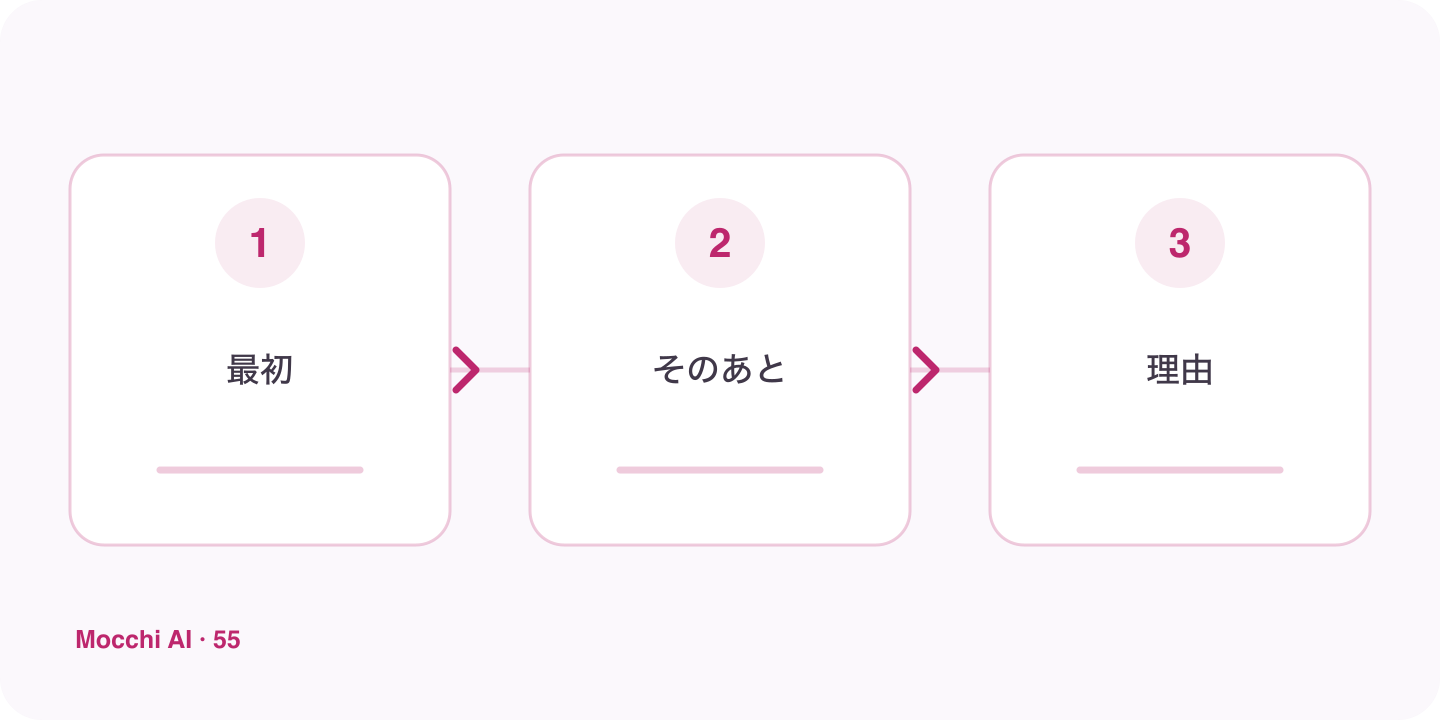
An initial event leads to a later event and a reasoned ending in a connected Japanese paragraph
A reader should be able to follow what happened and why before the story becomes more elaborate.
JapaneseRomajiMeaning
昨日、友達に会いました。Kinō, tomodachi ni aimashita.I met a friend yesterday.
そのあと、喫茶店で話しました。Sono ato, kissaten de hanashimashita.After that, we talked at a café.
雨が降ってきたので、早く帰りました。Ame ga futte kita node, hayaku kaerimashita.Because it started raining, I went home early.

Check who is acting when a reference is omitted

Japanese often leaves information understood from context, but a learner's paragraph can still become unclear when the actor changes. Ask Mocchi to identify the first point where a reader might lose track. Clarify that point with the smallest useful change instead of automatically inserting a subject into every sentence or removing every repeated noun.

Add a cause without inventing a new event

A revision may introduce a reason that was not in your original intention. Tell the tutor whether a suggested cause is part of the story or only an optional example. Keep factual or fictional details under your control. The goal is a clearer relationship between your events, not a more dramatic narrative that the AI has created in your place.

Use another tiny story for the follow-up

Write a new sequence with different familiar events and apply the same clarity questions. Can the reader tell what happened first, what changed, and why the ending follows? If one connection remains difficult, make it the next small practice target. Mocchi can help you build a personal writing routine through these repeated decisions, while each new story keeps the exercise from becoming a recitation of the original model.

Key points

A practical way to improve

Write three short sentences about meeting a friend, doing an activity, and returning home. Ask Mocchi whether the order is clear and which connection most needs improvement. Revise that connection yourself, then change one event and check that the story still flows. At a later session, write another tiny story without opening the old version and compare the clarity of the sequence.

  1. 1

    Choose one clear goal

    Focus each session on a situation or skill you can actually use.

  2. 2

    Practice actively

    Say complete answers aloud instead of only reading or recognizing Japanese.

  3. 3

    Review and repeat

    Keep useful corrections and revisit the same skill until it feels natural.

FAQ

Frequently asked questions

Do I need many different connectors in a short story?

No. Use the connection the reader needs, and avoid adding markers only to make the paragraph look advanced. A clear sequence with simple wording can be more effective than several connectors whose roles overlap.

Should every sentence repeat the subject?

Not necessarily, but the reader must be able to follow who acts. Ask Mocchi where an omitted or repeated reference becomes confusing in the actual paragraph rather than applying one rule everywhere.

Can I use an invented story for practice?

Yes. A fictional scene lets you control vocabulary and avoid sharing private details. The writing target is the connection between events, not whether the story happened in your real life.

Make the next event easy to follow

Use Mocchi to improve one connection in a story you can still explain and rewrite yourself.