
Why a fixed shape beats practising when you feel ready
The advantage of an AI tutor is that it is always free, always patient, and never annoyed by a fourth attempt at the same sentence. The hidden cost is that nothing external holds the appointment. A human teacher, a class, or an exchange partner creates a time you cannot silently move. An AI session can be postponed forever at no social cost, which is why so many learners have a tutor app and almost no speaking hours.
A fixed routine restores the missing structure. When the segments and their lengths are decided in advance, the only remaining choice is whether to begin. That is one decision instead of five, and it can be made while tired. Streak-based drill apps solve the same problem with notifications, but a streak of tapping answers is not a streak of speaking, so build your structure around minutes of talking.
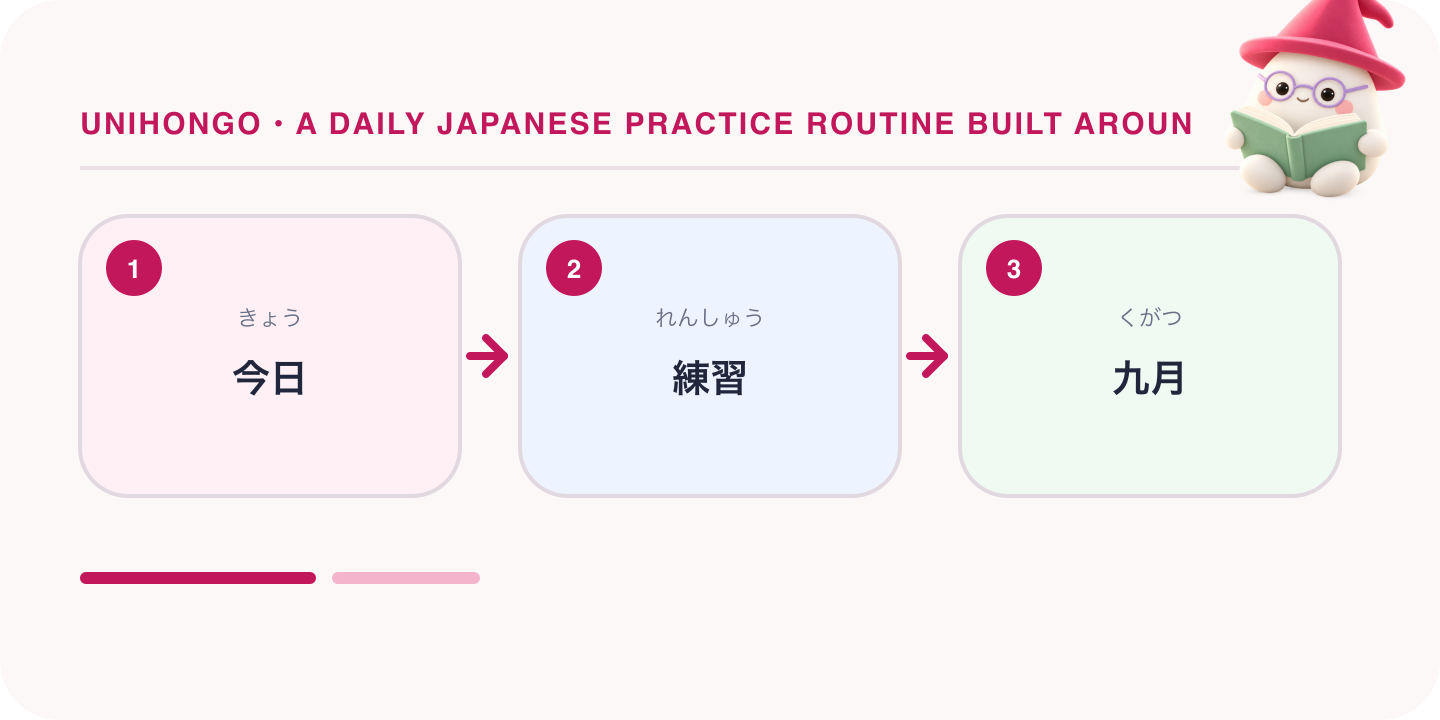
The twenty-minute core block
| Segment | Minutes | What you do | Why it is there |
|---|---|---|---|
| Warm-up | 2 | Say six fixed sentences aloud about today | Moves your mouth and mind into Japanese before anything hard |
| Conversation | 10 | One live roleplay aimed at one target pattern | Produces the pattern under time pressure, where it actually forms |
| Report | 3 | Read the corrections and pick the top three | Turns a vague sense of struggle into named, fixable errors |
| Repair | 5 | Re-say each corrected line and two new versions | Puts the correct form in your mouth, not only in your eyes |
The ordering matters more than the exact minutes. Warm-up before conversation stops the first three minutes of the roleplay being wasted on finding your voice. Repair after the report is the segment learners drop first and the one that carries most of the benefit, because a correction you only read leaves almost nothing behind.
Two minutes of warm-up said aloud
Use the same six sentences every day so no thinking is required. They should be about today, which forces small changes to the date, the weather, and your plan, and they should end with a statement of what you are about to practise. Say them standing up if you can, at normal volume. Whispering trains a different set of muscles from the ones you will need in a real conversation.
| Japanese | Romaji | Meaning |
|---|---|---|
| おはようございます。今日も練習します。 | Ohayō gozaimasu. Kyō mo renshū shimasu. | Good morning. I am practising again today. |
| 今日は九月五日、金曜日です。 | Kyō wa ku-gatsu itsuka, kin'yōbi desu. | Today is Friday the fifth of September. |
| 今、朝の七時半です。 | Ima, asa no shichi-ji han desu. | It is half past seven in the morning. |
| 昨日は友達と晩ご飯を食べました。 | Kinō wa tomodachi to bangohan o tabemashita. | Yesterday I had dinner with a friend. |
| これから会社に行きます。 | Kore kara kaisha ni ikimasu. | I am going to the office after this. |
| 今日は許可の言い方を練習します。 | Kyō wa kyoka no iikata o renshū shimasu. | Today I am practising how to ask permission. |
Picking one target instead of practising everything
The common mistake is to open a session hoping to improve Japanese in general. Nothing measurable happens, because attention is spread across vocabulary, particles, verb forms, and politeness at once. Choose one target before you start speaking, name it out loud in the warm-up, and let everything else stay approximate for twenty minutes. Errors outside the target are not failures today; they are simply not today's job.
A good target is small enough to appear eight or ten times in ten minutes. A grammar pattern works well, and so does a single function such as refusing politely, or a single sound such as the doubled consonant in kitte and chotto. Pick tomorrow's target at the end of today's session, usually from the correction report, so the choice is already made when you sit down.
| Japanese | Romaji | Meaning |
|---|---|---|
| ちょっと聞いてもいいですか。 | Chotto kiite mo ii desu ka. | Permission target: May I ask you something? |
| ここに荷物を置いてもいいですか。 | Koko ni nimotsu o oite mo ii desu ka. | Permission target: May I leave my bag here? |
| 先週、京都に行きました。 | Senshū, Kyōto ni ikimashita. | Past-tense target: I went to Kyoto last week. |
| 写真をたくさん撮りました。 | Shashin o takusan torimashita. | Past-tense target: I took a lot of photos. |
| はい、時々行きます。月に一回ぐらいです。 | Hai, tokidoki ikimasu. Tsuki ni ikkai gurai desu. | Fuller-answer target: Yes, I go sometimes, about once a month. |
| いいえ、あまり飲みません。コーヒーの方が好きです。 | Iie, amari nomimasen. Kōhī no hō ga suki desu. | Fuller-answer target: No, I do not drink much; I prefer coffee. |
- Good target: the permission pattern -te mo ii desu ka, used in six different situations.
- Good target: past-tense verbs only, in a story about your weekend.
- Good target: replacing every hai with a fuller answer of at least eight words.
- Poor target: improve my grammar, which cannot be checked at the end of the session.
- Poor target: five patterns at once, which gives each of them two attempts.
Each of these could carry a whole session on its own. Say the target aloud before you start, and check at the end whether you produced it at least eight times; if you produced it twice, the roleplay did not suit the target and the situation needs changing rather than the pattern.
Ten minutes of live conversation on that pattern
Say the target aloud to the tutor at the start, then let the situation run. The point is not to have a smooth chat; it is to force your pattern into eight or ten turns, including turns where the reply surprises you. When the tutor asks something you cannot answer with the target, answer anyway and steer back afterwards. Below is what a permission-focused roleplay in a cafe and an office actually sounds like.
| Japanese | Romaji | Meaning |
|---|---|---|
| 今日は許可の表現を練習したいです。 | Kyō wa kyoka no hyōgen o renshū shitai desu. | Today I would like to practise expressions for asking permission. |
| すみません、ここに座ってもいいですか。 | Sumimasen, koko ni suwatte mo ii desu ka. | Excuse me, may I sit here? |
| はい、どうぞ。空いていますよ。 | Hai, dōzo. Aite imasu yo. | Yes, go ahead. It is free. |
| 写真を撮ってもいいですか。 | Shashin o totte mo ii desu ka. | May I take a photo? |
| 申し訳ありませんが、店内は撮影禁止です。 | Mōshiwake arimasen ga, tennai wa satsuei kinshi desu. | I am sorry, but photography is not allowed inside. |
| 分かりました。じゃあ、外で撮ってもいいですか。 | Wakarimashita. Jā, soto de totte mo ii desu ka. | I see. In that case, may I take one outside? |
| すみません、明日は早く帰ってもいいですか。 | Sumimasen, ashita wa hayaku kaette mo ii desu ka. | Excuse me, may I leave early tomorrow? |
| 理由を聞いてもいいですか。 | Riyū o kiite mo ii desu ka. | May I ask the reason? |
| 病院の予約があるんです。 | Byōin no yoyaku ga aru n desu. | I have a hospital appointment. |
Notice the third and sixth lines. A refusal is where most learners stop speaking, so ask the tutor in advance to say no sometimes. An AI partner will happily agree to everything unless you request friction, and a conversation where every request is granted trains only half of the pattern.
Three minutes reading the correction report
A session report is easy to skim and forget. Give it three timed minutes and a narrow job: find the three corrections that matter and ignore the rest. Corrections that changed your meaning come first, then anything touching today's target, then repeated errors you recognise from earlier sessions. Style suggestions that only make a correct sentence more elegant can wait until the basic form is stable.
Write the three down in your own words, as a rule you could say to yourself, not as a copied sentence. Something like ni for the destination, de for the place of the action is more useful than a corrected line you no longer remember the context for. Three minutes is deliberately short, because reading feels productive and is the cheapest part of the routine.
Five minutes of re-saying the corrected lines
This is the segment that converts feedback into speech. For each of your three corrections, say the corrected sentence twice at normal speed, then invent two fresh sentences with the same structure and different content. You are not memorising the corrected line; you are teaching your mouth the pattern behind it. Say them aloud even though nobody is listening, because silent reading produces almost none of the benefit.
| Japanese | Romaji | Meaning |
|---|---|---|
| すみません、ここに座ってもいいですか。 | Sumimasen, koko ni suwatte mo ii desu ka. | Excuse me, may I sit here? |
| 先生、質問してもいいですか。 | Sensei, shitsumon shite mo ii desu ka. | Sensei, may I ask a question? |
| この資料をコピーしてもいいですか。 | Kono shiryō o kopī shite mo ii desu ka. | May I make a copy of this document? |
| エアコンをつけてもいいですか。 | Eakon o tsukete mo ii desu ka. | May I turn the air conditioning on? |
| 今日はここで終わってもいいですか。 | Kyō wa koko de owatte mo ii desu ka. | May we finish here for today? |
| すみません、もう一度お願いしてもいいですか。 | Sumimasen, mō ichido onegai shite mo ii desu ka. | Sorry, may I ask you to say that once more? |
Finish by choosing tomorrow's target out loud. It takes ten seconds and it removes the hardest decision from the start of the next session, which is exactly when your motivation is lowest.
The ten-minute and forty-minute variants
| Version | Warm-up | Conversation | Report | Repair |
|---|---|---|---|---|
| Ten minutes | 1 minute, three sentences | 5 minutes, one short scene | 1 minute, one correction | 3 minutes on that one correction |
| Twenty minutes | 2 minutes, six sentences | 10 minutes, one roleplay | 3 minutes, three corrections | 5 minutes on all three |
| Forty minutes | 3 minutes plus pronunciation | 20 minutes, two roleplays of the same target | 5 minutes across both | 12 minutes, including a retold version of scene one |
The forty-minute version is not the twenty-minute version done twice. The second roleplay repeats the same target in a different setting, which is where transfer happens, and the long repair segment ends with you retelling the first scene from memory with the corrections built in. Use it once or twice a week; daily forty-minute sessions collapse faster than daily twenty-minute ones.
The weekly review of repeated mistakes
Once a week, put your five or six sets of three corrections side by side and look only for repeats. One particle error is noise. The same particle error on four days is your actual curriculum for next week, and it deserves to become a target rather than a footnote. Most learners discover they have three or four recurring errors, not thirty, which is far less discouraging than it sounds.
Sort the repeats into three buckets: things you did not know, things you knew but produced too slowly, and things you know perfectly and still say wrong under pressure. The first needs an explanation, the second needs volume, and the third needs slower speech rather than more study. Confusing these three is why learners re-read grammar notes for a problem that was never about knowledge.
- Count how many of the week's corrections were the same error wearing different clothes.
- Promote the most frequent one to next week's daily target.
- Delete corrections you have not repeated in two weeks; they are finished.
- Keep one recording from week one to compare against later.
What to do on a low-energy day
The routine has to survive the day you get home late and want nothing to do with Japanese. The answer is a version so small it cannot be refused: three minutes, spoken, no report, no new material. Say a few sentences about your day, repeat yesterday's corrected lines once, and stop. This is not a real session and does not need to be. It keeps the habit alive and keeps your mouth in contact with the language.
| Japanese | Romaji | Meaning |
|---|---|---|
| 今日は疲れているので、少しだけ話します。 | Kyō wa tsukarete iru node, sukoshi dake hanashimasu. | I am tired today, so I will speak only a little. |
| 三分だけ練習します。 | San-pun dake renshū shimasu. | I will practise for three minutes only. |
| 昨日と同じ文をもう一度言います。 | Kinō to onaji bun o mō ichido iimasu. | I will say yesterday's sentences one more time. |
| 今日は新しいことをしません。 | Kyō wa atarashii koto o shimasen. | I am not doing anything new today. |
| また明日、続けます。 | Mata ashita, tsuzukemasu. | I will carry on again tomorrow. |
Decide the rules for these days while you are feeling motivated, not at eleven at night. Write down what counts as a minimum session, and treat hitting the minimum as a success rather than a failed full session.
Telling whether the routine is working after four weeks
Four weeks is long enough to judge a routine and short enough to change it without much loss. Do not judge by feeling fluent, because that feeling arrives late and unreliably. Judge by evidence you can compare: an old recording against a new one on the same prompt, the list of recurring corrections, and how long you can speak before switching to English. Progress in speaking usually shows up as fewer stalls before it shows up as better sentences.
- Re-record your week-one warm-up and compare the two takes directly.
- Check whether at least one recurring correction has disappeared entirely.
- Time how long you can keep going before your first long stall.
- Count how many turns you began without translating from English first.
- Notice whether the tutor now asks you follow-up questions instead of simple ones.
If nothing has moved after four honest weeks, change one variable, not all of them. The most common fix is not more minutes but a narrower target and a longer repair segment. Be honest about the limits too: this routine builds production and confidence, but it will not replicate exam-day nerves, a colleague's regional accent, or a conversation with someone who knows your history and expects you to remember theirs. For those, add real people to the week and let the daily block do the volume.