
What a study buddy is good for
A buddy gives you three things that are hard to get alone. First, speaking time: you can practise conversations, roleplays and quizzes out loud, which most solo study leaves out. Second, accountability: when someone is expecting you on Thursday evening, you are far more likely to study on Wednesday. Third, company: someone who also finds particles confusing makes the hard parts feel normal.
A buddy is not a teacher. Neither of you can be sure about natural Japanese, and that is fine, as long as you treat your sessions as practice and check new points elsewhere.
| Japanese | Romaji | Meaning |
|---|---|---|
| 一緒に勉強しよう! | Issho ni benkyō shiyō! | Let's study together! (casual) |
| 勉強仲間 | benkyō nakama | study buddy, study companion |
| 今週は何を勉強した? | Konshū wa nani o benkyō shita? | What did you study this week? (casual) |
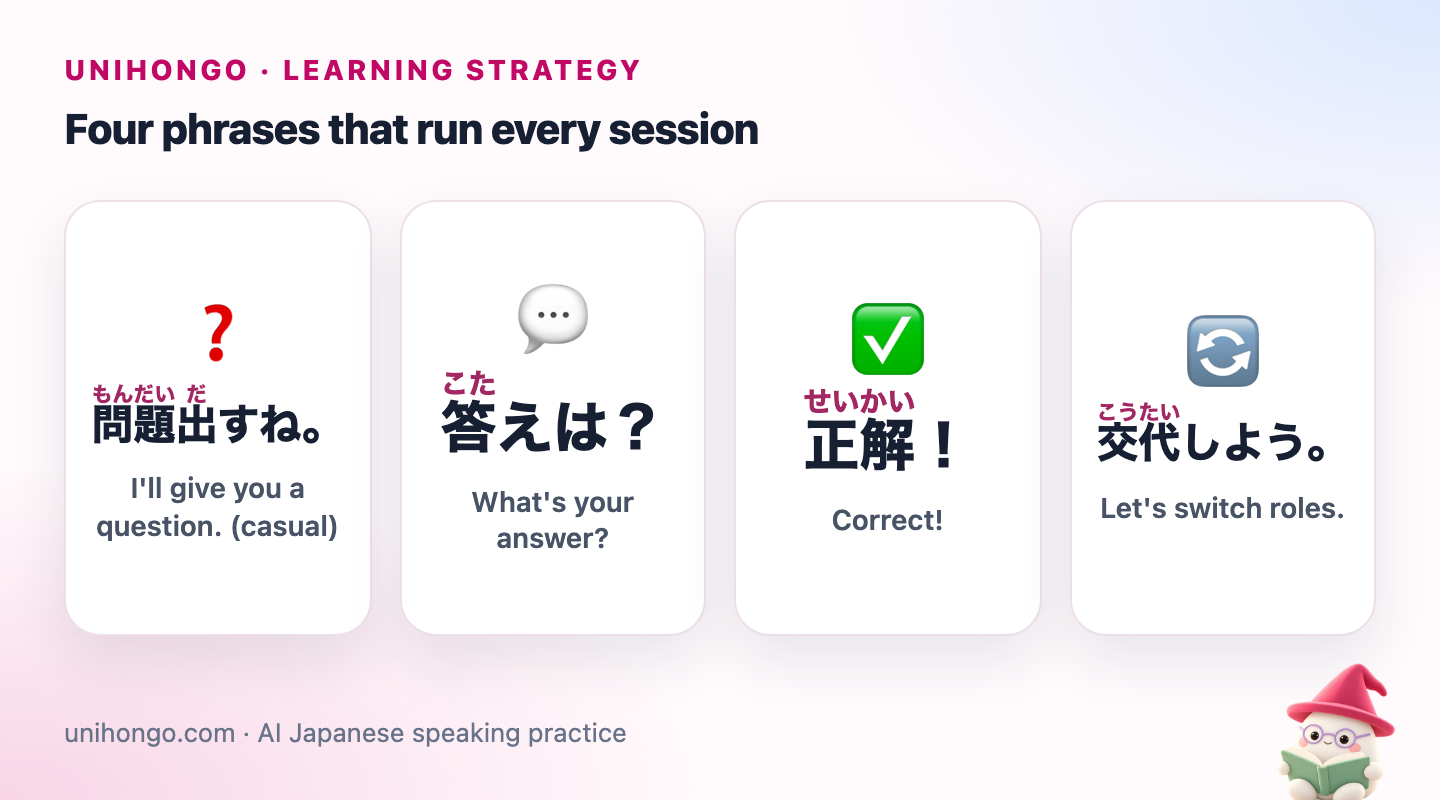
Four phrases that run every session
These four lines keep a session moving in Japanese. Learn them first and use them every time; after a few weeks they will feel automatic, and that alone keeps you out of English.
| Japanese | Romaji | Meaning |
|---|---|---|
| 問題出すね。 | Mondai dasu ne. | I'll give you a question. (casual) |
| 答えは? | Kotae wa? | What's your answer? |
| 正解! | Seikai! | Correct! |
| 交代しよう。 | Kōtai shiyō. | Let's switch roles. |
These are casual forms, which suit two friends of similar age. If your buddy is older than you or a coworker you do not know well, use polite forms: mondai o dashimasu ne, kōtai shimashō. Agree on one register for the session; switching between them is good practice too.
Choosing the right buddy
- A similar level. A small gap is fine, but if one of you is far ahead, sessions turn into lessons and both get bored.
- A shared goal, or at least a compatible one: the same JLPT level, the same textbook, or the same trip coming up.
- A schedule you can both keep. A fixed weekly time beats a flexible one that needs planning every week.
- A similar attitude to mistakes. You both need to be comfortable speaking imperfect Japanese in front of each other.
- Reliability. Someone who cancels often will take the habit with them.
Online buddies work well too, as long as time zones allow a regular slot. A short video call with cameras on keeps the session focused; voice-only calls drift more easily.
Before you commit, try two or three trial sessions. They show quickly whether your levels and styles fit, and they make it easy for either of you to say this is not working without any hard feelings. If it does work, agree on a review point, such as after two months, to check that you both still want the same things.
A session format that works
Keep the structure the same every week, so you do not waste time deciding what to do. The format below fits in under an hour, and you can shorten every part on busy weeks.
| Japanese | Romaji | Meaning |
|---|---|---|
| 今日のテーマは何にする? | Kyō no tēma wa nani ni suru? | What shall today's topic be? |
| じゃあ、ロールプレイをしよう。 | Jā, rōru purei o shiyō. | OK, let's do a roleplay. |
| 私が店員をやるね。 | Watashi ga ten'in o yaru ne. | I'll be the shop assistant. |
| 来週も同じ時間でいい? | Raishū mo onaji jikan de ii? | Same time next week? |
| Part | What you do | Language |
|---|---|---|
| Check-in | Say what you studied and one thing that happened this week | Japanese |
| Quiz | Take turns asking five questions on the week's target | Japanese |
| Roleplay | Act out a situation, then swap roles | Japanese |
| Questions | Note grammar you were both unsure about, to check later | Shared language allowed |
| Next week | Agree on the next target and time | Japanese |
Correcting each other without spreading mistakes
The biggest risk with a buddy is that you both agree on something wrong and repeat it for months. The fix is to separate what you are sure about from what you think. When you correct your buddy, say how confident you are, and when you are both unsure, write the question down and check it before the next session.
Be kind with corrections. Let your buddy finish the sentence, then mention one thing, not five. A good rule is to correct only the week's target during the roleplay and save other points for the questions part.
| Japanese | Romaji | Meaning |
|---|---|---|
| たぶん「に」だと思う。 | Tabun "ni" da to omou. | I think it's probably ni. |
| 自信ないけど… | Jishin nai kedo… | I'm not sure, but… (casual) |
| あとで調べてみよう。 | Ato de shirabete miyō. | Let's look it up later. |
| それ、どういう意味? | Sore, dō iu imi? | What does that mean? |
| もう一回言って。 | Mō ikkai itte. | Say it once more. (casual) |
Mini dialogue: the weekly check-in
The check-in is where most of your free speaking happens. Keep it simple and personal: what you studied, one small event, and how you felt about it. Here is a typical exchange between two buddies at a similar level.

| Japanese | Romaji | Meaning |
|---|---|---|
| 今週、どうだった? | Konshū, dō datta? | Buddy: How was your week? |
| ちょっと忙しかったけど、単語は毎日やったよ。 | Chotto isogashikatta kedo, tango wa mainichi yatta yo. | You: A bit busy, but I did my words every day. |
| すごい!私はて形が難しかった。 | Sugoi! Watashi wa tekei ga muzukashikatta. | Buddy: Great! I found the te-form hard. |
| じゃあ、今日はて形の問題を出すね。 | Jā, kyō wa tekei no mondai o dasu ne. | You: Then I'll quiz you on the te-form today. |
| ありがとう。お願い! | Arigatō. Onegai! | Buddy: Thanks. Please do! |
Notice how much grammar is packed into this simple chat: past forms of adjectives, kedo for contrast, and plans with dasu ne. Repeating the same check-in every week is not boring; it lets you see your progress as the sentences get longer.
Keep it going between sessions
The time between sessions matters as much as the sessions themselves. A short message in Japanese every day or two keeps you both practising and gives you real writing practice, the kind you will need for messages with Japanese friends later. Keep it simple: what you studied, one sentence about your day, and a reaction to your buddy's message.
Some buddies also share a small daily target, such as five words or one page of a reader, and send a quick message when it is done. It sounds small, but knowing that someone will see the message is often enough to make you do the work on a tired evening.
| Japanese | Romaji | Meaning |
|---|---|---|
| 今日は単語を十個覚えた。 | Kyō wa tango o jukko oboeta. | Today I learned ten words. (casual) |
| お疲れさま! | Otsukaresama! | Good job today! (to a buddy who finished) |
| 今日はちょっと疲れたから、明日やる。 | Kyō wa chotto tsukareta kara, ashita yaru. | I'm a bit tired today, so I'll do it tomorrow. |
| がんばってね! | Ganbatte ne! | Good luck! You can do it! (casual) |
| また木曜日にね。 | Mata mokuyōbi ni ne. | See you on Thursday. |
Otsukaresama is a lovely word for buddies. It recognises the effort someone made, and Japanese speakers use it all the time at the end of work or study. Using it in your messages makes the habit feel shared.
Common reasons buddy partnerships fade
- No fixed time, so every session needs a round of messages to arrange.
- Sessions turn into chatting in your shared language.
- One person always prepares and the other never does. Take turns choosing the target.
- Corrections feel like criticism. Agree at the start how you want to be corrected.
- Goals drift apart. Check every few months whether you still want the same things.
Bring Mocchi to your next session
Mocchi can do the preparation that usually falls on one person. Before a session, ask: "Make a ten-question quiz on the te-form that I can use with my study buddy." Afterwards, paste the sentences you both wrote and use /correct: Mocchi explains each change, so you settle the questions you could not agree on, and it remembers the points you keep missing for your next /review.
If one of you is shy about roleplays, rehearse first in AI Sensei. Sakura-sensei can play a shop assistant or a coworker, you get a session report afterwards, and then you act it out with your buddy with more confidence.