
The plan in four habits
Everything below comes down to four habits. Say your goal out loud once, because a sentence you have said is a sentence you believe. Speak for ten minutes every day, because production turns slow recognition into instant recognition. Take mock tests under real timing, because the JLPT is as much a test of pace as of knowledge. And review mistakes, because a mock test you do not review is only a measurement, not study.
The four lines below are the plan in Japanese. Say them now; they are also good N5 and N4 grammar.
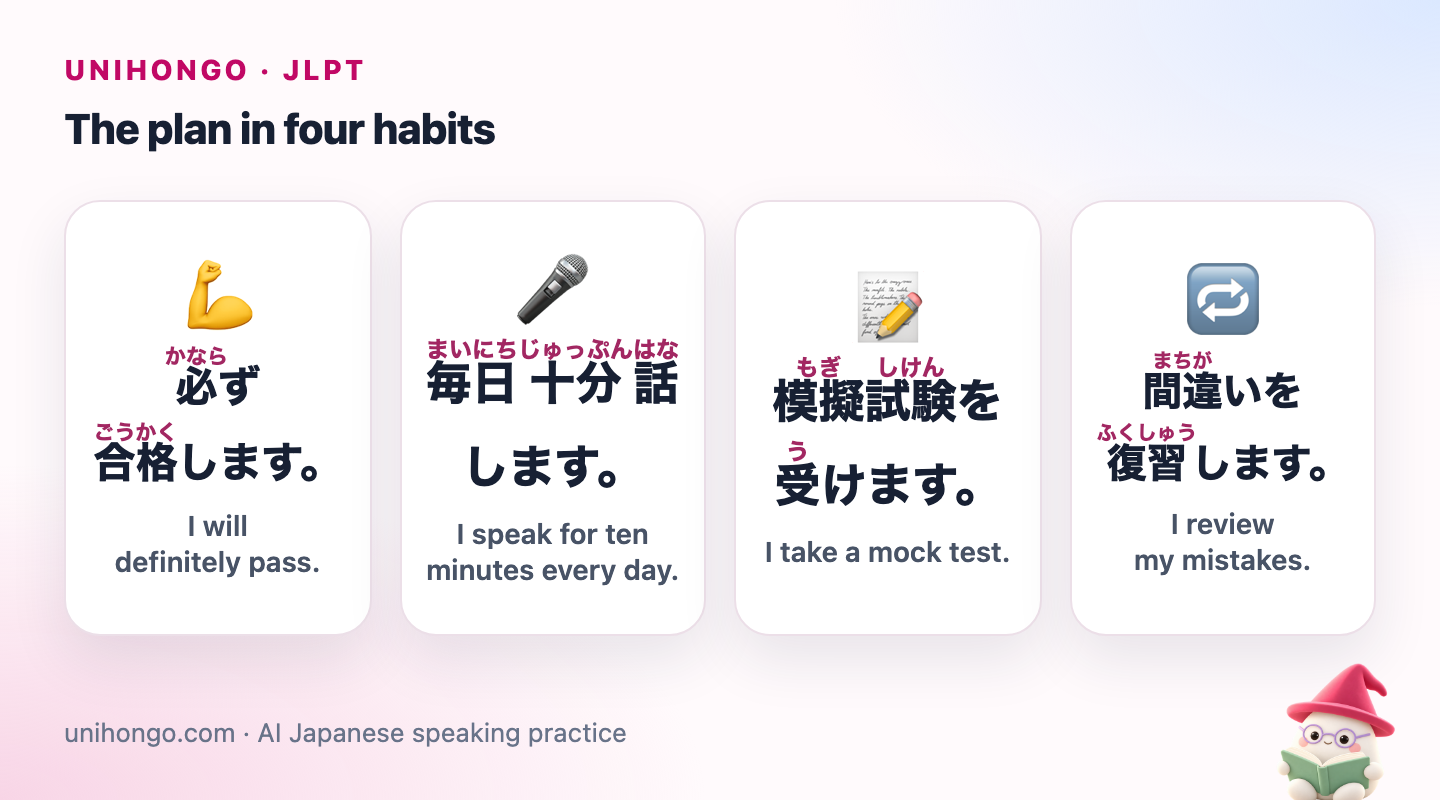
| Japanese | Romaji | Meaning |
|---|---|---|
| 必ず合格します。 | Kanarazu gōkaku shimasu. | I will definitely pass. |
| 毎日十分話します。 | Mainichi juppun hanashimasu. | I speak for ten minutes every day. |
| 模擬試験を受けます。 | Mogi shiken o ukemasu. | I take a mock test. |
| 間違いを復習します。 | Machigai o fukushū shimasu. | I review my mistakes. |
| 試験まであと七週間です。 | Shiken made ato nanashūkan desu. | Seven weeks to go until the exam. |
What the JLPT tests, and what it does not
The Japanese-Language Proficiency Test has five levels, N5 (easiest) to N1. Every level is multiple choice and marked by machine. N1 and N2 are split into two test sessions: language knowledge (vocabulary and grammar) together with reading, then listening. N3, N4 and N5 are split into three: vocabulary, then grammar with reading, then listening. Scores are scaled to 180 points, and you need both an overall pass mark and a minimum score in each scored section, so you cannot ignore listening and make it up with kanji.
There is no speaking and no writing. That is why some people pass N2 and still freeze when a coworker asks them a question. Treat the next seven weeks as a chance to avoid that: everything you study, you will also say.
| Japanese | Romaji | Meaning |
|---|---|---|
| 言語知識 | gengo chishiki | language knowledge: vocabulary and grammar |
| 読解 | dokkai | reading comprehension |
| 聴解 | chōkai | listening comprehension |
| 受験票 | jukenhyō | test voucher |
| 合格点 | gōkakuten | pass mark |
| Level | Test sessions | What typically costs the most points |
|---|---|---|
| N5 and N4 | Vocabulary; grammar and reading; listening | Running out of time in reading; particles in grammar |
| N3 | Vocabulary; grammar and reading; listening | Kanji readings; longer passages; fast listening |
| N2 and N1 | Language knowledge and reading; listening | Sentence-composition items; stamina across long passages |
Registration for the December session closed in most countries in September or early October. If you have a test voucher (受験票, jukenhyō) on the way, this plan is for you. If you missed it, the same seven weeks still work as a dry run for the July 2027 session.
Week by week, 18 October to 6 December
Each week has one main job. Keep the speaking column every single day; it is the smallest item and the easiest to drop, which is exactly why it is written down.
| Week | Dates | Main job | Ten minutes of speaking |
|---|---|---|---|
| 1 | 18 to 24 Oct | Diagnose: one timed past paper or mock test on day one; list your weak question types | Read the grammar list for your level aloud, one example sentence per point |
| 2 | 25 to 31 Oct | Patch: grammar points you got wrong, ten a day, with example sentences | Change the subject and tense of each example sentence and say the new one |
| 3 | 1 to 7 Nov | Mock test 1 on Sunday 1 Nov; then reading: one passage a day, timed | Retell each passage in four sentences, past tense |
| 4 | 8 to 14 Nov | Vocabulary and kanji from your mistake list; listening every day | Pause each listening dialogue and answer the question yourself before the options |
| 5 | 15 to 21 Nov | Weakest section only, double time; everything else on maintenance | Explain a grammar point to an imaginary classmate in Japanese |
| 6 | 22 to 28 Nov | Mock test 2 on Sunday 22 Nov under real timing; review for three days | Talk through your test-day plan and your mistakes out loud |
| 7 | 29 Nov to 5 Dec | Light review of the mistake notebook; sleep; route to the venue | Short, calm conversations; nothing new |
| Test | Sunday 6 Dec | Arrive early, eat before, pencils and watch ready | Say your goal sentence once, then stop talking |
Two mock tests are enough. The first shows you where to spend the middle weeks; the second shows you whether it worked and trains the pacing. A third one in the final week only costs sleep.
Why ten minutes of speaking helps a test with no speaking
Multiple-choice grammar questions reward recognition speed. If you have only ever read a pattern like ~ばよかった, you decode it each time: ba, past, good, oh, regret. If you have said ~ばよかった about your own week thirty times, it arrives as a single meaning and you move on with seconds to spare. The listening section is even clearer: the dialogues are conversational Japanese, and the learners who follow them are the ones who have spoken conversational Japanese.
The ten minutes are not free conversation about anything. They use the same material you are studying for the exam, so no time is lost. Here is the kind of self-talk that counts, using patterns from N4 and N3.
| Japanese | Romaji | Meaning |
|---|---|---|
| 今日は読解を二つ解きました。 | Kyō wa dokkai o futatsu tokimashita. | Today I did two reading passages. |
| この文法はまだ使えません。 | Kono bunpō wa mada tsukaemasen. | I can't use this grammar point yet. |
| もっと早く始めればよかった。 | Motto hayaku hajimereba yokatta. | I should have started earlier. |
| 聴解は速くて聞き取れないことがあります。 | Chōkai wa hayakute kikitorenai koto ga arimasu. | The listening is fast and sometimes I can't catch it. |
| 合格したら、日本語で友達と話したいです。 | Gōkaku shitara, Nihongo de tomodachi to hanashitai desu. | If I pass, I want to talk with friends in Japanese. |
| 毎日少しずつ覚えています。 | Mainichi sukoshi zutsu oboete imasu. | I'm memorising a little every day. |
Notice that these are the exam's own grammar: ~ばよかった, ~ことがあります, ~たら. Saying them about your real study makes them yours.
Test day: the Japanese you will hear and need
The test is run in Japanese, with instructions that are deliberately simple and the same at every venue. The proctor will check your voucher and ID, tell you when to open the booklet, and tell you when to stop. The listening section begins with a spoken example. Knowing these lines in advance removes one small layer of stress.

| Japanese | Romaji | Meaning |
|---|---|---|
| 受験票と身分証明書を机の上に置いてください。 | Jukenhyō to mibun shōmeisho o tsukue no ue ni oite kudasai. | Proctor: Put your voucher and ID on the desk. |
| 問題用紙を開いてください。 | Mondai yōshi o hiraite kudasai. | Proctor: Open the question booklet. |
| 鉛筆を置いてください。 | Enpitsu o oite kudasai. | Proctor: Put your pencils down. |
| 解答用紙 | kaitō yōshi | answer sheet |
| すみません、トイレに行ってもいいですか。 | Sumimasen, toire ni itte mo ii desu ka. | Excuse me, may I go to the toilet? |
| 鉛筆を一本貸していただけますか。 | Enpitsu o ippon kashite itadakemasu ka. | Could you lend me a pencil? |
Bring several HB pencils or a mechanical pencil, a plain eraser, and a watch without any smart functions. Phones must be switched off and put away; venues are strict about this, so do not rely on your phone for the time.
Mistakes that cost points in the last seven weeks
- Starting a new textbook. Seven weeks is for patching, not for a new course. Finish what you have, then drill from your mistake list.
- Studying only kanji and vocabulary because they feel measurable. Reading speed and listening are where most candidates actually lose the pass.
- Doing mock tests untimed. The question types are not hard; doing them fast enough is. Use a timer from week 1.
- Reviewing nothing. Every wrong answer goes into one notebook with the correct answer and one sentence you say aloud using it.
- Dropping the speaking when you feel behind. Ten minutes of speaking is the cheapest listening practice you can buy.
- An all-night session on 5 December. Reading comprehension collapses with fatigue faster than any other skill.
After the test: talking about it
On the evening of 6 December you will want to talk about the exam, and on 7 December your speaking plan starts for real, because now the knowledge is there to be used. Here is the conversation you will have with a classmate or a Japanese friend. Casual forms are shown where a friend would use them.
| Japanese | Romaji | Meaning |
|---|---|---|
| 試験、どうだった? | Shiken, dō datta? | Friend: How was the test? (casual) |
| 読解は大丈夫だったけど、聴解が難しかった。 | Dokkai wa daijōbu datta kedo, chōkai ga muzukashikatta. | You: Reading was fine, but the listening was hard. |
| 時間が足りなかった。 | Jikan ga tarinakatta. | You: I ran out of time. |
| 結果はいつ出るの? | Kekka wa itsu deru no? | Friend: When do the results come out? |
| 一月の終わりごろだと思う。 | Ichigatsu no owari goro da to omou. | You: Around the end of January, I think. |
| お疲れさま。今日はゆっくり休んで。 | Otsukaresama. Kyō wa yukkuri yasunde. | Friend: Well done. Rest properly today. |
| これからはもっと話す練習をします。 | Kore kara wa motto hanasu renshū o shimasu. | You: From now on I'll practise speaking more. (polite) |
The last line is the point of the whole plan. A JLPT certificate opens doors, but what people on the other side of the door will do is talk to you.