
Why the marks look familiar and are not
Modern Japanese punctuation is younger than the language by a long way, and it was standardised for school use rather than growing up with the writing system. That history explains its character. There are fewer marks than English uses, several of them exist mainly to separate rather than to structure, and the rules are conventions taught in school and followed by publishers rather than laws a reader can enforce. Usage varies between newspapers, publishers, companies and individuals, so when you see a house style that differs from what you learned, both are usually acceptable.
The practical consequence for a learner is that you should stop translating punctuation. A Japanese comma is not an English comma with a different shape; it does a different job. Quotation marks are not decorative variants of inverted commas; they have their own rule about where the full stop goes. Learn each mark on its own terms and your writing will stop reading as English typed in Japanese characters.
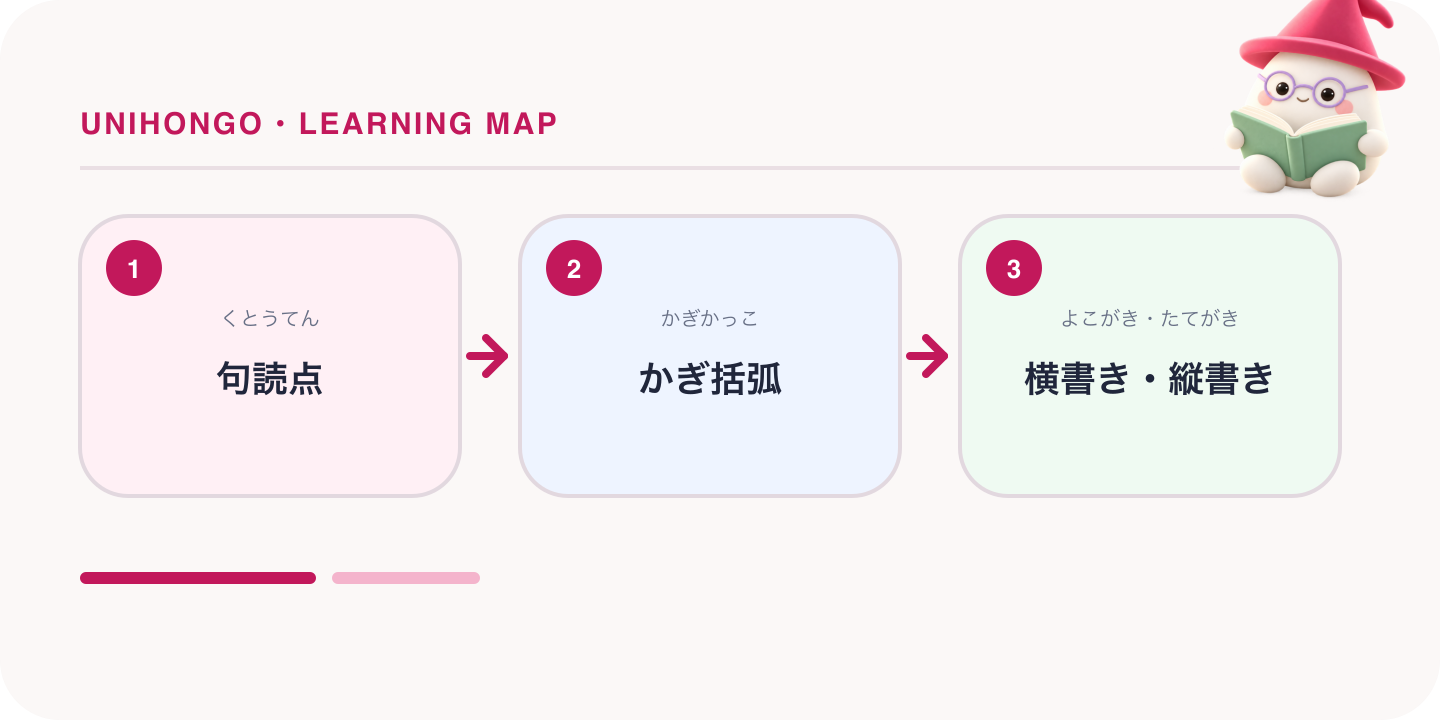
The marks at a glance
| Mark | Name | What it does | Example |
|---|---|---|---|
| 。 | 句点 kuten, casually maru | Ends a sentence | 行きます。 |
| 、 | 読点 tōten, casually ten | Marks a pause or separates items | はい、行きます。 |
| 「」 | 鉤括弧 kagi kakko | Quotation, speech, emphasis | 「行きます」と言いました。 |
| 『』 | 二重鉤括弧 nijū kagi kakko | Quote inside a quote; book and work titles | 『雪国』を読みました。 |
| ・ | 中黒 nakaguro | Separates parts of a foreign name or short list items | ジョン・スミス |
| 〜 | 波ダッシュ nami dasshu | A range, from A to B; also a drawn-out tone | 九時〜五時 |
| ? | 疑問符 gimonfu | Marks a question, mainly in casual writing | 行く? |
| ! | 感嘆符 kantanfu | Marks emphasis or surprise, mainly casual | すごい! |
| … | 三点リーダー santen rīdā | A trailing off or a silence, usually doubled | そうですね…… |
| ー | 長音符 chōonpu | Lengthens the vowel, mostly in katakana | コーヒー |
| () | 括弧 kakko | Parenthetical notes and readings | 私(わたし) |
Two of these are not punctuation at all in the strict sense. The chōonpu is part of the spelling of a katakana word, so writing kōhī without it produces a different word shape entirely, and the middle dot is a separator rather than a mark of sentence structure. Both are included here because learners meet them at the same time and mix them up with the dash.
The full stop and the comma
The full stop, 。, ends a sentence and takes one full-width square of its own. It is not used after a question mark or exclamation mark, and in headings, titles, captions and single-line labels it is commonly omitted. Inside quotation brackets, the closing 。 before 」 is usually dropped in ordinary writing, which is the opposite of the English habit of tucking the full stop inside the quotation marks.
The comma, 、, is the mark that surprises people most. It has no rule corresponding to the English comma before a relative clause or between two independent clauses. It marks where a reader would take a breath, where a long modifier ends, or where a sentence might otherwise be misread. That means two careful writers can punctuate the same sentence differently and both be right, and it also means a sentence with no commas at all is perfectly normal if it is short.
There are places where a comma does real work. After a topic phrase with wa at the start of a long sentence, after a conjunction such as shikashi, between items in a list where the middle dot would look odd, and above all wherever leaving it out would let two readings compete. The last of these is the one to care about: if a sentence can be parsed two ways, the comma decides which one the reader gets.
| Japanese | Romaji | Meaning |
|---|---|---|
| はい、分かりました。 | Hai, wakarimashita. | Yes, I understand. (comma after a short response word) |
| 私は、昨日買った本をまだ読んでいません。 | Watashi wa, kinō katta hon o mada yonde imasen. | I still have not read the book I bought yesterday. (comma after a long topic) |
| しかし、時間がありませんでした。 | Shikashi, jikan ga arimasen deshita. | However, there was no time. |
| 赤い、大きな傘を買いました。 | Akai, ōkina kasa o kaimashita. | I bought a red, large umbrella. (the comma keeps akai attached to the umbrella) |
| ここではきものを脱いでください。 | Koko de wa kimono o nuide kudasai. | Please take off your kimono here. (unpunctuated and ambiguous) |
| ここで、はきものを脱いでください。 | Koko de, hakimono o nuide kudasai. | Please take off your footwear here. (the comma settles the reading) |
Quotation with corner brackets
Speech and quotation use 「 」, the kagi kakko or corner brackets. They wrap the quoted words, and the particle to plus a verb of saying or thinking follows outside them. The closing full stop of the quoted sentence is normally dropped, so you write the quote, close the bracket, then continue with to iimashita and end the whole sentence with a single 。. Novels use the same brackets for every line of dialogue, usually on a line of their own.
The double version, 『 』, has two jobs. It marks a quotation inside a quotation, keeping the layers visible, and it marks the titles of complete works such as books, films and albums, where 「 」 would mark a chapter or a song. Outside these two jobs, corner brackets are also used the way English uses italics or scare quotes: to highlight a term, to name a menu item, or to set off a word being discussed rather than used.
| Japanese | Romaji | Meaning |
|---|---|---|
| 田中さんは「明日行きます」と言いました。 | Tanaka-san wa 「ashita ikimasu」 to iimashita. | Tanaka said, “I will go tomorrow.” |
| 先生は「田中さんが『行けない』と言っていた」と話しました。 | Sensei wa 「Tanaka-san ga 『ikenai』 to itte ita」 to hanashimashita. | The teacher said that Tanaka had said he could not go. |
| 『こころ』という小説を読んでいます。 | 『Kokoro』 to iu shōsetsu o yonde imasu. | I am reading a novel called Kokoro. |
| この漢字は「読む」と読みます。 | Kono kanji wa 「yomu」 to yomimasu. | This kanji is read as yomu. |
| メニューの「本日のおすすめ」をください。 | Menyū no 「honjitsu no osusume」 o kudasai. | I will have the item on the menu called today's recommendation. |
| 「すみません」と言ってから入ってください。 | 「Sumimasen」 to itte kara haitte kudasai. | Say sumimasen and then come in. |
The mistake learners make most often here is punctuating like English: a comma before the quotation, a full stop inside the closing bracket, and to left out. Japanese needs no comma before 「, keeps the sentence-final 。 outside 」, and requires the quoting particle to before the verb of saying.
The middle dot, the wave dash and the ellipsis
The middle dot, ・, separates things that belong together but are not one word. Its most visible job is foreign names, where it stands between the given name and the family name written in katakana, so that a reader can tell where one ends. It also separates short list items where commas would look heavy, joins paired terms, and appears in some abbreviations and dates in tables.
The wave dash, 〜, marks a range: times, dates, page numbers, prices and stations. In casual writing it does a second job at the end of a word, stretching the vowel to soften or lengthen the tone, which is why a friend's message might end with a wave that a business email never would. The ellipsis, …, marks trailing off, hesitation or a silence, and Japanese typography commonly doubles it to fill two squares.
| Japanese | Romaji | Meaning |
|---|---|---|
| マリア・ガルシアさんです。 | Maria Garushia-san desu. | This is Maria Garcia. (middle dot between the names) |
| 受付は九時〜五時です。 | Uketsuke wa ku-ji kara go-ji made desu. | Reception is from nine to five. (the wave dash is read as kara ... made) |
| 東京〜大阪の新幹線に乗りました。 | Tōkyō kara Ōsaka no shinkansen ni norimashita. | I took the bullet train from Tokyo to Osaka. |
| 朝食はパン・卵・コーヒーです。 | Chōshoku wa pan, tamago, kōhī desu. | Breakfast is bread, egg and coffee. (middle dots as list separators) |
| ええと、そうですね……。 | Ēto, sō desu ne...... | Well, let me see... (a doubled ellipsis for hesitation) |
| ありがとう〜。 | Arigatō. | Thanks. (the wave stretches the vowel, casual only) |
Question marks and exclamation marks
A polite written question already ends in ka, and ka is doing the work that a question mark does in English, so formal Japanese writing normally ends it with 。 and no ?. Business letters, official documents and academic writing follow this almost without exception. As soon as the register drops, the question mark appears: messages, dialogue in fiction, advertising, blog posts and anything spoken informally.
The question mark becomes genuinely necessary when the question has no ka at all. Casual Japanese asks questions by intonation, and on the page a rising tone is invisible, so iku on its own is a statement and iku with a question mark is a question. Exclamation marks work the same way: unremarkable in casual writing and messages, out of place in a formal letter. Both marks are written full-width, and in horizontal text a full-width space usually follows them before the next sentence begins.
| Japanese | Romaji | Meaning |
|---|---|---|
| 明日いらっしゃいますか。 | Ashita irasshaimasu ka. | Will you be coming tomorrow? (formal, no question mark) |
| 明日来る? | Ashita kuru? | Coming tomorrow? (casual, the mark carries the question) |
| これ、食べる? | Kore, taberu? | Are you going to eat this? (casual) |
| 本当ですか。 | Hontō desu ka. | Is that so? (polite, written with a full stop) |
| 本当!? | Hontō!? | Really? (casual surprise, mark and question combined) |
| おめでとう! 元気でね。 | Omedetō! Genki de ne. | Congratulations. Take care. (a full-width space follows the mark) |
Full-width and half-width characters
Every kanji and kana occupies a square, and punctuation typed in Japanese input mode occupies a square too. These are full-width characters. The Latin letters and digits on an English keyboard are half-width, narrower, and they sit oddly among kanji if they are used for punctuation. The practical rule is simple: in Japanese text, use the Japanese marks, so 。 not a full stop, 、 not a comma, and full-width brackets rather than the ASCII ones.
Numbers and Latin words are the grey area, and practice differs. Horizontal Japanese text commonly uses half-width digits, especially in longer numbers, while vertical text usually spells numbers in kanji. Company forms sometimes specify which they want, and some systems still ask for full-width entry in every field. Half-width katakana, the narrow legacy form, is best avoided in anything you write yourself; it survives mainly in receipts, older systems and bank transfer fields.
- Switch input mode before typing punctuation so the marks come out full-width.
- Use 。 and 、 in Japanese sentences even when the sentence contains English words.
- Prefer half-width digits in horizontal text and kanji numerals in vertical text.
- Leave a small gap around embedded Latin words by writing them half-width; do not add manual spaces in body text.
- Avoid half-width katakana in messages, documents and forms unless a system demands it.
- Check whether an official form asks for full-width entry before filling it in.
Spaces and where they do appear
Japanese text runs without spaces between words. The reader separates words by script: a run of kanji is a content word, the hiragana after it is grammar, and katakana signals a loanword or a name. This is why reading gets easier once you know a few hundred kanji, and why writing everything in kana is genuinely harder to read even though every character is one you can sound out.
Spaces do exist, and each has a job. A single full-width space indents the first line of a paragraph. A space separates the surname from the given name in form fields and on some name lines. A space follows a question mark or exclamation mark in the middle of a line. Children's books and beginner materials insert spaces between words as a temporary aid. And a space can be used for layout, for example spreading a date line across the bottom of a card. None of these is a word separator in ordinary prose.
- Indent a new paragraph with one full-width space, not with a blank line and not with a tab.
- Do not put a space after 。 or 、 in body text; the marks already carry their own width.
- Do put a full-width space after ? or ! when the sentence continues on the same line.
- Write your surname and given name with one space between them on forms, family name first.
- Resist inserting spaces around English words in Japanese text; the width difference is enough.
Vertical and horizontal writing
Japanese is written both vertically, top to bottom with columns running right to left, and horizontally, left to right in lines running down the page. Books, novels, newspapers, letters and formal cards are commonly vertical; textbooks, science and technical writing, forms, websites and almost everything on a screen are horizontal. Many documents mix the two, with a vertical body and horizontal headings or tables.
The marks change with the direction. In vertical writing, 。 and 、 sit in the upper right of their square rather than at the bottom left. The corner brackets rotate a quarter turn, so 「 opens at the top of a column and 」 closes at the bottom. The chōonpu, ellipsis and wave dash all turn to run with the column, and small kana such as っ and ゃ move to the top right of their square. Numbers written in figures do not rotate comfortably, which is why vertical text prefers kanji numerals.
| Feature | Horizontal writing | Vertical writing |
|---|---|---|
| Reading direction | Left to right, lines downward | Top to bottom, columns right to left |
| Typical use | Textbooks, forms, screens, business documents | Novels, newspapers, letters, cards |
| Full stop position | Bottom left of its square | Top right of its square |
| Corner brackets | Open on the left, close on the right | Rotated: open at the top, close at the bottom |
| Numbers | Usually half-width figures | Usually kanji numerals |
| Long vowel mark | A horizontal stroke | A vertical stroke running with the column |
| Where the page turns | Bound on the left, like an English book | Bound on the right, so pages turn the other way |
Genko yoshi manuscript paper in brief
Genkō yōshi is the squared manuscript paper used for school compositions, essay competitions and some exams. Each square holds one character, the sheets are commonly ruled as twenty squares by twenty columns, and the rules exist so that a marker can count length precisely. Even if you never use the paper, the rules describe the conventions that carry over into ordinary writing.
The most useful of them is the line-break rule, called kinsoku shori. A full stop, a comma or a closing bracket may not begin a line, so if one falls at a start it is written into the last square of the previous line, sharing it. The same applies in reverse to an opening bracket, which may not end a line. Word processors do this automatically, which is why a line of Japanese on a screen sometimes looks slightly crowded at the end.
- Write the title on the first line, leaving about three squares empty at the top.
- Write your name on the second line, aligned toward the bottom, with a space between surname and given name.
- Start the body on the third line, and indent the first square of every new paragraph.
- Give every character, kana, kanji and punctuation mark, its own square.
- Put small kana such as っ, ゃ and ゅ in their own square, positioned toward the top right in vertical writing.
- Never begin a line with 。 、 」 or 』; write the mark into the previous line's last square.
- Spread ellipses and dashes over two squares, since they are conventionally doubled.
- Write a quotation's opening bracket in its own square, and start a new line for each line of dialogue in a story.
Reading the punctuation aloud
Punctuation is easier to internalise through the voice than through rules, because most of it encodes something a speaker does. A 。 is the drop at the end of a sentence, a 、 is a breath, a 「 is the change of voice when you quote somebody, and an ellipsis is a genuine pause. Read the lines below aloud and act each mark rather than ignoring it, and your written commas will start landing in sensible places.
| Japanese | Romaji | Meaning |
|---|---|---|
| 今日は、雨ですね。 | Kyō wa, ame desu ne. | It is raining today, isn't it. (breathe at the comma) |
| すみません、少し待ってください。 | Sumimasen, sukoshi matte kudasai. | Excuse me, please wait a moment. |
| 母は「早く帰りなさい」と言いました。 | Haha wa 「hayaku kaerinasai」 to iimashita. | My mother said, come home early. (change your voice inside the brackets) |
| 彼は行くと言いましたが、来ませんでした。 | Kare wa iku to iimashita ga, kimasen deshita. | He said he would go, but he did not come. |
| えっ、本当ですか。 | E, hontō desu ka. | What, really? (the small tsu is a cut-off, not a pause) |
| そうですね……難しいですね。 | Sō desu ne...... muzukashii desu ne. | Well... that is difficult. (hold the ellipsis) |
| 会議は十時〜十二時です。 | Kaigi wa jū-ji kara jūni-ji made desu. | The meeting is from ten to twelve. (read the wave dash as kara ... made) |
| 名前はアンナ・リーです。 | Namae wa Anna Rī desu. | My name is Anna Lee. (the middle dot is silent) |
| これ、いくらですか。 | Kore, ikura desu ka. | How much is this? (polite question, written with a full stop) |
| これ、いくら? | Kore, ikura? | How much is this? (casual, rising at the question mark) |
| 『雪国』は有名な小説です。 | 『Yukiguni』 wa yūmei na shōsetsu desu. | Yukiguni is a famous novel. |
| 書類には、名前と住所を書いてください。 | Shorui ni wa, namae to jūsho o kaite kudasai. | On the form, please write your name and address. |
Notice that two of these marks are silent, the middle dot and the corner brackets, yet both change how the sentence is delivered: the dot tells you where a foreign name divides, and the brackets tell you to shift into somebody else's words. That is the general shape of Japanese punctuation. It is less about grammar than about telling the reader how to say the sentence in their head.
Mistakes learners commonly make
- Typing an ASCII full stop or comma in Japanese text instead of 。 and 、.
- Putting the sentence-ending 。 inside the closing 」 the way English tucks in a full stop.
- Adding a question mark to a formal sentence that already ends in ka.
- Using a middle dot between the parts of a Japanese name.
- Writing a hyphen or an ASCII tilde where the wave dash belongs in a range.
- Inserting spaces between words to make the sentence look clearer.
- Indenting a paragraph with a blank line instead of one full-width space.
- Using half-width katakana because a keyboard offered it.