
What immersion means when you stay at home
Immersion is usually described as an environment, which makes it sound like something only a move abroad can supply. Look at what actually changes when a learner arrives in Japan and the picture is more mundane: they hear Japanese many times a day, they have to produce sentences to get ordinary things done, and the difficulty is set by the situation rather than by a textbook. All three of those are schedulable at home, though the third takes deliberate effort.
The honest limit is volume. A resident might get eight hours of contact a day without trying; you are building one, and you have to defend it against everything else in the evening. That is why home immersion works best as a fixed, repeated slot rather than an ambition to think in Japanese all the time. An hour that happens every day for three months will change your speech more than a weekend of total immersion followed by nothing.
The daily Japanese hour as stacked blocks
| Block | Minutes | What it trains | How it fails |
|---|---|---|---|
| Passive listening | 20 | Sound patterns, speed tolerance, familiar vocabulary | Becomes background noise you stop hearing |
| Spoken conversation | 15 | Retrieval under time pressure, corrections you can use | Skipped because it is the only tiring block |
| Chore narration | 10 | Turning what you are doing into sentences | Drifts into the same four sentences daily |
| Labelled objects | 5 | Concrete nouns attached to real things | Labels become wallpaper after a week |
| Review of corrections | 10 | Fixing the errors you actually made | Read once and never said aloud |
The blocks are deliberately uneven in cost. Listening and labels are nearly free, so they can ride on top of activities you already do. Conversation and review demand attention, which is why they need a fixed time. If your hour has to shrink on a bad day, cut the listening and keep the fifteen minutes of speaking, because that is the block the others exist to feed.
Why output has to be inside the hour
It is easy to build an immersive environment where you never say anything. Japanese plays in the kitchen, subtitles run in the evening, the phone interface is in Japanese, and after two months you understand more and speak exactly as badly as before. Comprehension and production draw on different skills. Recognising a word takes a weak memory trace; retrieving it while someone waits takes a strong one, and only retrieval practice builds that.
The practical rule is that no listening block should exist without an output block attached to it. If you listen to a podcast while washing up, spend the last two minutes summarising what you heard aloud in three sentences. If you watch a scene, replay one line and say it back. The point is not comprehension checking. It is making sure that every piece of input passes through your mouth before the day ends.
Narrating chores out loud
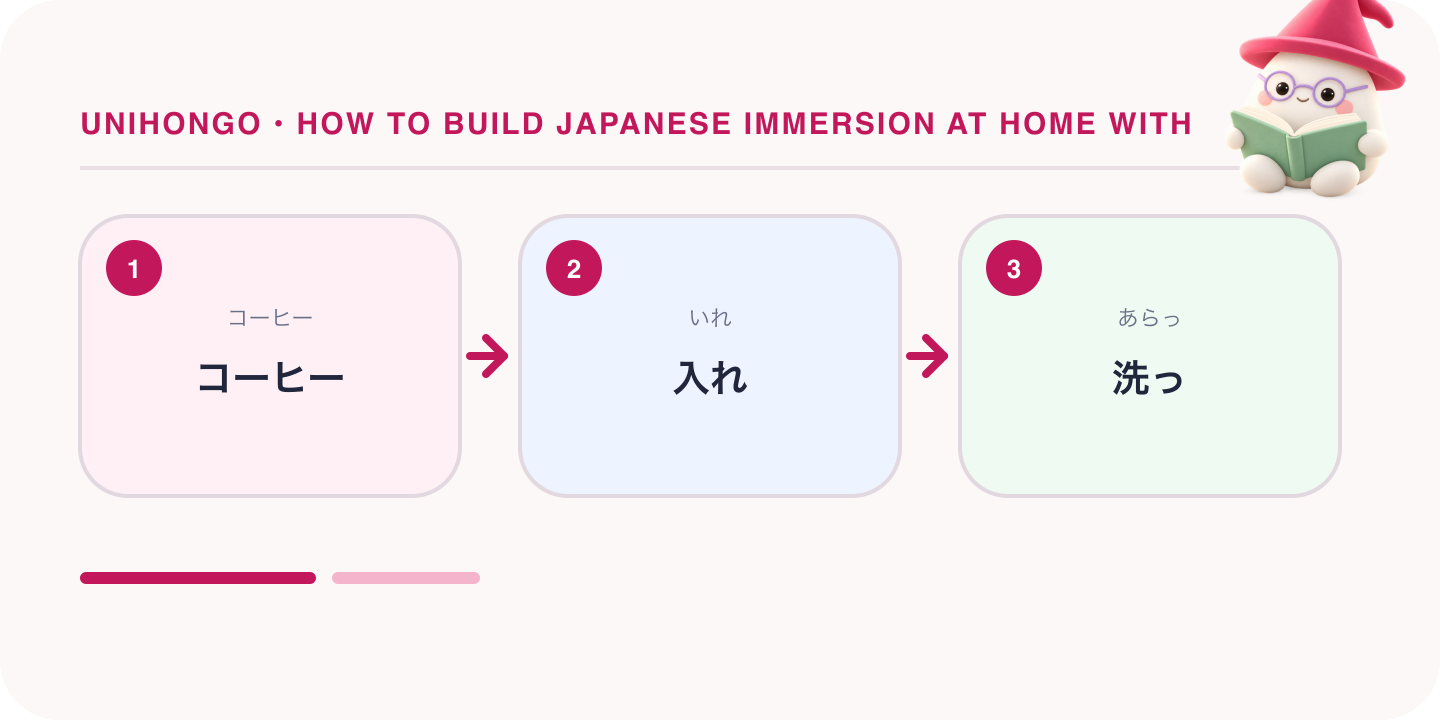
Chore narration is the cheapest way to turn a silent hour into a speaking hour. You describe what you are doing, in Japanese, at the pace of the task. Cooking, tidying, and laundry are ideal because they are slow, repetitive, and full of concrete verbs. Start with plain -masu sentences in the present, then add a second clause with -te kara or node once the first version comes without effort.
Expect the narration to expose gaps immediately. You will know how to say I cook but not I drain the pasta, and that is the value of the exercise: it generates a vocabulary list from your own life instead of a textbook's. Keep a note open on the counter, write the missing word in English, and look up two or three of them at the end. Do not stop mid-sentence to search, because the flow is the point.
| Japanese | Romaji | Meaning |
|---|---|---|
| 今からコーヒーを入れます。 | Ima kara kōhī o iremasu. | I am going to make coffee now. |
| お皿を洗ってから、ゴミを出します。 | Osara o aratte kara, gomi o dashimasu. | After I wash the dishes, I will take out the rubbish. |
| 洗濯物をたたんでいます。 | Sentakumono o tatande imasu. | I am folding the laundry. |
| お湯が沸きました。 | Oyu ga wakimashita. | The water has boiled. |
| 米を研いで、炊飯器に入れます。 | Kome o toide, suihanki ni iremasu. | I rinse the rice and put it in the rice cooker. |
| 窓を開けて、空気を入れ替えます。 | Mado o akete, kūki o irekaemasu. | I open the window and air the room. |
| 今日は少し寒いので、暖房をつけます。 | Kyō wa sukoshi samui node, danbō o tsukemasu. | It is a bit cold today, so I will turn the heating on. |
| 部屋を片付けてから、少し休みます。 | Heya o katazukete kara, sukoshi yasumimasu. | I will tidy the room and then rest for a while. |
Labelling the house so objects speak back
Labels work for a fortnight and then disappear into the furniture, so use them as a short, replaceable layer rather than a permanent decoration. Label ten things at a time, keep them in one or two rooms, and change the set when you stop noticing them. The label should carry the word you would actually say, which usually means a whole short sentence rather than an isolated noun on a sticker.
| Japanese | Romaji | Meaning |
|---|---|---|
| これは冷蔵庫です。 | Kore wa reizōko desu. | This is the fridge. |
| テーブルの上に鍵があります。 | Tēburu no ue ni kagi ga arimasu. | The keys are on the table. |
| 玄関に靴を並べます。 | Genkan ni kutsu o narabemasu. | I line the shoes up in the entrance. |
| 冷蔵庫に牛乳がもうありません。 | Reizōko ni gyūnyū ga mō arimasen. | There is no milk left in the fridge. |
| 電気を消すのを忘れました。 | Denki o kesu no o wasuremashita. | I forgot to turn the light off. |
| 棚の一番上に食器があります。 | Tana no ichiban ue ni shokki ga arimasu. | The dishes are on the top shelf. |
- Write a sentence on the label, not just the noun: 鍵をテーブルに置きます rather than 鍵.
- Limit yourself to ten labels per room so each one still catches your eye.
- Say the label aloud every time you touch the object, even when you are in a hurry.
- Replace the whole set every two weeks and move the retired words into your conversation session.
- Add a verb to any label that has become automatic, so the noun starts appearing inside sentences.
Running your own routines as roleplay
Once a routine is narrated smoothly, hand it to a conversation partner as a scene. This is the step that converts private rehearsal into usable speech, because a partner asks the question you did not prepare for. Describe the situation in one line, stay in it, and let the other side push back: what is in the fridge, why you are cooking that, how long it takes. An AI tutor is well suited to this because it will play the scene as many times as you like and never finds your kitchen boring.
Notice what the AI cannot do here. It does not know your flat, your schedule, or what you cooked yesterday unless you tell it, so the details that make the scene real have to come from you. That is a small cost and a hidden benefit: supplying the context is itself speaking practice, and it is the part most learners skip when they answer prepared questions.
| Japanese | Romaji | Meaning |
|---|---|---|
| 今から夕食を作ります。何がいいと思いますか。 | Ima kara yūshoku o tsukurimasu. Nani ga ii to omoimasu ka. | I am about to make dinner. What do you think would be good? |
| 冷蔵庫に何が入っていますか。 | Reizōko ni nani ga haitte imasu ka. | What is in the fridge? (the tutor's likely reply) |
| 卵とキャベツと豚肉があります。 | Tamago to kyabetsu to butaniku ga arimasu. | There are eggs, cabbage, and pork. |
| では、お好み焼きはどうですか。作り方を説明してください。 | Dewa, okonomiyaki wa dō desu ka. Tsukurikata o setsumei shite kudasai. | How about okonomiyaki then? Please explain how you make it. (the tutor's reply) |
| まずキャベツを細かく切ります。 | Mazu kyabetsu o komakaku kirimasu. | First I chop the cabbage finely. |
| 次に、卵と小麦粉を混ぜます。 | Tsugi ni, tamago to komugiko o mazemasu. | Next I mix the eggs and the flour. |
| 五分ぐらい焼けば、できあがりです。 | Gofun gurai yakeba, dekiagari desu. | If you fry it for about five minutes, it is done. |
Repeat the same scene the next day with one detail changed: a missing ingredient, a guest who cannot eat eggs, or a delivery that arrives late. Changing one variable proves you learned the pattern rather than a script, and it keeps a familiar routine from turning into a recital.
Talking to yourself when nobody is home
Self-talk fills the gaps between blocks. It costs nothing, needs no equipment, and works in the moments when a conversation would be impossible. Use plain -masu forms if you are still consolidating polite speech, and switch deliberately to casual forms when you want the register you would use in your own head. Say the casual lines out loud too, because the vowels and the rhythm are what you are training, not the reading.
| Japanese | Romaji | Meaning |
|---|---|---|
| 今日は何をしましょうか。 | Kyō wa nani o shimashō ka. | What shall I do today? |
| 午前中に買い物に行って、午後は勉強します。 | Gozenchū ni kaimono ni itte, gogo wa benkyō shimasu. | I will go shopping in the morning and study in the afternoon. |
| そろそろ出かける時間です。 | Sorosoro dekakeru jikan desu. | It is about time to head out. |
| 傘を持って行った方がいいかもしれません。 | Kasa o motte itta hō ga ii kamoshiremasen. | It might be better to take an umbrella. |
| 明日の朝、ゴミを出さなければなりません。 | Ashita no asa, gomi o dasanakereba narimasen. | I have to put the rubbish out tomorrow morning. |
| あ、忘れてた。 | A, wasureteta. | Oh, I forgot. (casual) |
| よし、やるか。 | Yoshi, yaru ka. | Right, let us get on with it. (casual) |
| 今日は疲れたので、早く寝ます。 | Kyō wa tsukareta node, hayaku nemasu. | I am tired today, so I will go to bed early. |
Keep a short list of the lines you were unsure about and take them into your next spoken session. Two minutes of checking prevents a self-invented phrase from becoming a habit, which is the one real risk of talking to yourself for months.
Keeping difficulty in the useful band
Home immersion fails in two directions. Material that is far too hard turns into pleasant noise, because you cannot pick out words and therefore learn nothing from hearing them. Material that is far too easy is comfortable and equally useless. The band you want is the one where you follow the thread but lose individual sentences, and where speaking requires a small search rather than a full stop.
Difficulty is easier to control in conversation than in media, because you can ask for it. Say what you want directly at the start of a session and adjust mid-conversation instead of enduring a level that does not fit. A tutor that never varies its speed is not adapting to you, however natural it sounds.
| Japanese | Romaji | Meaning |
|---|---|---|
| もう少しゆっくり話してもらえますか。 | Mō sukoshi yukkuri hanashite moraemasu ka. | Could you speak a little more slowly? |
| もう少し難しい日本語で話してください。 | Mō sukoshi muzukashii Nihongo de hanashite kudasai. | Please speak in slightly more difficult Japanese. |
| 今の言い方を直してください。 | Ima no iikata o naoshite kudasai. | Please correct the way I just said that. |
| 日本語で何と言うか分かりません。 | Nihongo de nan to iu ka wakarimasen. | I do not know how to say it in Japanese. |
- Judge listening by whether you catch words, not by whether you understand the topic.
- Ask for slower speech before you ask for translation, and only translate when both fail.
- Raise difficulty by changing the situation rather than the vocabulary list: a complaint is harder than an order.
- Drop back a level for one session after a hard week instead of skipping the session entirely.
A realistic week for someone with a job
| Day | Around the day | Fixed evening slot |
|---|---|---|
| Monday | Podcast on the commute, kitchen narration | 15 min conversation, then read corrections |
| Tuesday | Same podcast episode again, labels in the kitchen | 15 min conversation reusing yesterday's corrections |
| Wednesday | Listening only, no new material | 10 min conversation on a tired day |
| Thursday | Narrate cooking, note missing words | 15 min roleplay of the cooking scene |
| Friday | Music or a show with Japanese subtitles | 10 min free conversation, no topic prepared |
| Saturday | Longer listening while cleaning | 20 min conversation plus a repeat of the week's hardest scene |
| Sunday | Rest from input | 10 min review of the week's corrections out loud |
The schedule assumes about an hour a day, most of it stacked onto things you were doing anyway, and one protected slot of ten to twenty minutes. Notice that Wednesday and Sunday are deliberately light. A plan with no easy days is a plan you abandon in week three, and the streak matters more here than any single session.
What home immersion cannot do
Being honest about the limits keeps the routine from disappointing you later. Practising alone with an AI partner gives you volume, patience, and instant retries at no social cost, and none of those are small. It does not give you the constant low-level exposure of living somewhere, the accountability of a person expecting you at seven, or the cultural read on whether a sentence was rude rather than merely wrong.
- It cannot supply real consequences: nothing goes wrong when you fail to explain yourself at home.
- It cannot judge your register the way a Japanese colleague would, so save uncertain corrections for a human teacher.
- It cannot hold you accountable, so the calendar slot has to do that job.
- It cannot reproduce exam or interview nerves, which need a real audience.
- It can mis-hear a strong accent, so check the transcript before believing a correction.