
Why three lines a day beats a page a week
A page a week sounds productive and usually dies within a month. It needs a free hour, a topic worth a page, and enough grammar to fill it, and on the Sunday when any of those is missing you skip, and the following Sunday the gap feels bigger. Three lines a day needs three minutes and no topic at all, because the day itself is the topic. You produce the past tense every evening, you meet the same time and feeling words until they stop needing thought, and you never face a blank page.
There is also a language reason. Most of what you want to say in conversation is short past-tense narration about your own day: I went, I ate, it was tiring, tomorrow I will. A short daily entry drills exactly that, in the exact vocabulary of your own life, with no textbook characters in between. A long weekly essay tends to reach for grammar you cannot yet say aloud, which is good writing practice but poor preparation for speaking.
Plain form is the diary register
A diary is written for yourself, so Japanese diaries commonly use the plain form: datta instead of deshita, tabeta instead of tabemashita, tanoshikatta with no desu after it. This is the register of casual speech and of most written Japanese outside letters and business, and practising it nightly makes plain-form conjugation automatic in a way that grammar drills do not. It is also the form that longer sentences are built on, since kedo, kara and to omotta all attach to it.
If your plain-form past tense is still unreliable, write in desu and masu for the first couple of weeks. The polite version is not wrong in a diary, it is simply less usual, and a correct polite sentence is worth more than a guessed casual one. The pairs below show the same line in both registers; the plain form is labelled casual so you can see the change at the end of each sentence.
| Japanese | Romaji | Meaning |
|---|---|---|
| 今日は雨だった。 | Kyō wa ame datta. | It rained today. (casual plain form) |
| 今日は雨でした。 | Kyō wa ame deshita. | It rained today. (polite form) |
| 友達とラーメンを食べた。 | Tomodachi to rāmen o tabeta. | I had ramen with a friend. (casual plain form) |
| 友達とラーメンを食べました。 | Tomodachi to rāmen o tabemashita. | I had ramen with a friend. (polite form) |
| 楽しかった。 | Tanoshikatta. | It was fun. (casual plain form) |
| 楽しかったです。 | Tanoshikatta desu. | It was fun. (polite form) |
The three-line skeleton
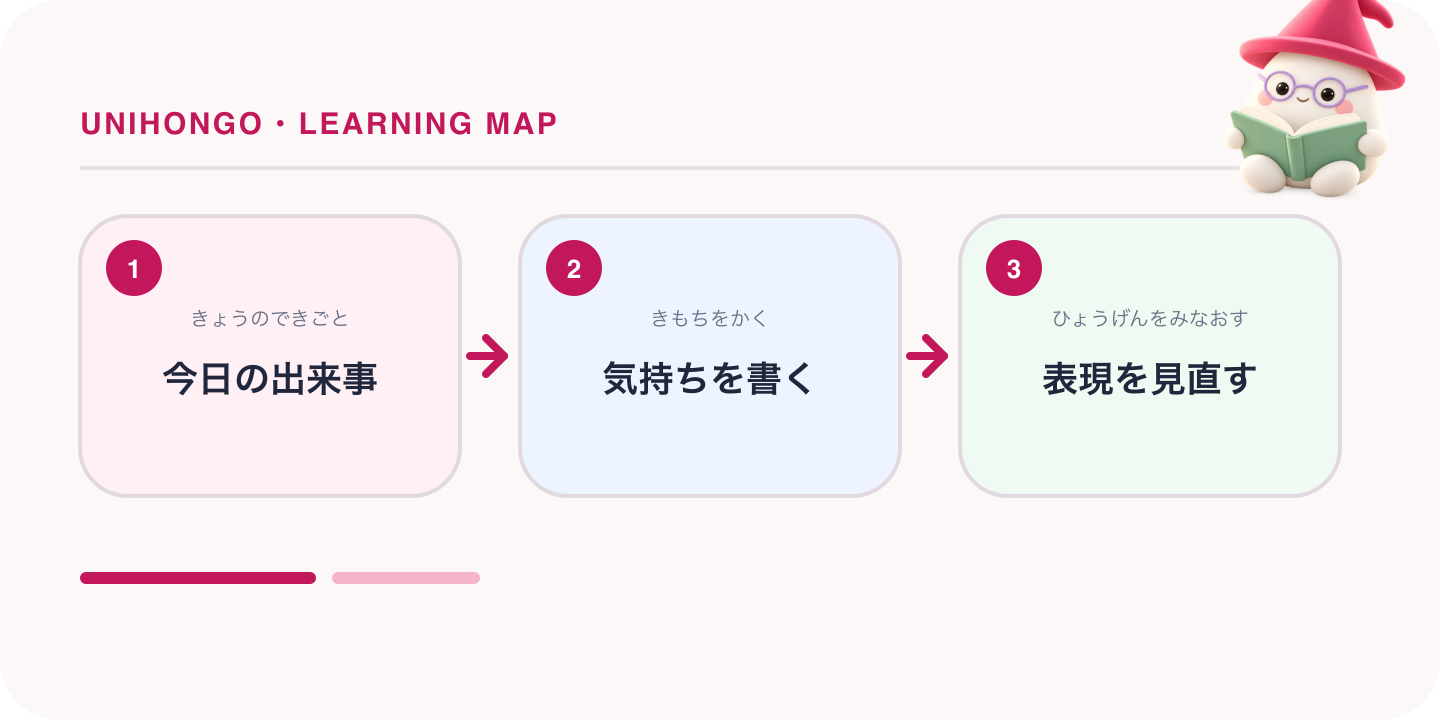
Every entry has the same three jobs. Line one says what happened, in the past tense, with a time word if you have one. Line two says how it felt, using a past-tense adjective or a short feeling phrase. Line three says one thing for tomorrow, starting with ashita wa. The skeleton is boring by design; boredom is what makes it possible at eleven at night. Once the three lines are automatic, you will start joining them, and that is where the grammar grows.
| Japanese | Romaji | Meaning |
|---|---|---|
| 今日は新しい先生と話した。 | Kyō wa atarashii sensei to hanashita. | Today I talked with a new teacher. |
| 少し緊張したけど、楽しかった。 | Sukoshi kinchō shita kedo, tanoshikatta. | I was a bit nervous, but it was fun. |
| 明日はもっと質問する。 | Ashita wa motto shitsumon suru. | Tomorrow I will ask more questions. |
Notice that line three uses the plain present tense for a plan, which is how Japanese usually expresses a simple intention. You can also write ashita wa hayaku neru tsumori, I intend to sleep early, or ashita wa yasumitai, I want to rest, when the intention is softer. Keep the plan small and checkable; tomorrow's entry can then begin by saying whether you did it.
Diary sentence patterns
| Pattern | Job | Example |
|---|---|---|
| 今日は〜た。 Kyō wa ...ta. | What happened | 今日は買い物に行った。Kyō wa kaimono ni itta. I went shopping today. |
| 〜と〜た。 ...to ...ta. | Who you did it with | 同僚と昼ご飯を食べた。Dōryō to hirugohan o tabeta. I had lunch with a colleague. |
| 〜かった。 ...katta. | Feeling, i-adjective past | 面白かった。Omoshirokatta. It was interesting. |
| 〜だった。 ...datta. | Feeling, na-adjective or noun past | 大変だった。Taihen datta. It was tough. |
| 〜て、〜た。 ...te, ...ta. | Two actions in sequence | 家に帰って、すぐ寝た。Ie ni kaette, sugu neta. I got home and went straight to bed. |
| 〜から、〜。 ...kara, ... | Reason | 雨だったから、家にいた。Ame datta kara, ie ni ita. It was raining, so I stayed home. |
| 〜けど、〜。 ...kedo, ... | Contrast | 疲れたけど、勉強した。Tsukareta kedo, benkyō shita. I was tired, but I studied. |
| 初めて〜た。 Hajimete ...ta. | A first | 初めて一人で電話をかけた。Hajimete hitori de denwa o kaketa. I made a phone call alone for the first time. |
| 〜と思った。 ...to omotta. | What you thought | 難しいと思った。Muzukashii to omotta. I thought it was difficult. |
| 明日は〜。 Ashita wa ... | Plan for tomorrow | 明日は早く起きる。Ashita wa hayaku okiru. Tomorrow I will get up early. |
| 〜ようにする。 ...yō ni suru. | A resolution | 明日は日本語で挨拶するようにする。Ashita wa Nihongo de aisatsu suru yō ni suru. Tomorrow I will make a point of greeting people in Japanese. |
Ten patterns cover a month of entries. Add one new row to your active set each week rather than trying to use all of them at once, and when a pattern feels easy, retire it from your attention and let it appear on its own. The te-form row and the kedo and kara rows are the ones that turn a list of sentences into a paragraph, which the later section on connecting sentences returns to.
Time and feeling words that come back every week
A diary uses a small vocabulary over and over, and that repetition is the point. Time words anchor line one: kesa, this morning; hiruyasumi, lunch break; shigoto no ato, after work; yoru, in the evening; hisashiburi ni, for the first time in a while. Feeling words fill line two, and the useful ones go beyond tanoshikatta. Kuyashikatta, frustrated with yourself, hotto shita, relieved, and kimochi yokatta, pleasant, appear constantly in real Japanese diaries and rarely in textbooks.
| Japanese | Romaji | Meaning |
|---|---|---|
| 今朝は六時に起きた。 | Kesa wa roku-ji ni okita. | I got up at six this morning. |
| 昼休みに散歩した。 | Hiruyasumi ni sanpo shita. | I went for a walk at lunch break. |
| 仕事の後、ジムに行った。 | Shigoto no ato, jimu ni itta. | After work I went to the gym. |
| 夜は映画を見た。 | Yoru wa eiga o mita. | In the evening I watched a film. |
| 久しぶりに母に電話した。 | Hisashiburi ni haha ni denwa shita. | I phoned my mother for the first time in a while. |
| 褒められて嬉しかった。 | Homerarete ureshikatta. | I was praised and it made me happy. |
| 今日はとても疲れた。 | Kyō wa totemo tsukareta. | I was really tired today. |
| 言いたいことが言えなくて悔しかった。 | Iitai koto ga ienakute kuyashikatta. | I could not say what I wanted to, and that was frustrating. |
| 試験が終わってほっとした。 | Shiken ga owatte hotto shita. | The exam finished and I felt relieved. |
| 天気がよくて気持ちよかった。 | Tenki ga yokute kimochi yokatta. | The weather was good and it felt lovely. |
| もう眠い。 | Mō nemui. | I am sleepy now. |
From single sentences to connected ones
After a week or two of three separate sentences, join two of them. Kedo joins a contrast: isogashikatta kedo, tanoshikatta, it was busy but fun. Kara joins a reason to a result: ame datta kara, ie ni ita, it rained so I stayed in. Sorekara starts a new sentence that continues a sequence: kaimono ni itta, sorekara kafe de hon o yonda. These three connectors do most of the work in spoken narration, and because they attach to the plain form, the diary is where you can practise them without an audience.
Do not chain more than two connectors in one sentence at first. Learners who discover kedo and kara tend to produce sentences with three clauses and a lost verb at the end. Two clauses, one connector, full stop. When that is easy, allow one sentence a day with kedo and kara together, and check the next morning that the final verb still agrees with what you meant.
| Japanese | Romaji | Meaning |
|---|---|---|
| 忙しかった。でも、楽しかった。 | Isogashikatta. Demo, tanoshikatta. | It was busy. But it was fun. (two sentences) |
| 忙しかったけど、楽しかった。 | Isogashikatta kedo, tanoshikatta. | It was busy, but it was fun. (joined with kedo) |
| 雨だったから、家にいた。 | Ame datta kara, ie ni ita. | It was raining, so I stayed home. |
| 買い物に行った。それから、カフェで本を読んだ。 | Kaimono ni itta. Sorekara, kafe de hon o yonda. | I went shopping. Then I read a book in a cafe. |
| 早く寝たかったけど、仕事が終わらなかったから、十二時まで起きていた。 | Hayaku netakatta kedo, shigoto ga owaranakatta kara, jūni-ji made okite ita. | I wanted to sleep early, but work did not finish, so I was up until twelve. |
A week of model entries
Here is one ordinary week written in the skeleton, in the plain form. None of the entries is interesting, and that is the standard to aim for: honest, short, and finished. Each row is a full entry of three sentences. Read them for the shape, then notice how often the same words return, and how the Wednesday and Sunday entries already join clauses with kedo, kara and sorekara.
| Japanese | Romaji | Meaning |
|---|---|---|
| 今日は月曜日。会議が長かった。明日は早く帰りたい。 | Kyō wa getsuyōbi. Kaigi ga nagakatta. Ashita wa hayaku kaeritai. | Monday today. The meeting was long. Tomorrow I want to go home early. |
| 昼休みに新しいカフェに行った。コーヒーがおいしかった。明日も行くかもしれない。 | Hiruyasumi ni atarashii kafe ni itta. Kōhī ga oishikatta. Ashita mo iku kamoshirenai. | I went to a new cafe at lunch. The coffee was good. I might go again tomorrow. |
| 日本語で電話をかけた。緊張したけど、通じた。明日は先生に報告する。 | Nihongo de denwa o kaketa. Kinchō shita kedo, tsūjita. Ashita wa sensei ni hōkoku suru. | I made a phone call in Japanese. I was nervous, but I got through. Tomorrow I will tell my teacher. |
| 雨だったから、ずっと家にいた。ちょっと退屈だった。明日は散歩する。 | Ame datta kara, zutto ie ni ita. Chotto taikutsu datta. Ashita wa sanpo suru. | It rained, so I stayed home all day. It was a bit boring. Tomorrow I will go for a walk. |
| 仕事の後、同僚と飲みに行った。楽しかったけど、疲れた。明日はゆっくり寝る。 | Shigoto no ato, dōryō to nomi ni itta. Tanoshikatta kedo, tsukareta. Ashita wa yukkuri neru. | After work I went for a drink with colleagues. It was fun, but tiring. Tomorrow I will sleep in. |
| 久しぶりに母に電話した。元気そうで安心した。明日は部屋を掃除する。 | Hisashiburi ni haha ni denwa shita. Genki sō de anshin shita. Ashita wa heya o sōji suru. | I phoned my mother for the first time in a while. She seemed well and I was relieved. Tomorrow I will clean my room. |
| 部屋を掃除して、それから本を読んだ。静かな一日だった。明日から、また頑張る。 | Heya o sōji shite, sorekara hon o yonda. Shizuka na ichinichi datta. Ashita kara, mata ganbaru. | I cleaned my room, then read a book. It was a quiet day. From tomorrow, back to work. |
Sunday's third line, ashita kara mata ganbaru, is a stock diary ending and a useful one: it closes the week and sets up Monday. Saturday's genki sō de anshin shita shows a feeling attached to a reason with the te-form, which is the next step after kedo and kara. Copy the shape of any entry that matches your day and change the nouns.
Read yesterday's entry aloud tomorrow
A diary entry is a tiny story about your own life, which makes it the best possible speaking material: you know the content, you chose the words, and it happened. The next day, read the entry aloud to a teacher and ask whether it sounds natural. Reading to an AI Sensei in the 3D classroom works well for this because you can do it every single day, the teacher will ask the natural follow-up, and the session report afterwards lists the corrections in one place instead of in your memory.
Switch to the polite form when you speak, since you are addressing a teacher: tabeta becomes tabemashita and the diary's plain-form practice becomes conjugation practice in reverse. Ask about one line, not all three, and repeat the corrected version aloud twice before moving on. The teacher's reply often contains a more natural verb, such as tabe ni ikimashita instead of tabemashita, and that phrase goes straight into the word bank.
| Japanese | Romaji | Meaning |
|---|---|---|
| 昨日の日記を読んでもいいですか? | Kinō no nikki o yonde mo ii desu ka? | May I read you yesterday's diary entry? |
| 昨日は友達とラーメンを食べました。 | Kinō wa tomodachi to rāmen o tabemashita. | Yesterday I had ramen with a friend. |
| この言い方は自然ですか? | Kono iikata wa shizen desu ka? | Is this way of saying it natural? |
| いいですね。「食べました」の代わりに「食べに行きました」と言うと、もっと自然ですよ。 | Ii desu ne. 'Tabemashita' no kawari ni 'tabe ni ikimashita' to iu to, motto shizen desu yo. | Nice. If you say 'tabe ni ikimashita' instead of 'tabemashita', it sounds more natural. |
| もう一度言ってみますね。 | Mō ichido itte mimasu ne. | Let me try saying it again. |
| 昨日は友達とラーメンを食べに行きました。 | Kinō wa tomodachi to rāmen o tabe ni ikimashita. | Yesterday I went for ramen with a friend. |
| 「疲れた」と「眠い」はどう違いますか? | 'Tsukareta' to 'nemui' wa dō chigaimasu ka? | What is the difference between 'tsukareta' and 'nemui'? |
| 今日は何をする予定ですか? | Kyō wa nani o suru yotei desu ka? | What do you plan to do today? |
| 日記に書いたとおり、今日は散歩するつもりです。 | Nikki ni kaita tōri, kyō wa sanpo suru tsumori desu. | As I wrote in my diary, I intend to go for a walk today. |
| ありがとうございました。明日も読みます。 | Arigatō gozaimashita. Ashita mo yomimasu. | Thank you. I will read to you again tomorrow. |
Build a word bank from your own entries
The corrections and the words you had to look up are more valuable than any frequency list, because they are the words your life actually needs. Keep a page at the back of the notebook, or a simple list on your phone, and add to it only from your own entries. Each item gets the word, the sentence you used it in, and the corrected version if there was one. Review the page once a week by reading the sentences aloud, not by testing the isolated words.
- Add a word only if you needed it for an entry; do not import lists from elsewhere.
- Write the whole sentence, not just the word, so the particle and verb travel with it.
- Mark teacher corrections with a symbol so you can see which words came from feedback.
- Once a week, write one entry that uses three words from the bank on purpose.
- Retire a word after it appears in three entries without effort.
A thirty-day plan
The plan adds one demand every five days and never removes the skeleton. If you miss a day, write the next day's entry as normal and do not write two; catching up is how weekly essays die, and the diary should never carry debt. By day thirty you will have written ninety sentences about your own life, read most of them aloud, and collected a word bank that no textbook could have predicted.
| Days | Focus | Each entry contains |
|---|---|---|
| 1 to 5 | The skeleton in three lines | One past-tense event, one feeling word, one plan with ashita wa |
| 6 to 10 | Time words | Kesa, hiruyasumi, shigoto no ato or yoru at the start of line one |
| 11 to 15 | Joining with kedo and kara | Lines one and two joined into one sentence at least once |
| 16 to 20 | Sequence with the te-form and sorekara | Two events in order in line one |
| 21 to 25 | Thoughts and reasons | One ...to omotta and one feeling attached to a reason with the te-form |
| 26 to 30 | Read-aloud week | Every entry read to the teacher the next day and one line rewritten from the correction |
After day thirty, keep the three lines and let the entries grow only when they want to. Some learners move to five lines, some add a weekly longer entry on top of the daily three, and some stay at three for a year. All of those work; the version that fails is the one that makes each night's entry longer than the night before.
Mistakes that kill the habit
- Writing the entry in your own language first and translating it, which produces grammar you cannot yet say.
- Mixing plain and polite forms inside one entry; choose one and keep it for the whole month.
- Writing tanoshikatta every night; ban it for a week and find the real feeling.
- Skipping three days and then writing a page to catch up; write today's three lines and move on.
- Never rereading old entries; once a month, read the first week aloud and enjoy how easy it has become.
- Waiting until you know enough kanji; write in kana now and add kanji as you learn them.