

Choose a passage that leaves room for thinking
A long text can consume the whole session before you have checked what you understood. Start with a short everyday explanation or opinion and keep enough time to summarize and respond. Tell Mocchi your approximate level and the amount of time available. If the passage is overloaded with unfamiliar vocabulary, ask for a shorter or clearer version while keeping the main language challenge.
Use a specific reading question. You might want to identify why someone changed a plan, how two choices differ, or what problem the writer is describing. A question gives the reading a direction and makes it easier to tell whether a detail is central or merely interesting.
Separate the writer's reason from your own opinion
In a sentence such as 電車が遅れたので、約束の時間に間に合いませんでした, the train delay explains why the speaker missed the arranged time. A response about whether public transport is convenient is a new opinion, not a summary of that sentence. Ask Mocchi to keep these two tasks separate so you do not replace the text's message with something plausible but unsupported.
| Japanese | Romaji | Meaning |
|---|---|---|
| 電車が遅れたので、約束の時間に間に合いませんでした。 | Densha ga okureta node, yakusoku no jikan ni maniaimasen deshita. | Because the train was delayed, I did not make the arranged time. |
| 時間に余裕を持つことが大切だと思います。 | Jikan ni yoyū o motsu koto ga taisetsu da to omoimasu. | I think it is important to allow extra time. |
Use a one-sentence summary as a comprehension check
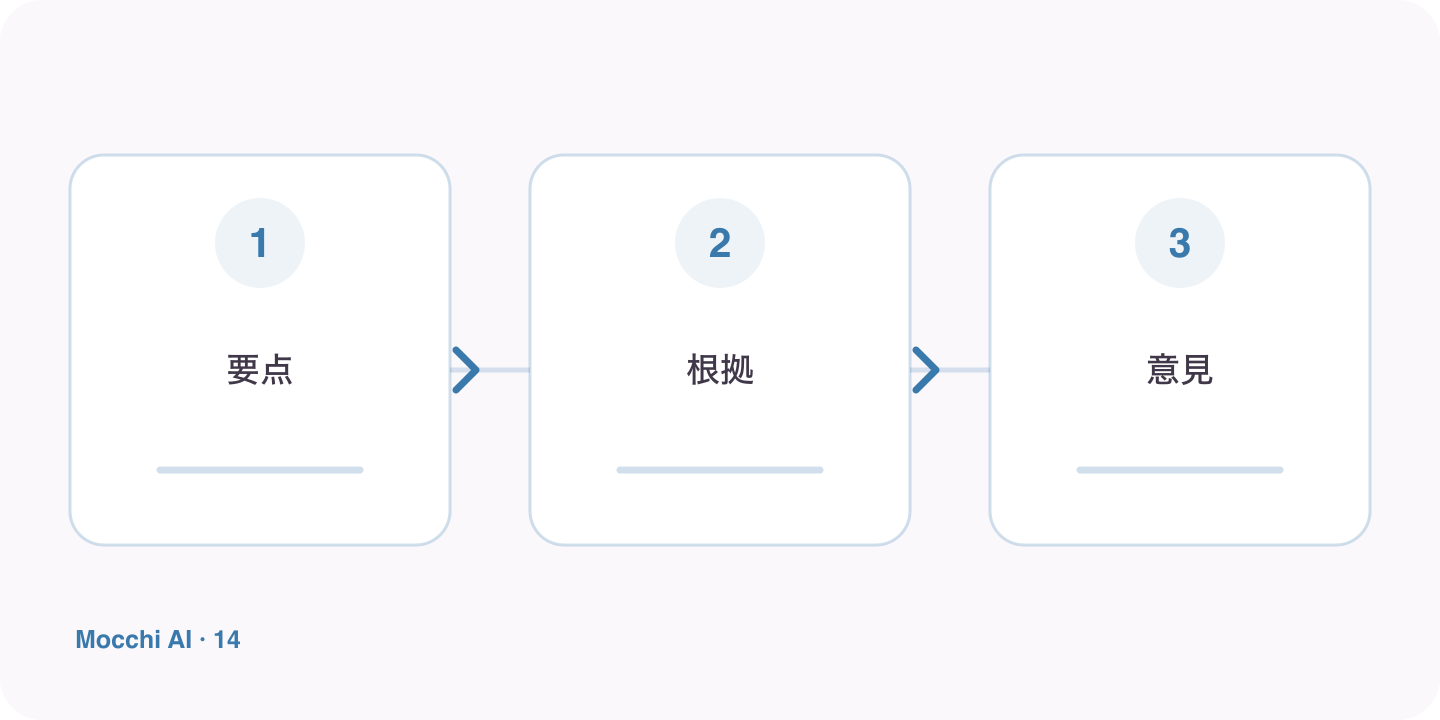
Look away from the passage and state its main point. If you can repeat several words but cannot explain their relationship, ask for help with that connection. Then return to the text and identify the supporting phrase. This makes the summary an evidence-based task rather than an invitation to guess a likely message from a few familiar nouns.
Write a small response before collecting more expressions
Use two or three sentences to agree, disagree, relate an experience, or propose an alternative. Keep the vocabulary manageable and make the reason clear. Ask Mocchi to correct the most important meaning problem first. A short controlled answer gives you a better next practice target than a long copied response whose attractive expressions you cannot retrieve independently.
Plan the next session from the bottleneck
If the passage was understandable but your response lacked a connector, practice that connection next. If an unknown word blocked the writer's main point, learn it in context and reread a different short passage. If you guessed the stance without evidence, practice identifying the supporting clue. A weekly plan becomes personal when these observations influence the next task instead of adding the same amount of new content regardless of the result.