
Why N2 feels like a different exam
N3 rewards a learner who knows the pieces. Sentences are short enough to assemble from the words you recognise, the listening reports facts, and the reading describes ordinary life. N2 rewards a learner who processes Japanese at speed and reads between the lines. That is why many learners pass N3 comfortably, buy an N2 book, and stall for a year: they add patterns and kanji, but the patterns were never the bottleneck. Five specific things change, and naming them turns a vague sense of being out of your depth into five separate problems.
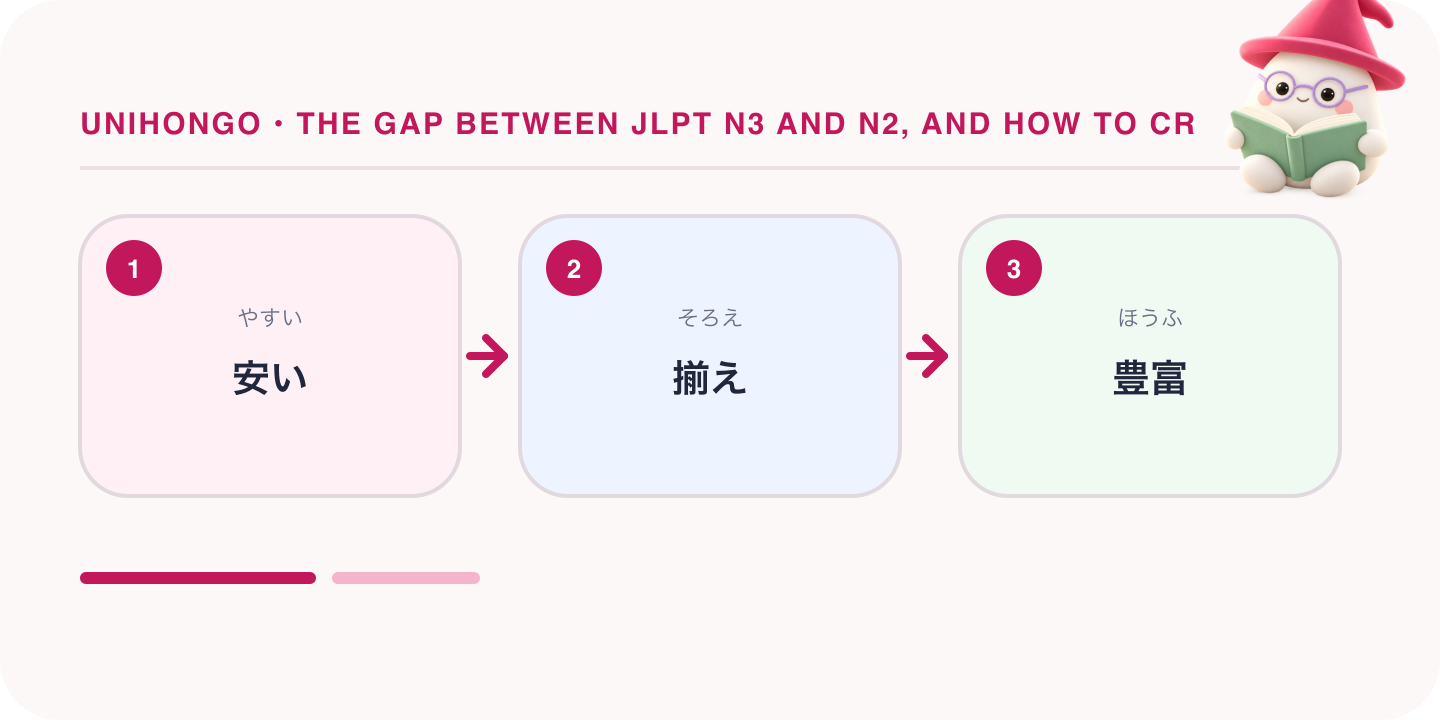
The five shifts at a glance
| Shift | What changes at N2 | Drill that addresses it |
|---|---|---|
| Reading volume | Passages get longer while time per question shrinks | One timed passage, then a three-sentence spoken summary |
| Topic type | Daily life gives way to society, work, and argument | A topic notebook of ten themes, filled from real articles |
| Listening content | Speakers give positions and hints rather than facts | Audio only, paused before the question, position said aloud |
| Grammar | Patterns differ by nuance instead of by meaning | Minimal pairs: one sentence, two patterns, spoken difference |
| Kanji | Compounds must be recognised whole, not worked out | Twenty compounds read aloud in sentences against a timer |
Work through the five in the order that hurts most. Learners who stall usually find that reading speed and kanji recognition are one problem wearing two hats, and that fixing it buys back the minutes the grammar section needed.
Reading: from decoding sentences to processing paragraphs
At N3 you can usually afford to read a passage twice. At N2 the passages are longer, the questions often ask what the writer thinks rather than what the text states, and in most sittings language knowledge and reading share one block of time, so slow reading eats the minutes grammar needed. Speed here does not mean skimming; it means taking a clause in one look.
Train on one passage at a time under a timer set slightly shorter than comfortable. Read once, close the page, say the argument aloud in three sentences. If you cannot produce them, a fourth reading will not rescue you. Go back for the connective words that carried the argument, because those, not the content nouns, are what you missed.
| Japanese | Romaji | Meaning |
|---|---|---|
| この店は安いです。 | Kono mise wa yasui desu. | N3: This shop is cheap. |
| この店は品揃えが豊富なわりに、値段が抑えられている。 | Kono mise wa shinazoroe ga hōfu na wari ni, nedan ga osaerarete iru. | N2: For a shop with such a wide range, this one keeps its prices down. |
| 会議は三時から始まります。 | Kaigi wa san-ji kara hajimarimasu. | N3: The meeting starts at three. |
| 会議の開始時刻については、後ほど担当者からご連絡いたします。 | Kaigi no kaishi jikoku ni tsuite wa, nochihodo tantōsha kara go-renraku itashimasu. | N2: As for the start time, the person in charge will contact you later. |
| つまり、筆者が一番言いたいことは何ですか。 | Tsumari, hissha ga ichiban iitai koto wa nan desu ka? | In short, what is the writer most trying to say? |
| この文章の内容と合っているものはどれですか。 | Kono bunshō no naiyō to atte iru mono wa dore desu ka? | Which of these matches the content of the passage? |
Topics: from your own day to society's arguments
N3 reading lives in a world you already have words for: a part-time job, a trip, a notice about rubbish collection. N2 moves into education, work culture, the environment, ageing, and technology, in the register of a newspaper column. The grammar is often something you met at N3. What defeats you is that every content word turns abstract at the same time.
The fix is a topic notebook rather than a longer word list. Choose about ten themes that keep recurring and give each a page: the ten nouns, five verbs, and three set phrases it cannot do without. Fill the page from one short real article, not from a list. Vocabulary learned inside a theme arrives with its neighbours attached.
| Japanese | Romaji | Meaning |
|---|---|---|
| 私は毎日自転車で会社に行きます。 | Watashi wa mainichi jitensha de kaisha ni ikimasu. | N3: I go to the office by bicycle every day. |
| 通勤手段の選択は、環境への意識と深く関わっている。 | Tsūkin shudan no sentaku wa, kankyō e no ishiki to fukaku kakawatte iru. | N2: The choice of commute is closely bound up with environmental awareness. |
| 少子化が進むにつれて、労働力が不足している。 | Shōshika ga susumu ni tsurete, rōdōryoku ga fusoku shite iru. | As the birth rate keeps falling, the labour force is running short. |
| 技術の発達は、必ずしも生活の豊かさにつながらない。 | Gijutsu no hattatsu wa, kanarazushimo seikatsu no yutakasa ni tsunagaranai. | Advances in technology do not necessarily lead to a richer life. |
| この問題の背景には、社会の大きな変化がある。 | Kono mondai no haikei ni wa, shakai no ōkina henka ga aru. | Behind this problem lies a major change in society. |
| その意見には一理あるが、根拠が弱いと思う。 | Sono iken ni wa ichiri aru ga, konkyo ga yowai to omou. | There is something in that view, but I think the evidence is weak. |
Listening: opinion and implication instead of facts
N3 listening asks what happens: which platform, what time, what the customer ordered. You answer by catching nouns and numbers. N2 asks what a speaker thinks, whether two speakers agree, and what somebody is really refusing while sounding agreeable. In most sittings there is also a part where the options are read aloud rather than printed, so nothing on the page anchors you.
Practise with audio alone. Play a short conversation, pause before the question, and say in one Japanese sentence what each speaker's position is. The habit to build is listening for the turn: が, けど, というより, 一概には, ただ. Speakers signal a change of direction before the real point, so the second half of a sentence carries the answer far more often than the first.
| Japanese | Romaji | Meaning |
|---|---|---|
| 電車は九時に出発します。 | Densha wa ku-ji ni shuppatsu shimasu. | N3: The train departs at nine. |
| 九時の電車でも間に合わないことはないんですが……。 | Ku-ji no densha demo maniawanai koto wa nai n desu ga…. | N2: It is not that we would miss it on the nine o'clock train, but... |
| 悪くはないんですが、もう少し検討したいですね。 | Waruku wa nai n desu ga, mō sukoshi kentō shitai desu ne. | It is not bad, but I would like to think it over a little longer. |
| 賛成というより、ほかに選択肢がないだけです。 | Sansei to iu yori, hoka ni sentakushi ga nai dake desu. | It is less that I agree, and more that there is no other option. |
| 一概にそうとは言えないと思います。 | Ichigai ni sō to wa ienai to omoimasu. | I do not think you can say that across the board. |
| そう言われれば、確かにそうですね。 | Sō iwarereba, tashika ni sō desu ne. | Now that you put it that way, you are certainly right. |
Grammar that differs by nuance, not by meaning
At N3 a grammar question usually has one option that means the right thing. At N2 two or three mean roughly the right thing, and only one carries the right attitude: regret, resignation, a polite refusal, or a concession made before disagreeing. A list of patterns with an English gloss beside each is close to useless here, because the glosses collide.
Study N2 grammar in minimal pairs. Write a sentence, rewrite it with the neighbouring pattern, and say aloud what changed about the speaker. わけではない says the conclusion you drew is wrong; ないわけではない admits the thing does happen. かねない warns of a bad outcome; かねる politely declines. Once you can voice the difference, the options stop looking interchangeable.
| Japanese | Romaji | Meaning |
|---|---|---|
| 嫌いなわけではありません。ただ、量が多すぎるんです。 | Kirai na wake de wa arimasen. Tada, ryō ga ōsugiru n desu. | It is not that I dislike it. The portion is simply too large. |
| 辛いものを食べないわけではありません。 | Karai mono o tabenai wake de wa arimasen. | It is not as though I never eat spicy food. |
| その方法は事故につながりかねない。 | Sono hōhō wa jiko ni tsunagari kanenai. | That method could well lead to an accident. |
| その件については、お答えしかねます。 | Sono ken ni tsuite wa, o-kotae shikanemasu. | I am afraid I am unable to answer on that matter. |
| 申し込んだものの、まだ返事が来ていない。 | Mōshikonda mono no, mada henji ga kite inai. | Although I applied, no reply has arrived yet. |
| 一言注意したばかりに、話が大きくなってしまった。 | Hitokoto chūi shita bakari ni, hanashi ga ōkiku natte shimatta. | Simply because I gave one word of warning, the matter blew up. |
Kanji compounds you read rather than decode
N3 kanji study still works by parts. You see 環 and 境 and reason your way to environment. That reasoning costs perhaps two seconds a compound, which is affordable in a short passage and ruinous in a long one. At N2 compounds have to arrive whole, reading and meaning together. Decoding is a beginner's crutch that quietly becomes a speed limit.
Drill compounds in sentences against a clock. Take twenty N2 compounds, put each in a short natural sentence, and read the set aloud until none of them makes you pause. Watch families that share a character and differ in use, such as 実施, 実現, and 実際, or 対応 and 対策. Reading those is not about knowing 実 or 対; it is about having met each word until it is one unit.
| Japanese | Romaji | Meaning |
|---|---|---|
| 計画を実施することになりました。 | Keikaku o jisshi suru koto ni narimashita. | It has been decided that the plan will be carried out. |
| 長年の夢がようやく実現した。 | Naganen no yume ga yōyaku jitsugen shita. | A long-held dream has finally come true. |
| 実際に使ってみると、印象が変わります。 | Jissai ni tsukatte miru to, inshō ga kawarimasu. | Once you actually try using it, your impression changes. |
| お客様の苦情に対応しています。 | Okyakusama no kujō ni taiō shite imasu. | We are dealing with customer complaints. |
| 早めに対策を立てる必要がある。 | Hayame ni taisaku o tateru hitsuyō ga aru. | We need to draw up countermeasures early. |
| 需要と供給のバランスが崩れている。 | Juyō to kyōkyū no baransu ga kuzurete iru. | The balance between supply and demand has broken down. |
A week that moves you toward N2
- Monday and Thursday: one timed passage, then a three-sentence spoken summary of its argument.
- Tuesday: twenty compounds read aloud on a timer inside full sentences, confusable families marked.
- Wednesday: audio only. Two conversations, paused before the question, each position said aloud in Japanese.
- Friday: five grammar minimal pairs, each with a spoken explanation of what changed about the speaker.
- Saturday: one theme page in the topic notebook, filled from a short real article.
- Sunday: no new material. Speak for fifteen minutes using the week's words, then note the ones you only recognised.
What the gap does not measure
N2 is a recognition exam. It is multiple choice from beginning to end, it never asks you to speak or write a sentence of your own, and a strong result tells an employer that you can process Japanese rather than produce it. Learners who cross this gap by reading alone often find their spoken Japanese has not moved, because nothing in the preparation required a sentence built under time pressure.
Add production deliberately, using N2 material. After every passage, argue with it out loud: state a position, give two reasons, concede one point, restate. Those are the discourse moves the listening section tests, so speaking and exam practice stop competing for your evening. Confirm current exam details on the official JLPT site before you register, since formats and timings vary between sittings.
| Japanese | Romaji | Meaning |
|---|---|---|
| この意見に賛成です。理由は二つあります。 | Kono iken ni sansei desu. Riyū wa futatsu arimasu. | I agree with this view. There are two reasons. |
| 一つ目は費用の問題です。 | Hitotsume wa hiyō no mondai desu. | The first is the question of cost. |
| 確かにそういう面もありますが、私はこう考えます。 | Tashika ni sō iu men mo arimasu ga, watashi wa kō kangaemasu. | There is certainly that side to it, but this is how I see it. |
| うまく言えないので、言い換えてもいいですか。 | Umaku ienai node, iikaete mo ii desu ka? | I cannot say it well, so may I put it another way? |
| 今の説明で伝わりましたか。 | Ima no setsumei de tsutawarimashita ka? | Did that explanation come across? |
Mistakes that keep learners stuck at N3
- Studying an N2 grammar book the way you studied N3: one pattern, one gloss, one example.
- Reading untimed, so comprehension improves while reading speed never moves.
- Blaming unknown kanji when the real delay is decoding kanji you already know.
- Listening with the transcript open, which trains the eye and leaves the ear where it started.
- Waiting to feel ready before attempting a full paper under real exam conditions.
- Letting speaking stop during the study months, then finding the certificate did not carry it.