
Where the mismatch comes from
Much of the standard beginner material grew out of university programmes, and it shows: the example sentences are about lectures and club activities, the characters are students, and the vocabulary follows.
That is not a flaw in the material so much as a mismatch with a different audience. An adult learning around a job needs different situations and, quite quickly, different vocabulary.
What it costs
The obvious cost is boredom, and the less obvious one is sequencing: the vocabulary you meet first is the vocabulary the material chose, and for an adult it is frequently not the most useful.
A learner may reach several hundred words without being able to describe their own job.
- Vocabulary that does not match your life comes first.
- Situations you will never encounter are practised.
- Workplace and administrative language arrives late.
- Motivation suffers, which affects consistency.
- The Japanese you can produce does not describe you.
Adapting what you have
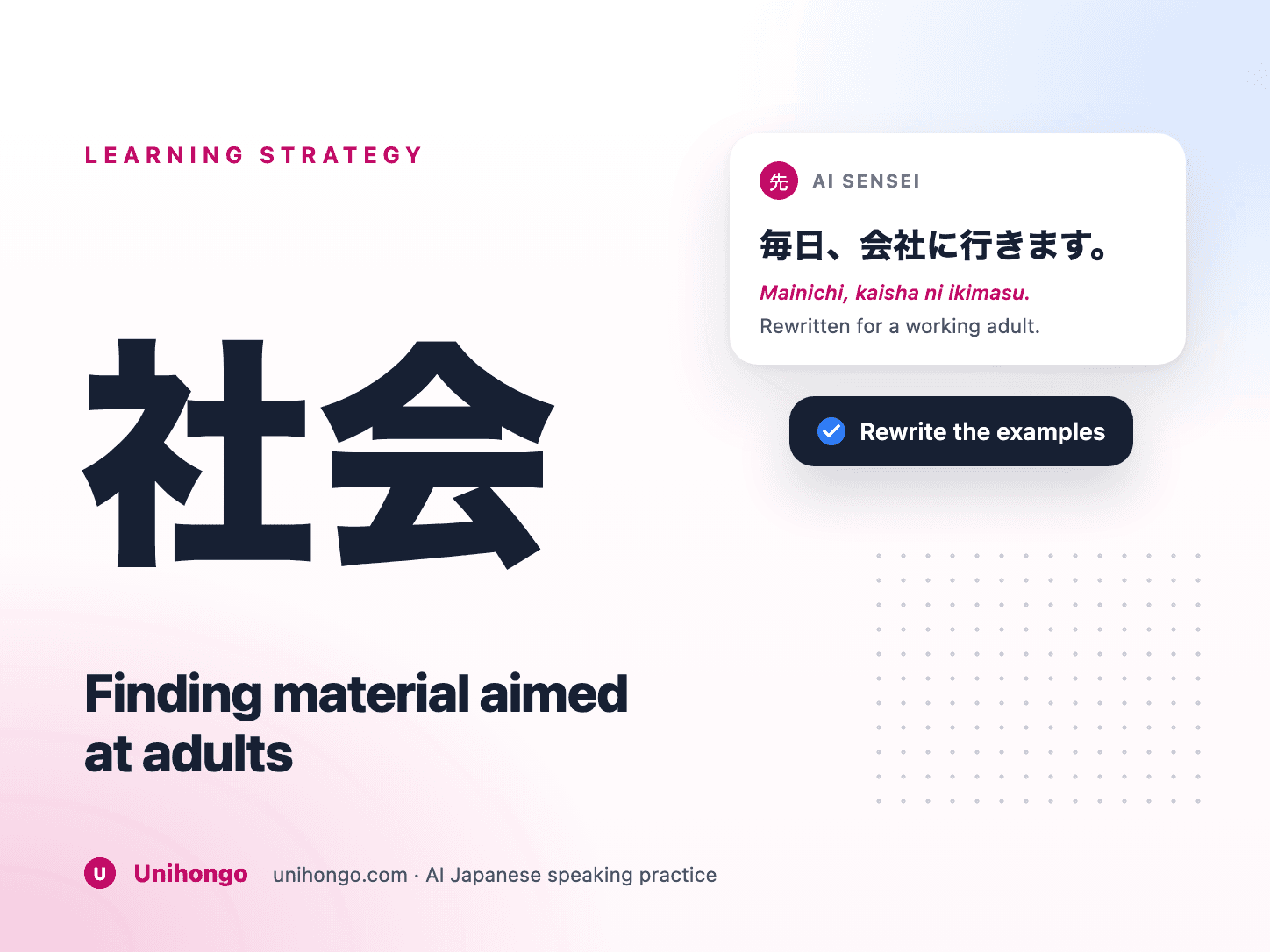
The cheapest fix does not require different material. Take the pattern from each example sentence and rewrite it about your own life, which takes seconds and makes the grammar immediately relevant.
This also produces better retention, because a sentence about your actual commute is more memorable than one about a fictional student's.
| Japanese | Romaji | Meaning |
|---|---|---|
| 毎日、学校に行きます。 | Mainichi, gakkō ni ikimasu. | The textbook version |
| 毎日、会社に行きます。 | Mainichi, kaisha ni ikimasu. | Rewritten for a working adult |
| 部活があります。 | Bukatsu ga arimasu. | The textbook version |
| 会議があります。 | Kaigi ga arimasu. | Rewritten |
| 宿題をします。 | Shukudai o shimasu. | The textbook version |
| 残業をします。 | Zangyō o shimasu. | Rewritten |
Same grammar, same difficulty, entirely different usefulness. This is the highest-return five seconds available in beginner study.
Choosing your own vocabulary
Grammar has real dependencies and is worth taking in a sensible order. Vocabulary does not, and the standard order is a convention rather than a requirement.
Choosing your own early means learning the words for your job, your commute, your household and your interests before the ones a textbook chose, which changes how soon Japanese becomes usable.
- List thirty words you would need to describe your own week.
- Learn those alongside whatever the textbook is covering.
- Add the vocabulary of your own field early rather than late.
- Include the words for your daily administrative life.
- Keep the textbook order for grammar and ignore it for vocabulary.
Material that fits better
Beyond adapting, some material is simply aimed at a different audience and is worth seeking out. Business Japanese material assumes an adult context, and graded news covers adult topics at a manageable level.
The label on the level matters less than whether the situations are ones you will actually meet.
| Material | Fits | Note |
|---|---|---|
| Business Japanese texts | Working adults | Situational and relevant |
| Graded news | Adults, any field | Current and topical |
| Podcasts for learners | Varies | Check the assumed audience |
| Standard beginner texts | Students | Adapt the examples |
| Children's material | Children | Kana-only, harder than it looks |
| Field-specific material | Your profession | Highly relevant, often advanced |
The last row is worth attempting earlier than the level would suggest, because familiarity with the content compensates for a great deal of linguistic difficulty.
Using your own life as the syllabus
The strongest version of this is to let your own week determine what you study: the conversations you needed and could not have, the documents you could not read, the words you reached for and missed.
That produces a syllabus that is relevant by construction, and it has the useful property of being self-correcting, because what recurs is what matters.
In Unihongo the session reports do part of this automatically, since the words you reached for and could not find during a spoken session can be saved as flashcards, which builds a deck from your own life rather than from a textbook's assumptions.
Textbook order is a default, not an obligation. For an adult with limited time, relevance is worth more than sequence.