
Write a Japanese Reading Summary With Mocchi AI

A reading summary should preserve the text's main point and essential support without translating every line or adding your own opinion. Ask Mocchi to help you decide what must remain before polishing the Japanese wording.

Mocchi helps reduce a short Japanese passage to its main point and one supporting idea
What you need to know

Write a Japanese Reading Summary With Mocchi AI

Summarizing can expose a gap that line-by-line translation hides: you may understand individual sentences without seeing how they form one message. Start with a short original text and explain its point in plain language. Then choose the detail needed to make that point accurate. Write a concise version using language you can control, and ask whether the summary changes the claim's scope, cause, or certainty. Style comes after fidelity to the source.

State the main point before shortening sentences.

Keep essential support and remove incidental detail.

Separate the writer's claim from your response.

Check for meaning changes before polishing style.

Identify the point before reducing the word count

Ask what the text wants the reader to understand. Is it explaining a change, arguing for a choice, describing a problem, or reporting an event? Tell Mocchi your interpretation before requesting a model summary. This gives the tutor a chance to respond to your reading rather than supplying a polished answer that you only recognize afterward.

Keep the first source short. If the passage contains many claims, a beginner summary can become a selection problem larger than the language task you intended. Start with one clear point and a supporting detail, then add complexity when you can explain what deserves to remain.

Separate the central action from a supporting detail

A passage might explain that someone walks to the station to get more exercise, then mention the color of a bag. The walking and reason may matter to the summary while the bag color does not. Ask Mocchi to make that selection explicit. The task is not simply choosing the longest sentence or retaining every familiar noun.
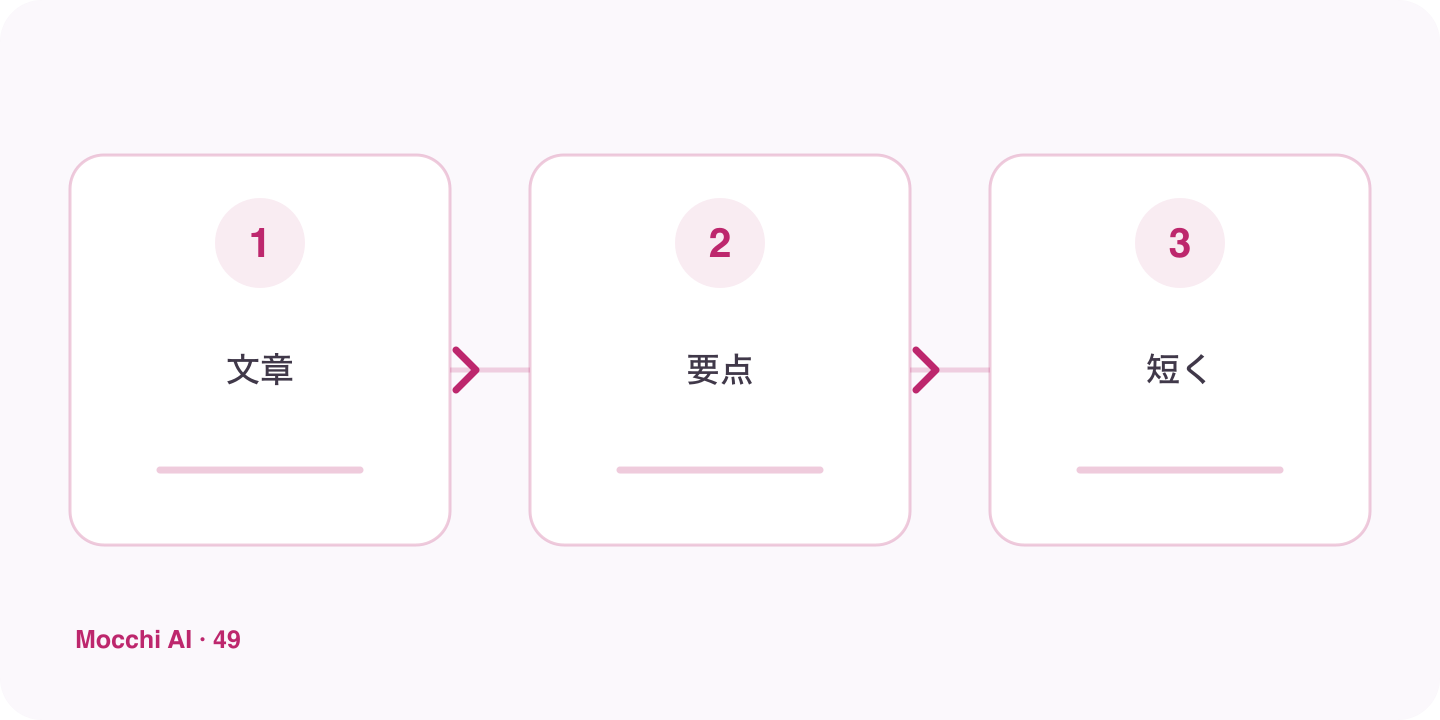
A passage is filtered into a main claim and essential support before a concise summary is written
A summary selects what matters while preserving the writer's meaning; it is not a place to add a new argument.
JapaneseRomajiMeaning
運動のために、駅まで歩いています。Undō no tame ni, eki made aruite imasu.I walk to the station for exercise.
毎日の習慣にしたいです。Mainichi no shūkan ni shitai desu.I want to make it a daily habit.

Check that the shorter version does not strengthen the claim

A summary can become inaccurate by replacing sometimes with always, a possibility with certainty, or one reason with the only reason. Ask Mocchi to compare the scope of the original and your version. If a qualification matters to the central point, retain it even when removing it would make the sentence shorter.

Use your own controllable language

Draft the summary with vocabulary and structures you can explain. Ask for help with one missing expression, but avoid copying a long model and calling it your understanding. If the wording is simple but the meaning is accurate, you have a useful base to improve. Polishing should clarify the same message rather than replacing it with a more impressive but different one.

Add the personal response as a separate task

After checking the summary, write a sentence saying whether you agree, relate to the situation, or would choose another approach. Label that sentence as your response. Mocchi can help refine both pieces, while the separation keeps reading comprehension and opinion writing honest. At a later session, summarize a new passage before opening the old model to see whether the selection process transfers.

Key points

A practical way to improve

Ask Mocchi for a short original Japanese passage and read it without immediately requesting a summary. State the main point, choose one essential supporting idea, and draft a brief version. Ask the tutor which claim you omitted or added, then revise. Finish with a separate personal response so you practice distinguishing what the text says from what you think about it.

  1. 1

    Choose one clear goal

    Focus each session on a situation or skill you can actually use.

  2. 2

    Practice actively

    Say complete answers aloud instead of only reading or recognizing Japanese.

  3. 3

    Review and repeat

    Keep useful corrections and revisit the same skill until it feels natural.

FAQ

Frequently asked questions

Is a summary just a shorter translation?

Not exactly. A summary selects the central message and necessary support, while a full translation aims to represent the whole text. Decide which task you are doing before choosing what to leave out.

Can I include my own opinion in the summary?

Keep it separate unless the assignment explicitly asks for a combined response. Otherwise, readers may be unable to tell which ideas belong to the original writer and which you added.

What if my Japanese is simpler than the passage?

Use clear language you can control, then check that the meaning remains accurate. A simple faithful summary is more useful than an elegant copied phrase that changes the argument or hides your own understanding.

Make a shorter version that keeps the meaning

Use Mocchi to check your selection of ideas, not only the smoothness of the final wording.