
Find the Main Claim After a Japanese Contrast With Mocchi

A Japanese paragraph may acknowledge one point before arguing for another. Ask Mocchi to help you separate the concession from the main claim and explain how the contrast changes what you should retain from the passage.

Mocchi separates an acknowledged benefit from a contrast and the writer's main Japanese claim
What you need to know

Find the Main Claim After a Japanese Contrast With Mocchi

When familiar vocabulary appears in an early sentence, it is tempting to choose an answer before processing the rest of the paragraph. Contrastive writing can make that habit unreliable. Read the whole short argument, identify what is accepted, and check what the writer ultimately claims. Mocchi can supply controlled original examples and ask for evidence before revealing an explanation. This develops a reading decision rather than a rule that blindly treats one connector as an automatic answer key.

Read beyond the first familiar or agreeable statement.

Separate an acknowledged point from the main claim.

Use the paragraph's wording to justify the interpretation.

Avoid treating a contrast marker as a mechanical shortcut.

Read the relationship between the statements

A paragraph can grant that something is convenient and still argue that another factor matters more. Ask Mocchi what role each statement plays: background, acknowledgment, contrast, reason, or conclusion. These roles are more useful than collecting connector translations without seeing how the ideas fit together.

Keep the first argument short enough that you can hold both sides in mind. A dense passage with unfamiliar vocabulary may create a second problem before the structure is clear. Increase the complexity after you can explain the simple relationship and support it with actual wording.

A benefit can be acknowledged without deciding the whole question

確かに便利です。しかし、費用も考える必要があります acknowledges convenience and then introduces cost as another consideration. A summary saying only that the option is convenient leaves out the qualification. Ask Mocchi to compare that incomplete summary with one that preserves both the benefit and the need to consider another factor.
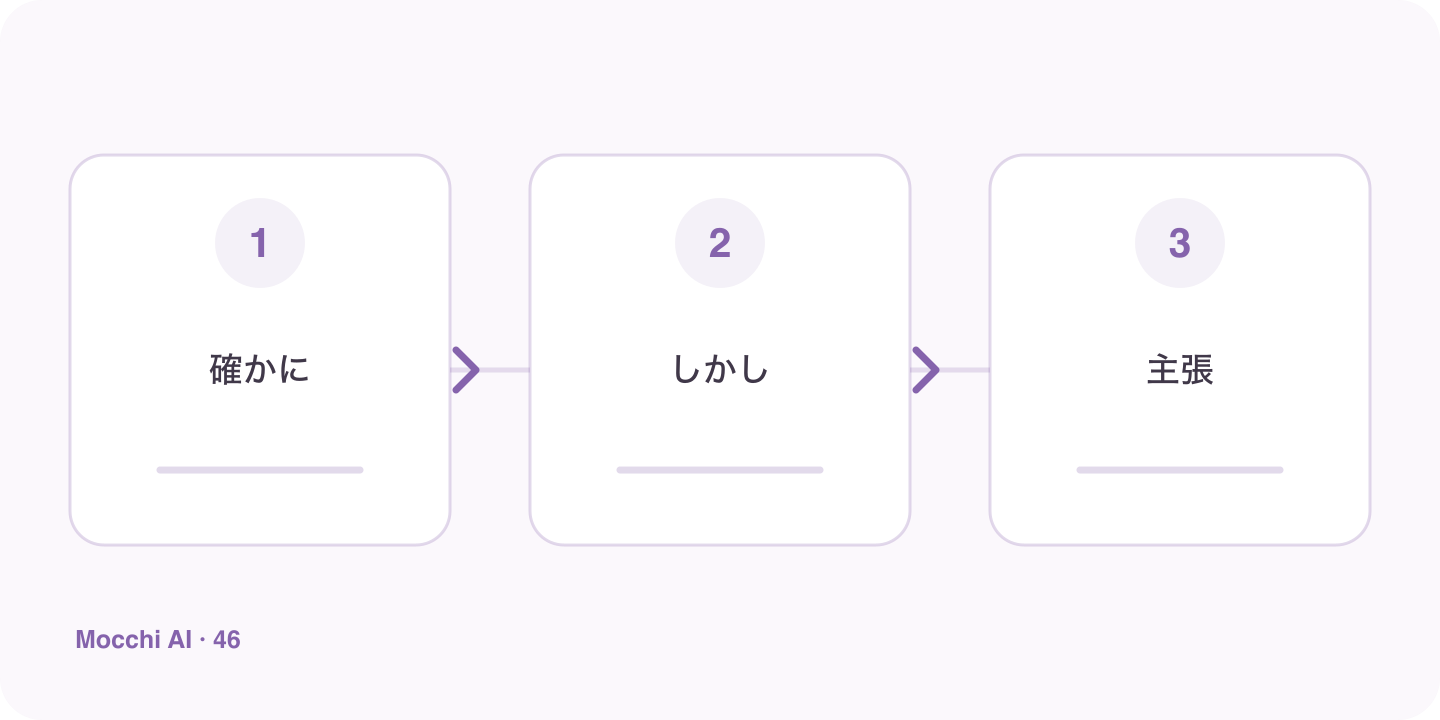
A concession leads through a contrast marker to a claim supported by the end of the paragraph
A point the writer acknowledges is not necessarily the conclusion the paragraph asks you to retain.
JapaneseRomajiMeaning
確かに便利です。Tashika ni benri desu.It is certainly convenient.
しかし、費用も考える必要があります。Shikashi, hiyō mo kangaeru hitsuyō ga arimasu.However, it is also necessary to consider the cost.

State the main claim in simpler language

After identifying the roles, paraphrase what the paragraph asks the reader to understand. Keep the strength and scope of the claim intact. Do not turn a call to consider cost into a statement that the option must never be used. Ask Mocchi to point out any interpretation you added that the paragraph itself does not support.

Explain why the attractive alternative is incomplete

A wrong answer may repeat an accurate sentence from the passage while omitting its relationship to the rest. Describe that omission directly. This makes the review more useful than saying the option was wrong because another one was better. You are learning how the paragraph's structure changes what counts as a faithful summary.

Vary the structure during later practice

Request another paragraph with a different connector or a claim spread across more than one sentence. Apply the same questions about roles and evidence rather than relying on one visual cue. Mocchi can help target the contrast you repeatedly miss, while the varied structure checks whether the strategy works beyond the original example and its familiar layout.

Key points

A practical way to improve

Ask Mocchi for a short original paragraph that acknowledges a benefit and then qualifies it. State both points separately and identify the writer's main claim. Choose a summary and explain which phrase supports it. Then compare a tempting summary that keeps only the first point. Try another paragraph where the structure differs so the practice does not reduce to choosing whichever sentence follows one familiar connector.

  1. 1

    Choose one clear goal

    Focus each session on a situation or skill you can actually use.

  2. 2

    Practice actively

    Say complete answers aloud instead of only reading or recognizing Japanese.

  3. 3

    Review and repeat

    Keep useful corrections and revisit the same skill until it feels natural.

FAQ

Frequently asked questions

Is the main claim always immediately after しかし?

No. A contrast marker is a clue to a relationship, not a universal location rule for every paragraph. Read the whole passage and identify what the writer supports or concludes.

Can the writer accept a benefit and still criticize a choice?

Yes. Acknowledging a useful feature does not mean endorsing every consequence or choosing it overall. Keep the accepted point and the qualified conclusion separate.

How should I review a wrong summary choice?

Explain which part of the paragraph attracted you and which later wording limits or changes it. Then practice a new argument with a similar relationship instead of simply memorizing the correct summary.

Follow the argument through the contrast

Use Mocchi to test what the writer actually claims rather than stopping at the first familiar idea.