
Plan Your First N5-Level Week With Mocchi AI

A first N5-level week should help you do a few small things in Japanese while building the reading support to continue. Ask Mocchi for a realistic starting plan based on what you already recognize, your available time, and one everyday goal.

Mocchi connects a beginner's kana recognition to a simple introduction and an end-of-week recall task
What you need to know

Plan Your First N5-Level Week With Mocchi AI

Beginners are often handed long lists of kana, vocabulary, grammar patterns, and study resources before they have used a single sentence. A better first week connects these parts around a few understandable tasks, such as introducing yourself and describing an ordinary activity. N5 is a useful difficulty reference, but this week is a learning routine, not an official exam syllabus or a promise that a fixed number of days will produce a particular result.

Start with what you can recognize now.

Connect kana and words to a short message.

Include review before adding another large list.

Choose an end-of-week task you can attempt without copying.

Check the starting point before choosing the workload

Tell Mocchi what you have already encountered: a few kana, familiar greetings, a textbook lesson, or no prior Japanese. Then attempt a small reading or meaning question instead of relying only on a label such as complete beginner. Someone who recognizes kana but struggles to connect words has a different next task from someone meeting the script for the first time.

Be realistic about time. A short plan you can complete on workdays is more useful than a detailed schedule that assumes a free afternoon every day. Include the amount of explanation support you need, since reading instructions and examples is part of the actual study time.

Use one simple message to connect the parts

A sentence such as 学生です, 'I am a student,' lets you connect a familiar meaning, a short noun, and a basic polite ending. Add 日本語を勉強しています when it fits your current practice, but do not force a longer introduction before the smaller pieces are understandable. Use invented details if you prefer. The exercise is about making a message, not collecting personal information.
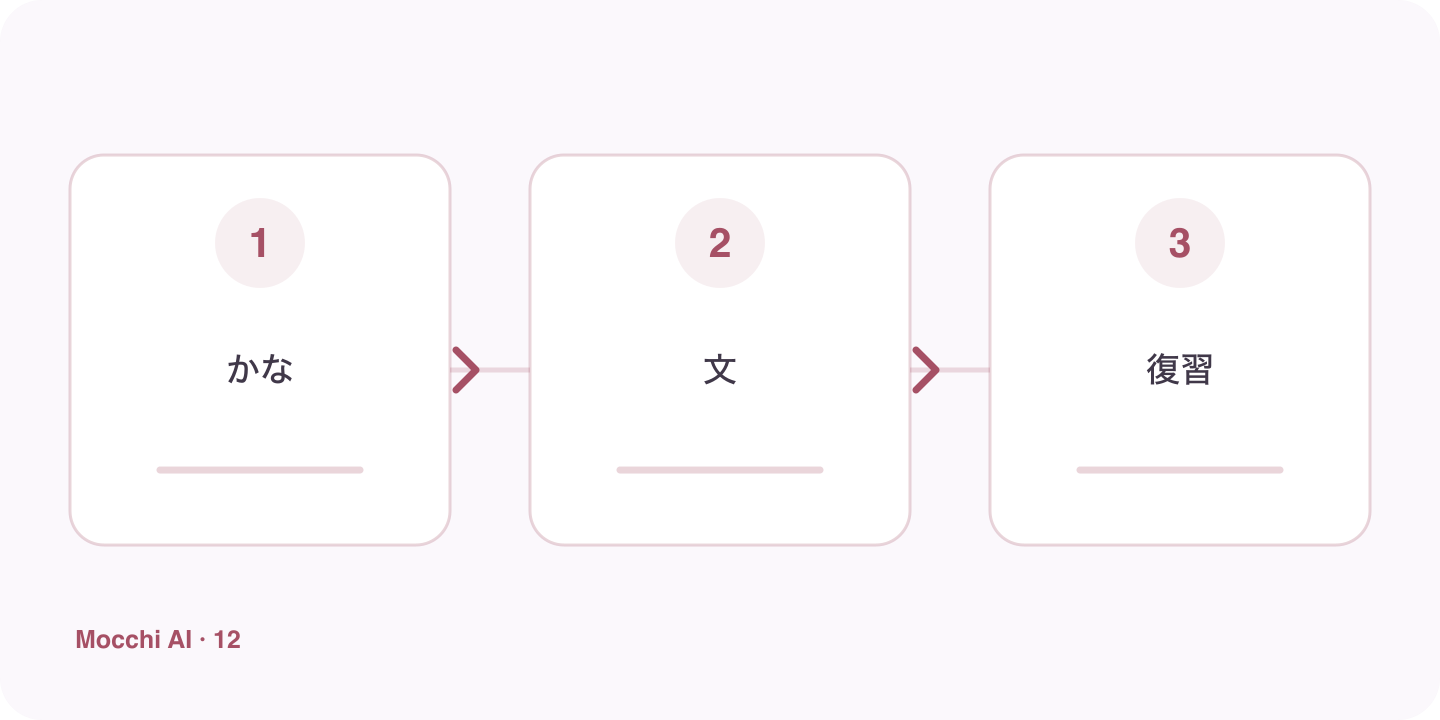
A first beginner week moves from recognizing words to making a short sentence and recalling it later
A beginner plan should connect reading, meaning, and a small usable response instead of treating them as unrelated lists.
JapaneseRomajiMeaning
学生です。Gakusei desu.I am a student.
日本語を勉強しています。Nihongo o benkyō shite imasu.I am studying Japanese.

Spread attention across reading and meaning

Kana practice should help you recognize real words rather than become a separate copying task with no meaning attached. Read a short familiar word, connect it to its meaning, and find it again in a simple sentence. Ask Mocchi to keep the surrounding vocabulary controlled. This makes it easier to tell whether a mistake came from recognizing the script or understanding the message.

Leave room to revisit yesterday's language

A week filled entirely with new material can create an impressive record of exposure and little usable recall. Begin later sessions with something from an earlier day. Try the word or pattern before looking, then change a detail. If the old material needs more support, adjust the plan rather than treating review as work that does not count.

End the week with a small independent attempt

Make a short introduction or describe a familiar activity without copying a model. Ask Mocchi to identify one useful next improvement, then keep that point for the following week. A successful first week does not require mastery of a whole level. It should leave you with a repeatable routine, a few pieces of Japanese you can use, and a clearer picture of what support you need next.

Key points

A practical way to improve

Tell Mocchi whether you can read any hiragana and how much time you can protect on an ordinary day. Choose one beginner situation, such as a simple self-introduction. Practice a small set of useful words and one sentence pattern, then return to them with changed details. At the end of the week, make a short introduction without copying the model and note which parts still need support.

  1. 1

    Choose one clear goal

    Focus each session on a situation or skill you can actually use.

  2. 2

    Practice actively

    Say complete answers aloud instead of only reading or recognizing Japanese.

  3. 3

    Review and repeat

    Keep useful corrections and revisit the same skill until it feels natural.

FAQ

Frequently asked questions

Do I need to know all kana before using Mocchi?

You can ask for beginner support while learning kana, but developing normal-script recognition will make later practice easier. Tell the tutor what you can currently read so the first tasks do not rely on unsupported assumptions.

Is this an official N5 study schedule?

No. It is a beginner learning routine organized with an approximate difficulty reference. Use the official JLPT information for exam scope and format rather than treating a tutor-generated week as an official syllabus.

How many new words should I learn each day?

Choose an amount you can retrieve and use in the available time. If yesterday's words are not available in a simple sentence, reduce new additions and practice the existing set rather than chasing a fixed number.

Start with a small beginner outcome

Let Mocchi connect your first reading practice to a sentence you can understand and make yourself.