
Why writing is judged differently
A spoken mistake is forgiven because the listener knows you were composing in real time. A written mistake had time available, and readers apply a correspondingly higher standard.
The same fact works in your favour. Writing is the one place where a learner can produce Japanese indistinguishable from a competent colleague's, because the constraint that limits speech has been removed.
That makes a checking routine worth having. Most of what goes wrong in written Japanese is catchable with four or five specific passes.
Register consistency
This is the error Japanese readers notice most and the one learners produce most often: a message that begins in polite forms and slips into plain ones partway, usually as concentration drops.
Check the ending of every sentence in one pass, ignoring the content. Consistency is a visual check and it is quick.
| Japanese | Romaji | Meaning |
|---|---|---|
| 確認しました。ありがとう。 | Kakunin shimashita. Arigatō. | Mixed: polite then casual |
| 確認しました。ありがとうございます。 | Kakunin shimashita. Arigatō gozaimasu. | Consistent |
| 送ります。よろしく。 | Okurimasu. Yoroshiku. | Mixed |
| 送ります。よろしくお願いします。 | Okurimasu. Yoroshiku onegai shimasu. | Consistent |
| わかった。確認いたします。 | Wakatta. Kakunin itashimasu. | Badly mixed: casual then humble |
| 承知しました。確認いたします。 | Shōchi shimashita. Kakunin itashimasu. | Consistent |
The fifth line is the worst kind, because it jumps two levels within two sentences. Scanning sentence endings catches all of these in seconds.
Keigo direction
The second most noticeable error is keigo pointing the wrong way: humble forms used for the reader's actions, or honorific forms used for your own.
The check is mechanical. For each keigo verb, ask whose action it describes. Your own actions take humble forms; the reader's take honorific ones.
| Whose action | Correct form | Common error |
|---|---|---|
| Yours | 参ります | いらっしゃいます |
| Yours | 拝見します | ご覧になります |
| Yours | いたします | なさいます |
| Reader's | いらっしゃいます | 参ります |
| Reader's | ご覧になります | 拝見します |
| Your company's | Humble, to outsiders | Honorific |
The last row catches many learners. Your own manager takes humble treatment when you write to a client, which is the reverse of internal usage.
Particles, which nothing else catches
A wrong particle produces a grammatical sentence with a different meaning, so no tool flags it and the sentence looks fine. Only a deliberate pass finds these.
The pairs worth checking are the ones that are genuinely confusable rather than every particle in the message.
| Japanese | Romaji | Meaning |
|---|---|---|
| 会社に働いています。 | Kaisha ni hataraite imasu. | Wrong particle for an activity |
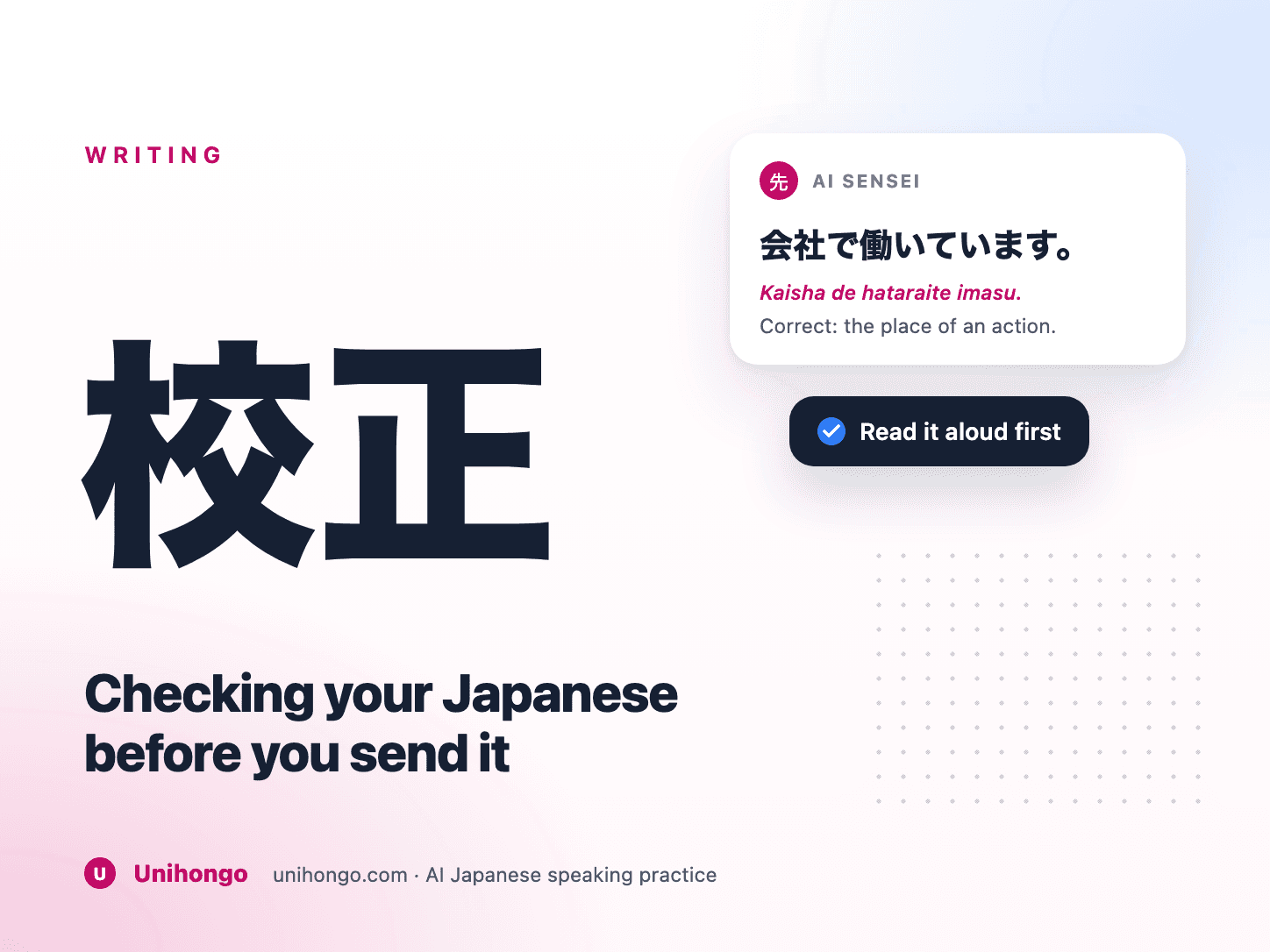
| 会社で働いています。 | Kaisha de hataraite imasu. | Correct: the place of an action |
| 東京で行きます。 | Tōkyō de ikimasu. | Wrong: destination |
| 東京に行きます。 | Tōkyō ni ikimasu. | Correct |
| 友達を会いました。 | Tomodachi o aimashita. | Wrong particle for meeting |
| 友達に会いました。 | Tomodachi ni aimashita. | Correct |
Conversion errors
Typing Japanese means selecting from candidate conversions, and choosing the wrong one produces a real word rather than a misspelling. Nothing flags it, and it can produce sentences that are comprehensible and wrong.
The only defence is reading the characters rather than reading for meaning, because reading for meaning is exactly what makes a plausible wrong word invisible.
- Read the characters, not the meaning, on one dedicated pass.
- Pay particular attention to names, which convert unpredictably.
- Check any word you typed quickly and accepted without looking.
- Watch homophone-heavy words, where several conversions are plausible.
- Read numbers separately; a wrong digit reads as a word to your eye.
A routine that fits in two minutes
Four passes catch the great majority of what goes wrong, and together they take about two minutes on a short message.
Reading aloud is the single most effective one, because register slips and particle errors are audible before they are visible. If you only do one check, do that one.
- Pass one: read it aloud, listening for anything that sounds wrong.
- Pass two: scan the sentence endings for register consistency.
- Pass three: check the direction of every keigo verb.
- Pass four: read the characters for conversion errors, especially names.
- For anything external, ask a colleague before sending.