
The routine in four verbs
The whole method fits on four cards. Kiku, listen. Yomu, read the lyrics. Shiraberu, look up what you do not know. Utau, sing. Do them in that order for one line of a song, not for the whole song at once.
The order matters. Listening first forces your ear to work before your eyes help it. Singing last means that your mouth practises something you already understand. The rows after the cards are the words you need to talk about a song.
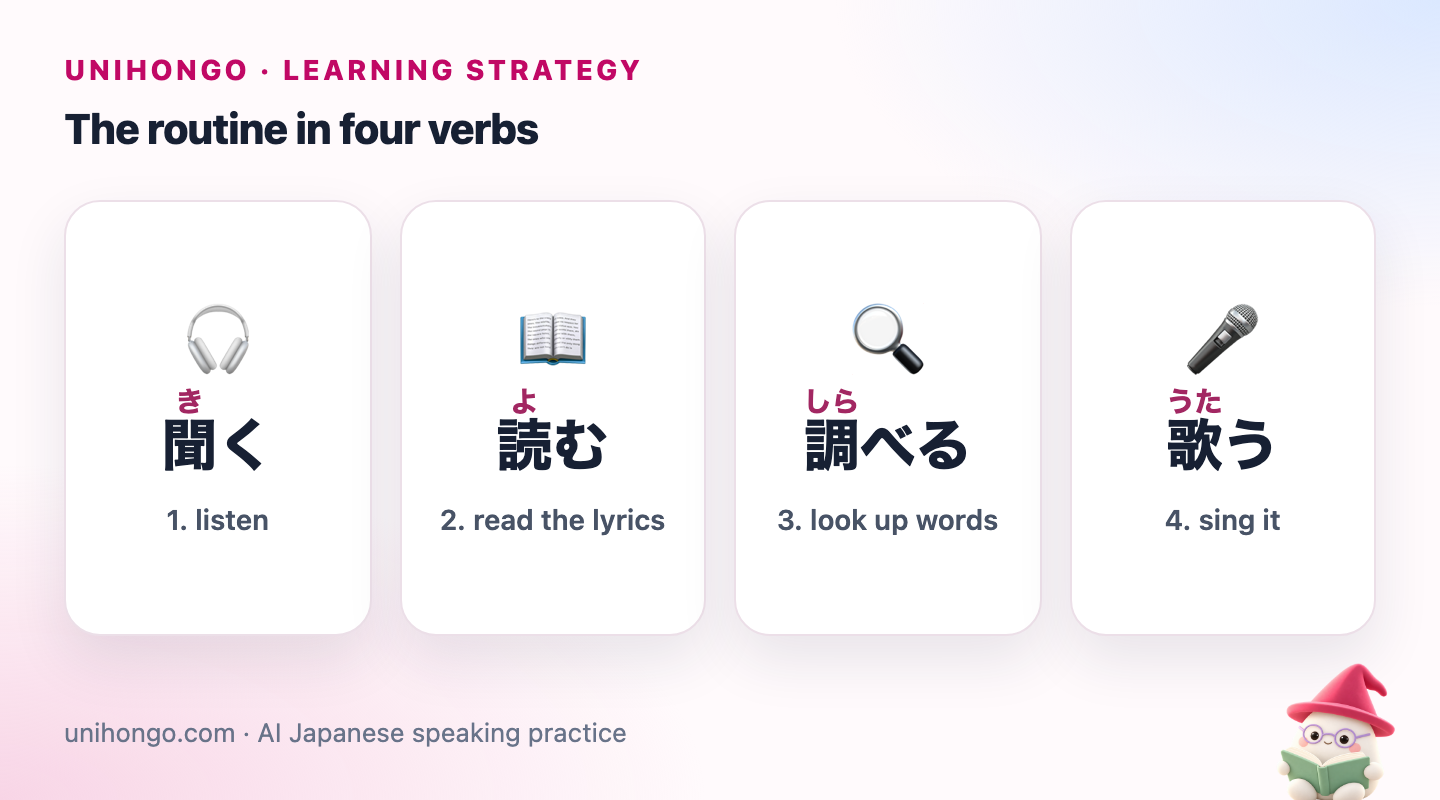
| Japanese | Romaji | Meaning |
|---|---|---|
| 聞く | kiku | 1. listen |
| 読む | yomu | 2. read the lyrics |
| 調べる | shiraberu | 3. look up words |
| 歌う | utau | 4. sing it |
| 歌詞 | kashi | lyrics |
| 曲 | kyoku | song, track |
| サビ | sabi | chorus, the hook |
Choosing a song that will teach you
The best study song is one you already love, because you will hear it dozens of times. Among the songs you love, some are far better teachers than others.
- Tempo: slow or medium, so that you can hear where one word ends and the next begins.
- Voice: a clear lead vocal that is not buried under the instruments.
- Lyrics: officially published, so that you can check them with furigana.
- Language: everyday words and a small story, not dense wordplay.
- Length of lines: short lines that you can hold in memory after two or three plays.
Ballads and gentle pop songs usually pass this test. Many anime opening themes are exciting and very fast, so keep them as a reward for later. Start with the sabi, the chorus, since it repeats and you will get the most practice from it.
Reading lyrics with furigana
Find the kashi, the lyrics, in Japanese script, not only in romaji. Reading along in kana and kanji while the singer sets the pace is one of the best reading drills there is. If the kanji are too many, add furigana by hand above the words you cannot read.
Be ready for one special habit of songwriters. They sometimes print one word in kanji and sing a different one. A lyric may show the kanji for "universe" and have the singer say sora, "sky", or show "fate" written one way and sung in an older, softer reading. The furigana in the official lyrics tells you what is sung, so follow it.
Why sung Japanese is not spoken Japanese
Enjoy the differences, but know them, or you will carry song habits into your conversation.
| Feature | In a song | In conversation |
|---|---|---|
| Length of sounds | One mora can be held for several beats | Every mora takes about the same short time |
| Pitch | The melody decides which sounds go up | Each word has its own pitch accent |
| Word order | Lines are turned around to fit the rhythm | The verb comes at the end |
| Pronouns | The song words for "you" and "I" in almost every line | Names, titles, or no pronoun at all |
| Particles | Often dropped to fit the beat | Dropped among friends, kept in polite speech |
| Vocabulary | Poetic and old-fashioned words | Plain daily words |
One feature of songs helps your pronunciation directly. Japanese melodies usually give each mora its own note, including the n sound, the second half of a long vowel and the pause of a small tsu. Singing a line slowly shows you how many beats a word really has.
Kimi and boku: the pronouns of song
Open almost any lyric sheet and you will find kimi and boku. They are short, they are gentle, and they suggest a private world of two people. Female singers often use boku in songs, too.
Real speech is different. Boku is used mainly by boys and men. Kimi is said by a senior to a junior, or between people who are very close, and calling your teacher or a stranger kimi would be rude. Learn these words for listening, and keep using names with san when you talk.
| Japanese | Romaji | Meaning |
|---|---|---|
| 君 | kimi | you (familiar; common in lyrics) |
| 僕 | boku | I (soft; male in daily speech) |
| あなた | anata | you (tender in songs) |
| 私 | watashi | I (neutral) |
| 俺 | ore | I (rough, male) |
Line by line: a ten-minute session
A short daily session beats a long one at the weekend. One line a day finishes a chorus in a week.
- Play the line three times with your eyes closed, and try to count the words.
- Read the line in Japanese script while it plays twice more.
- Look up unknown words, and note where a particle such as wa, ga or o seems to be missing.
- Say the line as a normal spoken sentence, with the particles restored and the verb at the end.
- Sing the line with the recording until you can do it without reading.
- Next day, before starting a new line, sing yesterday's line from memory.
Step four is the one that turns a song into a language lesson. It forces you to decide what the line means as a sentence, and it gives you a version that you could actually say to someone.
Karaoke as speaking practice
Japanese karaoke machines display the lyrics with furigana over the kanji, and the colour of the text changes in time with the music. You cannot pause, so you read at the speed of a native singer.
Choose a song you have already studied line by line. Around the singing there is plenty of real conversation, too: choosing songs, passing the microphone and praising your friends.
| Japanese | Romaji | Meaning |
|---|---|---|
| 何を歌いますか。 | Nani o utaimasu ka. | What are you going to sing? |
| この曲、知っていますか。 | Kono kyoku, shitte imasu ka. | Do you know this song? |
| 一緒に歌いましょう。 | Issho ni utaimashō. | Let's sing together. |
| この歌詞が好きです。 | Kono kashi ga suki desu. | I like these lyrics. |
| 歌詞の意味が分かりません。 | Kashi no imi ga wakarimasen. | I don't understand the lyrics. |
| 上手ですね。 | Jōzu desu ne. | You're good! |
What songs cannot teach you
Three things are missing from even the best song. The first is pitch accent, because the melody replaces it. The second is turn-taking: a song never asks you a question and waits for your answer. The third is politeness. Lyrics are mostly written in plain forms, and they rarely use the desu and masu style that you need with strangers.
So let songs do what they do well, which is to fill your memory with words and rhythm, and get your conversation practice somewhere that answers back.