
A different question from the one the JLPT asks
The JLPT asks whether you can recognise vocabulary, grammar, written passages and spoken material across a broad academic range. A practical test such as JFT-Basic asks something narrower and more immediate: can you cope with the Japanese of ordinary life and simple work communication. That means shop counters, clinics, city offices, train platforms, break rooms and shift handovers rather than editorials and essays.
The difference shows in the material. Where the JLPT gives you a passage and four options, a practical test tends to place you in a scene with an image or a short exchange and asks what fits. Nothing about it is easier in principle, but the ability it rewards is the one a new arrival needs first, which is why the specified skilled worker route generally accepts evidence of this kind alongside a JLPT level.
The two tests side by side
| Aspect | JFT-Basic | JLPT |
|---|---|---|
| Purpose | Whether you can manage daily life and basic workplace communication | Recognition of Japanese across a broad academic range at five levels |
| Format | Computer based at a test centre | Paper based, multiple choice, in a large session |
| Frequency | Offered frequently through the year at participating centres | Usually twice a year, in summer and winter |
| Levels | A single practical standard rather than a ladder | Five levels, N5 through N1 |
| Content | Situation and image based scenes from life and work | Vocabulary, grammar, longer reading passages, listening |
| Result timing | Reported comparatively quickly | Published online some months after the sitting |
| Common use | Evidence of everyday Japanese on some work routes | Study, employment and general proof of level |
| What neither tests | Free spoken production | Free spoken production |
Formats, availability and acceptance all change over time and differ by country, so treat this comparison as a map of the difference in purpose rather than as current specification. Confirm the details on the official site for each test before you plan around them.
What visa routes generally expect, in plain terms
In general terms, a work route of this kind asks for two things: evidence that you can work in the field, usually through a skills test, and evidence that you can function in Japanese. The second is where the language test sits. The route also involves an accepting organisation or employer in Japan and a set of documents that vary by sector.
What none of that survives is generalisation. Which language evidence counts, at what standard, and whether an alternative such as completing a particular training programme substitutes for it, differs by industry and by the country you apply from, and the rules are revised. Ask your employer, ask the accepting organisation, and read the official information for the test itself. Treat anything you are told by an agent or a forum as something to verify rather than something to act on.
- Confirm with the employer which language evidence they will accept for your role.
- Confirm with the accepting organisation, since sector rules differ from general advice.
- Check the official test site for locations, booking and identification rules where you live.
- Keep original result documents; a screenshot is rarely enough for an application.
- Never pay an intermediary for a guarantee about a test result or a visa outcome.
Who each test suits
A practical test suits you if you are heading to a job in Japan on a work route, need evidence within months rather than at the next seasonal sitting, and will spend your days speaking rather than reading. It also suits candidates who find long written passages disproportionately hard, since the material leans on situations rather than on text.
The JLPT suits you better if you want a recognised level that schools and a wider range of employers already understand, if you are heading toward study or an office role with substantial reading, or if you want a ladder that marks progress over years rather than a single practical standard. Many workers eventually do both: the practical test to arrive, a JLPT level later to move.
- Need evidence soon and work with your hands or with customers: the practical test.
- Applying to study, or to a role with heavy documentation: the JLPT.
- Want a progress ladder over several years: the JLPT levels.
- Live far from a paper exam site but near a computer test centre: the practical test.
- Employer has named one specifically: take the one they named, and ask in writing.
How to prepare for a practical test
Preparation for a situation-based test looks very different from JLPT preparation. Instead of working through grammar lists, build a stock of complete scenes: arriving at work, asking where something is, reporting a problem, understanding an instruction, apologising for being late, asking a colleague for help. Each scene has a small, repeating set of lines, and fluency in those lines is most of the test.
Do the practice with sound. Listen to the line, say your reply aloud, and only then check whether it was right. Reading the exchange silently trains recognition, which is the skill you already have; producing the reply under a small amount of time pressure trains the skill the scene is testing. Fifteen focused minutes on one situation beats an hour of passive review.
- Work one situation at a time and finish it before moving on.
- Say every line aloud, including the ones you think you already know.
- Learn the question forms staff and colleagues use, not only your own lines.
- Practise asking for repetition, since that single skill rescues most real exchanges.
- Rehearse numbers, times and dates until they come without translating.
- Test yourself by role, not by chapter: could you get through a whole shift?
Everyday Japanese the test targets
These are the ordinary exchanges of living in Japan: a shop, a counter, a neighbour, a form. None of them is grammatically hard, and all of them are hard the first time under pressure. Learn them as whole lines rather than as constructions to assemble.
| Japanese | Romaji | Meaning |
|---|---|---|
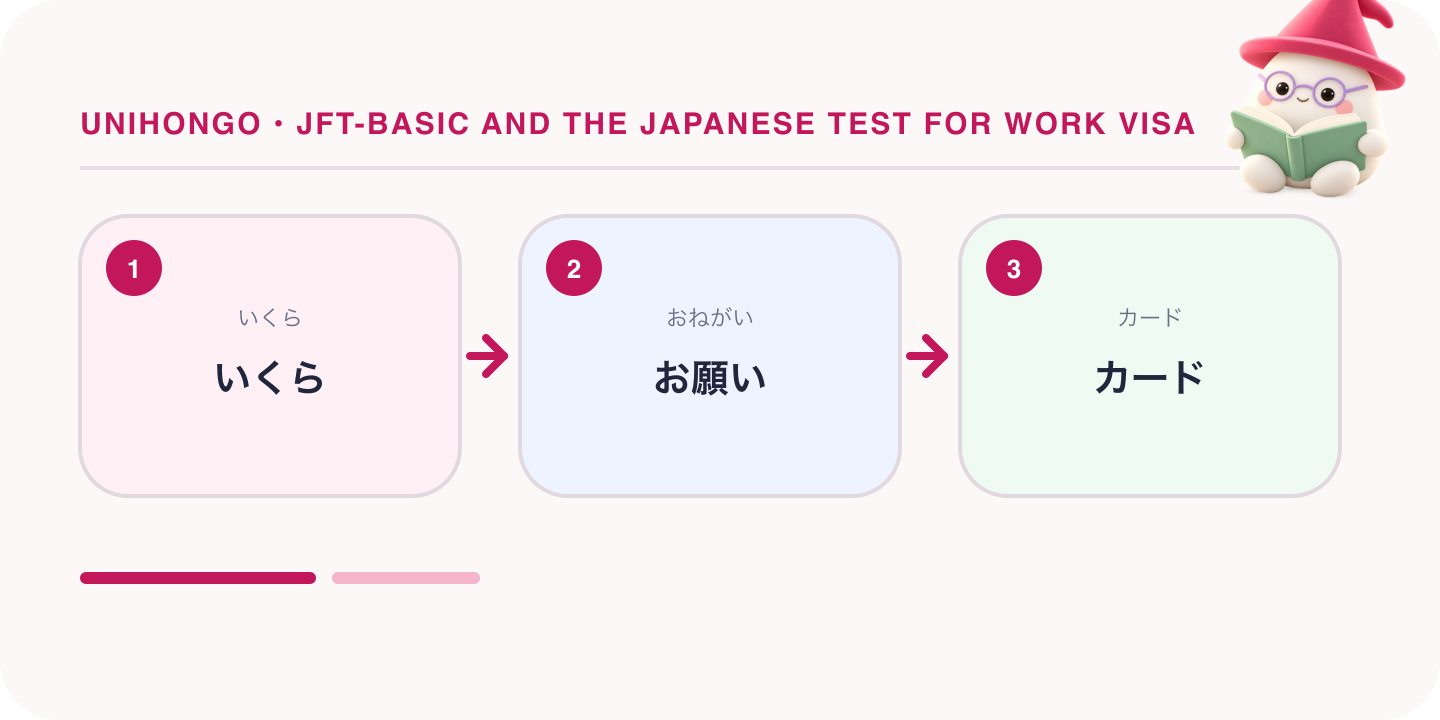
| すみません、これはいくらですか。 | Sumimasen, kore wa ikura desu ka. | Excuse me, how much is this? |
| 袋をお願いします。 | Fukuro o onegai shimasu. | A bag, please. |
| カードで払えますか。 | Kādo de haraemasu ka. | Can I pay by card? |
| トイレはどこですか。 | Toire wa doko desu ka. | Where is the toilet? |
| この電車は東京に行きますか。 | Kono densha wa Tōkyō ni ikimasu ka. | Does this train go to Tokyo? |
| 切符の買い方を教えてください。 | Kippu no kaikata o oshiete kudasai. | Please tell me how to buy a ticket. |
| ゴミはいつ出しますか。 | Gomi wa itsu dashimasu ka. | When do we put out the rubbish? |
| 書き方がわかりません。 | Kakikata ga wakarimasen. | I do not know how to fill this in. |
| ここに何を書けばいいですか。 | Koko ni nani o kakeba ii desu ka. | What should I write here? |
| 少し熱があります。 | Sukoshi netsu ga arimasu. | I have a slight fever. |
| 予約したいのですが。 | Yoyaku shitai no desu ga. | I would like to make a booking. |
| 在留カードの手続きの窓口はどちらですか。 | Zairyū kādo no tetsuzuki no madoguchi wa dochira desu ka. | Which counter handles residence card procedures? |
| もう一度お願いします。 | Mō ichido onegai shimasu. | Once more, please. |
| ゆっくり話していただけますか。 | Yukkuri hanashite itadakemasu ka. | Could you speak slowly, please? |
| 日本語が少しだけわかります。 | Nihongo ga sukoshi dake wakarimasu. | I understand only a little Japanese. |
| 書いていただけますか。 | Kaite itadakemasu ka. | Could you write it down for me? |
The last four lines are worth more than the rest combined. A candidate who can ask for repetition politely and get something written down can survive almost any counter, and the same lines work unchanged at work.
Basic workplace communication
Workplace Japanese on this route is not keigo-heavy business language. It is the language of a shift: greeting, receiving an instruction, confirming you understood, reporting a problem, and leaving. The register is polite -masu forms toward everyone at first, and you can soften it later once you hear how your own team speaks.
| Japanese | Romaji | Meaning |
|---|---|---|
| おはようございます。 | Ohayō gozaimasu. | Good morning. (used at the start of a shift at any hour) |
| お疲れさまです。 | Otsukaresama desu. | Thank you for your work. (greeting a colleague) |
| はい、わかりました。 | Hai, wakarimashita. | Yes, I understand. |
| すみません、もう一度説明していただけますか。 | Sumimasen, mō ichido setsumei shite itadakemasu ka. | Sorry, could you explain that once more? |
| これでよろしいでしょうか。 | Kore de yoroshii deshō ka. | Is this all right like this? |
| 先に確認させてください。 | Saki ni kakunin sasete kudasai. | Please let me check first. |
| 機械が止まりました。 | Kikai ga tomarimashita. | The machine has stopped. |
| 部品が足りません。 | Buhin ga tarimasen. | We are short of parts. |
| すぐに報告します。 | Sugu ni hōkoku shimasu. | I will report it right away. |
| 少し手伝っていただけませんか。 | Sukoshi tetsudatte itadakemasen ka. | Could you help me a little? |
| 体調が悪いので、早退してもいいですか。 | Taichō ga warui node, sōtai shite mo ii desu ka. | I am unwell, so may I leave early? |
| 電車が遅れているので、十分ほど遅れます。 | Densha ga okurete iru node, juppun hodo okuremasu. | The train is delayed, so I will be about ten minutes late. |
| 申し訳ありません、間違えました。 | Mōshiwake arimasen, machigaemashita. | I am very sorry, I made a mistake. |
| 明日は何時からですか。 | Ashita wa nan-ji kara desu ka. | What time do I start tomorrow? |
| お先に失礼します。 | Osaki ni shitsurei shimasu. | Excuse me for leaving before you. |
| ありがとうございました。また明日。 | Arigatō gozaimashita. Mata ashita. | Thank you. See you tomorrow. |
Instructions and safety words you must catch first time
In a practical test and on a real shift, some words cannot be worked out from context afterwards. Safety and instruction words are the ones to over-learn, because they are spoken quickly and expect an immediate physical response. Practise them as heard input rather than as reading.
| Japanese | Romaji | Meaning |
|---|---|---|
| 危ない。 | Abunai. | Watch out. (a warning you hear) |
| 止めてください。 | Tomete kudasai. | Please stop it. |
| 触らないでください。 | Sawaranai de kudasai. | Please do not touch it. |
| 気をつけてください。 | Ki o tsukete kudasai. | Please be careful. |
| こっちに来てください。 | Kotchi ni kite kudasai. | Please come over here. |
| ちょっと待ってください。 | Chotto matte kudasai. | Please wait a moment. |
| 手を洗ってから始めてください。 | Te o aratte kara hajimete kudasai. | Please wash your hands before starting. |
| ヘルメットをかぶってください。 | Herumetto o kabutte kudasai. | Please put on a helmet. |
| この線から中に入らないでください。 | Kono sen kara naka ni hairanai de kudasai. | Please do not go inside this line. |
| 急いでください。 | Isoide kudasai. | Please hurry. |
| ゆっくりで大丈夫です。 | Yukkuri de daijōbu desu. | Taking it slowly is fine. |
| わかりません。教えてください。 | Wakarimasen. Oshiete kudasai. | I do not understand. Please show me. |
Notice how many of these are te-form requests. If you can hear the te-form ending and the presence or absence of nai, you can catch most instructions even when the noun in the middle is new to you.
Planning around either test
Both tests share a limitation worth naming. Neither asks you to produce free speech, so neither certifies that you can hold a conversation. On a work route that gap becomes visible in the first week, when a colleague asks something unscripted and the multiple-choice reflex has nothing to offer. Preparing by speaking closes the gap and passes the test at the same time, which is the rare case where the efficient study and the useful study are the same activity.
- Ask the employer or accepting organisation which evidence they accept, in writing.
- Check the official site for the test you choose, for current locations and rules.
- If both are accepted and time is short, favour the frequently offered computer-based test.
- Book a date first; a fixed date is worth more to your study than an open intention.
- Spend the preparation on scenes and speech, not on grammar lists you will never say.
- Whatever result you get, keep one speaking session a week afterwards, or the ability fades.