
What a year can realistically give you
Set the target first, then the plan. After twelve months of steady study you should be able to: introduce yourself and ask about the other person; buy things, order food and ask for the bill; ask and understand simple directions; describe your day, your weekend and your plans; say what you like and why; and manage a conversation that is going too fast by asking people to repeat or slow down. In the terms of the Common European Framework that is roughly A2, and in textbook terms it is the content of a full beginner course. It is a lot, and it is enough to make living or travelling in Japan feel different.
The three lines below are the attitude the plan needs. The first is the motto, with koso adding this year, finally.
| Japanese | Romaji | Meaning |
|---|---|---|
| 今年こそ話せるようになる。 | Kotoshi koso hanaseru yō ni naru. | This year I will finally learn to speak. |
| 毎日少し勉強します。 | Mainichi sukoshi benkyō shimasu. | I study a little every day. |
| 間違えてもいいです。 | Machigaete mo ii desu. | It's fine to make mistakes. |
The year in four quarters
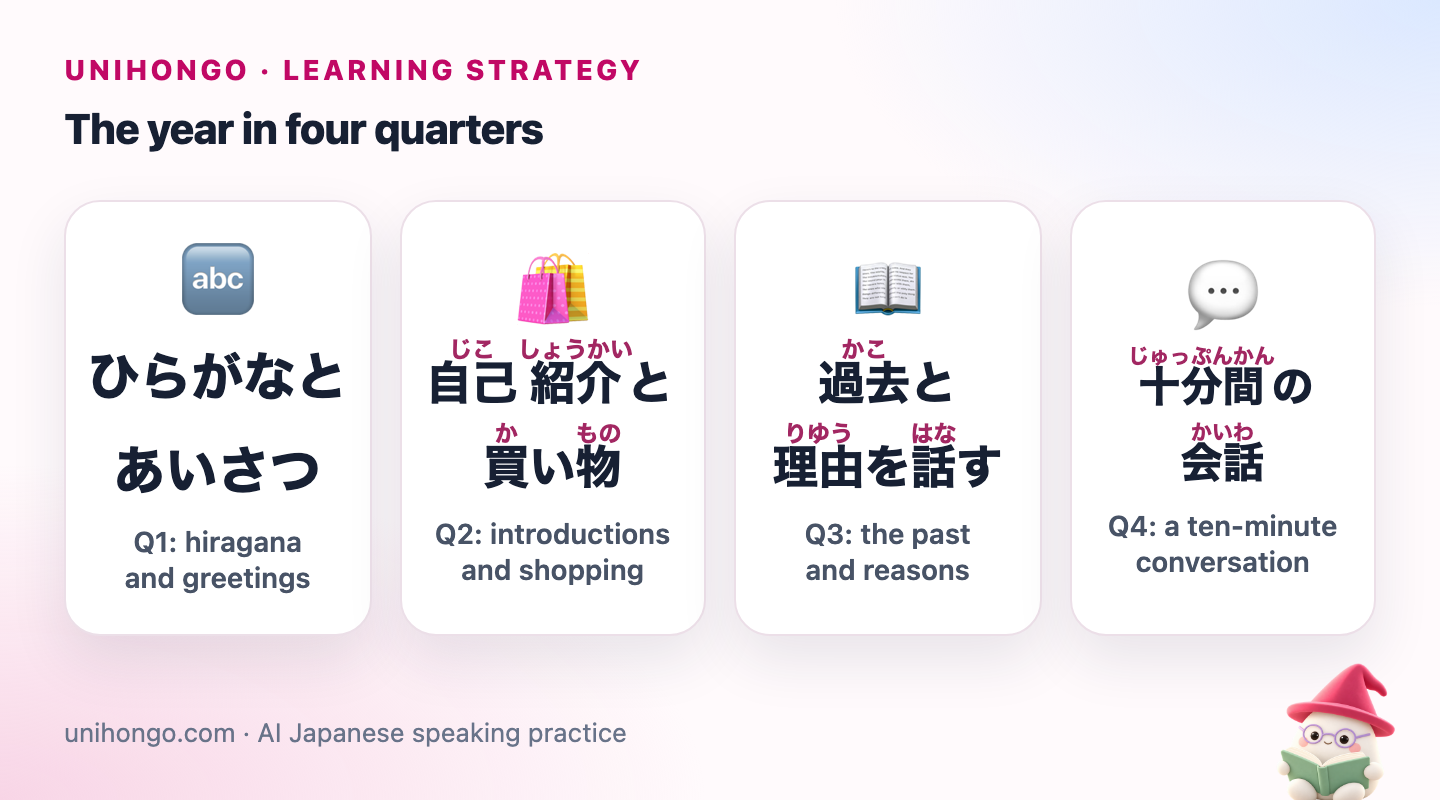
Each quarter below is a block of about thirteen weeks. The grammar target tells you what to study; the speaking checkpoint tells you how you will know it worked. Write the checkpoint dates in your calendar now: 28 March, 27 June, 26 September and 19 December 2027, all Sundays.
| Japanese | Romaji | Meaning |
|---|---|---|
| ひらがなとあいさつ | hiragana to aisatsu | Q1: hiragana and greetings |
| 自己紹介と買い物 | jikoshōkai to kaimono | Q2: introductions and shopping |
| 過去と理由を話す | kako to riyū o hanasu | Q3: the past and reasons |
| 十分間の会話 | juppunkan no kaiwa | Q4: a ten-minute conversation |
| Quarter | Months | Grammar and vocabulary target | Speaking checkpoint |
|---|---|---|---|
| 1 | January to March | Hiragana and katakana; greetings; numbers, time and dates; desu/masu sentences; about 300 words | Introduce yourself for one minute and ask the listener three questions |
| 2 | April to June | Particles wa, o, ni, de, to; te-form requests; adjectives; existence (arimasu/imasu); first 100 kanji; about 700 words | Buy something, order a meal and ask the way, each in a short roleplay |
| 3 | July to September | Past tense; reasons with kara and node; wants with tai; comparisons; plain forms with friends; about 1,100 words | Tell a two-minute story about last weekend and give one opinion with a reason |
| 4 | October to December | Potential form; experience with koto ga aru; conditionals tara and to; giving and receiving; about 1,500 words | A ten-minute conversation with a partner on daily topics, no script |
The word counts are hedged targets, not a test. What matters is that each quarter's checkpoint is harder than the last and that you record it.
Quarter one: get Japanese into your mouth
January to March is about sounds and scripts. Learn hiragana in the first two weeks and katakana in the next two, writing each one and reading short words aloud. At the same time, learn greetings and the desu/masu sentence, because you can speak from day three. Japanese pronunciation is kinder to beginners than its reputation: five clear vowels, even timing, no stress. The two things worth drilling early are long vowels, because obasan (aunt) and obāsan (grandmother) are different words, and the small tsu, because kite and kitte are too.
By the end of March you should be able to say the lines below without reading them, and ask the same questions back.
| Japanese | Romaji | Meaning |
|---|---|---|
| はじめまして。マリアです。 | Hajimemashite. Maria desu. | Nice to meet you. I'm Maria. |
| ブラジルから来ました。 | Burajiru kara kimashita. | I'm from Brazil. |
| 日本語を一月から勉強しています。 | Nihongo o ichigatsu kara benkyō shite imasu. | I've been studying Japanese since January. |
| お仕事は何ですか。 | Oshigoto wa nan desu ka. | What do you do for work? |
| もう一度お願いします。 | Mō ichido onegai shimasu. | Once more, please. |
Quarter two: the sentences of daily life
April to June is where Japanese starts to feel like a language rather than a code. The particles arrive, the te-form opens the door to requests and to describing what you are doing, and adjectives let you have opinions. Shops, cafés and stations are your classroom because their conversations are short and predictable. Learn the whole exchange, not only your lines: what the clerk will say and what it means.
The checkpoint is three short roleplays. If you can do them with a patient partner, you can do them in Japan.
| Japanese | Romaji | Meaning |
|---|---|---|
| これをください。 | Kore o kudasai. | This one, please. |
| 袋はいりません。 | Fukuro wa irimasen. | I don't need a bag. |
| 駅はどこですか。 | Eki wa doko desu ka. | Where is the station? |
| この近くにコンビニはありますか。 | Kono chikaku ni konbini wa arimasu ka. | Is there a convenience store near here? |
| コーヒーを一つ、お願いします。 | Kōhī o hitotsu, onegai shimasu. | One coffee, please. |
| ゆっくり話してください。 | Yukkuri hanashite kudasai. | Please speak slowly. |
Quarter three: the past, reasons and opinions
July to September adds time and reasons, which is when conversations stop being transactions and start being talk. The past tense lets you tell what happened; kara and node let you explain why; tai lets you say what you want. This is also the quarter to learn plain forms, because friends do not speak to each other in masu, and a learner who only knows polite forms understands half of what is said at a table.
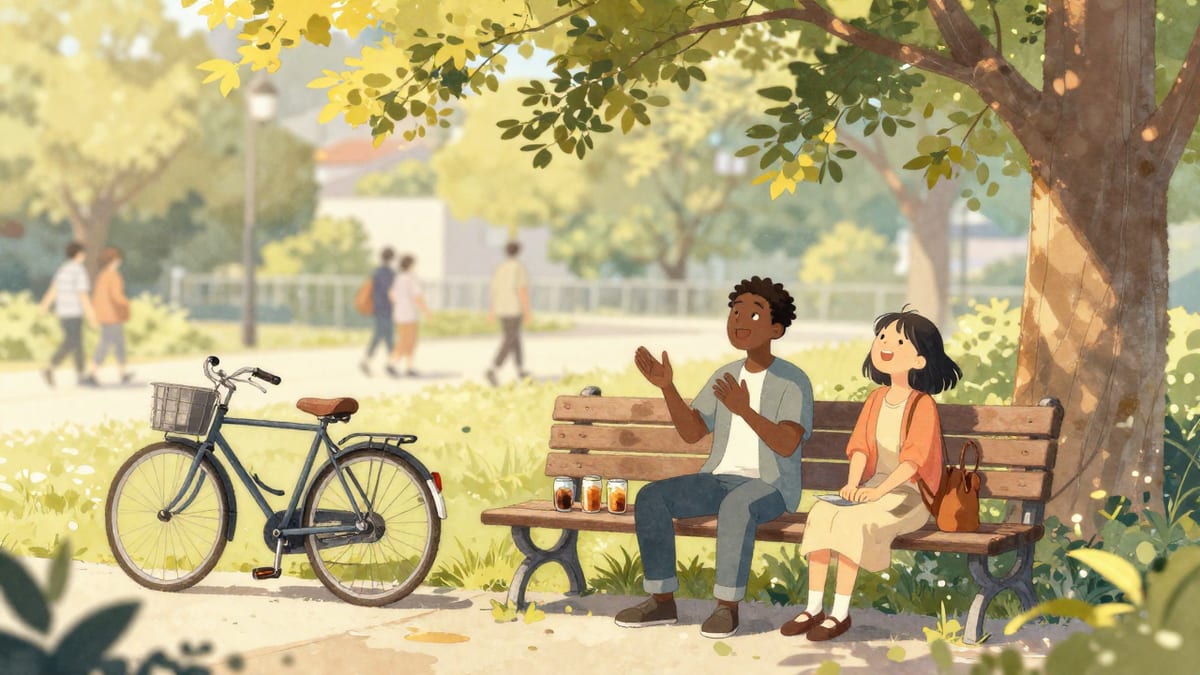
The checkpoint is a two-minute story. Here is the shape of one, polite version.
| Japanese | Romaji | Meaning |
|---|---|---|
| 週末は友達と海に行きました。 | Shūmatsu wa tomodachi to umi ni ikimashita. | At the weekend I went to the sea with friends. |
| 暑かったので、たくさん泳ぎました。 | Atsukatta node, takusan oyogimashita. | It was hot, so we swam a lot. |
| 魚がおいしかったです。 | Sakana ga oishikatta desu. | The fish was delicious. |
| また行きたいです。 | Mata ikitai desu. | I want to go again. |
| 夏は海のほうが山より好きです。 | Natsu wa umi no hō ga yama yori suki desu. | In summer I prefer the sea to the mountains. |
| どうして日本語を勉強しているの? | Dōshite Nihongo o benkyō shite iru no? | Friend: Why are you studying Japanese? (casual) |
| 日本で働きたいから。 | Nihon de hatarakitai kara. | You: Because I want to work in Japan. (casual) |
Quarter four: conversations that last
October to December is about length and recovery. The grammar is still beginner level, with the potential form, experiences with koto ga aru and simple conditionals, but the skill is new: keeping a conversation going for ten minutes without a script, and getting back on track when you lose the thread. The phrases for recovering are the most valuable things you will learn all year, because they turn a breakdown into a normal part of talking.
| Japanese | Romaji | Meaning |
|---|---|---|
| すみません、よく分かりませんでした。 | Sumimasen, yoku wakarimasen deshita. | Sorry, I didn't quite understand. |
| それはどういう意味ですか。 | Sore wa dō iu imi desu ka. | What does that mean? |
| 日本語で何と言いますか。 | Nihongo de nan to iimasu ka. | How do you say it in Japanese? |
| 日本に行ったことがありますか。 | Nihon ni itta koto ga arimasu ka. | Have you ever been to Japan? |
| 漢字は少し読めるようになりました。 | Kanji wa sukoshi yomeru yō ni narimashita. | I've become able to read a little kanji. |
| 時間があったら、京都に行きたいです。 | Jikan ga attara, Kyōto ni ikitai desu. | If I have time, I want to go to Kyoto. |
The December checkpoint is a ten-minute conversation. If a human partner is hard to schedule, an AI partner such as Unihongo's Sensei will do it at any hour and give you a report afterwards; what matters is that it is unscripted and that you record or review it.
Where first-year learners stall, and how to avoid it
- The February dip: the novelty is gone and kana are not yet automatic. Shrink the daily session rather than skipping it; ten minutes keeps the habit alive.
- Collecting resources instead of using one. Pick one main course and finish it; everything else is a supplement.
- Silent study. Reading and apps feel productive, but if you never speak, the December checkpoint will be the first time you hear yourself, and it will be a shock.
- Waiting to be ready. You will never feel ready to speak. Speak badly in March so that you can speak acceptably in December.
- Only polite forms. By the third quarter, learn how friends actually talk, or you will understand teachers and nobody else.
- Measuring by chapters. Measure by what you can say; the quarterly recording is the only honest test.