
The comparison by dimension
| Dimension | Japanese | Mandarin Chinese |
|---|---|---|
| Sound inventory | Small and regular, close to Spanish vowels | Larger, with contrasts English does not use |
| Tones | None; pitch accent exists but rarely blocks understanding | Four tones plus a neutral one, meaning-carrying from day one |
| Reading aloud early | Kana lets you pronounce anything written in kana | Characters carry no reliable sound, so you rely on pinyin |
| Scripts to learn | Hiragana, katakana and roughly two thousand common kanji | One character set, simplified or traditional |
| Word endings | Heavy: tense, negation, politeness, linking forms | Almost none; particles and word order do the work |
| Word order | Verb last, other parts flexible because particles label them | Subject verb object, with fixed slots for time, place and manner |
| Counting things | Counters chosen by shape and category | Measure words chosen by shape and category |
| Politeness | Built into the verb, so you choose a register every sentence | Carried by word choice and framing, not by verb endings |
| First simple conversation | Weeks, if you accept fixed polite forms | Longer, because tones must be produced and heard |
| First page of ordinary text | Slower, three scripts mixed together | Faster in structure, once enough characters are known |
| Listening difficulty | Moderate, but speed and dropped particles bite | Moderate, with tone plus vowel contrasts to separate |
| Travel usefulness | Concentrated in Japan and Japanese-run businesses | Spread across several markets and communities |
Read the table as a trade, not a scoreboard. Every learner pays a price in one column or the other, and the right question is which price you will still be willing to pay in month eight, when the novelty is gone and the work is routine.
Pronunciation is where Japanese is genuinely kind
Japanese uses a compact set of sounds. Five vowels stay stable, consonants map closely onto English ones, and almost every syllable is a consonant plus a vowel. That means a beginner can say a new word correctly the moment they can read it, and a listener will usually understand even a rough attempt. The traps are real but small: long versus short vowels, the doubled consonant in words like kitte, and the syllabic n. None of them stop a conversation the way a wrong tone can.
Mandarin asks for correct tone on every syllable from the first lesson, and a wrong tone is not an accent, it is a different word. That difficulty does not fade quickly, because it must be right in fast speech and in long sentences, not only in isolated drills. If the thought of monitoring pitch on every word tires you, that reaction matters more than any ranking of difficulty.
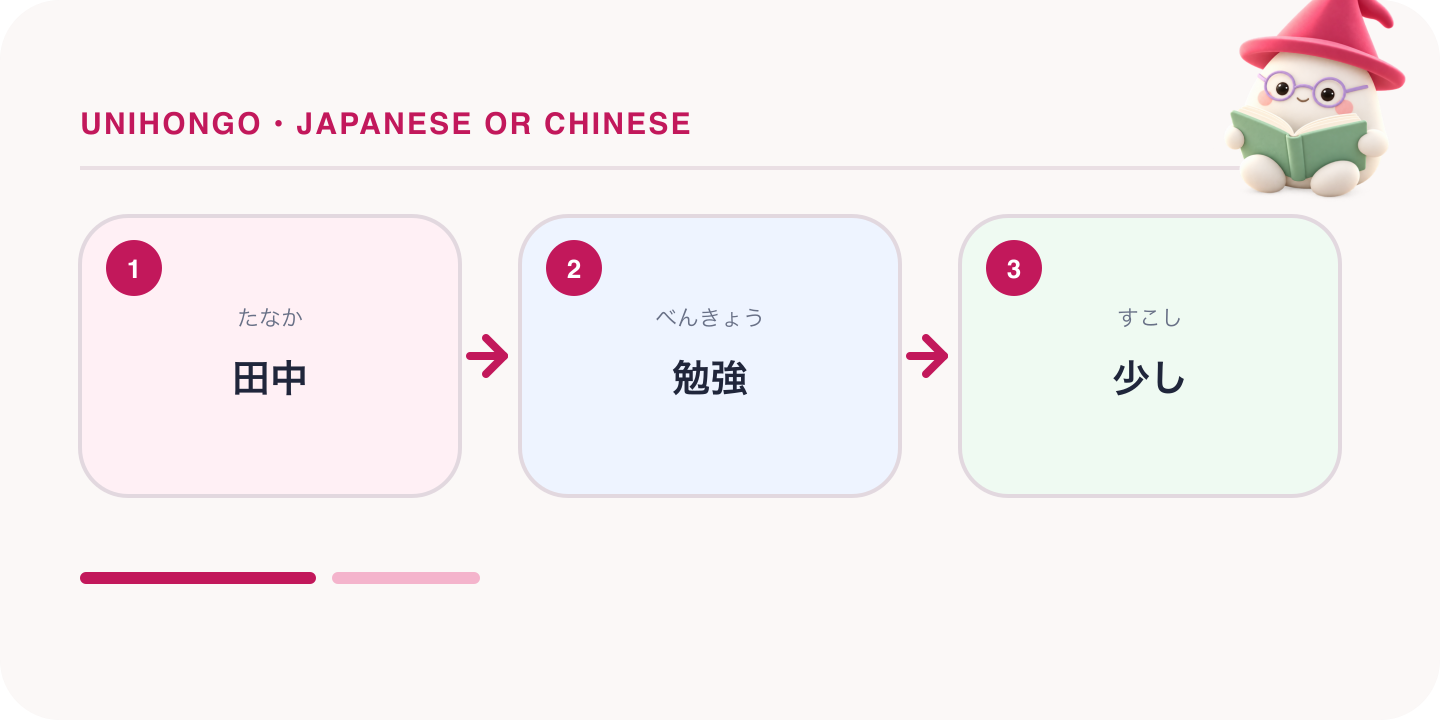
| Japanese | Romaji | Meaning |
|---|---|---|
| はじめまして。田中です。 | Hajimemashite. Tanaka desu. | Nice to meet you. I am Tanaka. |
| 日本語を勉強しています。 | Nihongo o benkyō shite imasu. | I am studying Japanese. |
| 少しだけ話せます。 | Sukoshi dake hanasemasu. | I can speak only a little. |
| もう一度お願いします。 | Mō ichido onegai shimasu. | One more time, please. |
| ゆっくり話していただけますか? | Yukkuri hanashite itadakemasu ka? | Could you speak slowly? |
| 日本語はまだ下手です。 | Nihongo wa mada heta desu. | My Japanese is still poor. |
| すみません、駅はどこですか? | Sumimasen, eki wa doko desu ka? | Excuse me, where is the station? |
| これをください。 | Kore o kudasai. | This one, please. |
| いくらですか? | Ikura desu ka? | How much is it? |
| ありがとうございます。 | Arigatō gozaimasu. | Thank you very much. |
Say those ten lines out loud before you read any further. If the rhythm feels natural and repeating them is pleasant rather than effortful, that is the strongest early signal you will get about Japanese.
Writing is where Japanese charges its bill
Japanese mixes three systems in one sentence. Hiragana carries grammar, katakana carries loanwords and emphasis, and kanji carries most content words. Both kana sets can be learned in a couple of weeks and they are genuinely phonetic, so a beginner can read a children's book aloud early. Kanji is the long tail: most kanji have several readings chosen by context, and a comfortable reading level takes years of steady work rather than one intensive push.
Chinese asks for one script instead of three, which sounds simpler and in some ways is. The cost is that the script gives you almost no help with sound. Pinyin is a learning aid, not something you meet on a menu or a train sign, so every new word must be learned twice, once as a shape and once as a pronunciation with its tone. Japanese at least lets kana and furigana rescue you when the kanji is unknown.
- Learn hiragana first, katakana second, and read every kana word aloud rather than transliterating it.
- Meet kanji inside words you already say, not as isolated characters with lists of readings.
- Accept furigana and dictionary lookups early; refusing help slows reading practice down.
- Judge progress by whether you can read a sign or a menu, not by how many characters you have seen once.
Grammar: endings against word order
Japanese grammar is agglutinative, which means meaning is built by stacking endings on a verb stem. One verb can carry tense, negation, politeness and a link to the next clause at the same time. Particles then label each phrase, so word order is flexible as long as the verb ends the sentence. It feels alien for a week and mechanical after a month, because the rules are unusually regular. The honorific system is the part that stays demanding, since choosing a register is a social decision, not a grammatical one.
Chinese grammar has very little morphology: verbs do not change for tense or person, which makes the first sentences quick to build. The difficulty moves elsewhere, into strict ordering rules, aspect markers, complement structures and a large set of measure words. Neither language is grammatically simple; they simply hide the complexity in different places.
| Japanese | Romaji | Meaning |
|---|---|---|
| 行きます。 | Ikimasu. | I will go. |
| 行きません。 | Ikimasen. | I will not go. |
| 行きました。 | Ikimashita. | I went. |
| 行きませんでした。 | Ikimasen deshita. | I did not go. |
| 行きたいです。 | Ikitai desu. | I want to go. |
| 行ってもいいですか? | Itte mo ii desu ka? | May I go? |
Those six lines come from one verb and one stem. Once you see that pattern, most beginner Japanese grammar becomes a small number of moves applied to a large number of verbs, which is why the particles guide and the verb conjugation guide on this blog pay for themselves so quickly.
How fast you reach a first real conversation
Japanese lets you sound acceptable early because polite speech is formulaic. A learner who knows twenty fixed expressions and one verb pattern can order food, check into a hotel and answer a question about themselves without improvising. The listener does most of the interpretive work, and mistakes rarely block meaning. That early success is motivating and it is one of the strongest practical arguments for Japanese.
Mandarin can take longer to reach the same point, not because the sentences are harder to build but because a listener cannot repair a wrong tone the way a Japanese listener repairs a wrong particle. The compensation arrives later: Mandarin reading in sentences accelerates once you hold a solid stock of characters, while Japanese reading stays slow for longer.
| Japanese | Romaji | Meaning |
|---|---|---|
| どうして日本語を勉強していますか? | Dōshite nihongo o benkyō shite imasu ka? | Why are you studying Japanese? |
| アニメが好きだからです。 | Anime ga suki dakara desu. | Because I like anime. |
| 日本で働きたいです。 | Nihon de hatarakitai desu. | I want to work in Japan. |
| 来年、日本へ旅行します。 | Rainen, Nihon e ryokō shimasu. | Next year I am travelling to Japan. |
| 仕事で日本語が必要です。 | Shigoto de nihongo ga hitsuyō desu. | I need Japanese for work. |
| 家族が日本に住んでいます。 | Kazoku ga Nihon ni sunde imasu. | My family lives in Japan. |
| 目標は日常会話です。 | Mokuhyō wa nichijō kaiwa desu. | My goal is everyday conversation. |
| 毎日十五分、声に出して練習します。 | Mainichi jūgo-fun, koe ni dashite renshū shimasu. | I practise aloud for fifteen minutes every day. |
| 一年で話せるようになりたいです。 | Ichinen de hanaseru yō ni naritai desu. | I want to become able to speak within a year. |
| がんばります。 | Ganbarimasu. | I will do my best. |
Notice that a full answer to the first question needs only a reason plus desu. A common reply to your goal statement is そうですか、いいですね (Sō desu ka, ii desu ne), meaning oh really, that is nice, which gives you a natural place to add one more sentence.
Media, culture and what keeps you coming back
The dimension learners underrate is pull. You will study on days when you do not feel like studying only if the language leads somewhere you already want to go. Japanese has an unusually deep supply of material that beginners genuinely enjoy: animation, games, film, music, cooking, crafts, and a travel culture that rewards even clumsy attempts at the language. Chinese offers enormous television, film, literature and internet culture, but the on-ramp for a beginner without a specific interest is often narrower in English-speaking countries.
This is personal, not objective. Look at the last three months of what you actually watched, read and listened to, and count how much of it came from each culture. That count predicts your study consistency better than any difficulty comparison, because consistency is what decides who is still learning in year two.
Work, travel and daily use
For work, the honest picture is that neither language is a job by itself. Japanese matters most when you intend to live in Japan, where internal business, service work, healthcare and most day-to-day dealings run in Japanese and where even intermediate ability changes what roles are open to you. Mandarin spreads across more markets and communities, which suits someone who wants optionality rather than one country. Demand varies by field and year, so ask employers in your own sector rather than trusting a general claim, including this one.
For travel, Japanese pays off quickly because a little goes a long way in shops, stations and restaurants, and because English support thins out as soon as you leave large stations. The lines below are the ones that repay a beginner most on a first trip or a first week in a Japanese workplace.
| Japanese | Romaji | Meaning |
|---|---|---|
| 予約をお願いします。 | Yoyaku o onegai shimasu. | I would like to make a reservation. |
| チェックインしたいです。 | Chekku-in shitai desu. | I would like to check in. |
| 英語でも大丈夫ですか? | Eigo de mo daijōbu desu ka? | Is English all right as well? |
| 会議は何時からですか? | Kaigi wa nan-ji kara desu ka? | What time does the meeting start? |
| お世話になっております。 | Osewa ni natte orimasu. | Thank you for your continued support. |
| 少々お待ちください。 | Shōshō omachi kudasai. | One moment, please. |
| 資料を送っていただけますか? | Shiryō o okutte itadakemasu ka? | Could you send me the documents? |
| 助かりました。ありがとうございます。 | Tasukarimashita. Arigatō gozaimasu. | That was a great help. Thank you. |
Choose Japanese or Mandarin: four readers
These are recommendations, not hedges. Find the reader who most resembles your situation, take the answer, and stop weighing the alternatives. The comparison above exists to explain the reasoning, not to hand the decision back to you. Revisit the choice only if your goal changes in a concrete way, such as a job offer, a move, or a course you have actually enrolled in.
- The reader who wants to speak soon and has never learned a second language: choose Japanese. The sound system forgives beginners, polite speech is formulaic, and you will be holding short conversations while a Mandarin learner is still fixing tones.
- The reader who is moving to one of the two countries for work or study: choose the language of that country, with no further analysis. Local daily life outweighs every difficulty comparison, and the language you use every evening is the one you will actually learn.
- The reader driven by media, games, animation or a long-standing interest in Japan: choose Japanese. Motivation is the scarce resource, and material you would consume anyway turns study time into something you do not have to schedule twice.
- The reader who wants the broadest commercial reach and enjoys pronunciation drills: choose Mandarin. If tones sound like a puzzle rather than a chore, the writing system will be your only long climb, and the reach is wider across markets.
If you fit two descriptions, the country you plan to spend time in wins. If you fit none, pick the one whose sample sentences you enjoyed saying earlier in this article, and give it six honest months before reopening the question.
The head start each gives toward the other
Whichever you choose, you are not shutting the other door. Japanese kanji and Chinese characters share ancestry, so a Japanese learner meets Chinese text already knowing what many characters mean, and a Chinese learner reads Japanese newspaper headlines with surprising success. The catch is sound: Japanese readings of kanji will not tell you the Mandarin pronunciation, and a small set of characters have drifted in meaning, so the head start is in comprehension rather than speech.
There is a second, quieter transfer. Both languages use counters or measure words, both drop subjects when context makes them obvious, and both expect the listener to carry more of the meaning than English does. Once you have adjusted to that, the second language feels less foreign in the way that matters, even though you still have to build the vocabulary from scratch.
- Learn one language to conversational level before adding the other, rather than alternating from the start.
- When you do add the second, learn its characters through the meanings you already know and treat the readings as brand new.
- Keep the first language alive with short weekly speaking sessions, or it fades faster than reading ability does.
- Expect interference in pronunciation, not in the writing system, and drill the new sounds separately.
What you are actually committing to
Be clear-eyed about scale. Reaching comfortable everyday conversation in Japanese is a project measured in years of regular practice, not months, and the reading level that makes a novel or a work email easy is a longer project still. Anyone who tells you otherwise is selling something. The good news is that the useful milestones arrive early and often: introducing yourself, ordering, asking directions, handling a hotel, and following a slow conversation are all reachable inside the first year of steady work.
A class, a private tutor or a beginner textbook series each do things software cannot. A class gives you a schedule and classmates who notice when you disappear. A tutor sees your specific weaknesses and adapts a plan. A textbook gives a coherent order to grammar so you are not learning at random. Speaking practice with an AI Sensei sits alongside those rather than replacing them: it is where you get the repetitions, because it never runs out of patience and there is no social cost to failing a sentence eight times.
- Decide once, then stop comparing. Reopening the choice every few weeks costs more than either language's difficulty.
- Book the speaking practice into your calendar first and let reading fill the leftover time.
- Set milestones by task, such as ordering a meal unaided, rather than by hours studied.
- Confirm exam dates, course details and visa requirements with the provider or authority; they change.