
Use a Mocchi Level Check to Choose Practice, Not a Label

A short Japanese check with Mocchi is useful when it helps select the next practice task. Treat the result as evidence about the questions you attempted, not as an official certificate or a complete description of every language skill.

Mocchi uses a small Japanese practice result to choose a next task rather than award a fixed level label
What you need to know

Use a Mocchi Level Check to Choose Practice, Not a Label

A level label can make a lesson easier to choose, but it can also hide an uneven profile. You may recognize grammar in a written question and still hesitate when producing a sentence. Begin with a manageable check, attempt it without unnecessary hints, and explain what was difficult. Mocchi can use that information alongside your goals and learning context to choose a better follow-up. The valuable result is a specific next action, not the strongest label you can obtain.

Use the check to guide the next task.

Keep unsupported and hinted answers distinct.

Notice differences between skills.

Do not confuse a tutor check with official certification.

State the purpose before starting the check

Tell Mocchi whether you want help choosing a beginner lesson, finding a weak grammar contrast, or adjusting a broader study plan. A purpose gives the result a practical use. Without one, a short quiz can become a search for a reassuring score that does not change what you study next.

Be clear about the conditions. If you use notes or ask for hints, that support is part of the result. There is nothing wrong with supported practice, but it should not be confused with an unaided check when deciding how much help the next exercise needs.

Separate the answer from the reason it was difficult

A wrong answer can arise because a word was unknown, a time clue was missed, or the question itself was misunderstood. Ask Mocchi to help identify that step. For example, a particle choice after an unfamiliar motion verb may require vocabulary support before another grammar drill. The next activity should respond to the cause of the difficulty rather than the broad topic label alone.
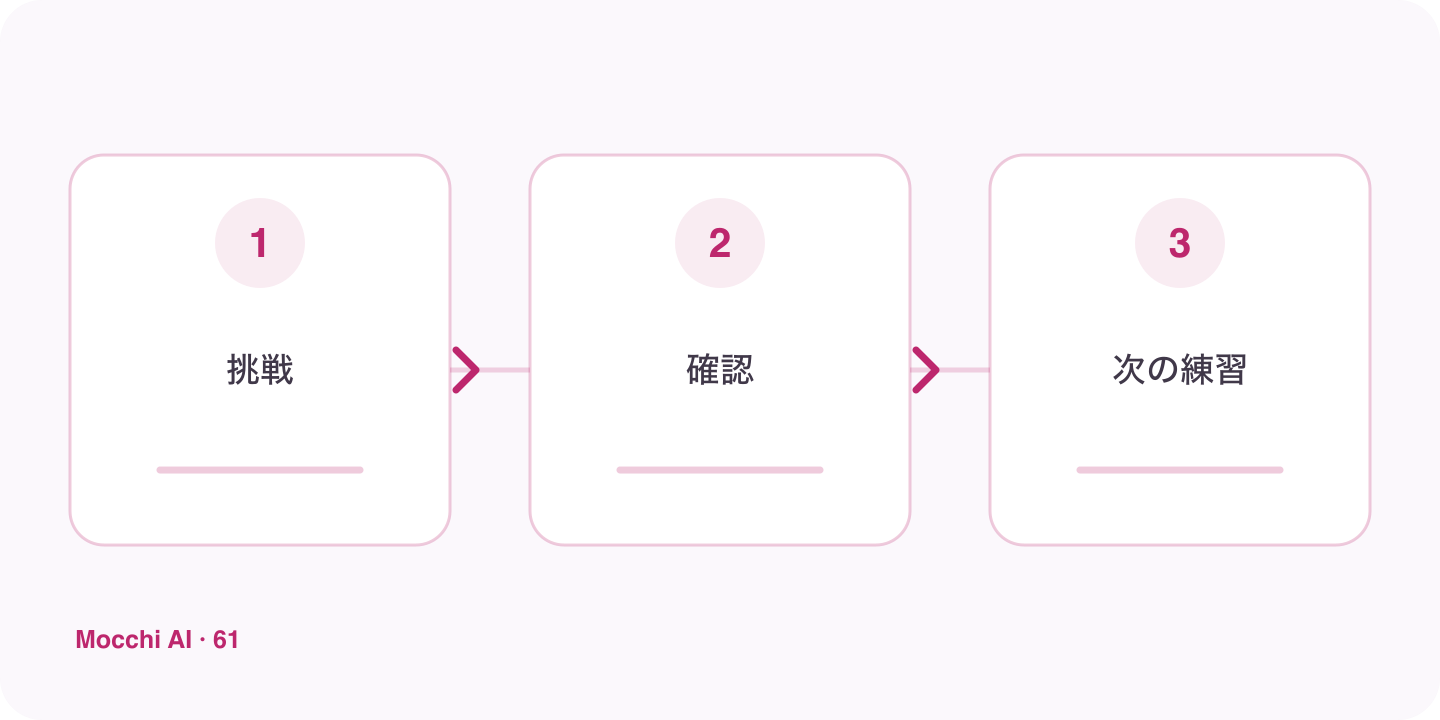
An initial attempt reveals a weak step and leads to a targeted follow-up activity
A short check is most useful when its result changes the next learning task.
Observed difficultyUseful follow-up
An unknown key wordLearn the word in a short context
A missed grammar clueCompare a fresh contrast
A confusing question formatPractice the task instructions separately

Use a fresh example to test the follow-up

After the explanation, try another question with changed details. Explain your decision before checking the answer. This gives more information than immediately repeating the same item. If the weak step remains, reduce the task and keep practicing that link; if it is clear, choose a related activity while retaining a small review.

Keep the profile more detailed than one label

Describe what you can read, recognize, and produce with the support you used. A learner may be comfortable with short texts but need simpler spoken prompts. Tell Mocchi that imbalance explicitly. A useful personal plan can preserve a challenging reading target while giving output practice more support instead of increasing or decreasing everything together.

Check progress with comparable tasks over time

Return to a similar kind of task after a gap, using new content and noting the help required. Look for clearer reasoning or more independent recall rather than only a bigger number. Mocchi can help interpret the practice, while official qualifications remain a separate matter. The check succeeds when it makes the next lesson more appropriate and gives you a clearer view of what still needs attention.

Key points

A practical way to improve

Tell Mocchi your approximate level and one learning goal, then request a brief check. Attempt the questions before asking for explanations. Afterward, identify whether the difficult parts involved word meaning, a grammar decision, or understanding the question. Choose one follow-up activity and try a new example. Keep the level description provisional until several comparable tasks provide a clearer picture.

  1. 1

    Choose one clear goal

    Focus each session on a situation or skill you can actually use.

  2. 2

    Practice actively

    Say complete answers aloud instead of only reading or recognizing Japanese.

  3. 3

    Review and repeat

    Keep useful corrections and revisit the same skill until it feels natural.

FAQ

Frequently asked questions

Is a Mocchi level check an official JLPT result?

No. It is a learning activity and cannot replace an official examination result or certificate. Use it to identify practice needs and consult official JLPT information for the actual test.

What if my reading result is stronger than my speaking?

Treat that difference as useful information. Choose practice for each skill instead of forcing every activity into one difficulty band. A reading question and an independent spoken response make different demands.

Should I retake the same questions until I get a higher level?

Repeating the exact set can test familiarity with its answers. Use new comparable questions and explain your reasoning if you want better evidence about what you can now do.

Make the result choose a useful next step

Use Mocchi to turn a short check into targeted practice rather than a label that hides what you still need.