
What thinking in Japanese actually means
Direct processing means that a Japanese form activates its meaning without a conscious first-language sentence in between. When atsui makes you feel today's heat, or daijōbu desu ka makes you check whether someone is okay, you are already thinking in Japanese. No inner monologue is required.
This ability grows unevenly. Restaurant phrases may be automatic while a discussion about economics still needs translation. Measure progress by the number of situations you can handle directly, not by whether your mind has become permanently monolingual.
Build direct links with images and actions
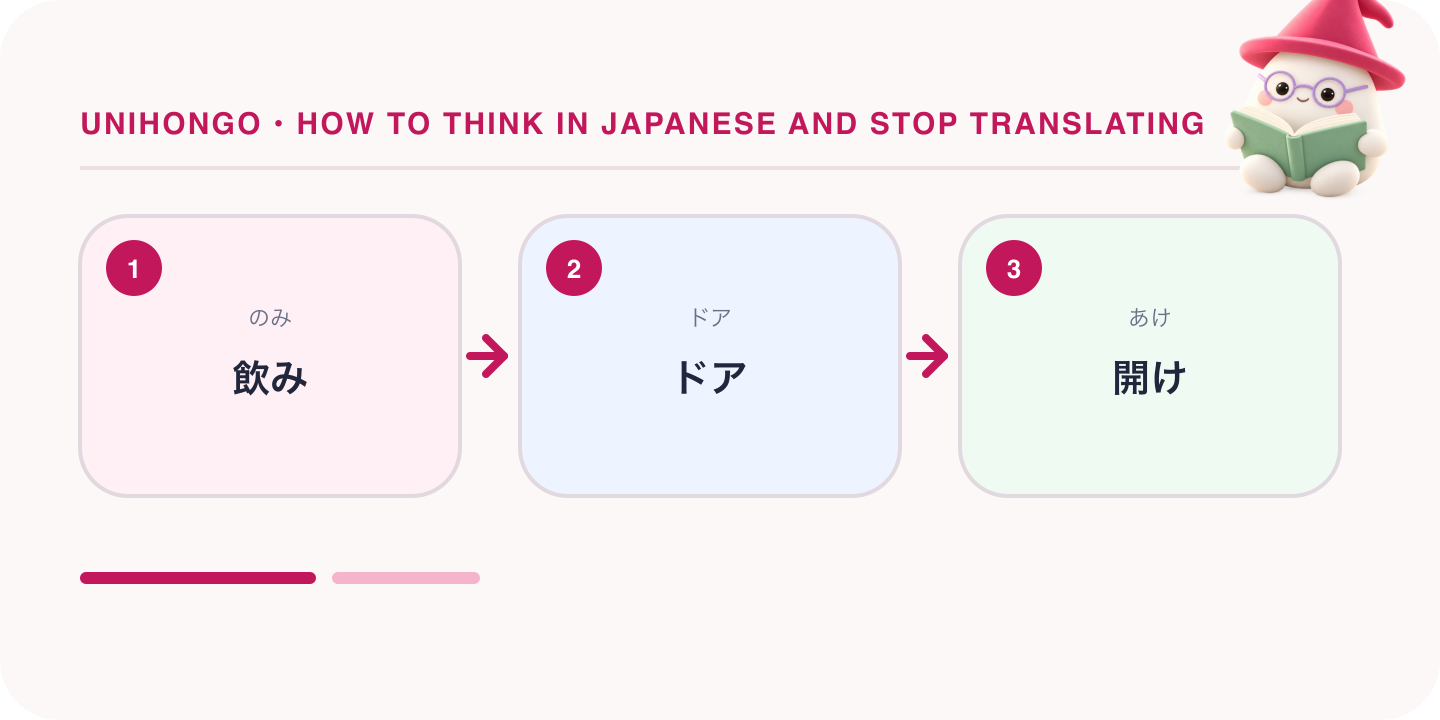
Concrete words are the easiest place to remove the middle step. Look at the object, say mizu, and interact with it. Perform akeru while opening a door and shimeru while closing it. For adjectives, notice a real sensation or contrast. The experience supplies meaning more richly than a single English gloss.
| Japanese | Romaji | Meaning |
|---|---|---|
| 水を飲みます。 | Mizu o nomimasu. | I drink water. |
| ドアを開けます。 | Doa o akemasu. | I open the door. |
| 今日は暑いです。 | Kyō wa atsui desu. | It is hot today. |
| このかばんは重いです。 | Kono kaban wa omoi desu. | This bag is heavy. |
Think in chunks before original sentences
Fluent speech retrieves many words as familiar groups: sō desu ne, ki o tsukete, koto ga arimasu, and to omoimasu. A chunk arrives with its grammar and rhythm already attached, reducing the number of choices you must make under time pressure.
Collect chunks from conversations you understand and vary one slot at a time. Watashi wa X to omoimasu becomes useful when X is yasui, omoshiroi, or chotto muzukashii. This is genuine productive practice even though you did not design the frame from scratch.
Use Japanese self-talk at your real level
- Morning: name the time, weather, and your first plan.
- During tasks: say the next action—mizu o nomimasu, mēru o kakimasu.
- Outside: describe one person, object, sound, or direction without judging your grammar.
- Evening: recall three things in past tense and one plan for tomorrow.
- When stuck: simplify the thought instead of translating the full sophisticated version.
Make listening too fast for translation
Choose audio you understand well and replay a short segment without pausing. On the first pass, follow the situation. On the second, notice exact wording. On the third, shadow it. Because the audio continues, your attention must move with Japanese instead of composing a polished translation.
Speed only helps when the material is comprehensible. Difficult news played repeatedly can train confusion. A familiar dialogue at near-natural speed is more effective because your brain can predict meaning and bind the sound to the scene.
Use translation strategically
- Translate once when you need a clear initial meaning or grammar contrast.
- Return to the Japanese sentence and picture the event without reciting the translation.
- Keep bilingual definitions for precision, especially with abstract or technical vocabulary.
- Try a simple Japanese definition only when every word in that definition is already comfortable.
- Never slow a real conversation to police an English word that briefly appears in your mind.
A seven-day direct-thinking routine
| Days | Five-minute focus | Target |
|---|---|---|
| 1–2 | Visible objects and actions | Twenty direct noun/action links |
| 3–4 | One daily routine | A one-minute narration |
| 5 | Chunk substitutions | Five frames with three variations each |
| 6 | Repeated easy listening | Understand without pausing |
| 7 | Live conversation | Stay in Japanese for five minutes |
Repeat the week with one new domain—food, travel, work, or hobbies. Thinking in Japanese grows as connected islands of experience until those islands begin to merge.