
What this guide is and is not
This is a study guide written by language people, not a clinical document, and nothing here diagnoses anything or replaces advice from a specialist who knows you. Dyslexia is not one profile: some people find decoding slow but comprehension strong, some struggle mainly with working memory under time pressure, some have no trouble with sound at all and everything to do with visual crowding on the page. So the honest instruction is to try an adaptation for two weeks, keep what measurably helps, and drop the rest without guilt.
One assumption runs through everything below. You are a capable adult who reads slowly or with effort in your first language, not a person who cannot learn. The task is to route around the part that costs you most, and Japanese happens to offer several usable routes because its skills separate cleanly.
The shape of Japanese: three systems, three demands
Spoken Japanese uses a small and regular sound inventory. Syllables are mostly a consonant plus a vowel, there are five vowel sounds, and words are pronounced as written with very few silent or shifting letters. Compared with English, where the same letter string can be read four ways, that regularity is a genuine advantage and it is why many learners report that Japanese pronunciation is the easy part.
Kana carries that regularity into writing. Hiragana and katakana are each a fixed set of characters, and one character reliably means one sound: か is always ka. There is no equivalent of the English problem where through, though and tough share letters and share no sound. The exceptions are few and learnable, mainly the particles は, へ and を read as wa, e and o.
Kanji is where the load sits. Each character is a distinct visual shape, most have more than one reading, and the reading depends on the word. If visual memory for arbitrary shapes is your weak point, this is the part that will feel unfair, and it is the part where the adaptations below matter most.
Common difficulties and workable adaptations
| Difficulty | Adaptation to try |
|---|---|
| Characters blur or swim on the page | Sixteen point or larger, one and a half line spacing, off-white background, and a card to cover the lines below |
| Kana learned yesterday are gone today | Three to five characters a session, each said aloud, revisited the next day and again a week later |
| Similar kana confuse you (さ and ち, ぬ and め) | Learn the confusable pair deliberately as a pair, with a different colour and a short story for each |
| Kanji feel like unlearnable pictures | Break each one into components and build a story from them; learn the components first as a small set |
| Reading aloud is slow and exhausting | Listen first, repeat after the audio, and only then look at the text you already know by ear |
| Long texts are overwhelming | Work in four-line chunks with audio, and never read a passage cold |
| Writing by hand is painful and slow | Type instead; Japanese input is phonetic, so you type the sound and choose the character |
| Timed exercises cause everything to collapse | Remove the timer; choose speaking practice and untimed review over speed drills |
| Vocabulary lists do not stick | Learn words inside spoken sentences with audio, not as written pairs |
None of these is a concession. They are the same adjustments a good teacher would make for any learner who is losing time to the wrong obstacle, and the resulting Japanese is exactly as real.
Start audio-first and let speaking lead
The audio-first route is simple: hear a sentence, understand what it means, repeat it until it is comfortable, and use it in a conversation, all before you look at how it is written. Reading then becomes recognition of something you already know rather than decoding of something new, which is a far lighter task. This is also how the sentences will actually be used, so nothing is wasted.
Work in short sentences you would genuinely say, rather than in single words. Ten of these, solid enough to produce without hesitation, are worth more than fifty half-known ones, and they give you a real conversation within a fortnight instead of a vocabulary list you cannot yet use. Keep the list deliberately small and add a new sentence only when an old one has become automatic.
| Japanese | Romaji | Meaning |
|---|---|---|
| おはようございます。 | Ohayō gozaimasu. | Good morning. |
| ありがとうございます。 | Arigatō gozaimasu. | Thank you. |
| すみません、これをください。 | Sumimasen, kore o kudasai. | Excuse me, I will have this one, please. |
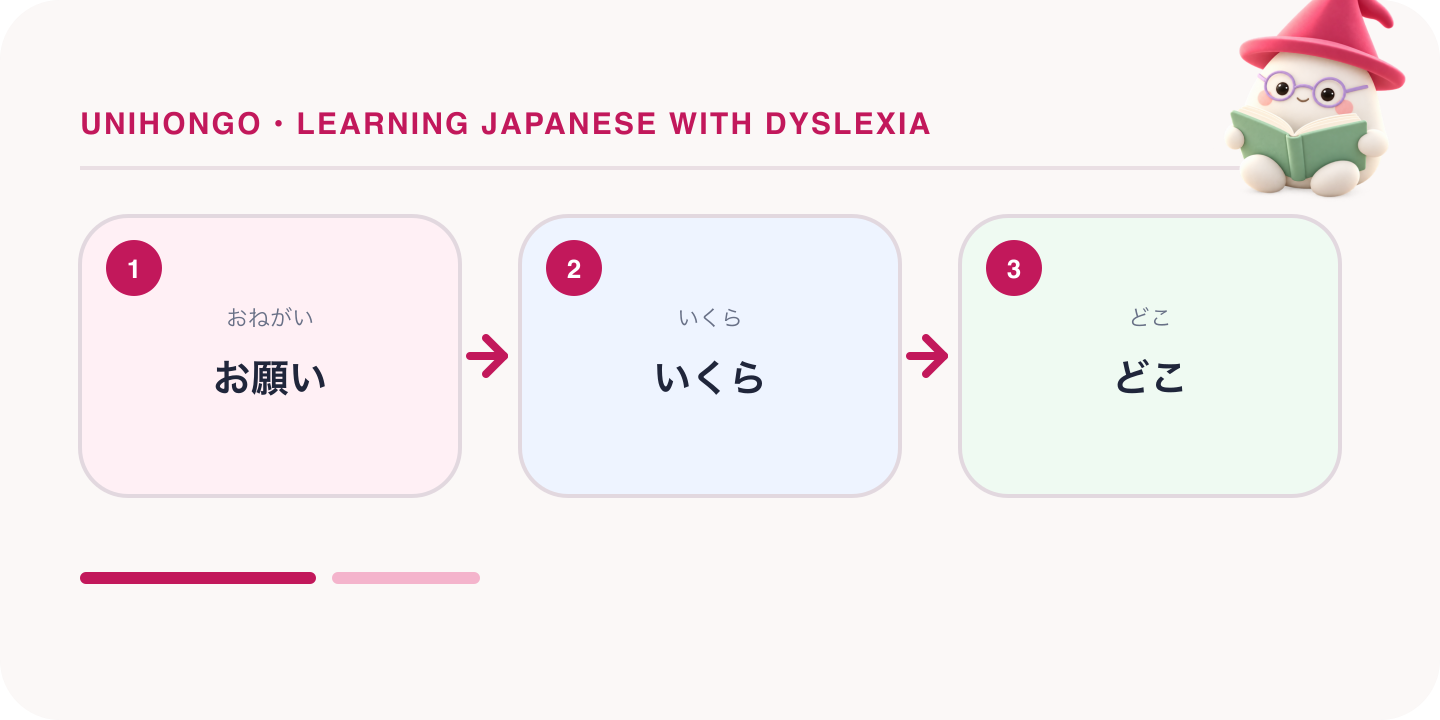
| 水をお願いします。 | Mizu o onegai shimasu. | Water, please. |
| いくらですか? | Ikura desu ka? | How much is it? |
| 駅はどこですか? | Eki wa doko desu ka? | Where is the station? |
| 大丈夫です。 | Daijōbu desu. | It is fine. / No, thank you. |
| 少し待ってください。 | Sukoshi matte kudasai. | Please wait a moment. |
| 分かりません。 | Wakarimasen. | I do not understand. |
| もう一度お願いします。 | Mō ichido onegai shimasu. | Once more, please. |
Expect the replies to be short and fixed: はい、どうぞ (hai, dōzo) meaning here you are, 千円です (sen-en desu) meaning it is a thousand yen, or あちらです (achira desu) meaning it is over there. Learning the three or four likely answers by ear is what turns a memorised line into a conversation.
Tell your teacher or partner what helps
You do not owe anyone an explanation of your reading history, and you can get everything you need by describing the adjustment rather than the reason. These lines do that in plain, polite Japanese, and they work equally well with a classroom teacher, an exchange partner or a shop assistant handing you a form.
| Japanese | Romaji | Meaning |
|---|---|---|
| 読むのが苦手です。 | Yomu no ga nigate desu. | Reading is difficult for me. |
| 音で覚えるほうが得意です。 | Oto de oboeru hō ga tokui desu. | I am better at learning by sound. |
| ふりがなを付けていただけますか? | Furigana o tsukete itadakemasu ka? | Could you add furigana, please? |
| 大きい字でお願いします。 | Ōkii ji de onegai shimasu. | In large print, please. |
| 声に出して読んでもらえますか? | Koe ni dashite yonde moraemasu ka? | Could you read it aloud for me? |
| 書くより話すほうがいいです。 | Kaku yori hanasu hō ga ii desu. | I would rather speak than write. |
| 少し時間をください。 | Sukoshi jikan o kudasai. | Please give me a moment. |
| ゆっくりお願いします。 | Yukkuri onegai shimasu. | Slowly, please. |
Take kana slowly, in small batches
Most courses race through hiragana in a fortnight because the set is small. There is no prize for that. Three to five characters a session, each one said aloud as you meet it and then heard again in a real word, spreads hiragana over six to eight weeks and leaves it far more secure. The sound is the anchor: a character learned as a shape alone has nothing to hold it, while a character learned as a sound inside あさ or みず is attached to something you can already say.
Deal with the confusable pairs on purpose rather than hoping. さ and ち, ぬ and め, は and ほ, and シ and ツ in katakana trip up most learners regardless of reading profile. Learn each pair side by side, give each character a different colour and a one-line story, and always practise them together so your brain learns the contrast rather than two separate near-identical shapes.
| Japanese | Romaji | Meaning |
|---|---|---|
| 朝、パンを食べます。 | Asa, pan o tabemasu. | In the morning I eat bread. |
| 水を飲みます。 | Mizu o nomimasu. | I drink water. |
| 切手をください。 | Kitte o kudasai. | A stamp, please. |
| 来てください。 | Kite kudasai. | Please come. |
| おじさんは元気です。 | Ojisan wa genki desu. | My uncle is well. |
| おじいさんは元気です。 | Ojiisan wa genki desu. | My grandfather is well. |
| ここはどこですか? | Koko wa doko desu ka? | Where is this? |
The pairs kitte and kite, ojisan and ojiisan differ only in length: a held consonant and a held vowel. They are worth practising by ear early, because length carries meaning in Japanese in a way it does not in English, and the difference is easier to hear than to see.
Learn kanji as components and stories
A kanji is not a picture to be photographed by the mind. It is built from a limited set of repeating parts, and once you know the parts, a new character is an arrangement of familiar pieces rather than a fresh shape. Learn thirty or forty common components first, give each a name you chose yourself, and then meet characters as combinations: tree plus tree is a wood, three trees is a forest.
The story matters more than the neatness of the story. A vivid, slightly ridiculous sentence that links the components to the meaning will outlast twenty careful copyings, and it uses narrative memory rather than the visual memory that is doing the least work for you. Write the story down once, in your own language, and reread that rather than redrawing the character.
| Kanji | Reading | Built from |
|---|---|---|
| 木 | ki (tree) | A single tree with branches and roots |
| 林 | hayashi (wood) | Two trees side by side |
| 森 | mori (forest) | Three trees stacked |
| 川 | kawa (river) | Three lines of flowing water |
| 山 | yama (mountain) | Three peaks on a ridge |
| 休 | yasumu (to rest) | A person beside a tree |
| 明 | akarui (bright) | Sun and moon together |
| 語 | go (language) | The speech component plus the parts for five and mouth |
Meet each new character inside a sentence you can already say, so the reading arrives with a context rather than as an isolated fact.
Use colour, space and place deliberately
Spatial and colour memory are often strong when arbitrary visual detail is not, so use them as scaffolding. Give each verb group its own colour and keep that colour everywhere. Put kana on a wall in a fixed grid and always look them up in the same physical position, so the location becomes part of the memory. Keep a single large sheet per topic rather than a notebook of small pages, because a page you can see all at once is easier to navigate than a sequence you have to search through.
- One colour per particle, used consistently in every sentence you write down.
- A wall grid for kana that you point at while saying the sound aloud, so hand, voice and position work together.
- Sentences written one per line with a blank line between, never in a paragraph block.
- A card or ruler under the line you are reading to cut visual crowding.
- Photograph your best sheets and review the photographs, so you are recalling a familiar layout rather than reading new text.
Let the machine do the reading
Text-to-speech is not a crutch to be outgrown; it is the correct tool when your goal is understanding Japanese rather than decoding it. Most phones and computers will read Japanese text aloud with a system voice, browser extensions add furigana to web pages, and dictionary apps will pronounce a word, show its reading and let you hear it again as often as you want. Set this up properly once, at the start, rather than struggling for a year and then discovering it.
Typing deserves the same treatment. Japanese input is phonetic: you type the sounds in romaji, the software offers the characters, and you choose. That means you can write correct Japanese with kanji in it while relying on recognition rather than production, which is a much lighter load, and it is how most Japanese people write day to day as well.
- Turn on your device's read-aloud function and learn the shortcut for it.
- Use a furigana browser tool for any page you need to read at length.
- Prefer materials that ship with audio; skip beautiful books with no recording.
- Record your teacher or your session so you can relearn by ear afterwards.
- Use dictation to capture what you want to say before you try to write it.
Choose goals that match what you want
A great deal of study stress comes from chasing a goal you never actually wanted. If your aim is to talk with your partner's family, work a shift in Japanese, or travel comfortably, reading fluency is not on the critical path, and a multiple-choice exam built mostly on reading speed is the worst possible measure of your progress. Pick a goal made of scenes you can picture, then work backwards to the sentences those scenes need.
If reading is part of what you want, keep it, but sequence it behind speaking rather than in front of it. Reading a text whose sentences you can already say aloud is a fundamentally different task from decoding new material, and the audio-first route arrives at reading by a gentler road rather than avoiding it.
| Japanese | Romaji | Meaning |
|---|---|---|
| 今日は聞く練習をします。 | Kyō wa kiku renshū o shimasu. | Today I will practise listening. |
| 話せるようになりたいです。 | Hanaseru yō ni naritai desu. | I want to become able to speak. |
| 読み書きは後でいいです。 | Yomikaki wa ato de ii desu. | Reading and writing can come later. |
| 毎日十分、声に出して練習します。 | Mainichi juppun, koe ni dashite renshū shimasu. | I practise aloud for ten minutes every day. |
| ひらがなを三つずつ覚えます。 | Hiragana o mittsu zutsu oboemasu. | I learn hiragana three characters at a time. |
| 間違えても気にしません。 | Machigaete mo ki ni shimasen. | I do not worry about making mistakes. |
| 家族と日本語で話したいです。 | Kazoku to nihongo de hanashitai desu. | I want to talk with my family in Japanese. |
A workable week
- Five days of ten to fifteen minutes of listening and repeating, with no reading at all in that slot.
- Two spoken conversations a week, however short, using only the sentences you already own.
- One session a week of three to five kana, said aloud and added to the wall grid.
- One weekend session of kanji components and stories, kept to twenty minutes while your eyes are fresh.
- A review pass of last week's sentences by ear on the day when you have least energy, since listening asks the least of you.
- One thing dropped every month that has stopped helping, so the routine keeps getting lighter rather than heavier.