
Use Mocchi to Read a Japanese Message About Changed Plans

A message about changed plans asks you to track what is no longer happening as well as what happens next. Use Mocchi to identify the original arrangement, the reason for the change, and the new action before you write a confirmation.

Mocchi separates an original meeting plan from a reason and a changed Japanese arrangement
What you need to know

Use Mocchi to Read a Japanese Message About Changed Plans

A reader may recognize every place and time in a short message but still follow the wrong plan. The problem is often the relationship between the details: one arrangement is being replaced, delayed, or made conditional. Ask for a controlled original message and explain which information remains active at the end. A small confirmation response then checks comprehension without requiring a long translation or a complicated writing task.

Separate the original plan from the final arrangement.

Notice the cue that introduces the change.

Check what the reader is now expected to do.

Confirm the new plan in a short response.

Track the status of each detail

A message can mention a place that is no longer the meeting point or a time that has been replaced. Ask Mocchi to help you label the details as original plan, reason, and current arrangement. This prevents the reading from becoming a list of recognized nouns and numbers with no account of their relationship.

Start with one change. If several times, people, and alternatives appear at once, it becomes harder to identify the weak step. Once the simple version is clear, add another detail and check whether you can still explain what the reader should do next.

Follow the reason to the replacement plan

雨なので、公園ではなく駅で会いましょう proposes meeting at the station rather than the park because of rain. The station is not just another place mentioned alongside the park; it is the proposed alternative. Ask Mocchi to check that relationship, then write a short confirmation that names the final arrangement rather than repeating the first location you recognized.
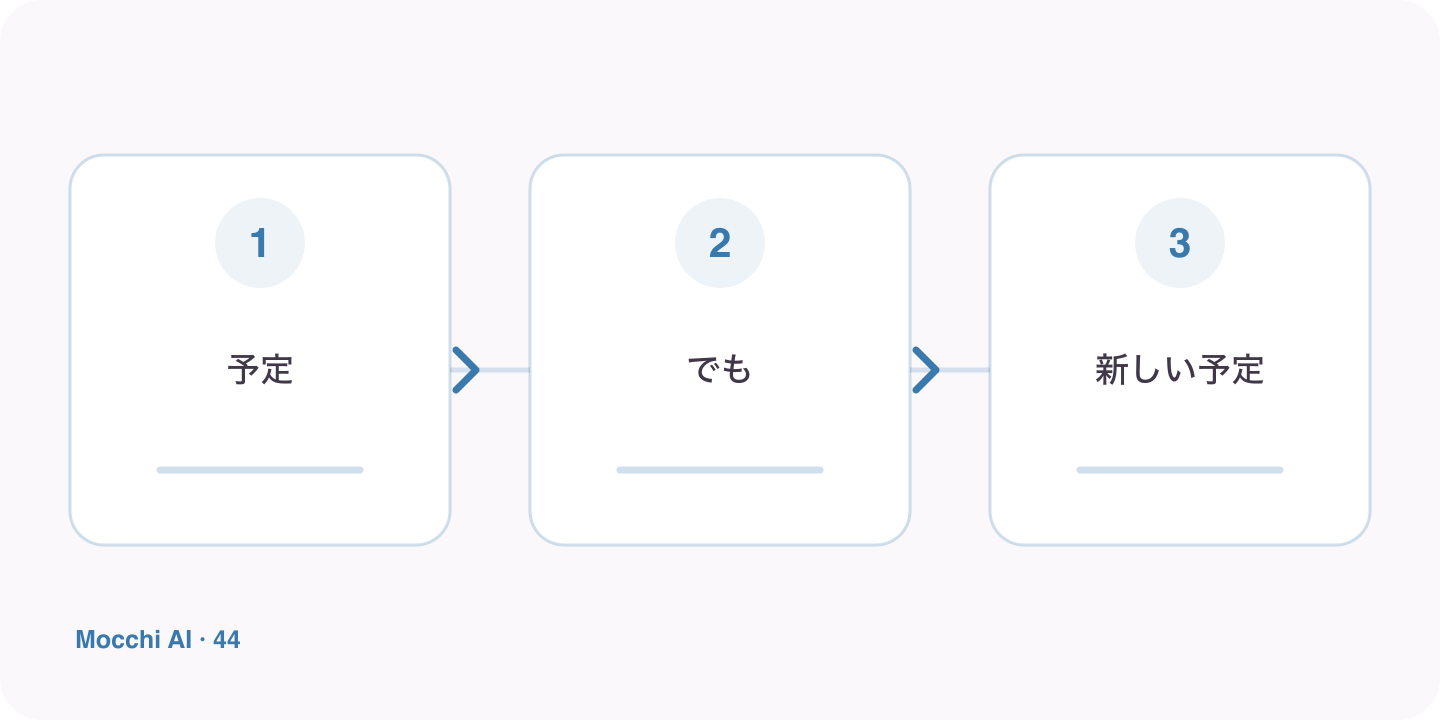
The original plan, a change cue, and the new arrangement are traced before the learner confirms the message
Do not carry the first plan forward after the message has replaced or qualified it.
JapaneseRomajiMeaning
雨なので、公園ではなく駅で会いましょう。Ame nanode, kōen de wa naku eki de aimashō.Because of the rain, let's meet at the station rather than the park.
駅で会いましょう。Eki de aimashō.Let's meet at the station.

Use a short confirmation as a comprehension test

State the new arrangement in one sentence or ask a concise confirmation question. This requires you to select the active information rather than reproduce every word. If the response names the old plan, return to the change cue and explain what it replaces. Keep the writing simple so the check remains focused on reading comprehension.

Change the time or reason in the next example

Ask for another original message with a different reason or a changed time instead of a location. Identify the same three roles and point to the evidence. This variation checks whether the reading strategy transfers beyond one familiar sentence. If a particular connector causes trouble, practice a small contrast before adding a longer message.

Ask for clarification when the real message stays ambiguous

In actual communication, not every message contains enough information for a confident answer. Explain what is clear and ask a short question about the remaining detail. Mocchi can help you prepare that wording with invented examples. The useful habit is distinguishing a supported reading from an assumption, then confirming what matters rather than acting on the first plausible interpretation.

Key points

A practical way to improve

Ask Mocchi for a short original message changing a meeting location because of rain. Identify the first plan, the reason, and the new location. State which place you should now go to and point to the phrase supporting the answer. Then write a brief confirmation. Repeat with a changed time or another simple reason so the exercise remains a reading decision rather than a memorized sequence.

  1. 1

    Choose one clear goal

    Focus each session on a situation or skill you can actually use.

  2. 2

    Practice actively

    Say complete answers aloud instead of only reading or recognizing Japanese.

  3. 3

    Review and repeat

    Keep useful corrections and revisit the same skill until it feels natural.

FAQ

Frequently asked questions

Why do I choose the first time or place I recognize?

Familiar details can capture attention before you process the change cue. Read through to the end and ask which arrangement the message now supports, not merely which details appeared first.

Do I need to translate every sentence into my own language?

A translation can help when needed, but a clear account of the old plan and new action is already a useful comprehension check. Use translation to resolve uncertainty rather than as an automatic first step.

What should I do if two interpretations seem possible?

Identify the wording that supports each and ask what remains unclear. In a real conversation, a short confirmation question may be better than silently choosing the interpretation you prefer.

Read the change, not only the familiar details

Use Mocchi to follow a short message through to the action that remains at the end.