
What the certificate actually buys you
Three things, and they are worth having. First, it passes a filter: many applications are sorted before a human reads them, and a stated level is the cheapest signal a recruiter can act on. Second, it is portable and standard, so a hiring manager who has never met you understands roughly what N3 or N2 implies. Third, it is verifiable, which matters in a market where self-assessed language claims are common.
Those three functions are administrative rather than professional. The certificate is doing paperwork for you at the stage where nobody has heard your voice. That is genuinely useful, and it is also the entire extent of what it does. Everything after the screening stage is a conversation with people who will form their own judgement in the first two minutes.
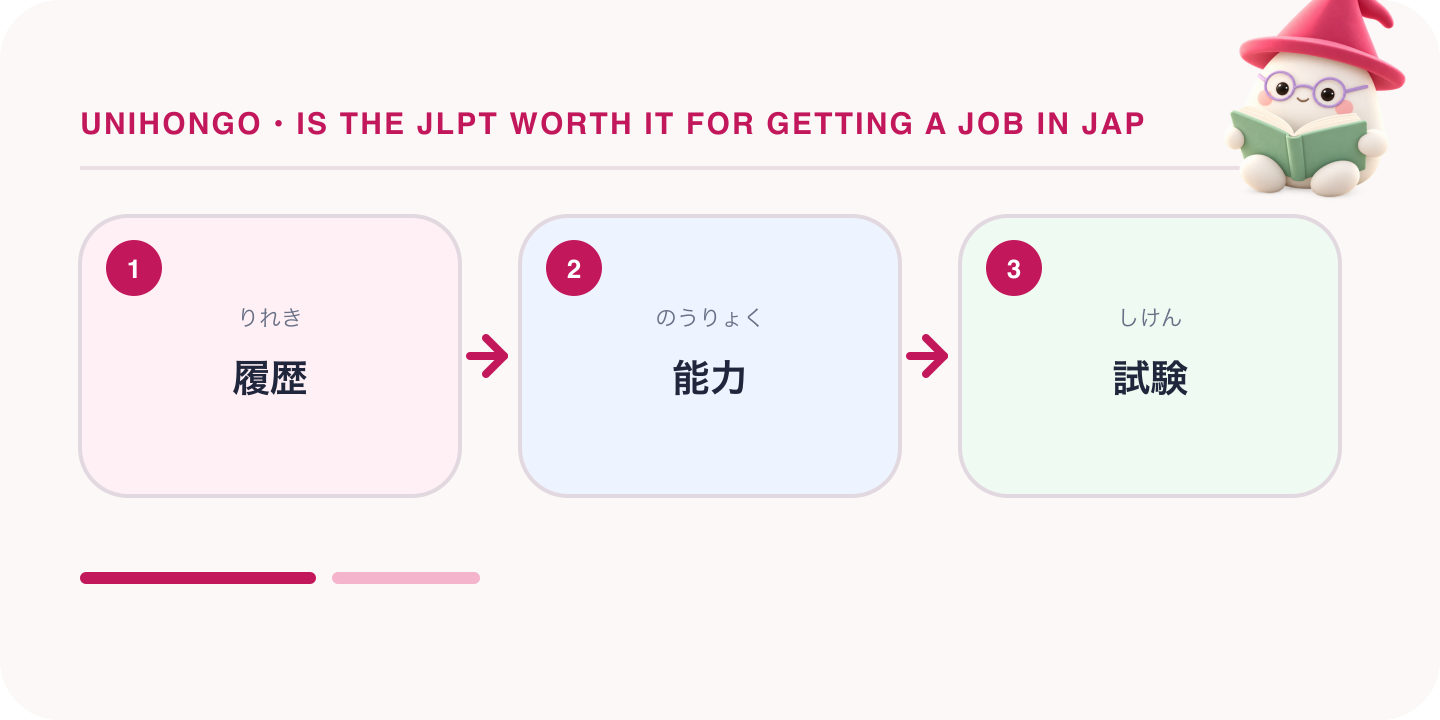
What the certificate does not do
The JLPT has five levels and three scored sections covering language knowledge, reading, and listening. All of it is multiple choice. Nothing on the paper asks you to build a sentence, recover from a misunderstanding, or say something polite while under pressure. So a certificate is evidence that you can recognise Japanese quickly and accurately; it is not evidence that you can produce it.
Interviews are entirely production. You will introduce yourself, describe a project, explain a decision, and ask questions of your own, all in real time with no options to choose between. A candidate who cannot sustain that is not rescued by the line on their resume, and the mismatch shows within a minute. The certificate and the ability to hold a working conversation are two different achievements, and the second has to be trained separately.
Which level roles usually ask for
| Type of role | Level often mentioned | What the work really demands |
|---|---|---|
| Engineering or research on an international team | Sometimes N3, often nothing stated | English-first meetings, with Japanese for internal chat, tickets, and paperwork |
| Customer-facing service, retail, and reception | Commonly N2 or above | Fast, polite speech with strangers, unscripted and with no time to prepare |
| Sales, consulting, and client-facing business roles | Frequently N1 preferred | Negotiation, phone calls, minutes, and reading contracts closely |
| Translation, interpreting, and bilingual coordination | N1 usually expected | Precision reading plus sustained production the exam never scores |
| Hospitality and tourism serving foreign visitors | Often N3 to N2, varies widely | Enough Japanese for the team, with English for the guests |
| Part-time and student work | Often N4 to N3 | Set routines, repeated phrases, and short spoken instructions |
These are patterns seen across job postings, not rules, and individual employers set their own bar. Two postings with the same title can ask for different levels because one team runs its meetings in English and the other does not. Read the duties section rather than the level line: it tells you whether the Japanese in the job is written, spoken, or both, which is the question the level number cannot answer.
A stated level is usually a minimum for consideration, not a target to hit exactly. Where a posting is ambiguous, ask the recruiter what proportion of the daily work happens in Japanese and in which mode. It is a normal question, and the answer tells you what to practise before the interview.
The certificate in visa and points contexts
Japanese ability is one of the factors that can be taken into account in certain visa and points-based immigration contexts, and a JLPT certificate is one of the commonly accepted ways of evidencing it. Employers sponsoring a role sometimes ask for it as part of the documentation even when the job itself runs in English, simply because it is the form of proof their paperwork recognises.
Beyond that general shape, do not plan around anything you read on a blog, including this one. Categories, thresholds, and accepted evidence change, and they differ by visa type and by circumstance. Confirm current requirements with the employer, or with the relevant immigration authority, before you make a decision that depends on them, and check exam dates and current details on the official JLPT site.
What to write on a resume
Keep the language line short, factual, and checkable, then let the rest of the resume show the Japanese in use. A level with a date is stronger than a level alone, because it tells the reader how current it is. Where you have used Japanese at work, say so in the experience section with a concrete task, since that is the part a recruiter will actually ask about.
| Japanese | Romaji | Meaning |
|---|---|---|
| 履歴書に日本語能力試験N2合格と書きました。 | Rirekisho ni Nihongo Nōryoku Shiken N2 gōkaku to kakimashita. | I wrote that I passed JLPT N2 on my resume. |
| 面接の機会をいただき、ありがとうございます。 | Mensetsu no kikai o itadaki, arigatō gozaimasu. | Thank you for giving me the opportunity to interview. |
| 自己紹介をさせていただきます。 | Jiko shōkai o sasete itadakimasu. | Allow me to introduce myself. |
| 御社で働きたいと思っています。 | Onsha de hatarakitai to omotte imasu. | I would like to work at your company. |
| どうぞよろしくお願いいたします。 | Dōzo yoroshiku onegai itashimasu. | I look forward to working with you. |
- State the level and the month and year you passed it, not just the level.
- Never round up. Claiming an unpassed level is the one mistake that ends an application.
- If you are sitting the exam soon, write that you are scheduled for it rather than implying a pass.
- Add one line of real usage: meetings attended, documents handled, customers served in Japanese.
- Keep a scan of the certificate ready, because it is sometimes requested at the offer stage.
What interviewers ask about your certificate
The certificate rarely goes unmentioned, and the questions that follow it are predictable. Interviewers want to know when you passed, what you have done with the language since, and whether the paper matches the person in front of them. Prepare real answers with concrete detail, because a vague reply invites a longer test. Expect these exchanges and rehearse both sides of them aloud.
| Japanese | Romaji | Meaning |
|---|---|---|
| 日本語のレベルはどのくらいですか。 | Nihongo no reberu wa dono kurai desu ka? | How good is your Japanese? |
| 日本語能力試験のN2に合格しました。 | Nihongo Nōryoku Shiken no N2 ni gōkaku shimashita. | I passed N2 of the Japanese-Language Proficiency Test. |
| 去年の十二月に受験しました。 | Kyonen no jūni-gatsu ni juken shimashita. | I sat it last December. |
| 合格してから、毎日会話の練習を続けています。 | Gōkaku shite kara, mainichi kaiwa no renshū o tsuzukete imasu. | Since passing, I have kept practising conversation every day. |
| 仕事で日本語を使ったことがありますか。 | Shigoto de Nihongo o tsukatta koto ga arimasu ka? | Have you used Japanese at work? |
| 週に二回、日本語で打ち合わせをしていました。 | Shū ni ni-kai, Nihongo de uchiawase o shite imashita. | I had meetings in Japanese twice a week. |
| 敬語はどのくらい使えますか。 | Keigo wa dono kurai tsukaemasu ka? | How much honorific language can you use? |
| 基本的な敬語なら使えます。今も勉強しています。 | Kihonteki na keigo nara tsukaemasu. Ima mo benkyō shite imasu. | I can use basic honorific language, and I am still studying it. |
Describing your level honestly
Overstating your Japanese is discovered in minutes and it costs you the room. Understating it wastes the preparation you have done. The useful middle is a specific description by mode: what you can read, what you can write, what you can follow, and where you still struggle. Naming a weakness and the work you are doing about it reads as professional rather than as a disqualification.
| Japanese | Romaji | Meaning |
|---|---|---|
| 日常会話はだいたい問題ありません。 | Nichijō kaiwa wa daitai mondai arimasen. | I have more or less no trouble with everyday conversation. |
| 専門用語はまだ勉強中です。 | Senmon yōgo wa mada benkyō-chū desu. | I am still studying the technical vocabulary. |
| 読み書きは得意ですが、会話はまだ練習中です。 | Yomikaki wa tokui desu ga, kaiwa wa mada renshū-chū desu. | I am strong at reading and writing, but I am still practising conversation. |
| 少しゆっくり話していただければ、理解できます。 | Sukoshi yukkuri hanashite itadakereba, rikai dekimasu. | If you speak a little slowly, I can understand. |
| 電話対応は少し苦手なので、練習しています。 | Denwa taiō wa sukoshi nigate na node, renshū shite imasu. | I am a little weak at handling phone calls, so I am practising. |
| メールは日本語で書けます。 | Mēru wa Nihongo de kakemasu. | I can write emails in Japanese. |
Lines that show you can work in Japanese
What convinces an interviewer is not vocabulary size but the handful of moves that keep a working conversation running: acknowledging an instruction, promising a follow-up, buying a moment, taking responsibility for a task. These are short, they are fixed, and they are the same in almost every office. Learn them to the point of reflex and you sound employable well before your grammar is complete.
| Japanese | Romaji | Meaning |
|---|---|---|
| お世話になっております。 | Osewa ni natte orimasu. | Thank you for your continued support. |
| 承知いたしました。 | Shōchi itashimashita. | Understood. |
| 確認してから、折り返しご連絡いたします。 | Kakunin shite kara, orikaeshi go-renraku itashimasu. | I will check and get back to you. |
| 資料は明日までにお送りします。 | Shiryō wa ashita made ni o-okuri shimasu. | I will send the materials by tomorrow. |
| その件は私が担当いたします。 | Sono ken wa watashi ga tantō itashimasu. | I will take charge of that matter. |
| 少々お待ちいただけますか。 | Shōshō omachi itadakemasu ka? | Could you wait just a moment? |
| 質問してもよろしいでしょうか。 | Shitsumon shite mo yoroshii deshō ka? | Would it be all right if I asked a question? |
Handling the part you did not catch
Every non-native employee misses things, and everyone knows it. What separates a candidate who will function from one who will not is whether they can say so gracefully and keep the exchange moving. Rehearse these until they arrive automatically, because the moment you need them is precisely the moment your Japanese is under the most strain.
| Japanese | Romaji | Meaning |
|---|---|---|
| 恐れ入りますが、もう一度おっしゃっていただけますか。 | Osoreirimasu ga, mō ichido osshatte itadakemasu ka? | I am sorry, could you say that once more? |
| 申し訳ありませんが、少し確認させてください。 | Mōshiwake arimasen ga, sukoshi kakunin sasete kudasai. | I am sorry, please let me check something. |
| 私の理解では、締め切りは金曜日です。合っていますか。 | Watashi no rikai de wa, shimekiri wa kin'yōbi desu. Atte imasu ka? | As I understand it, the deadline is Friday. Is that right? |
| すみません、今の部分をもう少し詳しくお願いします。 | Sumimasen, ima no bubun o mō sukoshi kuwashiku onegai shimasu. | Sorry, could I ask for a little more detail on that part? |
| お電話ありがとうございます。営業部の田中でございます。 | Odenwa arigatō gozaimasu. Eigyō-bu no Tanaka de gozaimasu. | Thank you for calling. This is Tanaka from the sales department. |
| 担当者に代わりますので、少々お待ちください。 | Tantōsha ni kawarimasu node, shōshō omachi kudasai. | I will pass you to the person in charge, so please hold for a moment. |
Building the evidence the certificate cannot give
If the exam measures recognition and the interview measures production, the gap has to be closed on purpose. Nothing in a textbook, a drill app, or a stack of practice papers will close it, because none of them require you to speak. The work is unglamorous and short: regular spoken rehearsal of the specific situations a job will put you in, with feedback on what came out wrong.
- Record a two-minute spoken self-introduction each month and keep the recordings to compare.
- Rehearse the four standard interview answers aloud: yourself, your experience, why this company, your questions.
- Practise one workplace scenario a week, such as a phone call, a status update, or an apology for a delay.
- Ask for one correction at a time and re-say the corrected sentence immediately, out loud.
- Talk about your actual job in Japanese, not about textbook topics, so the vocabulary transfers.
The honest verdict
Yes, with a condition attached. Sit the exam, because it structures your study, gives you a deadline, and produces a line that opens doors you cannot open by describing your own ability. It is one of the few pieces of evidence a stranger will accept before meeting you.
Then treat the pass as the beginning of the application rather than the end of it. The people who struggle are not the ones with the wrong level; they are the ones who reached a level and never spoke. Study for the exam and practise speaking in the same week, every week, and the certificate and the conversation arrive together.