
Why fluent is a useless target
Fluent is a compliment, not a specification. It has no threshold, so no amount of study ever satisfies it, and it gives no guidance about what to do tomorrow morning. Worse, it hides the fact that ability is uneven: a person who handles a construction site in Japanese may be lost in a bank, and someone who reads novels comfortably may struggle to order coffee by phone. Neither is more fluent than the other. They are trained for different tasks.
Replace it with a can-do list. A can-do item is a sentence in the form I can do this, in this place, with this person, and it is either true today or it is not. Ten of them describe your target far better than a level does, and when one is false you know exactly what this week's practice is. The rest of this guide gives you five ready-made lists to start from.
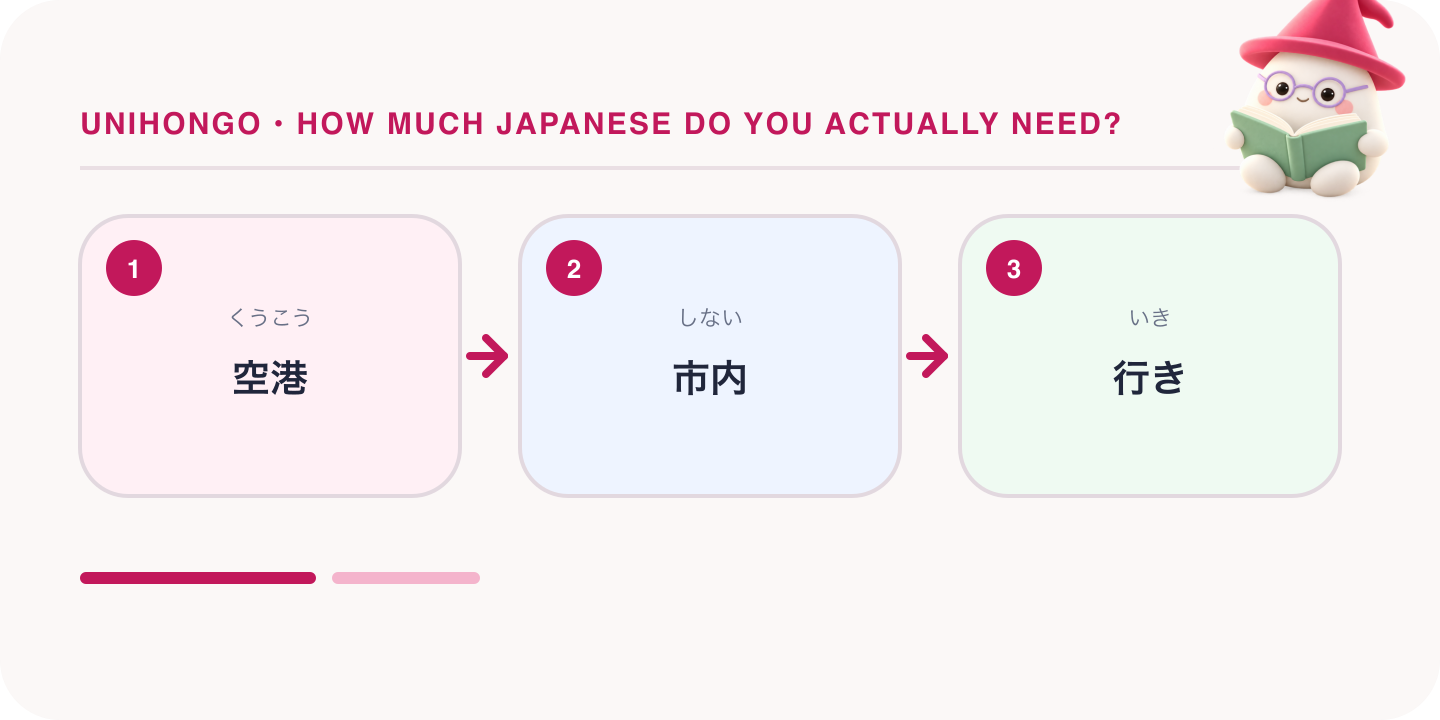
The five targets at a glance
| Target | Skills that carry it | First checkpoint |
|---|---|---|
| A two-week trip | Fixed transaction phrases, numbers, asking for repetition | Order a meal and pay without switching to English |
| Living in Japan, daily life | Admin vocabulary, explaining a problem, phone basics | Complete one counter errand start to finish |
| Part-time or service work | Set customer phrases, understanding instructions, reporting | Take one order and repeat it back correctly |
| An office job with colleagues | Meeting listening, short reporting, email reading, register | Give a one-minute progress update unprepared |
| Reading and media enjoyment | Kanji recognition, high-frequency vocabulary, tolerance for gaps | Follow one short episode without subtitles most of the way |
Read down the middle column and notice how little overlap there is. Only about a third of the work transfers between targets, which is why a general study plan feels slow: you are paying for four skill sets when you needed one. Choose your target, over-serve it, and add the others later when a reason appears.
Target one: a two-week trip
This is the smallest real target and the most commonly overbuilt. You need a set of transaction phrases you can say without thinking, the ability to hear numbers, prices and times reliably, and two or three lines that ask someone to slow down or repeat. Everything about the trip is predictable, staff expect foreign visitors, and the situations recur so often that a week of rehearsal shows up as visible competence.
What you may skip: the writing system beyond recognising a few station and menu characters, verb conjugation charts, casual speech, honorific verb forms and any vocabulary about work or opinions. You will not need to describe your feelings about a film. You will need to catch the word for platform.
| Japanese | Romaji | Meaning |
|---|---|---|
| 空港から市内までの行き方が聞けます。 | Kūkō kara shinai made no ikikata ga kikemasu. | I can ask how to get from the airport into the city. |
| レストランで注文して、会計ができます。 | Resutoran de chūmon shite, kaikei ga dekimasu. | I can order in a restaurant and pay the bill. |
| 値段と時間が聞き取れます。 | Nedan to jikan ga kikitoremasu. | I can catch prices and times when I hear them. |
| 道に迷ったとき、助けを求められます。 | Michi ni mayotta toki, tasuke o motomeraremasu. | I can ask for help when I am lost. |
| ホテルでチェックインとチェックアウトができます。 | Hoteru de chekkuin to chekkuauto ga dekimasu. | I can check in and out at a hotel. |
| もう一度ゆっくりお願いできます。 | Mō ichido yukkuri onegai dekimasu. | I can ask someone to repeat it slowly. |
Target two: living in Japan for daily life
Daily life is much bigger than travel because it is not staffed for visitors. A city office clerk, a landlord and a doctor all assume you can follow ordinary explanations, and the vocabulary is administrative rather than touristic: forms, deadlines, insurance, contracts, rubbish rules and appointments. The skill that carries this target is describing a situation clearly enough that someone can help you, which means the ability to give background before the request.
The other half is telephone survival. Phone calls remove facial expression and gestures, and a surprising share of daily-life friction lives there. Procedures and requirements differ by city and by office, so confirm details with the counter or your employer rather than trusting a general rule you read somewhere.
What you may skip for now: business honorifics, essay writing, and reading long official documents unaided. Bring the document to a counter or a friend and ask about the parts you do not follow, then note the two or three words that recur across forms. That is what a competent adult does in any language, and it is faster than studying paperwork vocabulary in the abstract.
| Japanese | Romaji | Meaning |
|---|---|---|
| 郵便局で荷物が送れます。 | Yūbinkyoku de nimotsu ga okuremasu. | I can send a parcel at the post office. |
| 病院で症状が説明できます。 | Byōin de shōjō ga setsumei dekimasu. | I can explain my symptoms at a clinic. |
| 役所で書類の書き方が聞けます。 | Yakusho de shorui no kakikata ga kikemasu. | I can ask at the city office how to fill in a form. |
| 不動産屋に部屋の条件が伝えられます。 | Fudōsan-ya ni heya no jōken ga tsutaeraremasu. | I can tell an estate agent what I want in a flat. |
| 電話で予約の変更ができます。 | Denwa de yoyaku no henkō ga dekimasu. | I can change an appointment by phone. |
| 近所の人と天気の話ができます。 | Kinjo no hito to tenki no hanashi ga dekimasu. | I can chat about the weather with a neighbour. |
| ゴミの出し方が分からないので、教えてもらえますか。 | Gomi no dashikata ga wakaranai node, oshiete moraemasu ka. | I do not know how to sort the rubbish. Could you tell me? |
Target three: part-time or service work
Service work is unusual in that the language is narrow but the standard is high. A shift repeats perhaps forty fixed phrases, most of them polite customer expressions you will say hundreds of times, and those are learned quickly. The demanding part is comprehension in the other direction: instructions from a supervisor, a customer's unusual request, and the safety or timing words you must understand instantly rather than eventually.
The skill that most improves a new worker's shift is not vocabulary but repetition back. Repeating an order or an instruction aloud before acting catches errors, buys thinking time, and reassures the person who told you. Learn one repeat-back phrase and one reporting phrase before you learn anything else.
What you may skip: written Japanese beyond your own shift notes, the theory behind honorific verbs as opposed to the fixed phrases themselves, and any conversation about topics outside the job. Nobody expects a new part-timer to discuss the news, and the small talk usually arrives on its own once your colleagues see that the work itself is safe in your hands.
| Japanese | Romaji | Meaning |
|---|---|---|
| お客様に敬語であいさつができます。 | Okyakusama ni keigo de aisatsu ga dekimasu. | I can greet customers in polite language. |
| 注文を復唱して確認できます。 | Chūmon o fukushō shite kakunin dekimasu. | I can repeat an order back to confirm it. |
| 分からない指示を聞き返せます。 | Wakaranai shiji o kikikaesemasu. | I can ask again about an instruction I did not understand. |
| ミスをしたとき、すぐに報告できます。 | Misu o shita toki, sugu ni hōkoku dekimasu. | I can report a mistake straight away. |
| 在庫や値段について答えられます。 | Zaiko ya nedan ni tsuite kotaeraremasu. | I can answer questions about stock and prices. |
| ご注文を繰り返します。コーヒーがお二つですね。 | Gochūmon o kurikaeshimasu. Kōhī ga ofutatsu desu ne. | Let me repeat your order. Two coffees, is that right? |
| 申し訳ありません、すぐに確認いたします。 | Mōshiwake arimasen, sugu ni kakunin itashimasu. | I am very sorry, I will check right away. |
Target four: an office job with Japanese colleagues
This is the largest of the five, and the demand is lopsided. Speaking in an office is often easier than people fear, because a report is short and you can prepare it. Listening is the hard part: a meeting has several speakers, overlapping turns, abbreviations specific to your company, and nobody adjusting their speed for you. Reading matters too, because internal messages carry the decisions, though you can lean on tools far more than in speech.
Register control is the third skill. You need a plain-polite default with colleagues, a more careful form with clients and senior staff, and the judgement to notice which room you are in. Expectations differ enormously between companies, from teams that work in English with occasional Japanese to teams where every meeting is in Japanese, so ask during hiring what the working language of your actual team is rather than assuming.
What you may skip early on: elaborate honorific chains, formal written correspondence, and speaking first in large meetings. Aim instead to follow what the meeting decided and to report your own work clearly when your turn comes. Those two carry the first year, and colleagues forgive a stiff sentence far more readily than a report nobody can follow.
| Japanese | Romaji | Meaning |
|---|---|---|
| 会議で自分の意見が言えます。 | Kaigi de jibun no iken ga iemasu. | I can state my own opinion in a meeting. |
| 進捗を短く報告できます。 | Shinchoku o mijikaku hōkoku dekimasu. | I can give a short progress report. |
| メールの用件が読み取れます。 | Mēru no yōken ga yomitoremasu. | I can work out the point of an email. |
| 電話を取り次ぐことができます。 | Denwa o toritsugu koto ga dekimasu. | I can transfer a phone call to the right person. |
| 締め切りの延長をお願いできます。 | Shimekiri no enchō o onegai dekimasu. | I can ask for a deadline extension. |
| すみません、今の部分だけ確認させてください。 | Sumimasen, ima no bubun dake kakunin sasete kudasai. | Sorry, let me just check that last point. |
| 現在、八割ほど終わっております。 | Genzai, hachi-wari hodo owatte orimasu. | At present, about eighty per cent is finished. |
Target five: reading and media enjoyment
If your goal is books, games, news or watching without subtitles, the profile changes completely. Kanji recognition and a large passive vocabulary carry almost everything, and speaking barely features. The other essential skill is psychological: tolerance for not understanding. A reader who stops at every unknown word never finishes anything, and finishing things is what builds the vocabulary in the first place.
Choose material where you follow most of it already and let the remainder go by. Reread or rewatch the same piece rather than always moving on, because the second pass is where the words stick. Subtitles in your own language are fine at the start and become a crutch later; Japanese subtitles are the useful middle step.
What you may skip: polite request forms, workplace register and phone language, at least until you want to talk about what you read. The moment you do want that, you will need a spoken output habit, because recognition alone never turns into speech.
| Japanese | Romaji | Meaning |
|---|---|---|
| ニュースの見出しが読めます。 | Nyūsu no midashi ga yomemasu. | I can read news headlines. |
| 字幕なしで大体の筋が追えます。 | Jimaku nashi de daitai no suji ga oemasu. | I can follow the general plot without subtitles. |
| 知らない漢字を辞書で調べられます。 | Shiranai kanji o jisho de shiraberaremasu. | I can look up kanji I do not know in a dictionary. |
| 好きな作品の感想が言えます。 | Suki na sakuhin no kansō ga iemasu. | I can say what I thought of something I liked. |
| 短い投稿なら理解できます。 | Mijikai tōkō nara rikai dekimasu. | I can understand short social media posts. |
| 分からない言葉があっても、最後まで読めます。 | Wakaranai kotoba ga atte mo, saigo made yomemasu. | I can read to the end even when there are words I do not know. |
What you can safely skip, and how to say so
Skipping is a strategy when it is deliberate and recorded. The danger is not skipping kanji or keigo; it is forgetting that you did, then feeling vaguely bad about your Japanese for a year without being able to name the gap. Keep a short list titled not yet, review it every couple of months, and promote an item only when a real situation demands it.
- Trip target: skip kanji study, verb charts, casual forms, opinion vocabulary.
- Daily life: skip business honorifics and long documents; ask a person instead.
- Service work: skip written Japanese and off-topic conversation until the shift is smooth.
- Office job: skip elaborate honorific chains and speaking first in big meetings.
- Reading: skip request forms and phone language until you want to discuss what you read.
- Everyone: keep asking for repetition. It is never on the skip list.
Write your own can-do list
Your real target is probably a mix of two of the five, so build a personal list rather than adopting one wholesale. Write each item as a task with a place and a person, keep it to ten items, and mark each one yes, nearly or not yet. Nearly is the useful category: those are this month's work. Rewrite the list every eight weeks, because a good list gets stale as soon as it becomes true.
| Japanese | Romaji | Meaning |
|---|---|---|
| 今週の目標は、これができるようになることです。 | Konshū no mokuhyō wa, kore ga dekiru yō ni naru koto desu. | This week's goal is to become able to do this. |
| まだ自信がないので、もう一度練習します。 | Mada jishin ga nai node, mō ichido renshū shimasu. | I am not confident yet, so I will practise it again. |
| 三回続けてできたら、次に進みます。 | Sankai tsuzukete dekitara, tsugi ni susumimasu. | If I manage it three times in a row, I will move on. |
| これは今の私には必要ないので、後にします。 | Kore wa ima no watashi ni wa hitsuyō nai node, ato ni shimasu. | I do not need this yet, so I will leave it for later. |
| 先月できなかったことが、今日はできました。 | Sengetsu dekinakatta koto ga, kyō wa dekimashita. | Something I could not do last month, I managed today. |
- Name the place and the other person in every item, not just the function.
- Make each item small enough to test in a single two-minute exchange.
- Cap the list at ten so it stays a plan rather than a wish.
- Mark yes, nearly or not yet, and work only on the nearly items this month.
- Test out loud, cold, with no notes; recognition on the page does not count.
- Rewrite the whole list every eight weeks and retire the items that came true.
Where classes and tutors still beat a checklist
A checklist tells you what to aim at, not how to get there, and that is where the options an app does not sell earn their place. A group class supplies sequence and a schedule you will actually keep. A tutor spots the habit you cannot hear in your own speech and answers the question you did not know to ask. A textbook series orders grammar sensibly. A language school gives structure and immersion together. Costs and formats vary widely, so ask each provider directly what a trial session includes.
Speaking practice with an AI Sensei sits alongside those rather than replacing them. It supplies the repetitions a weekly lesson cannot: the same roleplay run ten times, at midnight, with corrections afterwards and no social cost for failing. Use a teacher to decide what to practise, then use the volume to make it automatic, and check your can-do list at the end of the month to see which items moved.