
When a written thank-you is expected
Spoken thanks are covered in the guide to thank-you and sorry in Japanese; this post is about the note that follows. A written thank-you is commonly expected after you receive a gift, after someone pays for a meal, after a stay in a home, after a favour that cost real time or effort, after a job interview in many companies, and when a colleague leaves. The rough rule people give is that the more trouble someone went to, the more the thanks should take a form that lasts longer than a sentence at the door.
Timing matters more than length. Most people aim to write within a few days, and a postcard or card that arrives a week later usually opens with an apology for being slow. The medium follows the relationship: a paper card for people you see rarely or want to honour, an email for a company, a chat message only for close friends. Regions, generations and families differ, so if you are unsure, a short paper card is the choice least likely to feel wrong.
| Occasion | Common opening line | Romaji | Meaning |
|---|---|---|---|
| A gift | 素敵な贈り物をありがとうございました。 | Suteki na okurimono o arigatō gozaimashita. | Thank you for the lovely gift. |
| A meal someone paid for | 先日はごちそうさまでした。 | Senjitsu wa gochisōsama deshita. | Thank you for the meal the other day. |
| A stay in someone's home | 滞在中は大変お世話になりました。 | Taizai-chū wa taihen osewa ni narimashita. | Thank you for looking after me during my stay. |
| A favour | 先日は助けていただき、ありがとうございました。 | Senjitsu wa tasukete itadaki, arigatō gozaimashita. | Thank you for helping me the other day. |
| A job interview | 本日はお忙しい中、ありがとうございました。 | Honjitsu wa oisogashii naka, arigatō gozaimashita. | Thank you for your time today despite being busy. |
| A colleague leaving | 在職中は大変お世話になりました。 | Zaishoku-chū wa taihen osewa ni narimashita. | Thank you for everything during your time here. |
| A celebration gift | この度はお祝いをいただき、ありがとうございました。 | Kono tabi wa oiwai o itadaki, arigatō gozaimashita. | Thank you for the congratulatory gift. |
| A late note | お礼が遅くなり、申し訳ありません。 | Orei ga osoku nari, mōshiwake arimasen. | I am sorry my thanks come late. |
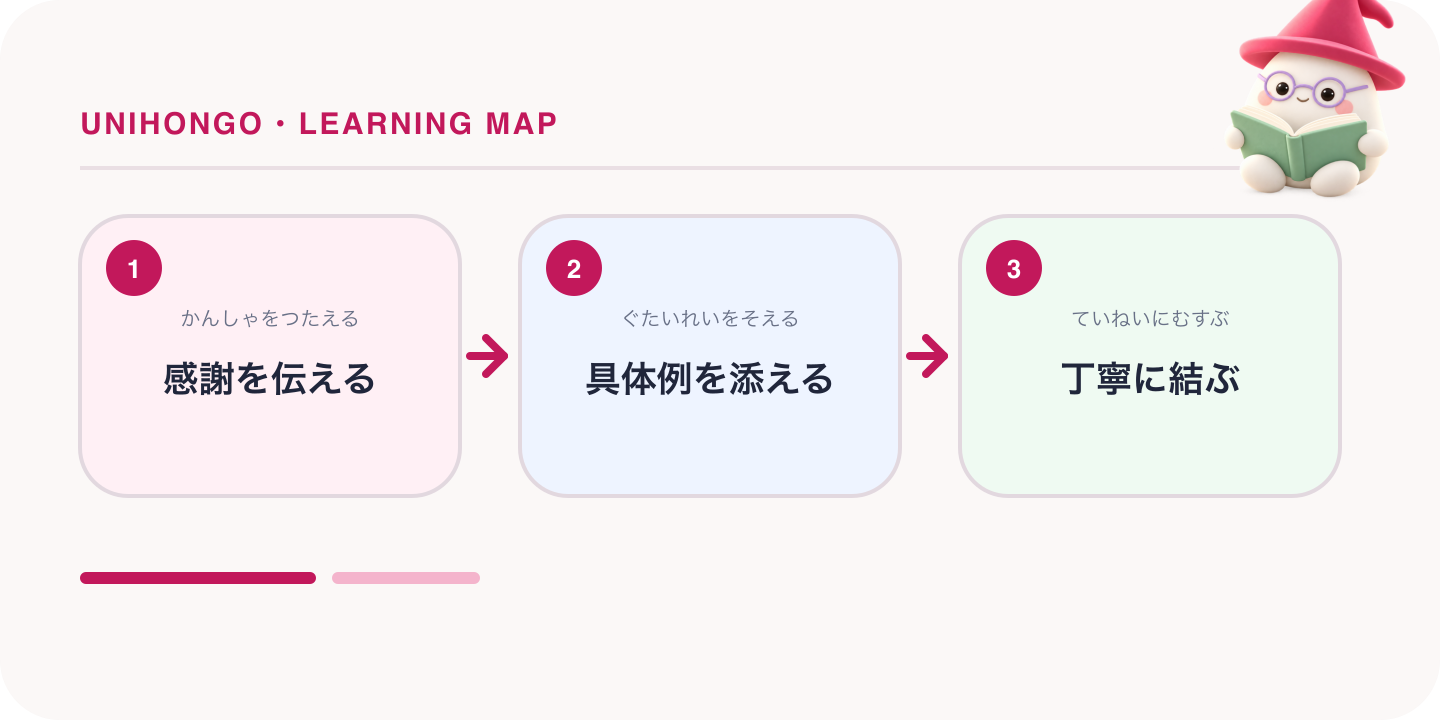
The three-line shape
Almost every thank-you note in this guide follows the same shape. Line one names the specific thing you are grateful for, with a time word such as senjitsu or kinō so the reader knows which kindness you mean. Line two says how it helped or how it felt: the sweets were shared with the family, the advice solved the problem, the evening was fun. Line three looks forward: you hope to meet again, you would like to return the favour, you wish them good health.
The specific detail in line two is what separates a warm note from a formula. Japanese readers expect the set phrases, so they do not read as cold, but a note that is only set phrases feels like a receipt. One concrete sentence, even a simple one, does the work. Learners commonly write too much here; three lines plus a greeting and your name is a complete card, and a longer note risks grammar mistakes that a short one avoids.
| Japanese | Romaji | Meaning |
|---|---|---|
| 素敵なお菓子をありがとうございました。 | Suteki na okashi o arigatō gozaimashita. | Thank you for the lovely sweets. |
| 家族みんなでおいしくいただきました。 | Kazoku minna de oishiku itadakimashita. | The whole family enjoyed them. |
| またお会いできるのを楽しみにしています。 | Mata oai dekiru no o tanoshimi ni shite imasu. | I look forward to seeing you again. |
| 昨日はごちそうさまでした。 | Kinō wa gochisōsama deshita. | Thank you for the meal yesterday. |
| 久しぶりにゆっくりお話しできて、とても楽しかったです。 | Hisashiburi ni yukkuri ohanashi dekite, totemo tanoshikatta desu. | It was a real pleasure to talk properly after so long. |
| 今度はぜひ私にごちそうさせてください。 | Kondo wa zehi watashi ni gochisō sasete kudasai. | Next time, please let me treat you. |
Set phrases by formality
The word you choose for thanks tells the reader how you see the relationship. Arigatō alone belongs on a card to a close friend, often with hontō ni in front of it. Arigatō gozaimashita is the safe default for anyone else, and the past tense matters: it marks the kindness as complete. Kansha shite imasu, and its formal written cousin kansha mōshiagemasu, raise the register and suit a mentor, a host family or a client.
Osewa ni narimashita is the phrase learners most often miss. It thanks a person for having looked after you over a period, not for a single act, so it fits a stay, a teacher at the end of term, a colleague on your last day or theirs. Adding taihen makes it warmer and slightly more formal. Using it for a single cup of coffee sounds odd, and leaving it out of a farewell card sounds cold, so match it to duration rather than to size.
| Japanese | Romaji | Meaning |
|---|---|---|
| 本当にありがとう。 | Hontō ni arigatō. | Thank you so much. (casual, to a close friend) |
| ありがとうございました。 | Arigatō gozaimashita. | Thank you for what you did. (polite default) |
| 心から感謝しています。 | Kokoro kara kansha shite imasu. | I am truly grateful. |
| 心より感謝申し上げます。 | Kokoro yori kansha mōshiagemasu. | Please accept my sincere gratitude. (formal, written) |
| 大変お世話になりました。 | Taihen osewa ni narimashita. | Thank you for all your kindness and care. |
| 厚く御礼申し上げます。 | Atsuku onrei mōshiagemasu. | I offer my deepest thanks. (very formal, written) |
| おかげさまで、無事に終わりました。 | Okagesama de, buji ni owarimashita. | Thanks to you, it went off without a hitch. |
Notes after a stay or a favour
A stay in someone's home earns the fullest note in this guide, because the host gave time, space and meals over days. Open with osewa ni narimashita, name one thing you will remember, and close with an invitation or a wish for their health. A favour note is shorter, but the second line should show the result: the move went smoothly, the form was accepted, the problem is solved. People who help you like to hear that the help worked.
| Japanese | Romaji | Meaning |
|---|---|---|
| 滞在中は大変お世話になりました。 | Taizai-chū wa taihen osewa ni narimashita. | Thank you for looking after me during my stay. |
| 温かいおもてなしのおかげで、忘れられない旅になりました。 | Atatakai omotenashi no okage de, wasurerarenai tabi ni narimashita. | Thanks to your warm hospitality, it became an unforgettable trip. |
| こちらにいらっしゃる機会がありましたら、ぜひご連絡ください。 | Kochira ni irassharu kikai ga arimashitara, zehi gorenraku kudasai. | If you ever have the chance to visit here, please do get in touch. |
| 先日は引っ越しを手伝っていただき、本当にありがとうございました。 | Senjitsu wa hikkoshi o tetsudatte itadaki, hontō ni arigatō gozaimashita. | Thank you so much for helping with my move the other day. |
| おかげさまで、無事に新しい生活を始めることができました。 | Okagesama de, buji ni atarashii seikatsu o hajimeru koto ga dekimashita. | Thanks to you, I have been able to start my new life smoothly. |
| 落ち着いたら、ぜひ新居に遊びに来てください。 | Ochitsuitara, zehi shinkyo ni asobi ni kite kudasai. | Once things settle down, please come and visit the new place. |
Closings vary with the season and the reader. Toriisogi, orei made, meaning in haste with thanks, is common between equals and closes a postcard neatly, though some people avoid it toward a superior. A wish for health, such as okarada ni oki o tsuke kudasai, suits anyone. Formal letters to elders may add the seasonal openers and the haikei and keigu frame described in the guide to seasonal greetings; a card to a friend does not need them.
O-rei: pairing the note with a small gift
O-rei is the word for thanks given a shape: a note, a small gift, or both together. After a stay, a large favour or a celebration gift, it is common to send or hand over something modest with the card. Sweets from your home region, tea or a small item the person can use up are typical. The gift is deliberately smaller than what you received, because an equal or larger gift can read as settling a debt rather than expressing thanks.
For congratulatory gifts, such as money given at a wedding or for a new baby, the return is called okaeshi, and people commonly describe it as around half the value, though families and regions differ and some occasions skip it entirely. Ask a Japanese friend or colleague about the specific case rather than guessing. Whatever you give, the card does the talking; a gift without a note can feel transactional, while a note without a gift is always acceptable.
| Japanese | Romaji | Meaning |
|---|---|---|
| ささやかですが、お礼の気持ちです。 | Sasayaka desu ga, orei no kimochi desu. | It is only small, but it is a token of my thanks. |
| 地元のお菓子を同封しました。 | Jimoto no okashi o dōfū shimashita. | I have enclosed some sweets from my hometown. |
| お口に合えば幸いです。 | Okuchi ni aeba saiwai desu. | I hope they are to your taste. |
| お礼のしるしに、心ばかりの品をお送りします。 | Orei no shirushi ni, kokoro bakari no shina o ookuri shimasu. | As a token of thanks, I am sending a small gift. |
The interview thank-you email
The interview itself is covered in the guide to Japanese job interview questions; here we look only at the email afterwards. It is commonly sent the same day, addressed to the person who arranged the interview, and kept to four or five lines. Thank the interviewer for their time, mention one thing you learned that strengthened your interest, and close with a standard request for their consideration. Do not introduce new selling points or ask about the result.
Two register points trip learners up. In writing, the company is kisha, while in speech it is onsha; a thank-you email uses kisha. The subject line should say what the email is and who it is from, because busy hiring staff scan by subject. Keep the tone modest: the email confirms you were attentive and courteous, which is all it is for.
| Japanese | Romaji | Meaning |
|---|---|---|
| 件名:面接のお礼 | Kenmei: mensetsu no orei | Subject: Thank you for the interview |
| 採用ご担当 田中様 | Saiyō gotantō Tanaka-sama | Dear Tanaka, hiring contact |
| 本日はお忙しい中、面接のお時間をいただき、誠にありがとうございました。 | Honjitsu wa oisogashii naka, mensetsu no ojikan o itadaki, makoto ni arigatō gozaimashita. | Thank you very much for making time to interview me today despite your busy schedule. |
| お話を伺い、貴社で働きたいという気持ちがいっそう強くなりました。 | Ohanashi o ukagai, kisha de hatarakitai to iu kimochi ga issō tsuyoku narimashita. | Hearing about the role made me even keener to work at your company. |
| 取り急ぎ、お礼を申し上げます。 | Toriisogi, orei o mōshiagemasu. | I write in haste to express my thanks. |
| 何卒よろしくお願い申し上げます。 | Nanitozo yoroshiku onegai mōshiagemasu. | I humbly ask for your favourable consideration. |
The farewell card for a colleague
When a colleague leaves, retires or transfers, workplaces commonly pass around a group card, sometimes called a yosegaki, and each person writes two or three lines. The opening depends on why they are leaving: congratulations suit a retirement or a promotion-transfer, while a plain osewa ni narimashita suits a resignation, where congratulations might sound wrong. Then name one thing they did for you, and close with a wish for their next chapter.
If you are the one leaving, the same three lines work in reverse: thank the team for the period, name what you learned, and ask them to keep in touch. Keep it short; a group card has little space, and the colleagues reading it will value one specific memory over a paragraph of set phrases.
| Japanese | Romaji | Meaning |
|---|---|---|
| ご退職おめでとうございます。 | Gotaishoku omedetō gozaimasu. | Congratulations on your retirement. |
| 三年間、大変お世話になりました。 | San-nenkan, taihen osewa ni narimashita. | Thank you for everything over these three years. |
| 田中さんに教えていただいたことを、これからも大切にします。 | Tanaka-san ni oshiete itadaita koto o, korekara mo taisetsu ni shimasu. | I will keep treasuring what you taught me. |
| 新しい職場でのご活躍をお祈りしています。 | Atarashii shokuba de no gokatsuyaku o oinori shite imasu. | Wishing you every success in your new workplace. |
| お体に気をつけて、お元気で。 | Okarada ni ki o tsukete, ogenki de. | Take care of yourself, and all the best. |
| 短い間でしたが、大変お世話になりました。 | Mijikai aida deshita ga, taihen osewa ni narimashita. | It was a short time, but thank you for everything. (when you are leaving) |
| またどこかでご一緒できる日を楽しみにしています。 | Mata dokoka de goissho dekiru hi o tanoshimi ni shite imasu. | I look forward to the day we work together again somewhere. |
What to say when you hand it over
Many notes are handed over in person, with or without a gift, and the moment has its own script. You lead with the thanks in speech, offer the card or bag with a humbling phrase, and expect the recipient to protest lightly. Your reply to the protest is kochira koso, which turns the thanks back on them. Learners commonly freeze here because they rehearsed the writing and not the exchange, so practise both halves.
The traditional humbling phrase tsumaranai mono desu ga, literally a trivial thing but, is still heard, though many people now prefer hon no kimochi desu, a small token of my feelings, which sounds warmer. Either is fine. Hold the card or gift with both hands, say your line, and let go only when the other person has taken hold.
| Japanese | Romaji | Meaning |
|---|---|---|
| 先日は本当にありがとうございました。 | Senjitsu wa hontō ni arigatō gozaimashita. | Thank you so much for the other day. |
| ほんの気持ちですが、どうぞ。 | Hon no kimochi desu ga, dōzo. | It is just a small token, but please take it. |
| これ、お礼です。受け取ってください。 | Kore, orei desu. Uketotte kudasai. | This is a little thank-you. Please accept it. |
| 手紙も書いたので、あとで読んでください。 | Tegami mo kaita node, ato de yonde kudasai. | I wrote a note too, so please read it later. |
| お口に合うといいのですが。 | Okuchi ni au to ii no desu ga. | I hope it is to your taste. |
| そんな、気を遣わないでください。 | Sonna, ki o tsukawanaide kudasai. | Oh, you did not need to go to any trouble. (the recipient) |
| わざわざありがとうございます。 | Wazawaza arigatō gozaimasu. | Thank you for going to the trouble. (the recipient) |
| いえいえ、こちらこそ。 | Ie ie, kochira koso. | Not at all, the thanks are mine. |
| みんなからです。お世話になりました。 | Minna kara desu. Osewa ni narimashita. | This is from all of us. Thank you for everything. |
| 寂しくなりますが、頑張ってください。 | Sabishiku narimasu ga, ganbatte kudasai. | We will miss you, but all the best. |
Reading the note aloud before you send it
Reading a note aloud is the fastest check that it sounds like you. Set phrases that look fine on paper sometimes clash when spoken: two mōshiagemasu in three lines, or a casual tanoshikatta next to a formal kansha mōshiagemasu. If a line makes you stumble, the register is probably mixed. Reading aloud also fixes the phrases in your mouth, so that when you meet the person, the thanks come out in speech as easily as they went onto the card.
For a card you will hand over, rehearse the whole moment: the greeting, the spoken thanks, the offering line, the protest and your kochira koso. For an email, read the subject and the closing aloud too; the phrases you can say without effort are the ones you will use again in the next note, and a small stock of them makes every future thank-you quick.
- Read the note once for meaning, once for register, once at the speed you would speak it.
- Check that every kanji you wrote is one you can read aloud; if not, write it in kana.
- Say the recipient's name with san or sama exactly as you wrote it on the envelope.
- Rehearse the handover reply, ie ie, kochira koso, so the protest does not catch you out.
- Keep a note of three phrases that felt natural and reuse them next time.
Mistakes learners commonly make
- Writing arigatō gozaimasu for a finished kindness; the note is written afterwards, so use gozaimashita.
- Using osewa ni narimashita for a single small act, or leaving it out of a farewell card where it belongs.
- Writing onsha in an email; the written form for the company is kisha.
- Skipping the specific second line, so the card reads as a string of formulas.
- Sending a gift with no card, which can feel like payment rather than thanks.
- Letting a week pass and sending nothing; a late note with an apology line is far better than silence.
- Writing long paragraphs that invite grammar errors; three good lines are a complete card.