
Four famous films and their Japanese titles
Start by learning the titles in Japanese. You will need them to search for subtitles, to talk about the films with Japanese friends, and to read the box. Japanese people shorten the first one to Totoro and the third to Sen to Chihiro in conversation.
The cards show the four films this guide is built around, in order of difficulty from left to right. Two more titles follow for when you want something new at a similar level.
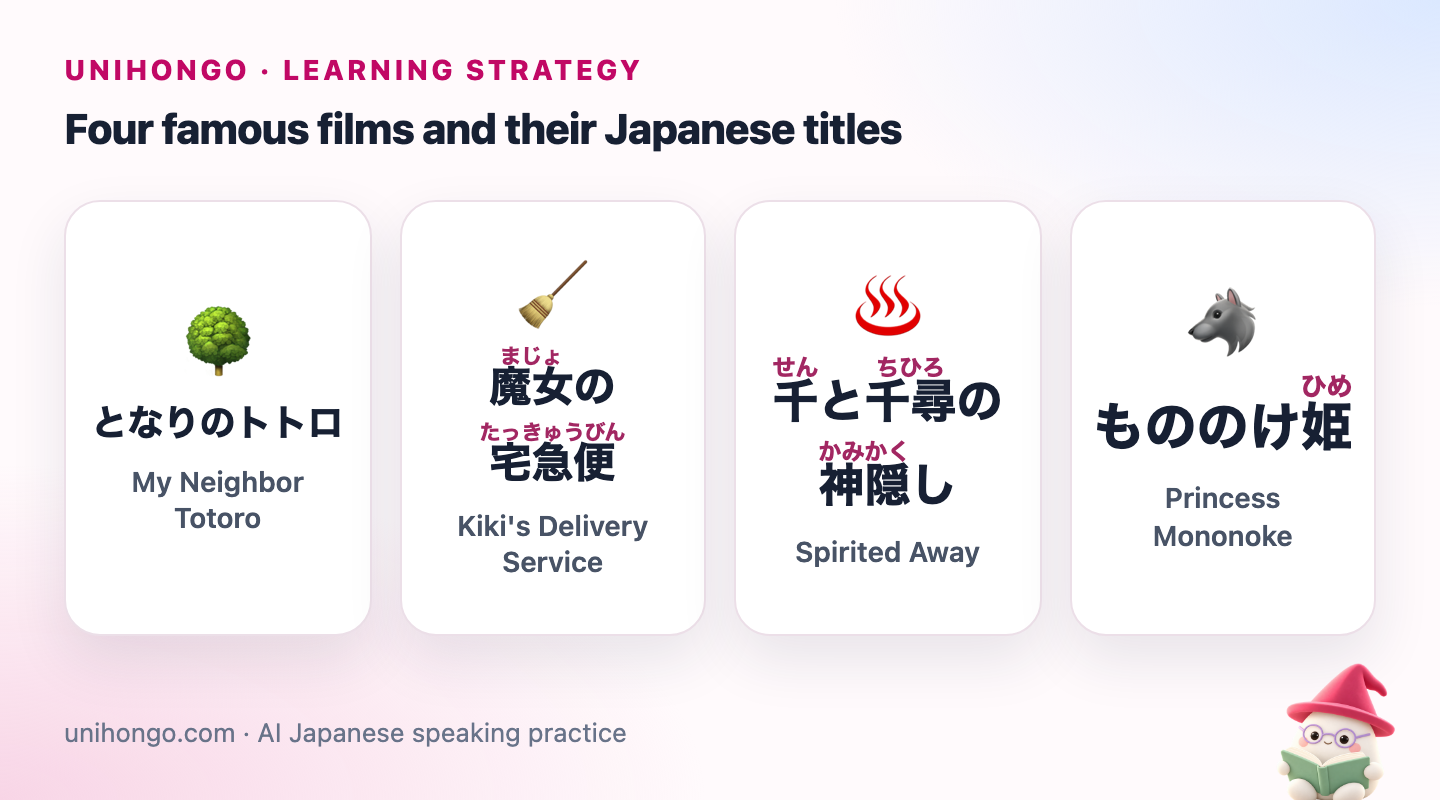
| Japanese | Romaji | Meaning |
|---|---|---|
| となりのトトロ | Tonari no Totoro | My Neighbor Totoro |
| 魔女の宅急便 | Majo no Takkyūbin | Kiki's Delivery Service |
| 千と千尋の神隠し | Sen to Chihiro no Kamikakushi | Spirited Away |
| もののけ姫 | Mononoke Hime | Princess Mononoke |
| 耳をすませば | Mimi o Sumaseba | Whisper of the Heart |
| 崖の上のポニョ | Gake no Ue no Ponyo | Ponyo |
Which film suits which level
Level here means the language, not the story. A film can be suitable for small children and still be hard to study from if its vocabulary is unusual.
| Film | Good for | Why |
|---|---|---|
| My Neighbor Totoro | Upper beginners | Family talk, greetings and short lines at a gentle pace |
| Kiki's Delivery Service | Upper beginners to intermediate | Polite speech to adults and customers, casual talk with friends |
| Whisper of the Heart | Intermediate | Modern school and family conversation at natural speed |
| Spirited Away | Intermediate | Workplace orders, rough speech, bathhouse and spirit vocabulary |
| Princess Mononoke | Advanced | Archaic grammar, warrior speech and old pronouns |
Totoro follows two sisters who move to the countryside with their father, so the script is full of the things families say to each other every day. Kiki is a young witch who leaves home and starts a delivery business, which means she introduces herself, thanks people and talks to customers again and again. Those are exactly the situations a learner needs.
What the titles themselves teach
Each title is a small lesson. Tonari no Totoro uses tonari (隣), "next door", joined to the name by no. Majo no Takkyūbin is "the witch's express delivery". Takkyūbin is in fact a trademark of the delivery company Yamato Transport; the general word that you should use for a parcel service is takuhaibin.
Sen to Chihiro no Kamikakushi means "the spiriting away of Sen and Chihiro". Kamikakushi is the traditional word for a person who vanishes mysteriously, literally "hidden by the gods". Notice that Sen and Chihiro share the kanji 千, read sen in one name and chi in the other. In Mononoke Hime, mononoke are spirits that haunt or possess, and hime is "princess".
| Japanese | Romaji | Meaning |
|---|---|---|
| 隣 | tonari | next door, neighbouring |
| 魔女 | majo | witch |
| 宅配便 | takuhaibin | parcel delivery service |
| 神隠し | kamikakushi | being spirited away |
| 姫 | hime | princess |
The method: one scene, six steps
Watching a whole film in Japanese feels productive, but most of it washes past. Real progress comes from a scene of one or two minutes that you take apart and put back together.
- Watch the whole film once, in whatever way lets you enjoy the story.
- Choose one scene with clear dialogue: a meal, a greeting at the door, a conversation at a shop counter.
- Play it with Japanese subtitles, nihongo jimaku (日本語字幕), and pause on every line to read it.
- Look up only the words that block your understanding, and write down five at most.
- Loop the scene without subtitles until you can hear every word you read.
- Shadow it: speak along with the characters a fraction of a second behind them, copying their speed and melody.
Whether Japanese subtitles are available depends on the disc or streaming service in your region, so check the subtitle menu before you plan around them.
Everyday words these films repeat
Home and work scenes in these films are built from a small set of fixed phrases. You will hear the same greetings at doors and tables in real Japanese homes, so every one of these is safe to use.
| Japanese | Romaji | Meaning |
|---|---|---|
| いってきます。 | Ittekimasu. | I'm off. (leaving home) |
| いってらっしゃい。 | Itterasshai. | Take care. (to the one leaving) |
| ただいま。 | Tadaima. | I'm home. |
| おかえりなさい。 | Okaerinasai. | Welcome back. |
| いただきます。 | Itadakimasu. | Said before eating. |
| お父さん | otōsan | dad, father |
| お母さん | okāsan | mom, mother |
| おばあちゃん | obāchan | grandma |
| 引っ越し | hikkoshi | moving house |
| お届け物です。 | Otodokemono desu. | I have a delivery for you. |
The greetings come in pairs, and each pair is a tiny conversation: ittekimasu is answered with itterasshai, and tadaima with okaerinasai. Practise them as pairs, playing both sides.
Why Princess Mononoke is the hard one
Princess Mononoke is set in Japan of the Muromachi period, several hundred years ago, and its script sounds the part. Characters say sonata (そなた) for "you", a pronoun nobody uses now. Negatives end in nu (ぬ) where modern speech has nai. Leaders and warriors speak in a formal, clipped style that belongs to period drama.
None of this makes it a bad film to watch in Japanese. It makes it a bad model. If you repeat its lines to a classmate, you will sound like someone speaking Shakespeare's English at a bus stop.
Lines to copy and lines to leave on the screen
Even the easier films contain speech you should not imitate. In Totoro, little Mei talks like a four-year-old, and her famous slip turns tōmorokoshi (とうもろこし), "corn", into a jumbled version of the word. It is charming, and it is wrong. In Spirited Away, much of what the heroine hears at the bathhouse is rough orders from people above her.
A simple rule helps. Copy what a character says politely to an adult, a stranger or a customer. Understand, but do not copy, what bosses shout, what villains growl and what small children babble. Kiki's careful greetings to the people she meets in her new town are some of the most reusable lines in any of these films.
From watching to speaking
The last step is the one most learners skip: saying something of your own. After a study session, close the laptop and describe the scene aloud. Who was in it? Where were they? What did they want?
Then borrow one line and change one word. If a character said that the bread was delicious, say that your lunch was delicious. A film phrase becomes yours only when you have used it to say something true about your own day.
| Japanese | Romaji | Meaning |
|---|---|---|
| この映画が大好きです。 | Kono eiga ga daisuki desu. | I love this film. |
| 日本語の字幕で見ました。 | Nihongo no jimaku de mimashita. | I watched it with Japanese subtitles. |
| 一番好きな場面はどこですか。 | Ichiban suki na bamen wa doko desu ka. | Which scene do you like best? |