
An honest ranking of what is hard
Most of the difficulty for an English speaker comes from five features, and none of them is the sound system. Two of them, kanji and politeness, are long-term projects that you keep refining for years. The other three, verb-final order with particles, pitch accent with mora timing, and dropped subjects, are habits that you can retrain in months if you practise them out loud. The table puts each one next to the thing that actually fixes it.
| Feature | Why it is hard for you | What actually fixes it |
|---|---|---|
| Kanji and three scripts | Thousands of characters with several readings each, and no alphabet to fall back on | Learn kanji inside words you already say; speaking does not have to wait for writing |
| Verb-final order and particles | The meaning arrives at the end, and roles are marked by particles rather than by position | Build sentences from the verb backwards and hold the earlier chunks lightly |
| The politeness system | Verb endings change with the relationship, and English has no equivalent switch | Default to masu and desu, then add plain forms and keigo one setting at a time |
| Pitch accent and mora timing | English stress lengthens and loudens a syllable; Japanese keeps beats even and uses pitch | Count beats on your fingers and shadow short lines rather than long ones |
| Dropped subjects | Sentences leave out what is already known, so context carries the meaning | Track the topic across turns and answer questions without a pronoun |
What is easier than its reputation
Japanese has five vowels and a small set of consonants, so almost every sound already exists in your mouth. There are no articles, so you never choose between a and the. Nouns have no gender and no plural ending; neko is a cat or several cats. Verbs do not change for person or number, and conjugation follows two regular classes plus two irregular verbs, suru and kuru. Compare that with the irregular verb lists of French or Spanish and the trade looks fair.
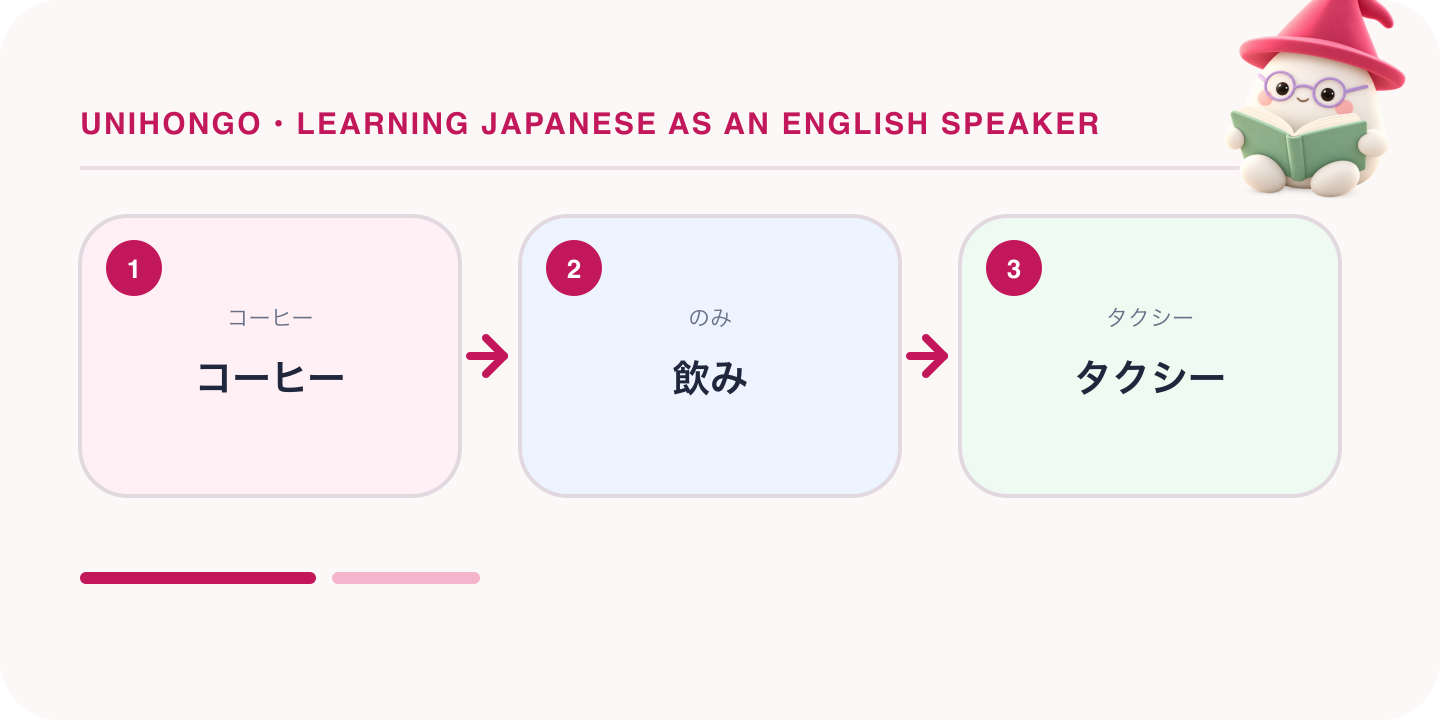
On top of that, Japanese has borrowed a large stock of English words, written in katakana and used daily. Coffee, taxi, hotel, test, bus and hundreds more are recognisable once you hear their Japanese shape. They are not free, because the sounds change, but they mean that your first hundred nouns arrive faster than in a language with no borrowings at all.
| Japanese | Romaji | Meaning |
|---|---|---|
| コーヒーを飲みます。 | Kōhī o nomimasu. | I drink coffee. |
| タクシーを呼んでください。 | Takushī o yonde kudasai. | Please call a taxi. |
| ホテルはどこですか? | Hoteru wa doko desu ka? | Where is the hotel? |
| 明日、テストがあります。 | Ashita, tesuto ga arimasu. | I have a test tomorrow. |
| 猫が好きです。 | Neko ga suki desu. | I like cats. (no article, no plural) |
| 学生です。 | Gakusei desu. | I am a student. (no subject needed) |
The mindset shift: start from the verb
English puts the subject first and the verb second, so you know what is happening almost immediately. Japanese puts the verb last, and a listener collects the pieces until it arrives. Many learners find that the sentence feels backwards for weeks, then suddenly does not. The shift is to stop thinking I go to Tokyo tomorrow and start thinking tomorrow, Tokyo, go. Decide the verb first in your head, then say the pieces that lead to it.
The second half of the shift is the topic. Wa does not mean is. It frames what the sentence is about, and the rest is a comment on that frame. That is why watashi wa unagi desu in a restaurant means I will have the eel, not I am an eel. English forces you to name a subject; Japanese lets you name a frame and then talk. Once you hear wa as as for, half of the strange sentences stop being strange.
| Japanese | Romaji | Meaning |
|---|---|---|
| 私は毎朝コーヒーを飲みます。 | Watashi wa maiasa kōhī o nomimasu. | I drink coffee every morning. |
| 私は学生です。 | Watashi wa gakusei desu. | As for me, I am a student. |
| 私はうなぎです。 | Watashi wa unagi desu. | I will have the eel. (at a restaurant) |
| 明日、友達と東京に行きます。 | Ashita, tomodachi to Tōkyō ni ikimasu. | I am going to Tokyo with a friend tomorrow. |
| 週末は家で休みました。 | Shūmatsu wa ie de yasumimashita. | At the weekend I rested at home. |
Particles are not prepositions in disguise
English prepositions come before the noun and often carry several meanings; Japanese particles come after the noun and label its role. The trap is translating at as one particle. At the station is eki de if you wait there and eki ni if you arrive there, because de marks the stage of an action and ni marks a point. Several English verbs also take an object where Japanese uses ni or ga, so meet a friend is tomodachi ni aimasu and understand Japanese is nihongo ga wakarimasu. The full particle map is covered in the particles guide on this blog.
| Japanese | Romaji | Meaning |
|---|---|---|
| 駅で待ちます。 | Eki de machimasu. | I will wait at the station. |
| 駅に着きました。 | Eki ni tsukimashita. | I arrived at the station. |
| 友達に会いました。 | Tomodachi ni aimashita. | I met a friend. |
| 日本語がわかります。 | Nihongo ga wakarimasu. | I understand Japanese. |
| 電車で行きます。 | Densha de ikimasu. | I go by train. |
Politeness is a grammar setting, not a tone of voice
English marks politeness with word choice and intonation: could you possibly, would you mind. Japanese builds it into the verb ending, so the same sentence changes form depending on who is listening. This feels alien at first, but it is simpler than it looks because the polite masu and desu forms are correct in nearly every situation a beginner meets. Plain forms are for friends and for grammar inside longer sentences; keigo is for customers and superiors. The polite versus casual guide on this blog covers the switch in depth.
| Japanese | Romaji | Meaning |
|---|---|---|
| おはようございます。 | Ohayō gozaimasu. | Good morning. (polite) |
| おはよう。 | Ohayō. | Morning. (casual) |
| 今、行きます。 | Ima, ikimasu. | I am on my way. (polite) |
| 今、行く。 | Ima, iku. | On my way. (casual) |
| すみません、もう一度お願いします。 | Sumimasen, mō ichido onegai shimasu. | Sorry, once more please. |
| 田中さんはいらっしゃいますか? | Tanaka-san wa irasshaimasu ka? | Is Mr Tanaka there? (honorific) |
Long vowels and the small tsu are whole beats
Japanese is timed in morae, even beats, and English is timed in stresses. That is why the two most common English-speaker errors are the same error: a beat goes missing. A long vowel is two beats, so obāsan, grandmother, is one beat longer than obasan, aunt, and bīru, beer, is longer than biru, building. The small tsu is a beat of silence before the next consonant, so kitte, cut, has a pause that kite, come, does not. An English ear hears these as the same word said with more or less emphasis; a Japanese ear hears different words.
| Japanese | Romaji | Meaning |
|---|---|---|
| おばさんとおばあさんがいます。 | Obasan to obāsan ga imasu. | My aunt and my grandmother are here. |
| ビルの前でビールを飲みました。 | Biru no mae de bīru o nomimashita. | I drank a beer in front of the building. |
| ここに来てください。 | Koko ni kite kudasai. | Please come here. |
| ここで切ってください。 | Koko de kitte kudasai. | Please cut here. |
| 切手を買いました。 | Kitte o kaimashita. | I bought stamps. |
| 東京に行きます。 | Tōkyō ni ikimasu. | I am going to Tokyo. (to-o-kyo-o, four beats) |
The r, the fu and vowels without a glide
The Japanese r is a single tap of the tongue behind the teeth, somewhere between an English d, l and r; it is never the curled American r or a rolled one. Fu is made by blowing air gently between the lips, with no teeth on the lower lip, so it sounds softer than an English f. The vowels are the deeper habit. English e and o glide into a second sound, so day ends in an ee and go ends in an oo. Japanese e and o stop where they start: eki is not ay-kee, and sō is not sow. Sake ends in a clean e, not ee.
| Japanese | Romaji | Meaning |
|---|---|---|
| りんごを二つください。 | Ringo o futatsu kudasai. | Two apples, please. |
| 富士山を見ました。 | Fujisan o mimashita. | I saw Mount Fuji. |
| お風呂に入ります。 | Ofuro ni hairimasu. | I take a bath. |
| 駅はあそこです。 | Eki wa asoko desu. | The station is over there. (e, not ay) |
| お酒を飲みますか? | O-sake o nomimasu ka? | Do you drink alcohol? (a clean e at the end) |
| そうですか。 | Sō desu ka. | I see. (o without a w glide) |
Stress is the habit pitch accent will punish
English gives every word one stressed syllable that is louder, longer and higher, and it squashes the others. Japanese keeps every beat the same length and uses pitch alone, a step up or down between morae, to shape the word. If you stress Tōkyō the English way, you lengthen one vowel and shorten another, and the pitch pattern goes with it. In standard Tokyo pronunciation, ame with a high-low pattern is rain and with a low-high pattern is a sweet; hashi high-low is chopsticks and low-high is a bridge. Context usually rescues you, but the even timing is what makes you sound like you are speaking Japanese rather than reading it.
| Japanese | Romaji | Meaning |
|---|---|---|
| 雨が降っています。 | Ame ga futte imasu. | It is raining. (a-me, high then low) |
| 飴を食べました。 | Ame o tabemashita. | I ate a sweet. (a-me, low then high) |
| 箸をください。 | Hashi o kudasai. | Chopsticks, please. (ha-shi, high then low) |
| 橋を渡ります。 | Hashi o watarimasu. | I cross the bridge. (ha-shi, low then high) |
Reading the context when the subject is gone
English needs a subject in almost every sentence, even a dummy one like it in it is raining. Japanese leaves out whatever both speakers already know, and that is usually the subject and often the object too. The question kinō nani o shimashita ka already establishes that we are talking about you and yesterday, so the natural answer is just eiga o mimashita. Adding watashi wa is not wrong, but it sounds like you are contrasting yourself with someone. Learn to answer with the verb and let the question supply the rest.
| Japanese | Romaji | Meaning |
|---|---|---|
| 昨日、何をしましたか? | Kinō, nani o shimashita ka? | What did you do yesterday? |
| 映画を見ました。 | Eiga o mimashita. | I watched a film. |
| 日本語を勉強していますか? | Nihongo o benkyō shite imasu ka? | Are you studying Japanese? |
| はい、しています。 | Hai, shite imasu. | Yes, I am. |
| おいしいですか? | Oishii desu ka? | Is it good? |
| はい、おいしいです。 | Hai, oishii desu. | Yes, it is delicious. |
Notice that none of the answers repeat the subject, the object or the time. This is the pattern to copy in conversation: the question hands you a frame, and you fill it with the smallest complete predicate. It also makes listening easier, because you stop hunting for a subject that was never going to be there.
A first-month speaking plan
- Week one: learn hiragana by reading it aloud with a finger tap for every beat, and record yourself on the contrast pairs obasan and obāsan, kite and kitte, biru and bīru.
- Week two: build ten verb-first sentences a day about your own routine, saying the verb silently first and then the time, companion, place and object in front of it.
- Week three: practise particle pairs out loud, eki de against eki ni and tomodachi to against tomodachi ni, until the choice comes from meaning rather than from English at.
- Week four: hold a five-minute conversation about your day in masu and desu, answering questions with the verb alone and without a single anata or watashi.
- Every day: shadow one short native line for timing, then say one thing about your day that you have never said before.