
The short answer and the catch
Most learners do well with five to fifteen new words a day. Ten is a sensible default if you study most days and use some kind of spaced review, such as flashcards. Busy beginners can start at five and still make solid progress; learners with more time and a steady routine sometimes go higher.
The catch is reviews. With spaced repetition, a word you add today comes back tomorrow, then a few days later, then weeks later. Each day you are reviewing words from many earlier days at once. In many learners' experience, the daily review load grows to several times the new-word number after the first weeks. So the real question is not how many words you can learn today, but how many reviews you can live with next month.
| Japanese | Romaji | Meaning |
|---|---|---|
| 今日の新しい言葉 | kyō no atarashii kotoba | today's new words |
| 単語 | tango | word, vocabulary item |
| 復習 | fukushū | review |
| 覚える | oboeru | to memorise, to remember |
Learn word families, not lonely words
Japanese has a big advantage for vocabulary: many words share kanji, and each shared kanji usually keeps a related meaning. If you learn words in small families, each word makes the next one easier to remember and to read.
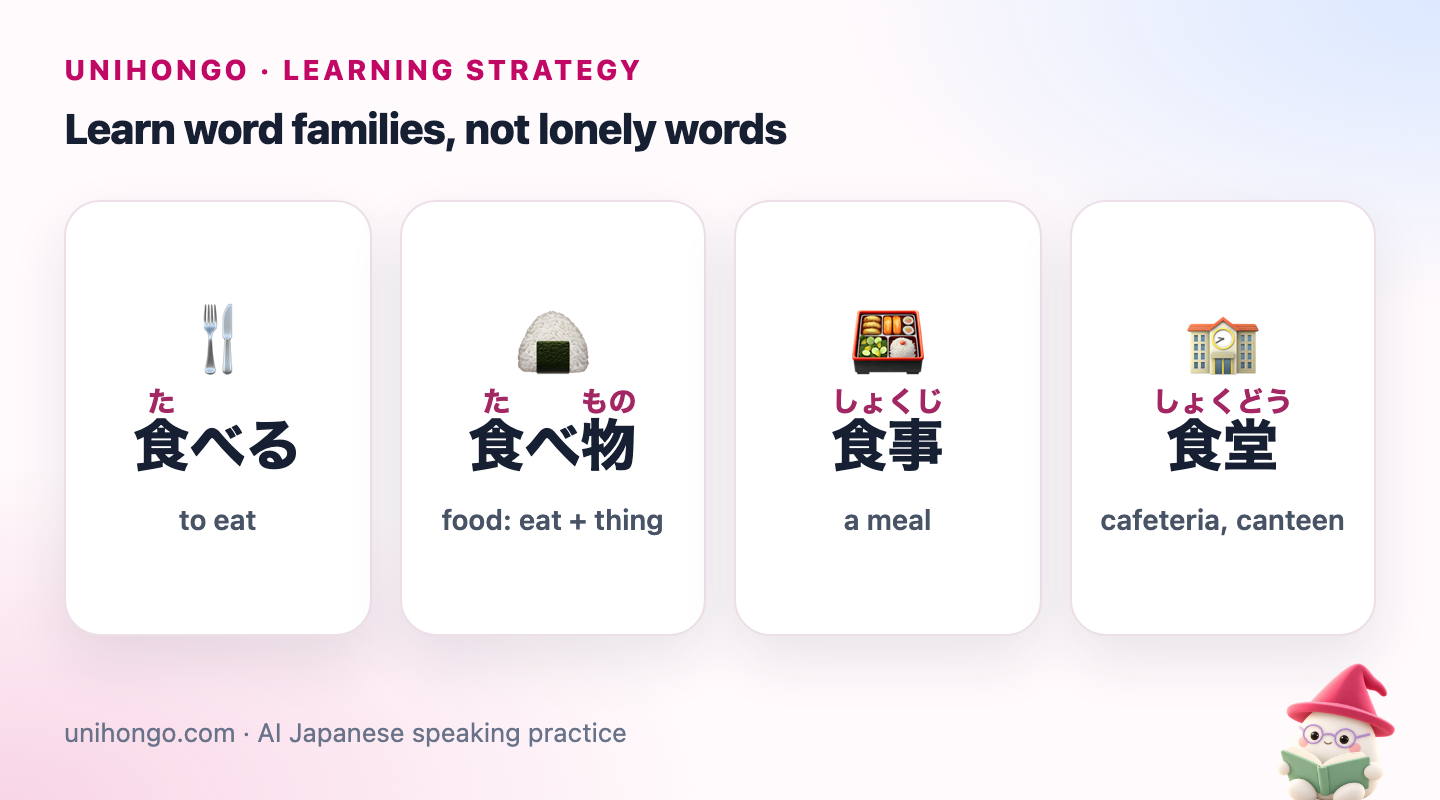
| Japanese | Romaji | Meaning |
|---|---|---|
| 食べる | taberu | to eat |
| 食べ物 | tabemono | food: eat + thing |
| 食事 | shokuji | a meal |
| 食堂 | shokudō | cafeteria, canteen |
The kanji 食 is read ta in taberu and tabemono and shoku in shokuji and shokudō. Learning the family together shows you both readings in context, which is far easier than meeting them months apart. Other productive families start from kanji like 電 (electricity: denki, densha, denwa) and 学 (study: gakkō, gakusei, daigaku).
How the daily numbers add up
The arithmetic is encouraging, as long as you keep it honest. The table shows how many words you would add at different paces if you studied every day. In reality you will forget some, skip some days and retire some cards, so treat these as upper limits rather than predictions.
| New words a day | After one month | After six months | After one year |
|---|---|---|---|
| 5 | about 150 | about 900 | about 1,800 |
| 10 | about 300 | about 1,800 | about 3,650 |
| 15 | about 450 | about 2,700 | about 5,500 |
| 20 | about 600 | about 3,600 | about 7,300 |
Compare this with the commonly quoted, unofficial estimates for the JLPT: roughly 800 words for N5 and 1,500 for N4. Even five words a day gets you past the N4 range within a year if you keep going. Steady beats fast.
What learning a word actually means
A Japanese word is not one fact but several: the meaning, the reading, usually the written form with kanji, and how it is used. 予約 (yoyaku) means reservation, but you also need to know that you say yoyaku suru, to make a reservation, and yoyaku o toru in some contexts. Counting a word as learned when you only recognise its meaning on a card is the main reason high daily numbers look good on paper and fail in conversation.
A practical definition: you have learned a word when you can understand it in a sentence and say it yourself in a simple sentence. That is why every word in your daily batch should come with at least one short example.
| Japanese | Romaji | Meaning |
|---|---|---|
| 予約 | yoyaku | reservation |
| 予約します。 | Yoyaku shimasu. | I'll make a reservation. |
| 予約をお願いします。 | Yoyaku o onegai shimasu. | I'd like to make a reservation, please. |
| 予約は七時です。 | Yoyaku wa shichiji desu. | The reservation is at seven. |
Choose your number by time and goal
- Little time, long goal: five new words a day, with reviews done every day. This is enough to build a real vocabulary over a year.
- Regular study, general goal: ten a day. Raise it only if reviews stay comfortable for a full month.
- A trip or exam coming up: choose the words you will need, not a bigger number. Twenty words for ordering food and asking the way beat fifty random words.
- Restarting after a break: start with zero new words until your old reviews are under control, then begin again at five.
- Advanced learners: numbers matter less than sources. Take new words from what you read and hear, and keep only the ones you meet more than once.
Whatever number you choose, keep it for at least a month before you change it. The first two weeks feel easy because reviews have not built up yet, so a number that seems too low at first is often exactly right by week four. If you want to go faster, raise the number by a few words at a time and watch your review load for another two weeks.
Use today's words the same day
Words stick better when you use them on the day you learn them. You do not need a long conversation: one short exchange with a friend, a coworker or a tutor is enough to turn a card into a memory. Here is a simple example with a word from today's family.

| Japanese | Romaji | Meaning |
|---|---|---|
| お昼、どこで食べる? | Ohiru, doko de taberu? | Coworker: Where are you having lunch? (casual) |
| 今日は食堂で食べようかな。 | Kyō wa shokudō de tabeyō ka na. | You: I think I'll eat in the cafeteria today. |
| いいね。一緒に行こう。 | Ii ne. Issho ni ikō. | Coworker: Nice. Let's go together. |
| 今日の定食、何かな。 | Kyō no teishoku, nan ka na. | You: I wonder what today's set meal is. |
| たしか、魚だったよ。 | Tashika, sakana datta yo. | Coworker: Fish, I think. |
Shokudō came from the word family above, and teishoku, a set meal, is a natural next word that you meet in exactly this situation. Taking new words from the conversations you actually have is the most reliable way to choose them.
Signs you are going too fast
- Your reviews take longer every week and you start skipping them.
- You recognise many cards but cannot use the words when you speak.
- You mix up words that share a kanji, such as 時間 (jikan, time) and 時代 (jidai, era).
- You feel a small dread before opening your flashcards.
- New words never appear outside your deck, in what you read or hear.
Any two of these mean it is time to cut new words for a week and let your reviews settle. Lowering the number is not a step back; it keeps the habit alive.
Let Mocchi set the pace for you
Instead of guessing, tell Mocchi your level, your goal and how much time you have, and ask: "How many new words a day should I learn, and which ones first?" Mocchi folds a daily word batch into your personal plan, uses /vocab to introduce words with examples, and keeps track of the ones you miss, so a later /review brings them back. If the pace feels too heavy, ask it to adjust the plan.
Turn the batch into flashcards with /create-flashcards, with a photo for each, and review them with spaced repetition. On days when reviews feel dull, play Vocabulary Dash or Mocchi Flight with your own flashcards: same words, different format.