
Why JLPT vocabulary is made for games
Vocabulary for a general purpose is open-ended: there is always another word, and no drill can cover it. JLPT vocabulary is different. Each level, N5 through N1, draws on a broadly settled body of words, and the higher levels build on the lower ones. A closed set can be covered completely by repetition, and covered again until the slow items become fast. That is what a game round does well: it shows you every item in a deck, feeds back on each one at once, and brings the ones you missed round sooner than the ones you knew.
The exam's format sharpens the fit. It is multiple choice, and it tests vocabulary by recognition: you pick the reading, the kanji, the word for the gap, the paraphrase, or the sentence in which the word is used naturally. Nothing asks you to produce a word from nothing. Games are recognition engines, so they train the exam's actual task. The honest corollary is that they train only that task, which is why the last section of this guide is about speaking.
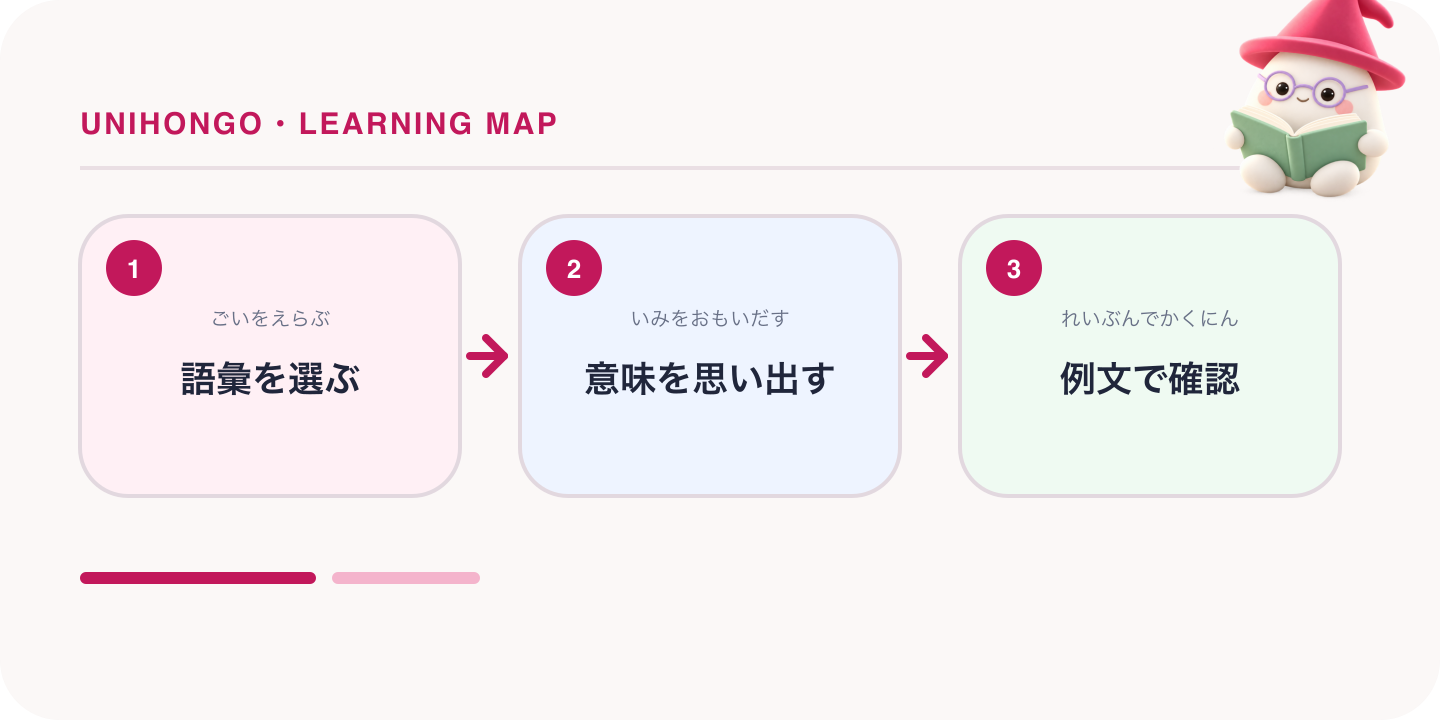
What the exam wants from a word
Knowing a JLPT word means more than matching it to an English gloss. In most sittings the language knowledge section asks about a word in several shapes: the kanji reading, the correct kanji for a word given in kana, the word that completes a sentence, a word or phrase with a similar meaning, and the sentence in which the word is used correctly. The last one is the trap. A learner who knows that shinchō means careful can still fail to see that it does not describe a careful stitch or a careful driver, because the word's range is narrower than its gloss.
- Reading: see the kanji and produce the kana in your head before the options appear.
- Orthography: see the kana and pick the kanji; lookalike kanji are the usual distractors.
- Gap fill: which word fits the sentence, often decided by collocation rather than meaning.
- Paraphrase: which option means nearly the same; near-synonyms are where N2 and N1 live.
- Usage: which of the sentences uses the word naturally; this rewards having met the word in real sentences.
Check the current question shapes on the official JLPT site before you sit, since details vary between levels and can change. The method below does not depend on the exact format, only on the fact that every shape is recognition.
Level by level: deck, focus and routine
| Level | Deck focus | Game routine |
|---|---|---|
| N5 | Everyday nouns, basic verbs and adjectives, numbers, time words | Vocabulary Dash from meaning to Japanese, then Listen & Pick; Say It! on every new word |
| N4 | Daily-life verbs, common adverbs, katakana loanwords, te-form partners | Vocabulary Dash in both directions, Kotoba Stack from an English clue, Sentence Builder twice a week |
| N3 | Work, study and society words; suru verbs; adverbs of degree | Kotoba Stack as the main game, Listen & Pick daily, Sentence Builder on every grammar point you meet |
| N2 | Abstract nouns, near-synonym sets, formal verbs, kanji compounds | Kotoba Stack on paraphrase clues, Vocabulary Dash for speed, Sentence Builder for usage |
| N1 | Low-frequency compounds, idioms, literary and bureaucratic register | Vocabulary Dash from reading to meaning, Quick Flip on misses every day, Sentence Builder on long sentences |
The decks are cumulative in practice even though the exam levels are separate. An N3 candidate who cannot clear the N4 deck quickly is carrying a gap the N3 reading passages will expose. Run the deck below yours once a week as a speed check, and treat any word that slows you there as a flashcard, not as beneath you.
N5 and N4: build the base in Vocabulary Dash
Vocabulary Dash is a 3D lane runner: a word or a meaning appears, and you steer into the gate that matches it. At N5 and N4 the words are concrete and frequent, so speed is the whole target. Play the N5 pack from meaning to Japanese until a round feels easy, then flip the direction so the Japanese word appears and you choose the meaning. The second direction is closer to the exam, but the first direction is what stops the words from being passive.
The lines below are what N5 and N4 vocabulary sounds like in use. Each contains two or three words from the packs, and each is a sentence you could say to a teacher about your own week. If you can read them but not say them without stopping, that is the gap the speaking step at the end of this guide is for, and it is normal at this level.
| Japanese | Romaji | Meaning |
|---|---|---|
| 毎日、学校で日本語を勉強します。 | Mainichi, gakkō de nihongo o benkyō shimasu. | I study Japanese at school every day. |
| 駅の前に銀行があります。 | Eki no mae ni ginkō ga arimasu. | There is a bank in front of the station. |
| この本は少し高いです。 | Kono hon wa sukoshi takai desu. | This book is a little expensive. |
| 週末は友達と映画を見ました。 | Shūmatsu wa tomodachi to eiga o mimashita. | I watched a film with a friend at the weekend. |
| 電車が遅れたので、会議に間に合いませんでした。 | Densha ga okureta node, kaigi ni maniaimasen deshita. | The train was late, so I did not make it to the meeting in time. |
| 日本の生活にだんだん慣れてきました。 | Nihon no seikatsu ni dandan narete kimashita. | I have gradually got used to life in Japan. |
| 用事があるので、先に失礼します。 | Yōji ga aru node, saki ni shitsurei shimasu. | I have something to do, so I will leave before you. |
| 荷物を預かってもらえますか? | Nimotsu o azukatte moraemasu ka? | Could you keep my luggage for me? |
N3: the bridge level in Kotoba Stack
N3 is where the vocabulary stops being things you can point at and starts being things you talk about: work, study, society, feelings and degrees. Kotoba Stack suits this level because it works from a clue. You read the clue, choose the Japanese word that matches, and every right answer adds a block to your tower; a wrong choice costs you the block. Because the clue can be a definition or a paraphrase rather than a one-word gloss, it trains the exam's paraphrase question directly.
Play the N3 deck in Kotoba Stack as your main game and use Vocabulary Dash for speed once the tower is reliably tall. The words that fall at this level are usually suru verbs and adverbs of degree, which sound alike and mean nearly the same thing. Say each one inside a sentence, as below, rather than as an isolated word, because the sentence is what fixes the difference.
| Japanese | Romaji | Meaning |
|---|---|---|
| 最近、仕事が忙しくて、なかなか運動できません。 | Saikin, shigoto ga isogashikute, nakanaka undō dekimasen. | Work has been busy lately and I can hardly find time to exercise. |
| この資料を明日までに確認しておいてください。 | Kono shiryō o ashita made ni kakunin shite oite kudasai. | Please check this document by tomorrow. |
| 彼はどんな仕事でも積極的に取り組みます。 | Kare wa donna shigoto demo sekkyokuteki ni torikumimasu. | He tackles any job proactively. |
| 環境問題について意見を交換しました。 | Kankyō mondai ni tsuite iken o kōkan shimashita. | We exchanged opinions about environmental problems. |
| 期限を延長してもらえないでしょうか。 | Kigen o enchō shite moraenai deshō ka. | Could you possibly extend the deadline? |
N2 and N1: near-synonyms and register
At N2 and N1 the exam stops asking whether you know a word and starts asking whether you know it better than its neighbours. The paraphrase and usage questions are built from sets of near-synonyms and from words whose register is wrong for the sentence around them. A game can still help, but the deck has to be played differently: from reading to meaning in Vocabulary Dash for speed on compounds, and from paraphrase clues in Kotoba Stack for the synonym sets.
The N1 lines below use plain form, because the register of N1 vocabulary is often written and formal, and the exam's usage sentences reflect that. Say them anyway. A learner who can only recognise kōchaku jōtai in a passage has one kind of knowledge; a learner who can use it in a sentence about a meeting has the kind that survives the exam.
| Japanese | Romaji | Meaning |
|---|---|---|
| 彼の説明は具体的で、とても分かりやすかったです。 | Kare no setsumei wa gutaiteki de, totemo wakariyasukatta desu. | His explanation was concrete and very easy to follow. |
| 新しい制度は来年度から導入される予定です。 | Atarashii seido wa rainendo kara dōnyū sareru yotei desu. | The new system is due to be introduced from next fiscal year. |
| 予算の都合上、計画を見直さざるを得ません。 | Yosan no tsugōjō, keikaku o minaosazaru o emasen. | Owing to budget constraints, we have no choice but to review the plan. |
| この件については、慎重に検討する必要があります。 | Kono ken ni tsuite wa, shinchō ni kentō suru hitsuyō ga arimasu. | This matter needs to be considered carefully. |
| 彼女の発言は、議論の核心を突いていた。 | Kanojo no hatsugen wa, giron no kakushin o tsuite ita. | Her remark went to the heart of the debate. (plain form) |
| 交渉は膠着状態に陥り、打開策が見いだせなかった。 | Kōshō wa kōchaku jōtai ni ochiiri, dakaisaku ga miidasenakatta. | The negotiations reached a deadlock and no way forward could be found. (plain form) |
| 曖昧な表現は、かえって誤解を招きかねません。 | Aimai na hyōgen wa, kaette gokai o manekikanemasen. | Vague wording may, if anything, invite misunderstanding. |
| 長年の努力が実を結び、ようやく目標を達成した。 | Naganen no doryoku ga mi o musubi, yōyaku mokuhyō o tassei shita. | Years of effort bore fruit and I finally reached the goal. (plain form) |
Mix directions so you can produce as well as recognise
A word has at least three faces for the exam: its kanji, its reading and its meaning. Most learners drill one direction, usually Japanese to meaning, because it is the comfortable one and it looks like the exam. But the reading questions run from kanji to kana, and the orthography questions run from kana to kanji, and a learner who has only ever gone from word to meaning will be slow in both. Games make switching direction cheap: change the deck setting, play one round, and the same words come back wearing a different face.
Production is the fourth face, and no recognition game supplies it. The nearest a game gets is Quick Flip with the meaning side up, where you must produce the Japanese before you flip, and Say It!, where you must say it. Use both, but understand that they are rehearsals for the speaking step, not substitutes for it.
- Monday and Thursday: Vocabulary Dash from Japanese to meaning, the exam's direction.
- Tuesday and Friday: Vocabulary Dash or Kotoba Stack from meaning or clue to Japanese, the production direction.
- Wednesday: Listen & Pick on the same deck, so the reading face and the sound face meet.
- Every day: Quick Flip on misses with the meaning side up, saying the Japanese before you flip.
- Weekend: Sentence Builder on the week's words, then say the words to a teacher.
Listen & Pick for the listening section
The listening section uses the same vocabulary as the language knowledge section, but delivered once, at speed, without kanji to lean on. Learners who are strong on paper fail here for a plain reason: they have never heard most of their words. Listen & Pick plays a Japanese word and asks you to choose its meaning, and the word is not shown first, so you cannot read your way to the answer. It is the smallest possible listening drill, and it isolates the one skill the section adds.
Play it on the same deck you are running in Vocabulary Dash, not a different one, so every word gets a sound face on the same day it gets a written face. The words that fail in Listen & Pick but pass in Vocabulary Dash are your listening list: usually long vowels, doubled consonants and voiced versus unvoiced pairs that you have been reading past. Those words go to Say It! next, because a sound you can produce is a sound you can hear.
Sentence Builder for the usage questions
Usage questions are where isolated memorisation is punished. Each offers the target word inside several sentences, and only one uses it naturally. The distractors are sentences where the gloss fits but the Japanese does not: the wrong particle after the word, the wrong kind of subject, the wrong register. You cannot answer these from a word list. You answer them from having seen and said the word in real sentences often enough to feel when the sentence around it is wrong.
Sentence Builder gives you Japanese chunks and asks you to tap them into the correct order. It is a grammar and word-order game, and for JLPT vocabulary its value is that the target word arrives with its particle, its verb and its position attached. After each round, say the completed sentence aloud, then say it again with one chunk changed. Sentences like these are what the game builds, and each one carries a word the usage questions like to test.
| Japanese | Romaji | Meaning |
|---|---|---|
| 昨日、駅で先生に会いました。 | Kinō, eki de sensei ni aimashita. | Yesterday I met my teacher at the station. |
| 雨が降っても、試合は行われます。 | Ame ga futte mo, shiai wa okonawaremasu. | Even if it rains, the match will go ahead. |
| 忘れないうちにメモしておきます。 | Wasurenai uchi ni memo shite okimasu. | I will make a note before I forget. |
| 説明を聞いたところ、思ったより簡単でした。 | Setsumei o kiita tokoro, omotta yori kantan deshita. | When I heard the explanation, it was easier than I had thought. |
| 忙しいにもかかわらず、手伝ってくれました。 | Isogashii ni mo kakawarazu, tetsudatte kuremashita. | Despite being busy, they helped me. |
Save misses as flashcards for Quick Flip
A JLPT deck is finite, which means the words you keep missing are a short list, and a short list is what a flashcard set should be. When you are signed in, misses from your games and words from your conversations can be saved as flashcards, and they appear automatically in Quick Flip and in the saved flashcards deck of Vocabulary Dash. Quick Flip is deliberately plain: a card shows one side, you try to remember the other before you flip, and you judge yourself.
Be strict when you judge. The exam does not give partial credit for a reading that was nearly right, and a card you clear too early comes back as a wrong answer in the language knowledge section. Keep the card in the form the exam will use: kanji on one side, reading and meaning on the other, and, for the usage traps, one short sentence that shows the word's range.
- Save every miss from Vocabulary Dash and Kotoba Stack on the day it happens, not at the weekend.
- Save any word you could not hear in Listen & Pick, marked as a listening card.
- Save any word the AI Sensei corrected or supplied in conversation, with the sentence you were trying to say.
- Clear a card only when you have produced the reading, the meaning and one sentence without hesitation.
- Once a week, run the saved flashcards deck in Vocabulary Dash so cleared words are tested at speed.
The speaking step the exam does not test
The JLPT measures recognition, and everything above serves that. But a learner who passes N3 and cannot ask a colleague to extend a deadline has a certificate and a problem. Speaking is the step you add because the exam will not, and it is also the step that makes the exam words stick, because producing a word is the strongest retrieval there is. Open a live voice conversation with your AI Sensei in Unihongo's immersive 3D classroom, name the level you are preparing for, and ask the teacher to work through the words you missed today.
Drive the conversation yourself. Name the word, make a sentence, and ask the teacher for a second sentence with the same word so you hear it back in a different frame. When two words share a gloss, ask the teacher to explain the difference in Japanese and then make a sentence with each. For an N2 or N1 candidate, choose the strict teacher and the job interview or workplace call mission, where the formal vocabulary belongs. Here is how a session on N3 words tends to run.
| Japanese | Romaji | Meaning |
|---|---|---|
| 今日は試験の言葉を使って話したいです。 | Kyō wa shiken no kotoba o tsukatte hanashitai desu. | Today I want to speak using exam words. |
| 「確認する」を使って文を作ります。 | "Kakunin suru" o tsukatte bun o tsukurimasu. | I will make a sentence using "kakunin suru". |
| 出発の前に、時間を確認します。 | Shuppatsu no mae ni, jikan o kakunin shimasu. | Before departure, I will check the time. |
| いいですね。「確認」と「検討」の違いは分かりますか? | Ii desu ne. "Kakunin" to "kentō" no chigai wa wakarimasu ka? | Good. Do you know the difference between "kakunin" and "kentō"? (teacher) |
| 確認は事実を確かめることで、検討はよく考えることです。 | Kakunin wa jijitsu o tashikameru koto de, kentō wa yoku kangaeru koto desu. | Kakunin is verifying a fact, and kentō is thinking something over. |
| その通りです。では、「検討」で一つ文を作ってください。 | Sono tōri desu. Dewa, "kentō" de hitotsu bun o tsukutte kudasai. | Exactly. Now make one sentence with "kentō". (teacher) |
| 新しい提案を検討しています。 | Atarashii teian o kentō shite imasu. | We are considering the new proposal. |
| 発音が合っているか教えてください。 | Hatsuon ga atte iru ka oshiete kudasai. | Please tell me whether my pronunciation is right. |
| 「提案」の「て」をもう少しはっきり言いましょう。 | "Teian" no "te" o mō sukoshi hakkiri iimashō. | Say the "te" in "teian" a little more clearly. (teacher) |
| 今日間違えた言葉をもう一度言います。 | Kyō machigaeta kotoba o mō ichido iimasu. | I will say the words I got wrong today once more. |
The session report afterwards lists the corrections, and every word the teacher supplied or fixed goes straight into flashcards, which closes the loop: games find the gaps, the conversation tests them under pressure, and Quick Flip carries them to tomorrow. The exam will only ever see the recognition half of that loop. You will have both halves.