

Month one: kana in two weeks, then your first sentences
Spend the first fourteen days on hiragana and katakana and nothing else that needs reading. Learn five to ten characters a day and test yourself by reading real kana words out loud rather than by writing lists. By day fourteen you should read a kana word in a second or two, not decode it letter by letter. From this point, switch every romaji resource off. Romaji is a crutch that quietly ruins pronunciation and delays reading.
In weeks three and four, learn the sentence frame that carries a beginner through hundreds of conversations: noun plus desu, and the polite masu verb form. Add the particles wa, o, ni and ka and around 150 words drawn from your own life: your job, your city, your food, your daily routine. The goal is not to know grammar rules but to say ten true sentences about yourself without stopping.
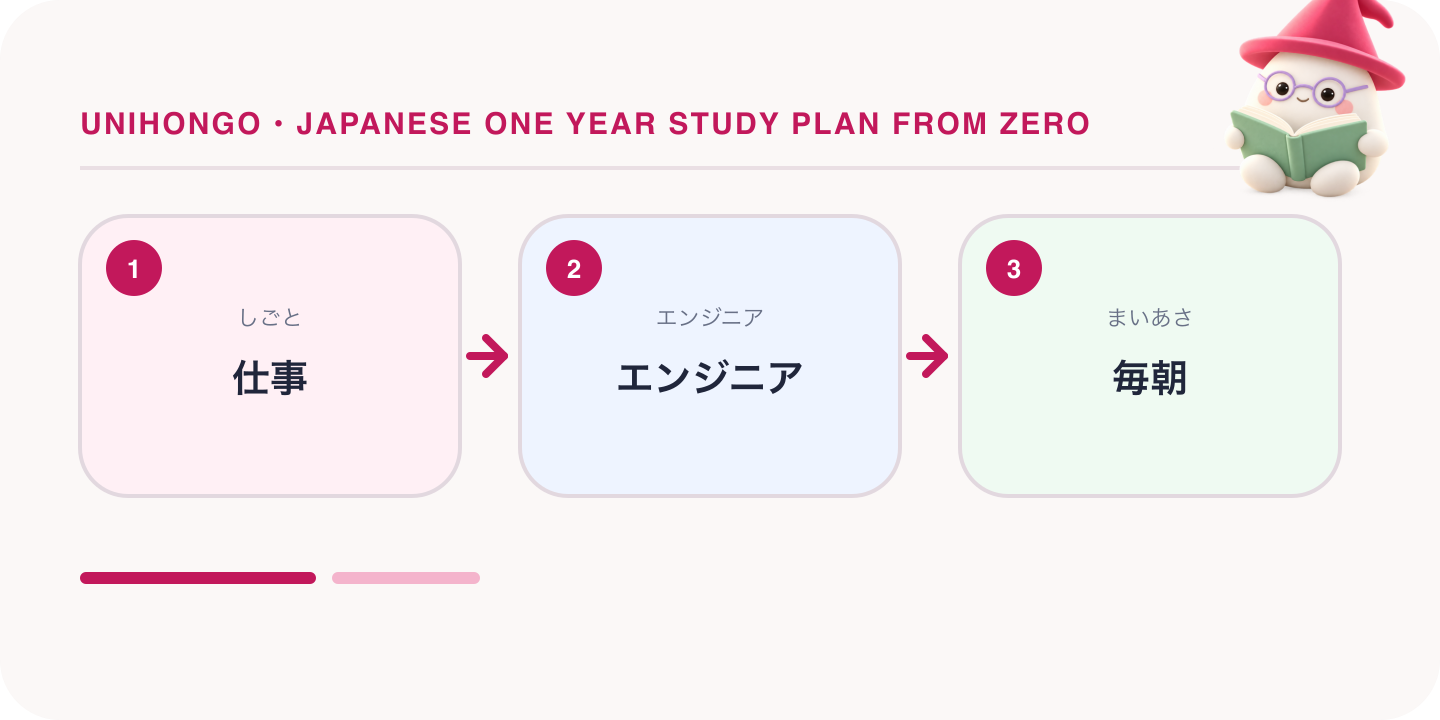
| Japanese | Romaji | Meaning |
|---|---|---|
| はじめまして。マリアです。 | Hajimemashite. Maria desu. | Nice to meet you. I'm Maria. |
| ブラジルから来ました。 | Burajiru kara kimashita. | I'm from Brazil. |
| 仕事はエンジニアです。 | Shigoto wa enjinia desu. | I work as an engineer. |
| 毎朝コーヒーを飲みます。 | Maiasa kōhī o nomimasu. | I drink coffee every morning. |
| 日本語を勉強しています。 | Nihongo o benkyō shite imasu. | I'm studying Japanese. |
| お名前は何ですか。 | O-namae wa nan desu ka. | What is your name? |
Months two to four: core grammar and first real conversations
This is the grammar-heavy stretch, but grammar here means patterns you immediately use in speech. Cover the plain form of verbs and adjectives, the te form and its uses (requests, ongoing actions, linking actions), past tense, negatives, the counters you actually need (people, flat things, long things, general things), time and frequency words, and the comparison patterns. Learn each pattern with three sentences about your own life, not with the textbook's example about Mr Tanaka.
Vocabulary should reach about 600 to 800 words by the end of month four. Prioritise verbs and the adjectives you use to describe feelings, weather and food. Start kanji in month two at five to ten characters a week, always inside words: learn 食 as part of tabemasu and shokuji, not as an isolated shape with a list of readings.
The speaking milestone for the first quarter is a transactional conversation: order food, buy something, ask for a price, ask where something is. The phrases below are the kind you should be producing without notes by the end of month four.
| Japanese | Romaji | Meaning |
|---|---|---|
| これをください。 | Kore o kudasai. | This one, please. |
| トイレはどこですか。 | Toire wa doko desu ka. | Where is the toilet? |
| 昨日は友達と映画を見ました。 | Kinō wa tomodachi to eiga o mimashita. | Yesterday I watched a film with a friend. |
| ちょっと待ってください。 | Chotto matte kudasai. | Please wait a moment. |
| 週末は何をしますか。 | Shūmatsu wa nani o shimasu ka. | What do you do at the weekend? |
| もう一度言ってください。 | Mō ichido itte kudasai. | Please say that once more. |
Months five to eight: connecting ideas and telling short stories
The middle of the year is where most learners stall, because the novelty has gone and the material becomes about nuance rather than new building blocks. Give this stretch a clear job: learn to connect sentences. That means kara and node for reasons, kedo and ga for contrast, to omoimasu for opinions, the conditional forms, and the giving and receiving verbs that Japanese uses constantly.
Vocabulary target by month eight: roughly 1,200 to 1,500 words, with kanji at 250 to 350. At this stage, listening should become a daily habit rather than an occasional treat: ten to twenty minutes of material slightly above your level, ideally with a transcript. Keep speaking at least three times a week; the second-quarter milestone is telling a two-minute story about something that happened to you, with a beginning, a problem and how it ended.
| Japanese | Romaji | Meaning |
|---|---|---|
| 雨が降っていたので、家にいました。 | Ame ga futte ita node, ie ni imashita. | It was raining, so I stayed at home. |
| 安いけど、あまりおいしくないです。 | Yasui kedo, amari oishikunai desu. | It's cheap, but not very tasty. |
| 日本語は難しいと思います。 | Nihongo wa muzukashii to omoimasu. | I think Japanese is difficult. |
| 時間があったら、京都に行きたいです。 | Jikan ga attara, Kyōto ni ikitai desu. | If I have time, I want to go to Kyoto. |
| 漢字が少し読めるようになりました。 | Kanji ga sukoshi yomeru yō ni narimashita. | I've become able to read a little kanji. |
| 友達に日本の本をもらいました。 | Tomodachi ni Nihon no hon o moraimashita. | I received a Japanese book from a friend. |
Months nine to twelve: unscripted conversation and repair skills
The final quarter is about coping with conversations you did not prepare for. Learn the repair language that fluent speakers use constantly: asking for a rephrase, checking you understood, buying time, admitting you do not know a word and describing it instead. Add the humble and honorific forms you will hear from staff, and the passive and causative patterns.
Vocabulary targets diverge by hour budget now: about 1,500 words on the five-hour route, 2,000 on ten and 2,500 on fifteen, with kanji at roughly 300, 450 and 600. The final milestone is a fifteen-minute unscripted conversation on everyday topics where you keep going despite gaps, using the repair phrases instead of switching to English.
| Japanese | Romaji | Meaning |
|---|---|---|
| すみません、今のはどういう意味ですか。 | Sumimasen, ima no wa dō iu imi desu ka. | Sorry, what does what you just said mean? |
| えっと、何と言えばいいかな。 | Etto, nan to ieba ii ka na. | Um, how should I put it. |
| その言葉は知らないんですが、説明します。 | Sono kotoba wa shiranai n desu ga, setsumei shimasu. | I don't know that word, but I'll explain it. |
| つまり、明日は休みということですか。 | Tsumari, ashita wa yasumi to iu koto desu ka. | So you mean tomorrow is a day off? |
| もう少しゆっくり話してもらえますか。 | Mō sukoshi yukkuri hanashite moraemasu ka. | Could you speak a little more slowly? |
| 先生に明日までに出すように言われました。 | Sensei ni ashita made ni dasu yō ni iwaremashita. | I was told by the teacher to hand it in by tomorrow. |
Weekly schedule at five, ten and fifteen hours
The route is the same at every budget; what changes is how far along it you get. Speaking is deliberately protected: even on the five-hour plan it never drops below an hour, because it is the activity people cut first and regret most.
| Activity | 5 hours a week | 10 hours a week | 15 hours a week |
|---|---|---|---|
| Vocabulary and kanji review | 1 hour | 2 hours | 2.5 hours |
| Grammar study with own sentences | 1 hour | 1.5 hours | 2 hours |
| Listening with transcript | 1 hour | 2 hours | 3 hours |
| Speaking out loud | 1 hour | 2 hours | 3 hours |
| Reading in kana and kanji | 0.5 hour | 1.5 hours | 2.5 hours |
| Weekly review and recording | 0.5 hour | 1 hour | 2 hours |
| Word target at month 12 | about 1,500 | about 2,000 | about 2,500 |
| Kanji target at month 12 | about 300 | about 450 | about 600 |
Split the hours across at least five days. If a week collapses, do the vocabulary review and one speaking session and let the rest go; the plan survives a bad week as long as those two continue.
Vocabulary and kanji pacing that does not burn you out
A good first-year rule is that every new word must be one you could plausibly say this month. Fill your deck from your own conversations and listening material, and let textbook lists be a backup rather than the source.
Kanji pacing is where plans most often break. The temptation is to sprint through a few hundred characters with mnemonics in the first months, which feels productive but produces recognition without reading. A steadier rhythm holds better across a year:
- Weeks 1-2: no kanji at all, only kana until they are automatic
- Months 2-4: five to ten kanji a week, always inside words you use
- Months 5-8: ten kanji a week, plus reading short texts daily
- Months 9-12: ten to fifteen a week, learning from what you read
- Every week: review old kanji in sentences, not as isolated cards
- Every month: read something with no furigana and note what you could not read
Daily repetition of words and kanji is exactly what Unihongo's free learning games are for: a few minutes of game play covers the day's review without opening a spreadsheet.
Speaking milestones each quarter
A plan without checkpoints becomes a reading list. Record each milestone and keep the recordings: hearing the difference between your month-three and month-nine self is the best evidence that the plan is working.
| Japanese | Romaji | Meaning |
|---|---|---|
| 自己紹介をしてもいいですか。 | Jikoshōkai o shite mo ii desu ka. | May I introduce myself? |
| ホットコーヒーを一つお願いします。 | Hotto kōhī o hitotsu onegai shimasu. | One hot coffee, please. |
| 先週、財布をなくして大変でした。 | Senshū, saifu o nakushite taihen deshita. | Last week I lost my wallet and it was awful. |
| 最近、日本の映画にはまっています。 | Saikin, Nihon no eiga ni hamatte imasu. | Lately I'm hooked on Japanese films. |
| それについては、私も同じ意見です。 | Sore ni tsuite wa, watashi mo onaji iken desu. | On that point, I have the same opinion. |
Quarter one: a self-introduction and a café or shop transaction. Quarter two: a two-minute story about something that happened to you. Quarter three: a five-minute conversation where you ask as many questions as you answer. Quarter four: a fifteen-minute unscripted conversation in which you repair misunderstandings in Japanese rather than switching languages.
What a realistic level looks like at twelve months
At the end of the year on the ten-hour route, you read kana instantly and recognise several hundred kanji, enough to read menus, signs, simple messages and graded readers without a dictionary for every line. You understand slow, clear speech on familiar topics and catch the gist of faster speech when the context is obvious. You can handle shops, restaurants, directions, small talk about work and hobbies, and simple problems such as a wrong order or a lost item.
On the five-hour route the picture is the same with fewer words and slower speech; on fifteen hours you will be starting longer conversations and short articles. None of this is fluency. The most common way to fall short is not laziness but silence: a year of diligent study with almost no speaking produces a learner who understands the milestone conversations perfectly and cannot take part in them. The fix is the same as in this plan: protect the speaking hour every week.
| Japanese | Romaji | Meaning |
|---|---|---|
| 一年前は、ひらがなも読めませんでした。 | Ichinen mae wa, hiragana mo yomemasen deshita. | A year ago I couldn't even read hiragana. |
| 今は簡単な会話ならできます。 | Ima wa kantan na kaiwa nara dekimasu. | Now I can manage simple conversations. |
| まだ分からないことが多いですが、続けます。 | Mada wakaranai koto ga ōi desu ga, tsuzukemasu. | There's still a lot I don't understand, but I'll keep going. |