
The heritage profile, described honestly
The typical heritage speaker understands fast natural speech without effort, has pronunciation and rhythm that a classroom learner would need years to approach, and can hold a warm, fluent conversation about food, family, weather, childhood and household logistics. Grammar is intuitive rather than explicit: you know that a sentence sounds wrong without being able to say which rule it broke, which is exactly how a first language feels.
The gaps follow the same logic. You never read at home, so kanji is close to zero. You were never anyone's subordinate in Japanese, so 敬語 was never addressed to you and you never had to produce it. Your vocabulary is wide in domestic life and thin everywhere else, so you can describe a rice cooker but not a lease, a mortgage, a deadline or a diagnosis. And a few child-level habits were fixed early and never corrected, because parents correct meaning, not register.
Why standard courses fit badly
A beginner course spends its first months on things you already own: sound, greetings, basic verbs, listening comprehension of slow speech. Sitting through that is not humility, it is lost time, and the boredom is the main reason heritage learners quit. Meanwhile the same course introduces kanji at a pace calibrated to someone who does not yet know the words, which for you is far too slow, because the hard part of a new kanji for a beginner is the word behind it, and you already have the word.
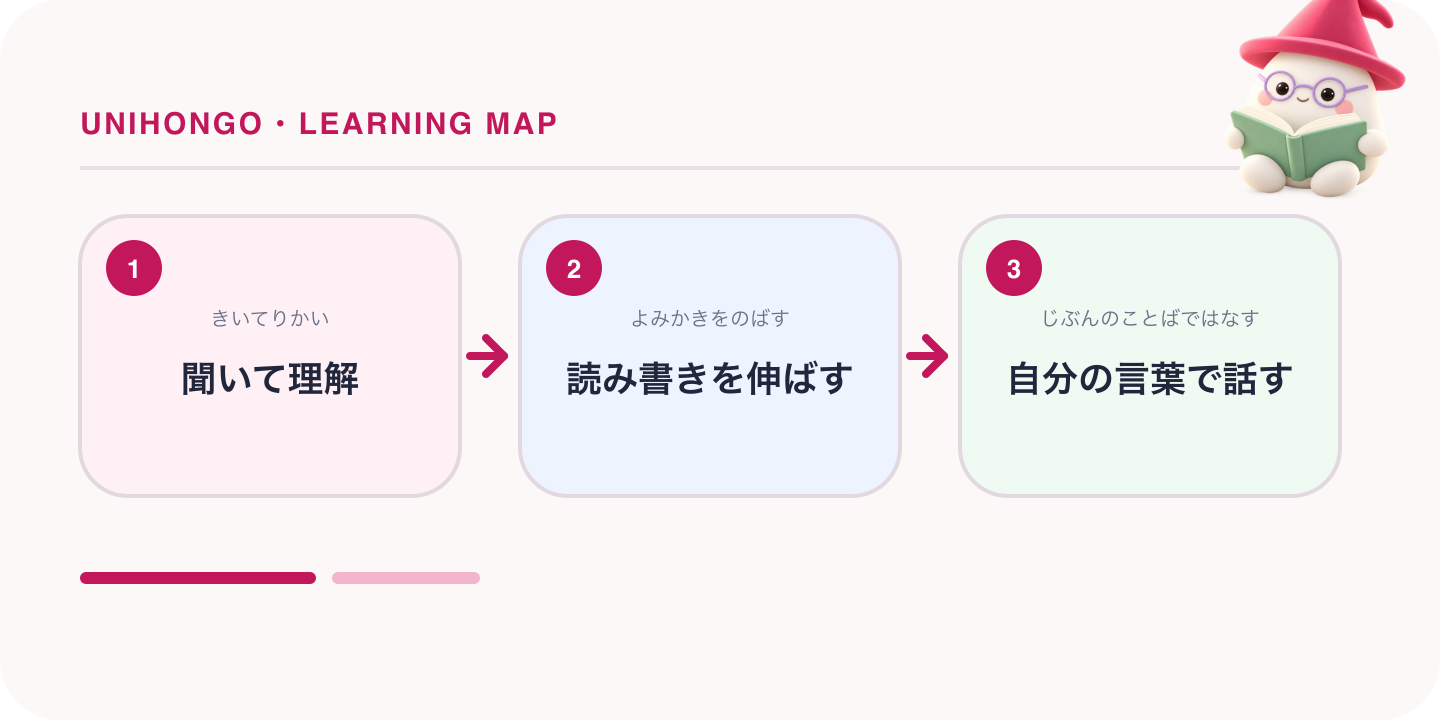
An advanced course has the opposite problem. It assumes you can read the text it hands out, follow written grammar explanations, and produce formal written Japanese, none of which you were ever taught. So you look strong in discussion and then fail on the page, which is demoralising and easy to misread as a lack of ability. The answer is not to find the one perfect course. It is to split your study into two tracks running at different speeds.
- Speaking and listening: start at intermediate or higher, and choose material for register and vocabulary, not for grammar.
- Reading and kanji: start at absolute zero, but expect to move several times faster than a course schedule.
- Writing: start at zero as well, and treat it as the skill that exposes everything the other two hide.
- Grammar: study explicitly for the first time, to attach names to patterns you already use correctly.
Strengths and gaps, with the study response
| Area | Where you usually stand | What to do about it |
|---|---|---|
| Listening | Strong, including fast casual speech | Move to news, business meetings and lectures for unfamiliar vocabulary |
| Pronunciation | Natural, often near-native rhythm | Protect it; only check pitch on words you learned from text |
| Casual speech | Fluent and idiomatic | Keep it, and label it as one register among several |
| Polite speech | Patchy, drifts back to casual under pressure | Drill whole polite sentences until they are the default |
| Keigo | Rarely acquired at home | Learn sonkeigo and kenjōgo as fixed pairs inside real scenes |
| Kanji | Usually the largest gap | Start from the beginning but pair each kanji with words you already say |
| Reading | Slow, guessy, avoids long text | Read daily at a level low enough to finish, then raise it |
| Writing | Little practice, weak formatting | Write short messages and emails, then real documents |
| Vocabulary range | Deep at home, thin at work and in the news | Add one non-domestic topic each week and speak it aloud |
| Grammar awareness | Intuitive but unnamed | Learn the terminology so you can self-correct and study |
Read the middle column honestly rather than modestly. A heritage speaker who says my Japanese is bad is usually describing the right-hand gaps while ignoring the left, and a heritage speaker who says my Japanese is fine is usually doing the reverse. Both halves are true at once, and the plan below assumes both.
Kanji from zero, at speed
The reason kanji is slow for most learners is that every character arrives with an unfamiliar word attached. You are not in that position. When you meet 冷蔵庫 you already say reizōko every day, so the only new work is the shapes and the mapping. That makes it reasonable to move through beginner kanji far faster than any course expects, provided you keep the pairing tight.
Work from words to characters, not the other way round. List the words you already use, then find how they are written; each character will arrive already anchored in something meaningful. Where a reading surprises you, mark it, because those are the points where your spoken vocabulary and the written system come apart. And write by hand, at least at first, because the differences between similar characters live in stroke placement and handwriting is what makes you look.
- Make a list of two hundred words you say at home and learn their written forms first.
- Add the on-readings as a second layer, since compound words are where your vocabulary is thinnest.
- Learn components as a small shared alphabet so new characters are combinations rather than pictures.
- Read your own name, your family's names and your address, which most heritage speakers cannot write.
- Set a daily reading minimum in real text, not flashcards, and keep it small enough to never skip.
- Use silent visual drilling between sessions; recognition games suit half-known words well.
Building the register you were never taught
Home Japanese is the language of intimacy. It is short, warm, elliptical and full of shared assumptions, and it is the wrong instrument for a job interview, a landlord, a doctor's receptionist or an email to a client. Learning the polite and formal registers is not learning a new language exactly, but it is close enough that it needs its own practice: the vocabulary is different, the sentence endings are different, the length is different, and the amount you are expected to say is different.
Practise it as whole sentences rather than as transformations. If you consciously convert casual to polite in your head while speaking, you will be slow and you will slip whenever you are tired or emotional. What works is drilling the polite version until it is the first thing that comes out in a formal setting, so that the two registers sit side by side rather than one being derived from the other.
| Japanese | Romaji | Meaning |
|---|---|---|
| ちょっと待って。 | Chotto matte. | Hang on. (home register) |
| 少々お待ちください。 | Shōshō omachi kudasai. | One moment, please. (polite equivalent) |
| わかんない。 | Wakannai. | Dunno. (home register) |
| わかりかねます。 | Wakarikanemasu. | I am afraid I cannot say. (polite equivalent) |
| 知らない。 | Shiranai. | I don't know. (home register) |
| 存じ上げません。 | Zonjiagemasen. | I am not aware of that. (humble equivalent) |
| 何時に来るの? | Nan-ji ni kuru no? | What time are you coming? (home register) |
| 何時にいらっしゃいますか。 | Nan-ji ni irasshaimasu ka. | What time will you be arriving? (honorific equivalent) |
| これ見て。 | Kore mite. | Look at this. (home register) |
| こちらをご覧いただけますか。 | Kochira o goran itadakemasu ka. | Could you take a look at this? (polite equivalent) |
| ごめん。 | Gomen. | Sorry. (home register) |
| 申し訳ございません。 | Mōshiwake gozaimasen. | I am very sorry. (formal equivalent) |
| ありがとう。 | Arigatō. | Thanks. (home register) |
| ありがとうございます。 | Arigatō gozaimasu. | Thank you very much. (polite equivalent) |
| 無理。 | Muri. | No way. (home register) |
| 対応が難しい状況です。 | Taiō ga muzukashii jōkyō desu. | That would be difficult for us to handle. (polite equivalent) |
| あとで電話する。 | Ato de denwa suru. | I'll call later. (home register) |
| のちほどお電話いたします。 | Nochihodo odenwa itashimasu. | I will call you later. (humble equivalent) |
| 聞いてない。 | Kiitenai. | Nobody told me. (home register) |
| 伺っておりません。 | Ukagatte orimasen. | I have not been informed. (humble equivalent) |
| 言っといて。 | Ittoite. | Tell them for me. (home register) |
| お伝えいただけますでしょうか。 | Otsutae itadakemasu deshō ka. | Could you pass that on, please? (polite equivalent) |
| 誰? | Dare? | Who is it? (home register) |
| どちら様でしょうか。 | Dochira-sama deshō ka. | May I ask who is calling? (honorific equivalent) |
| できない。 | Dekinai. | I can't. (home register) |
| いたしかねます。 | Itashikanemasu. | I am unable to do that. (humble equivalent) |
Notice how much longer the right-hand lines are. Formal Japanese is not just politer wording, it is more words per idea, and heritage speakers often stop mid-sentence because the polite version needs a longer runway than they are used to. Practising complete formal sentences out loud fixes that far faster than studying keigo tables.
Talking about your family to outsiders
One correction catches nearly every heritage speaker, because it is invisible at home. Inside the family you say お母さん and お父さん, and that is correct. Speaking to someone outside the family, your own relatives take humble forms while the other person's relatives take honorific ones, and the verbs attached to them shift too. It is a small set of swaps and it signals more about your Japanese than almost anything else in a first meeting.
| Japanese | Romaji | Meaning |
|---|---|---|
| お母さんが言ってた。 | Okāsan ga itteta. | Mum said so. (at home) |
| 母が申しておりました。 | Haha ga mōshite orimashita. | My mother mentioned it. (to an outsider) |
| うちのお父さんは会社員。 | Uchi no otōsan wa kaishain. | My dad works for a company. (at home) |
| 父は会社員でございます。 | Chichi wa kaishain de gozaimasu. | My father is a company employee. (formal) |
| お姉ちゃんが来るよ。 | Onēchan ga kuru yo. | My sister's coming. (at home) |
| 姉が参ります。 | Ane ga mairimasu. | My older sister will be coming. (humble) |
| お宅のお母さんは元気? | Otaku no okāsan wa genki? | How's your mum? (casual) |
| お母様はお元気でいらっしゃいますか。 | Okāsama wa ogenki de irasshaimasu ka. | Is your mother keeping well? (honorific) |
Widening the vocabulary beyond home topics
Domestic vocabulary is deep and specific: you know the word for the drying rack and the exact verb for rinsing rice. Outside that circle the map runs out, and the missing words are mostly Sino-Japanese compounds, which is precisely the layer that reading builds and speech at home does not. This is why vocabulary growth and kanji study are the same project for a heritage speaker rather than two.
Take topics deliberately, one a week, and force output. Read something short on the topic, list the ten words you did not have, then talk about it until those ten words come out naturally. The test is not whether you recognise the word when you hear it, since your recognition is already good and will flatter you. The test is whether it appears in your own sentence when you need it.
| Japanese | Romaji | Meaning |
|---|---|---|
| 家賃の更新について相談したいのですが。 | Yachin no kōshin ni tsuite sōdan shitai no desu ga. | I would like to discuss renewing the rent. |
| 契約書の内容を確認させてください。 | Keiyakusho no naiyō o kakunin sasete kudasai. | Please let me check the contract's contents. |
| 保険は会社の健康保険に加入しています。 | Hoken wa kaisha no kenkō hoken ni kanyū shite imasu. | For insurance, I am enrolled in the company health scheme. |
| 締め切りは来週の金曜日でよろしいでしょうか。 | Shimekiri wa raishū no kin'yōbi de yoroshii deshō ka. | Would next Friday be acceptable as the deadline? |
| 予算の関係で少し調整が必要です。 | Yosan no kankei de sukoshi chōsei ga hitsuyō desu. | Some adjustment is needed for budget reasons. |
| この件は上司に確認してから回答いたします。 | Kono ken wa jōshi ni kakunin shite kara kaitō itashimasu. | I will reply on this matter after checking with my manager. |
| 症状はいつ頃から続いていますか。 | Shōjō wa itsu goro kara tsuzuite imasu ka. | Roughly when did the symptoms begin? (you will hear this) |
| 手続きに必要な書類を教えていただけますか。 | Tetsuzuki ni hitsuyō na shorui o oshiete itadakemasu ka. | Could you tell me which documents the procedure requires? |
| 選挙の結果について記事を読みました。 | Senkyo no kekka ni tsuite kiji o yomimashita. | I read an article about the election results. |
| 環境問題に関心があります。 | Kankyō mondai ni kanshin ga arimasu. | I have an interest in environmental issues. |
Fossilised errors and how to unstick them
Some habits set early and stayed, because they never caused a misunderstanding at home. Common ones include leaving polite endings off under stress, using ら抜き言葉 forms such as 見れる where a formal setting expects 見られる, keeping a childhood word for something you now discuss as an adult, over-relying on a handful of vague fillers, and using speech patterns copied from whichever parent you heard most, which may not match how you want to present yourself.
None of these are moral failings and none of them make your Japanese fake. They are simply the shape of a language acquired in one narrow setting. What removes them is noticing, which is hard to do for yourself because the errors sound like home. Record yourself, get corrections in writing, and pick one habit at a time rather than trying to police everything at once, which only makes you hesitant.
- Record three minutes of yourself speaking formally and transcribe it; the leaks are obvious on the page.
- Choose one habit per fortnight and correct only that one, letting the others go for now.
- Ask for corrections on register specifically, since most people only correct grammar and meaning.
- Separate dialect from error: family speech features are not mistakes, they are simply not the formal standard.
- Rebuild any word you learned as a child but now need as an adult, especially body, money and health vocabulary.
Writing, the skill that hides nothing
Writing is where a heritage speaker's real level becomes visible, which is why it tends to be avoided. Speech lets you route around a word you cannot produce; a written message does not, and it also demands kanji, formatting conventions and a consistent register from the first line to the last. That discomfort is the reason to do it. Twenty minutes of writing exposes more gaps than two hours of comfortable conversation.
Start small and real. Write the messages you would actually send: a note to a landlord, a reply to a colleague, a message rescheduling an appointment. Keep the register consistent within one message, since mixing casual endings into a polite email is the most common heritage tell. Then reread yesterday's writing before you start today's, and correct it, because reviewing your own text is the cheapest teacher available.
| Japanese | Romaji | Meaning |
|---|---|---|
| お世話になっております。 | Osewa ni natte orimasu. | Thank you for your continued support. (email opener) |
| ご連絡いただきありがとうございます。 | Gorenraku itadaki arigatō gozaimasu. | Thank you for getting in touch. |
| 恐れ入りますが、日程を変更していただけますでしょうか。 | Osoreirimasu ga, nittei o henkō shite itadakemasu deshō ka. | I am sorry to trouble you, but could we change the date? |
| ご確認のほど、よろしくお願いいたします。 | Gokakunin no hodo, yoroshiku onegai itashimasu. | I would be grateful if you could check this. |
| 何卒よろしくお願い申し上げます。 | Nanitozo yoroshiku onegai mōshiagemasu. | Thank you very much in advance. (formal close) |
The part nobody puts in the syllabus
Heritage speakers often carry a specific discomfort: not Japanese enough in Japan, because the reading fails and the keigo slips, and too Japanese at home, where relatives assume you can handle anything in the language. People are surprised when you cannot read a form, and that surprise stings more than a stranger's correction would, because it seems to question something about who you are rather than what you studied.
It helps to say the plain version of the situation to yourself. You acquired a specific slice of a language in the setting where you got it, and the parts you lack are the parts nobody in that setting ever taught you. That is not a deficiency of identity, it is a fact about exposure, and it responds to study like any other gap. The learners who make progress are usually the ones who stopped treating a missing kanji as evidence about themselves.
| Japanese | Romaji | Meaning |
|---|---|---|
| 家では日本語を話していましたが、読み書きは苦手です。 | Ie de wa Nihongo o hanashite imashita ga, yomikaki wa nigate desu. | We spoke Japanese at home, but reading and writing are weak for me. |
| 話すのは大丈夫ですが、漢字がほとんど読めません。 | Hanasu no wa daijōbu desu ga, kanji ga hotondo yomemasen. | Speaking is fine, but I can barely read kanji. |
| 敬語にはまだ自信がありません。 | Keigo ni wa mada jishin ga arimasen. | I am still not confident with formal language. |
| 両親の言葉が少し混ざるかもしれません。 | Ryōshin no kotoba ga sukoshi mazaru kamo shiremasen. | My parents' way of speaking may slip in a little. |
| 日常会話は問題ありませんが、仕事の日本語は勉強中です。 | Nichijō kaiwa wa mondai arimasen ga, shigoto no Nihongo wa benkyōchū desu. | Everyday conversation is no problem, but I am still studying business Japanese. |
| 間違えたら直してもらえると助かります。 | Machigaetara naoshite moraeru to tasukarimasu. | It would help if you corrected me when I get things wrong. |
| 今年中に漢字を千字覚えるつもりです。 | Kotoshi-jū ni kanji o sen-ji oboeru tsumori desu. | I intend to learn a thousand kanji this year. |
| 少しずつ書く練習をしています。 | Sukoshi zutsu kaku renshū o shite imasu. | I am practising writing little by little. |
That last set is worth memorising, not because you owe anyone an explanation, but because a calm one-line answer ends the conversation and lets you get on with speaking. Vagueness invites questions; a clear sentence about what you can and cannot do usually gets a helpful reply.
A twelve-week shape for the plan
- Weeks one to four: kana confirmed, first two hundred kanji taken from words you already say, one polite self-introduction memorised.
- Weeks five to eight: daily reading of short real text, one new non-domestic topic a week, all speaking practice in polite form only.
- Weeks nine to twelve: keigo pairs inside scenes, one written message a day, and a recorded formal monologue each week to check for leaks.
- Throughout: keep speaking casually with family, because the fluency you have is the foundation everything else is being added to.
- Every fortnight: reread your own writing from two weeks ago and correct it, which measures progress better than any test.