
The head start: words that travelled in both directions
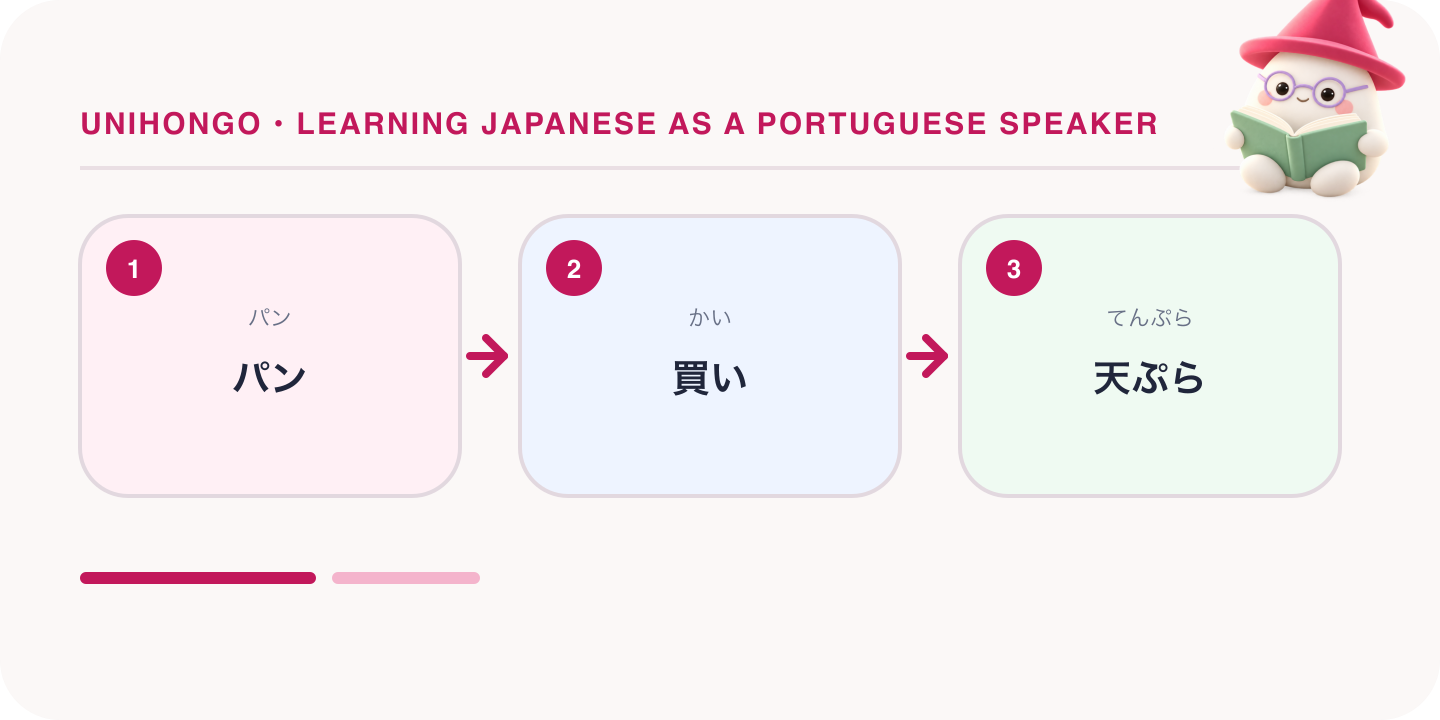
Portuguese traders and missionaries reached Japan in the sixteenth century, and a small group of their words stayed. Pan, bread, is pão. Kappa, a raincoat, is capa. Botan, a button, is botão. Karuta, the playing cards used in a New Year game, is carta. Tabako is tabaco, konpeitō, a star-shaped sugar sweet, is confeito, and shabon in shabondama, a soap bubble, is sabão. Tenpura is usually traced to Portuguese as well, though the exact source word is debated. Bīdoro, old glass, is vidro, and kirishitan, the early Japanese Christians, is cristão.
Words went the other way too. Quimono, saquê, sushi, samurai, judô, karaokê and bonsai are ordinary Portuguese. In Brazil the Japanese-descended community added more: shoyu is the everyday word for soy sauce, missô, yakisoba and sukiyaki are on menus far from any Japanese restaurant, and dekassegui names a Brazilian who has gone to work in Japan. If you grew up around that community you may also know batchan and ditchan for grandmother and grandfather, which are Japanese obāchan and ojīchan worn smooth by Portuguese mouths.
| Japanese | Romaji | Meaning |
|---|---|---|
| パンを買います。 | Pan o kaimasu. | I am buying bread. |
| 天ぷらをお願いします。 | Tenpura o onegai shimasu. | Tempura, please. |
| カッパを持っていますか? | Kappa o motte imasu ka? | Do you have a raincoat? |
| ボタンを押してください。 | Botan o oshite kudasai. | Please press the button. |
| カステラが好きです。 | Kasutera ga suki desu. | I like castella cake. |
| ブラジルから来ました。 | Burajiru kara kimashita. | I am from Brazil. |
| ポルトガル語を話します。 | Porutogarugo o hanashimasu. | I speak Portuguese. |
| 日系ブラジル人です。 | Nikkei burajirujin desu. | I am a Brazilian of Japanese descent. |
| Japanese | Romaji | Portuguese source | Meaning |
|---|---|---|---|
| パン | pan | pão | bread |
| 天ぷら | tenpura | usually traced to Portuguese | battered and fried food |
| カッパ | kappa | capa | raincoat |
| ボタン | botan | botão | button |
| カルタ | karuta | carta | traditional playing cards |
| たばこ | tabako | tabaco | tobacco, cigarettes |
| 金平糖 | konpeitō | confeito | star-shaped sugar sweet |
| シャボン | shabon | sabão | soap, in shabondama |
| カステラ | kasutera | associated with Castela | sponge cake |
| ビードロ | bīdoro | vidro | old-fashioned glass |
| フラスコ | furasuko | frasco | laboratory flask |
| ビロード | birōdo | veludo | velvet |
| オランダ | Oranda | Holanda | the Netherlands |
| イギリス | Igirisu | inglês | Britain |
| キリシタン | kirishitan | cristão | early Japanese Christian |
Fifteen words will not carry a conversation, but they do something more useful: they prove that the language is not sealed off from yours. Pan is the first noun most learners need in a shop or a cafe, and you already say it correctly, apart from the n.
The pronunciation head start
Japanese has five vowels, a, i, u, e, o, and they are the clear open vowels of Portuguese casa, vi, tu, pé and pó, with two small differences: Japanese u is said with the lips relaxed rather than rounded, and every vowel is full even when unstressed. Every syllable is a consonant plus a vowel or a vowel alone, with no clusters, which is close to how Brazilian Portuguese already treats words like advogado in fast speech. The Japanese r is the single r of caro, para and Maria, a quick tap of the tongue tip, in every position.
Two more sounds arrive free. Japanese chi is the tchi of tchau, and Brazilian speakers who turn tia into tchia make it without thinking. Japanese shi is the xi of xícara. Portuguese speakers from Portugal will recognise both from chá and chave, spelt differently but the same sounds. Many learners find they can be understood in Japanese from the first week on the strength of the vowels alone, which is not true for speakers of English or Chinese.
| Japanese | Romaji | Meaning |
|---|---|---|
| ラーメンが好きです。 | Rāmen ga suki desu. | I like ramen. |
| 料理をします。 | Ryōri o shimasu. | I cook. |
| ありがとうございます。 | Arigatō gozaimasu. | Thank you very much. |
| お茶をください。 | Ocha o kudasai. | Tea, please. |
| 七時に会いましょう。 | Shichi-ji ni aimashō. | Let's meet at seven. |
The traps your Portuguese sets
The first trap is nasality. In pão, bem, um and irmã the vowel itself goes through the nose and no consonant follows. Japanese has no nasal vowels. The n at the end of pan, san and Nihon is a separate sound with its own beat, and the vowel before it stays oral. Many Portuguese speakers say Nihon as Nihõ, and san as são, and are understood but sound foreign. Say the vowel clean, then close on n and hold it for a full count.
The second is length. Portuguese does not use vowel length to separate words, so the habit is to shorten everything to one beat. Japanese long vowels are two beats and change meaning: obasan is an aunt, obāsan a grandmother; biru a building, bīru a beer. Doubled consonants are the same idea applied to consonants: kite means come, kitte a stamp, and the difference is a silent beat. Finally, Japanese pronounces every h. Hai, haha, hana and Nihon all start with a breathed h, where Portuguese hotel and hora have none. Brazilian speakers can borrow the sound they already make for the r in Rio or carro, which is close enough.
Two smaller habits to watch. In Brazilian Portuguese an unstressed final o becomes u and a final e becomes i, so neko drifts to neku and sake to saki, and a final te or de becomes tchi or dji, so matte drifts to matchi. Japanese keeps every final vowel and consonant exactly as written. And when a word ends in n and the next begins with a vowel, do not run them together as you would in um amigo: sen'en has a clear n and then a fresh e.
| Japanese | Romaji | Meaning |
|---|---|---|
| 日本に住んでいます。 | Nihon ni sunde imasu. | I live in Japan. |
| 三人です。 | San-nin desu. | There are three of us. |
| パンをください。 | Pan o kudasai. | Bread, please. |
| おばあさんは元気です。 | Obāsan wa genki desu. | My grandmother is well. |
| 東京に行きます。 | Tōkyō ni ikimasu. | I am going to Tokyo. |
| ビールを二本ください。 | Bīru o ni-hon kudasai. | Two beers, please. |
| 切手を買いました。 | Kitte o kaimashita. | I bought stamps. |
| ちょっと待ってください。 | Chotto matte kudasai. | Please wait a moment. |
| はい、そうです。 | Hai, sō desu. | Yes, that is right. |
| 母は花が好きです。 | Haha wa hana ga suki desu. | My mother likes flowers. |
| 猫がいます。 | Neko ga imasu. | There is a cat. |
| お酒を飲みますか? | O-sake o nomimasu ka? | Do you drink alcohol? |
| 千円です。 | Sen'en desu. | That is one thousand yen. |
| Target | What a Portuguese accent tends to produce | Fix |
|---|---|---|
| 日本 Nihon | Nihõ, a nasal vowel | Clean o, then a held n |
| 三 san | são | Same: oral a, then n |
| パン pan | pão | Same: this is the loanword test |
| おばあさん obāsan | obasan, an aunt | Hold the a for two beats |
| 東京 Tōkyō | Tokyo in two beats | Four beats: to, o, kyo, o |
| ビール bīru | biru, a building | Two beats on the i |
| 切手 kitte | kite, come | A silent beat before te |
| 待って matte | matchi | Keep te as te, then hold the pause |
| はい hai | ai | Breathe the h as in the Brazilian r of Rio |
| 母 haha | aa | Two breathed h sounds |
| 猫 neko | neku | Full o at the end |
| 酒 sake | saki | Full e at the end |
| 千円 sen'en | se-nen, run together | Full n, then a fresh e |
| 来る kuru | A guttural first r | The r of caro |
The pronunciation guide on this blog covers the full sound system. For a Portuguese speaker the order of priority is nasal n first, because it marks every sentence; then vowel length and doubled consonants, because they change words; then the h and the final vowels, which are quick to fix once you hear them.
From SVO to SOV: the verb waits at the end
Eu como pão puts the verb between subject and object. Watashi wa pan o tabemasu puts it last, and everything before it is a labelled chunk: watashi wa, the topic; pan o, the object. Those labels are particles, and they do the job your prepositions do, but they come after the noun instead of before it. Em Tóquio becomes Tōkyō de or Tōkyō ni depending on whether something happens there or exists there; de São Paulo, meaning origin, becomes San Pauro kara; com um amigo becomes tomodachi to.
Possession reverses too. O livro do João is Joan no hon: owner, then no, then the thing. One habit transfers directly. Portuguese drops subject pronouns freely, so vou and como are complete sentences, and Japanese does the same: ikimasu and tabemasu need no watashi once the context is clear. What does not transfer is agreement. Como, comes, come and comemos are all tabemasu; the verb changes for tense and politeness, never for person.
| Japanese | Romaji | Meaning |
|---|---|---|
| 私はパンを食べます。 | Watashi wa pan o tabemasu. | I eat bread. |
| サンパウロから来ました。 | San Pauro kara kimashita. | I am from São Paulo. |
| リスボンに住んでいます。 | Risubon ni sunde imasu. | I live in Lisbon. |
| 友達とサッカーを見ました。 | Tomodachi to sakkā o mimashita. | I watched football with a friend. |
| これはマリアの本です。 | Kore wa Maria no hon desu. | This is Maria's book. |
| 私も行きます。 | Watashi mo ikimasu. | I am going too. |
| 九時まで働きます。 | Ku-ji made hatarakimasu. | I work until nine. |
| Portuguese | Japanese particle | Example |
|---|---|---|
| em (where something happens) | で de | 駅で待ちます eki de machimasu |
| em (where something is) | に ni | 駅にいます eki ni imasu |
| a, para (destination) | に ni / へ e | 東京に行きます Tōkyō ni ikimasu |
| de (origin) | から kara | リスボンから Risubon kara |
| de (possession) | の no, after the owner | マリアの本 Maria no hon |
| com (companion) | と to | 友達と tomodachi to |
| até | まで made | 九時まで ku-ji made |
| também | も mo | 私も watashi mo |
The sentence structure and particles guides on this blog go deeper. The one rule to hold in the first month is that the verb closes the sentence, so a Japanese listener waits for it before reacting. Many learners find they need a full month before the pause for the verb stops feeling like a mistake.
Politeness: what você and o senhor become
Portuguese chooses a pronoun and its verb form to set the tone: tu or você for a friend, o senhor and a senhora for respect, and in Portugal a careful avoidance of any pronoun at all in formal situations. Japanese takes that last habit to its conclusion. Pronouns are rare, the person's name with san does the work, and the respect sits on the verb ending. Tabemasu and desu are the polite everyday register, roughly where você in Brazil or a respectful o senhor sits. Plain form, taberu and da, is for the people you would call tu or address by nickname.
Above the masu level sits keigo, the honorific system, which raises the listener with verbs such as irasshaimasu and lowers the speaker with verbs such as mōshimasu. You will hear it from shop staff and use it in interviews and calls to other companies. The honorifics guide on this blog covers it in full; for now, learn a few fixed lines and stay in masu form everywhere else.
| Japanese | Romaji | Meaning |
|---|---|---|
| 田中さんは何を飲みますか? | Tanaka-san wa nani o nomimasu ka? | What will you have to drink, Tanaka? |
| 何飲む? | Nani nomu? | What are you having? (casual) |
| どちらからいらっしゃいましたか? | Dochira kara irasshaimashita ka? | Where have you come from? (respectful) |
| マリアと申します。 | Maria to mōshimasu. | My name is Maria. |
| 少々お待ちください。 | Shōshō o-machi kudasai. | Please wait a moment. |
| お先に失礼します。 | Osaki ni shitsurei shimasu. | Excuse me for leaving first. |
| Portuguese address | Feels like | Japanese equivalent |
|---|---|---|
| tu, você with close friends | Casual | Plain form: 食べる, だ, ない |
| você, Brazilian everyday | Neutral polite | です・ます form |
| o senhor, a senhora | Respectful | です・ます plus keigo, name with san |
No gender, no articles, no agreement
O livro, a mesa, os livros, as mesas: Portuguese makes you decide gender and number for every noun and then agree the article and adjective with it. Japanese has none of that. Hon is a book or books, tomodachi is a friend of either sex, and atarashii stays atarashii whatever it describes. Number appears only when it matters, through a counter after the noun: hon ga san-satsu, three books; neko ga ni-hiki, two cats. Many learners find this the most restful part of Japanese grammar, and it is where your workload drops so that kanji can take its place.
| Japanese | Romaji | Meaning |
|---|---|---|
| 友達が来ます。 | Tomodachi ga kimasu. | A friend is coming. / Friends are coming. |
| 本が三冊あります。 | Hon ga san-satsu arimasu. | There are three books. |
| 猫が二匹います。 | Neko ga ni-hiki imasu. | There are two cats. |
| 新しい車を買いました。 | Atarashii kuruma o kaimashita. | I bought a new car. |
Kanji is where your time will go
You start from an alphabet, so the two kana scripts come first and come fast: most learners have hiragana and katakana in a couple of weeks of daily practice. Kanji is the long project. Each character carries meaning and usually two kinds of reading, and the only way through is to learn characters inside words you already say. Katakana repays you early, because it is the script for foreign words, and a large share of them come from English and a few from Portuguese: pan, botan, kappa and tabako will be among the first words you read.
Your name goes into katakana as well, and it will not sound quite like itself. João becomes Joan, Rodrigo becomes Rodorigo, and Conceição becomes Konseisan. Learn the katakana version early and say it in your self-introduction, because Japanese speakers will use it back to you.
| Japanese | Romaji | Meaning |
|---|---|---|
| この漢字は何と読みますか? | Kono kanji wa nan to yomimasu ka? | How do you read this kanji? |
| ひらがなで書いてください。 | Hiragana de kaite kudasai. | Please write it in hiragana. |
| 名前はジョアンです。 | Namae wa Joan desu. | My name is João. |
| カタカナで書きます。 | Katakana de kakimasu. | I will write it in katakana. |
- Learn hiragana and katakana before anything else, writing each row by hand and reading it aloud.
- Learn each kanji inside one spoken word, never as an isolated symbol with a list of readings.
- Read short texts aloud daily so that reading speed and speaking speed grow together.
- Write your name in katakana on day one and practise saying it the Japanese way.
Your first month of speaking
Your sounds let you be understood from the first week, so the month is about building the verb-last habit and fixing the three or four sounds before fluent, slightly Portuguese-sounding Japanese sets in. Each week adds one focus while keeping the earlier ones alive.
| Japanese | Romaji | Meaning |
|---|---|---|
| もう一度、ゆっくりお願いします。 | Mō ichido, yukkuri onegai shimasu. | Once more, slowly, please. |
| 私の発音はどうですか? | Watashi no hatsuon wa dō desu ka? | How is my pronunciation? |
| ポルトガル語では違います。 | Porutogarugo de wa chigaimasu. | In Portuguese it is different. |
- Week one: self-introduction and daily routine in masu form. Record yourself and check two things only: a clean n with no nasal vowel, and every h pronounced.
- Week two: long vowels and doubled consonants. Say the trap table's minimal pairs at the start of every session, then use three of them in sentences.
- Week three: particles. Take ten nouns and run each through wa, o, ni, de, kara and to aloud, in full sentences, waiting for the verb at the end.
- Week four: register. Say the same request to a friend, a colleague and a hotel receptionist, switching between plain form, masu form and a fixed keigo line.
- Every day: read one short text aloud, tapping the beats, and drop one loanword into conversation to remind yourself the languages already overlap.
Expect fast early progress and a specific plateau. You will be understood almost immediately, which makes it tempting to leave the nasal n and the short vowels in place. Fix them in the first month, while the habits are still soft, and your Japanese will sound better than your grammar for years, which is the right way round.