
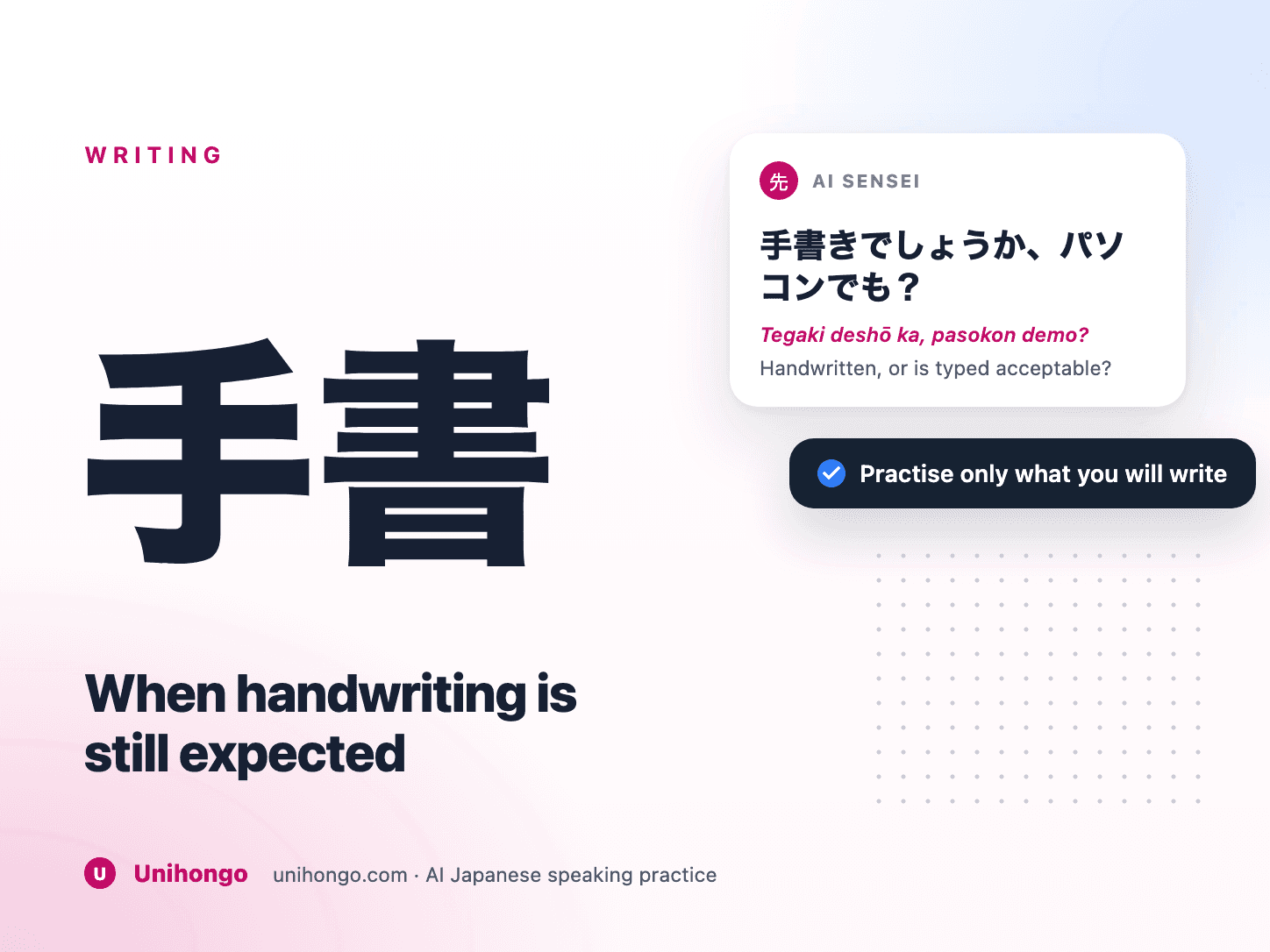
Where it survives
Handwriting in Japan has retreated to a specific set of situations, and they have something in common: they are the ones where the effort itself carries meaning, or where a signature and a physical record are required.
That means the remaining cases are disproportionately weighted socially, which is why they matter more than their frequency suggests.
| Situation | Handwritten? | Note |
|---|---|---|
| Ceremonial envelopes | Yes | Weddings, funerals |
| Thank-you notes | Usually | Typing reads as impersonal |
| Official forms | Usually | Black ink |
| Résumés | Increasingly not | Check with the employer |
| Business documents | No | Typed |
| Internal notes | Sometimes | Quick memos |
The fourth row has changed considerably in recent years. Handwritten résumés were once standard and are now the exception rather than the rule.
Forms and official documents
Municipal offices, banks and many services still use paper forms completed by hand. The conventions are practical rather than aesthetic: black ink, within the boxes, and no correction fluid.
Mistakes are usually handled by crossing out and stamping or initialling rather than by correcting invisibly, and the correct procedure varies, so asking is worthwhile.
| Japanese | Romaji | Meaning |
|---|---|---|
| 黒のボールペンでご記入ください。 | Kuro no bōrupen de gokinyū kudasai. | Please write in black ballpoint. |
| 消えるペンは使用できません。 | Kieru pen wa shiyō dekimasen. | Erasable pens cannot be used. |
| 修正液は使わないでください。 | Shūseieki wa tsukawanaide kudasai. | Please do not use correction fluid. |
| 間違えた場合はどうすればいいですか。 | Machigaeta baai wa dō sureba ii desu ka. | What should I do if I make a mistake? |
| 書き直したほうがいいですか。 | Kakinaoshita hō ga ii desu ka. | Should I rewrite it? |
| 枠内にご記入ください。 | Wakunai ni gokinyū kudasai. | Please write within the box. |
Ceremonial envelopes
Money is given at weddings and funerals in special envelopes, and these are handwritten as a matter of course. The conventions are specific, including which brush or pen to use and, for funerals, ink that appears faded.
This is one area where getting it wrong is noticed, so it is worth asking someone rather than guessing. Shops selling the envelopes will usually explain.
- The envelope type differs for weddings and funerals; they are not interchangeable.
- Your name goes on the front, below the centre.
- The amount is written inside, often in formal numerals.
- Funeral envelopes conventionally use ink that looks faded.
- Ask at the shop; staff routinely explain which envelope suits the occasion.
Notes and thank-you cards
Short personal notes are still handwritten, and the effort is the point: a handwritten thank-you carries weight precisely because it took longer than a message would have.
For a learner this is more approachable than it sounds, because these notes are short and use set phrases.
| Japanese | Romaji | Meaning |
|---|---|---|
| 先日はありがとうございました。 | Senjitsu wa arigatō gozaimashita. | Thank you for the other day. |
| おかげさまで助かりました。 | Okagesama de tasukarimashita. | Thanks to you it was a great help. |
| 心よりお礼申し上げます。 | Kokoro yori orei mōshiagemasu. | I offer my sincere thanks. |
| 取り急ぎお礼まで。 | Toriisogi orei made. | A quick note of thanks. |
| またお目にかかれる日を楽しみにしております。 | Mata ome ni kakareru hi o tanoshimi ni shite orimasu. | I look forward to meeting you again. |
| 季節の変わり目、ご自愛ください。 | Kisetsu no kawarime, gojiai kudasai. | Please take care as the season changes. |
Three or four of these sentences make a complete note. Length is not what makes a handwritten thank-you effective.
Making your handwriting acceptable
The target is legible and even, not beautiful. Nobody expects a learner to write elegantly, and slow careful writing is perfectly acceptable in every situation described here.
The practical route is to practise the specific things you will actually write rather than handwriting in general, which is a far smaller and more achievable task.
- Your own name in katakana, until it is consistent.
- Your address, which appears on almost every form.
- The numbers, including the formal forms used for amounts.
- The five or six set phrases used on notes and envelopes.
- Practise on squared paper, which keeps character size even.
What has stopped being handwritten
It is worth knowing where handwriting is no longer expected, so that effort is not spent where it does not help. Business documents, reports, proposals and most correspondence are typed, and handwriting them would be unusual rather than respectful.
The résumé question is the one that has changed most and the one worth checking each time rather than assuming either way.
| Japanese | Romaji | Meaning |
|---|---|---|
| 手書きでしょうか、パソコンでもよろしいでしょうか。 | Tegaki deshō ka, pasokon demo yoroshii deshō ka. | Handwritten, or is typed acceptable? |
| 履歴書はパソコンで作成しました。 | Rirekisho wa pasokon de sakusei shimashita. | I prepared the résumé on a computer. |
| 指定はございますか。 | Shitei wa gozaimasu ka. | Is there a requirement? |
| データでお送りしてもよろしいですか。 | Dēta de ookuri shite mo yoroshii desu ka. | May I send it as a file? |
| 印刷して持参いたします。 | Insatsu shite jisan itashimasu. | I will print it and bring it. |
| 手書きのほうがよろしければ、そういたします。 | Tegaki no hō ga yoroshikereba, sō itashimasu. | If handwritten is preferred, I will do that. |
Asking whether there is a requirement is the efficient move. It takes one sentence and removes the guesswork entirely.