
Add Listening to a Mocchi-Based JLPT Study Routine

A JLPT study routine needs listening practice as well as written work. Use Mocchi for grammar, vocabulary, reading, and targeted explanation, then plan dedicated listening activities instead of assuming that text-quiz success measures what you can understand by ear.

Mocchi connects reading and vocabulary review with a separate listening task and a useful follow-up explanation
What you need to know

Add Listening to a Mocchi-Based JLPT Study Routine

Recognizing a word in writing and identifying it in a spoken phrase are different demands. Mocchi's JLPT coaching supports written practice areas, while AI Sensei can provide conversational listening and response practice. Neither a text set nor a free-form conversation should be mistaken for every official listening question format. Use suitable official or appropriate exam-preparation audio for format familiarization, then bring a specific language difficulty back to Mocchi for explanation and review.

Give listening an explicit place in the routine.

Separate written recognition from sound recognition.

Use conversational practice for its actual purpose.

Check official formats with appropriate listening material.

Identify the listening task rather than a vague exposure goal

Choose what you need to do with the audio: catch a requested action, follow a change in plan, or identify the speaker's main point. A task gives listening a purpose and makes the result easier to discuss with Mocchi. Simply playing audio in the background may provide exposure, but it does not tell you which message you understood.

Keep the first task short enough to inspect. If you lose the entire passage, reduce the length or difficulty and identify one clear obstacle. A manageable attempt produces more useful evidence than repeatedly replaying a long segment without knowing what you are trying to recover.

Separate a known written word from a recognized spoken phrase

A learner may understand 予約を変更したいです when reading but miss it in an audio exchange. Check the phrase's meaning, listen to its actual sound, and try it in a new short context. Ask Mocchi whether the weak link appears to be vocabulary, a construction, or recognizing a familiar expression in speech.
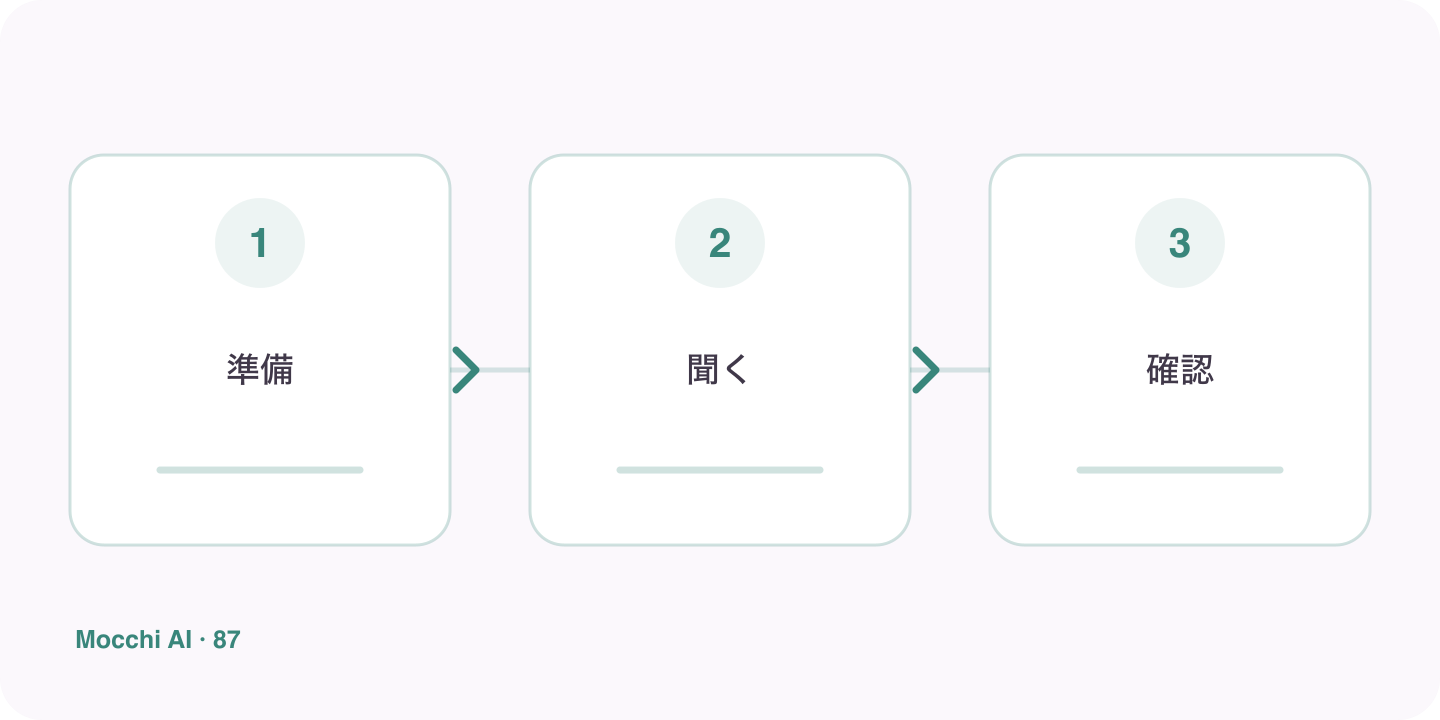
Language preparation leads to listening practice, then a specific difficulty returns to review
A balanced routine gives listening its own task instead of assuming written quiz success covers it.
JapaneseRomajiMeaning
予約を変更したいです。Yoyaku o henkō shitai desu.I would like to change the reservation.
何時がいいですか。Nanji ga ii desu ka.What time would be good?

Use conversational listening without confusing the format

AI Sensei or Roleplay can help you listen for a partner's question and choose a spoken response. That is a useful communicative activity. For the JLPT's actual listening tasks, also use appropriate exam-format examples and instructions. Tell Mocchi which goal the current session serves so the preparation and follow-up do not treat the two activities as interchangeable.

Review the missed language and then listen again

After a focused explanation, return to a comparable listening task. Check whether the phrase is now recognizable without reading it first. If you still need the transcript, note that support and choose another small step. A clear written explanation can help, but the listening follow-up is what tests the link you intended to strengthen.

Balance the routine from actual results

If written work is comfortable but listening remains difficult, give it deliberate practice time rather than assuming more text questions will solve the gap. If vocabulary blocks both, use Mocchi for a small relevant set and revisit it by ear. Keep official exam information as the reference for test demands while your personal practice results guide which language connections need the most attention.

Key points

A practical way to improve

Choose a short listening task appropriate to your goal and attempt it before reading support. Note whether the problem was word recognition, a missed relation, or losing the question's purpose. Bring one non-sensitive phrase or described difficulty to Mocchi for explanation and a short review. Use AI Sensei for a related conversational exchange if useful, while keeping exam-format audio practice as a separate activity.

  1. 1

    Choose one clear goal

    Focus each session on a situation or skill you can actually use.

  2. 2

    Practice actively

    Say complete answers aloud instead of only reading or recognizing Japanese.

  3. 3

    Review and repeat

    Keep useful corrections and revisit the same skill until it feels natural.

FAQ

Frequently asked questions

Does a good written quiz result show that my listening is ready?

No. Written recognition and understanding speech are different tasks. Try listening under appropriate conditions and use the specific difficulty to choose follow-up practice.

Is an AI Sensei conversation the same as a JLPT listening section?

No. It can provide useful conversational listening and response practice, but the official exam has its own task formats. Use appropriate material to become familiar with those formats separately.

Can Mocchi help after I miss an audio phrase?

You can bring the relevant wording or describe the difficulty for vocabulary and grammar support. Keep the explanation focused and avoid treating a text explanation alone as proof that the sound is now recognizable.

Connect written knowledge to a listening task

Use Mocchi to explain the language obstacle while giving listening practice its own clear role.