

The three formats and what each one measures
The grammar block sits inside the language knowledge and reading section from N3 upwards, and it always has the same three parts in the same order. Each measures a different skill, and the list below gives the trap each is built around.
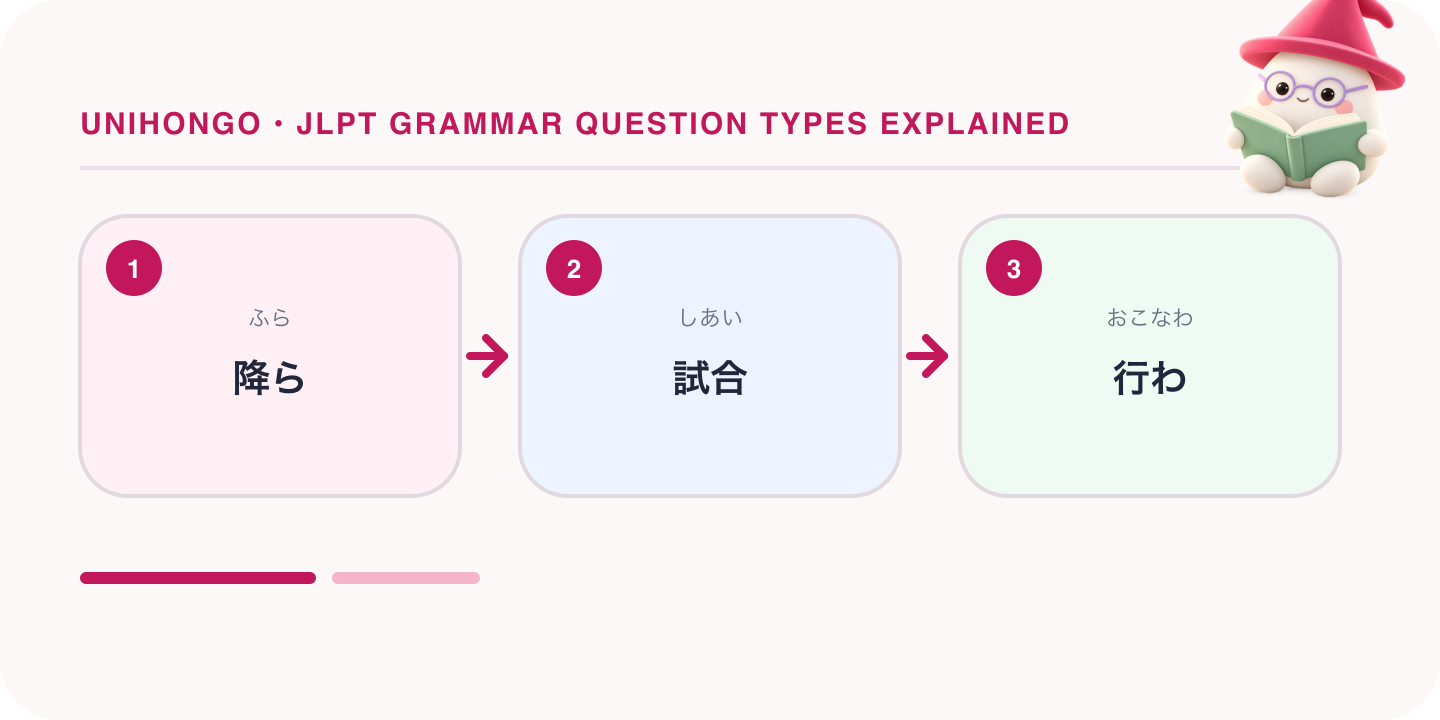
- Form selection: a gap in one sentence, four patterns; the trap is attachment and register
- Sentence ordering: four chunks, one on a star; the trap is translating word order
- Text grammar: several gaps in one passage; the trap is reading sentence by sentence
Form selection: attachment, register and nuance
Form selection gives you a sentence with a gap and four patterns. A typical N2 item: 雨が降らない ( ) 、試合は行われます, with the choices かぎり, かぎりに, にかぎって and ばかりに. All four contain kagiri or a relative, deliberately: kagiri follows a plain verb and means as long as, kagiri ni follows a noun and means starting from, ni kagitte means precisely when, and bakari ni follows a past verb and means just because, with a bad result.
The trap is threefold. Attachment: does the pattern follow a noun, a plain form, a te-form or a stem? Register: formal, so that zaru o enai fits, or conversational, so that nakya fits? Nuance: does the sentence describe bad luck, an obligation, a limit, a contrast? Look at the word before the gap first, eliminate any pattern that cannot attach to it, then read the whole sentence for nuance.
| Japanese | Romaji | Meaning |
|---|---|---|
| 雨が降らないかぎり、試合は行われます。 | Ame ga furanai kagiri, shiai wa okonawaremasu. | As long as it doesn't rain, the match will be held. |
| 彼は病気にもかかわらず、会議に出席した。 | Kare wa byōki ni mo kakawarazu, kaigi ni shusseki shita. | Despite being ill, he attended the meeting. |
| 忙しいときに限って、電話がかかってくる。 | Isogashii toki ni kagitte, denwa ga kakatte kuru. | It's precisely when I'm busy that the phone rings. |
| この問題は子どもにさえ分かる。 | Kono mondai wa kodomo ni sae wakaru. | Even a child can understand this question. |
| 説明を聞けば聞くほど分からなくなった。 | Setsumei o kikeba kiku hodo wakaranaku natta. | The more I listened to the explanation, the less I understood. |
| 彼女は泣かんばかりの顔で頼んできた。 | Kanojo wa nakan bakari no kao de tanonde kita. | She asked me with a face that looked ready to cry. |
Patterns that look alike and how the test separates them
Form selection distractors are rarely random. They share a word, a sound or a translation with the answer, and attachment or nuance separates them. The table gives twelve pairs and near-pairs from N3 to N1 with the distinction that decides the point.
| Pattern | Reading | Level and the distinction tested |
|---|---|---|
| わけがない / わけではない | wake ga nai / wake de wa nai | N3: impossible versus not necessarily |
| に限って / に限り | ni kagitte / ni kagiri | N2: bad luck versus a formal restriction |
| かねない / かねる | kanenai / kaneru | N2: might, with a bad result, versus cannot, politely |
| 次第で / 次第 | shidai de / shidai | N2: depending on versus as soon as, after a stem |
| ものの / ものだから | mono no / mono da kara | N2: although versus because, as an excuse |
| にすぎない | ni suginai | N2: merely; follows a noun or plain form |
| ざるを得ない | zaru o enai | N2: have no choice but to; formal, after the nai stem |
| ないことはない | nai koto wa nai | N3: not impossible; a hedged yes |
| たとたん / た以上 | ta totan / ta ijō | N2: the moment that versus now that |
| をきっかけに | o kikkake ni | N2: taking as the trigger; follows a noun |
| はともかく | wa tomokaku | N2: setting aside; follows a noun |
| ばかりに | bakari ni | N1: just because, with an unwanted result |
The levels are indicative rather than official. Many patterns return at a higher level as a nuance test in a longer sentence.
Sentence ordering: solving the star
The star format shows a sentence with four consecutive gaps, one marked with a star, and four chunks. You answer with the chunk on the star. A typical N2 item: 駅前に ___ ___ ★ ___ そうだ, with the chunks 若い人に, できたカフェは, 新しく and 人気がある. The order is atarashiku, dekita kafe wa, wakai hito ni, ninki ga aru, so the star is wakai hito ni.
The method has three steps. First, pair the chunks that must go together: an adverb with the verb it modifies, atarashiku dekita; a noun with its particle and the verb that governs it, wakai hito ni ninki ga aru. Second, build from the end backwards: sō da needs a plain form before it, so ninki ga aru goes last. Third, write the full order in the margin before choosing the star; picking it by eye is how neighbouring chunks get reversed.
| Japanese | Romaji | Meaning |
|---|---|---|
| 駅前に新しくできたカフェは、若い人に人気があるそうだ。 | Ekimae ni atarashiku dekita kafe wa, wakai hito ni ninki ga aru sō da. | The new café in front of the station is apparently popular with young people. |
| 彼が言ったことは、必ずしも正しいとは限らない。 | Kare ga itta koto wa, kanarazushimo tadashii to wa kagiranai. | What he said is not necessarily correct. |
| どんなに頑張ったところで、間に合わないだろう。 | Donna ni ganbatta tokoro de, maniawanai darō. | However hard we try, we probably won't make it in time. |
| 一度決めた以上、最後までやるつもりだ。 | Ichido kimeta ijō, saigo made yaru tsumori da. | Now that I've decided, I intend to see it through. |
| 環境問題について考えることなしに、経済の発展は語れない。 | Kankyō mondai ni tsuite kangaeru koto nashi ni, keizai no hatten wa katarenai. | You cannot discuss economic development without considering environmental problems. |
Text grammar: following the writer's argument
Text grammar gives you a passage of several paragraphs, often a personal essay or a short opinion piece, with four or five gaps. More than one choice is usually grammatical inside its own sentence; the surrounding sentences decide, by whether the writer is adding, reversing or concluding, and by who the subject is.
A typical gap: つまり、問題は時間ではなく、( ) のだ, where the previous paragraph has complained about a lack of funding. The choices might be お金な, お金だ, お金の and お金で, and the answer is お金な because no da after a noun needs na. Another gap tests the connective itself: after a sentence of expectation, ( ) 、結果は予想と全く違っていた needs tokoro ga, not sono tame or sara ni. Read the whole passage once before touching a gap, then fill each by asking what the writer is doing at that point.
| Japanese | Romaji | Meaning |
|---|---|---|
| つまり、問題は時間ではなく、お金なのだ。 | Tsumari, mondai wa jikan de wa naku, okane na no da. | In other words, the problem is not time but money. |
| ところが、結果は予想と全く違っていた。 | Tokoro ga, kekka wa yosō to mattaku chigatte ita. | However, the result was completely different from what was expected. |
| そのため、多くの店が閉店に追い込まれた。 | Sono tame, ōku no mise ga heiten ni oikomareta. | As a result, many shops were forced to close. |
| それでも、彼はあきらめようとしなかった。 | Sore demo, kare wa akirameyō to shinakatta. | Even so, he did not try to give up. |
| このように、言葉は時代とともに変化していくものである。 | Kono yō ni, kotoba wa jidai to tomo ni henka shite iku mono de aru. | In this way, language is something that changes with the times. |
Connectives that decide text grammar gaps
Most text grammar gaps that are not verb forms are connectives, and the set is small. The table gives the twelve that carry most passages, with the logical job each one does. Learn them as jobs, not translations: tokoro ga and shikashi both mean however, but tokoro ga insists the outcome was unexpected.
| Connective | Reading | Job in the passage |
|---|---|---|
| つまり | tsumari | restates the point in plainer words |
| ところが | tokoro ga | reverses an expectation |
| そのため | sono tame | gives the result of what came before |
| それでも | sore demo | concedes and continues anyway |
| ただし | tadashi | adds a condition or exception |
| したがって | shitagatte | draws a formal conclusion |
| 一方 | ippō | sets up a contrasting case |
| むしろ | mushiro | corrects towards a stronger alternative |
| さらに | sara ni | adds a further point in the same direction |
| なぜなら | naze nara | opens a reason, ending in kara da |
| このように | kono yō ni | sums up before the conclusion |
| もっとも | mottomo | admits a qualification after a claim |
Naze nara is the one that most often goes wrong, because it needs kara da or kara de aru at the end of its sentence; an item that offers it for a sentence without that ending is testing exactly this.
A time budget for each level
The grammar block shares its time with reading, and reading is where marks are slowest to earn, so the grammar budget should be tight. The figures below are working targets rather than official timings, which are published by the JLPT and can change.
- N3: form selection under 45 seconds per item, star items about 90 seconds, text grammar about 5 minutes
- N2: form selection under 40 seconds per item, star items about 90 seconds, text grammar about 5 minutes
- N1: form selection under 35 seconds per item, star items about 75 seconds, text grammar about 6 minutes
- All levels: mark uncertain items, move on, and return only after the reading passages are done
A form selection item you cannot solve in forty seconds will rarely be solved in two minutes, whereas two extra minutes on a reading passage often turns a guess into a correct answer.
Mistakes that cost grammar points
Four mistakes account for most lost points across the three formats. Choosing a pattern by meaning without checking attachment, so that zaru o enai is picked after a masu stem. Building the star sentence in English order, so that the modifier lands after the noun. Filling a text grammar gap from its own sentence alone, so that the connective contradicts the paragraph. And mixing registers, so that a formal essay gains a conversational nakya or a business dialogue loses its keigo.
The four sentences below each use a pattern that is frequently misattached or misplaced, correctly. Say them, then rewrite each with a different subject or tense and check that the join still holds.
| Japanese | Romaji | Meaning |
|---|---|---|
| 先生がおっしゃったとおりにやってみます。 | Sensei ga osshatta tōri ni yatte mimasu. | I'll try doing it the way the teacher said. |
| 資料は明日までにお送りいたします。 | Shiryō wa ashita made ni o-okuri itashimasu. | I will send the materials by tomorrow. |
| 彼の話を聞いていると、なんだか元気が出てくる。 | Kare no hanashi o kiite iru to, nandaka genki ga dete kuru. | When I listen to him talk, I somehow feel encouraged. |
| 遅くなったにしても、連絡ぐらいすべきだった。 | Osoku natta ni shite mo, renraku gurai subeki datta. | Even if you were late, you should at least have got in touch. |