
A Completed Mocchi Task Is a Step, Not Permanent Mastery

Completing a Japanese study task is useful progress, but it does not mean the language will remain available in every new situation. Use Mocchi to separate the work you finished from the recall and transfer checks that tell you what still needs practice.

Mocchi distinguishes finishing an activity from recalling the same Japanese decision later in a new context
What you need to know

A Completed Mocchi Task Is a Step, Not Permanent Mastery

A plan needs a record of completed activities, while learning needs evidence that knowledge can be retrieved and applied. These records answer different questions. You can finish a quiz and still need review of its hardest point; you can also improve during an activity that remains unfinished. Treat the checkbox as an honest account of the task and use later practice to judge stability, rather than forcing one label to describe every aspect of progress.

Record the activity you actually completed.

Keep hinted answers distinct from unaided recall.

Test a changed example after a delay.

Use review to refine progress rather than erase it.

Completion and competence answer different questions

Completion asks whether you carried out a defined activity. Competence asks what you can understand or produce under particular conditions. A checkbox can record that you answered a set of questions, but it cannot capture every future context in which the language might appear. Keeping the distinction clear helps a study plan remain useful without turning it into a claim that every finished topic is permanently mastered.

This is also why one difficult review should not erase the value of earlier work. You may need less support than before, notice the relevant clue sooner, or make a more precise mistake. Record those changes rather than reducing progress to either perfect performance or total failure.

A changed example reveals more than a repeated layout

If a completed task used 学校に行きます, 'I go to school,' try a different destination or a sentence in which the place has another role. 学校で勉強します, 'I study at school,' asks for a different decision. Recognizing the original example is useful, but explaining the new choice shows whether the relevant relationship is available beyond the task you already finished.
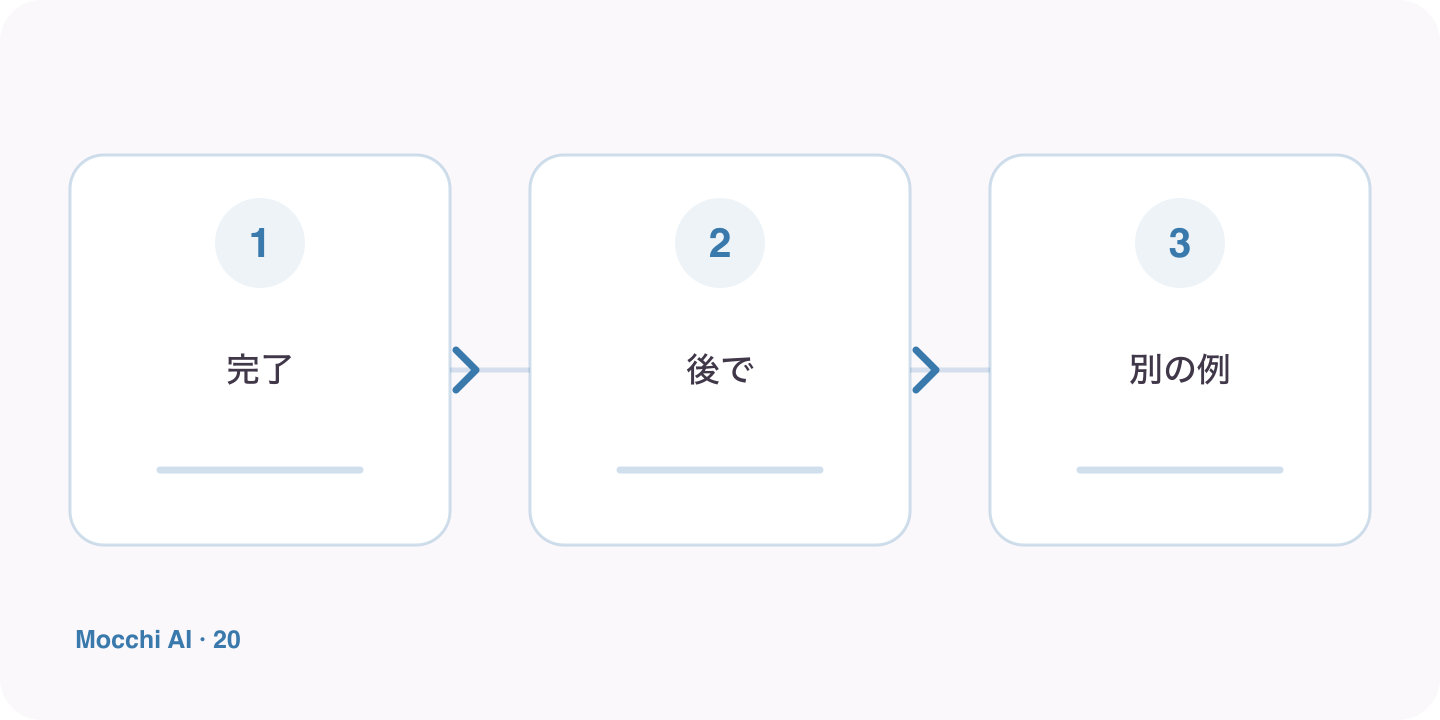
A completed task is followed by delayed recall and a changed example before judging learning stability
Completion records an action; later recall and transfer show how available the language has become.
JapaneseRomajiMeaning
学校に行きます。Gakkō ni ikimasu.I go to school.
学校で勉強します。Gakkō de benkyō shimasu.I study at school.

Record the amount of support you used

An answer produced after a hint is not the same as one retrieved independently, and both can be part of learning. Tell Mocchi whether you needed the translation, a first-word cue, or the full model. This gives the next review a better starting point. It also prevents a sequence of supported successes from being mistaken for evidence that no support is needed anymore.

Use delayed recall without turning it into punishment

Return to a small number of earlier points after a gap and attempt them in a fresh context. If a point is difficult, identify the clue that would help and practice it again. The purpose is to discover what needs attention, not to invalidate completed tasks. A calm review gives you more useful information than repeatedly testing yourself until you happen to get a perfect run.

Let the next step reflect the evidence

If the new example is easy and your explanation is accurate, move to a related challenge while retaining occasional mixed review. If the same decision remains unstable, keep the next task narrow. Mocchi can help connect practice results to a plan, but the record is strongest when you state what actually happened: the task completed, the help needed, and the specific language point to revisit.

Key points

A practical way to improve

Choose a task you recently completed and identify its main language decision. Ask Mocchi for a new example without showing the old answer. Attempt it before requesting a hint, then explain why your choice fits. Repeat a comparable check after a gap. If the language is still unstable, add a focused review while keeping an accurate record that the earlier activity was completed.

  1. 1

    Choose one clear goal

    Focus each session on a situation or skill you can actually use.

  2. 2

    Practice actively

    Say complete answers aloud instead of only reading or recognizing Japanese.

  3. 3

    Review and repeat

    Keep useful corrections and revisit the same skill until it feels natural.

FAQ

Frequently asked questions

Was the task pointless if I forget part of it later?

No. Forgetting can reveal what needs another retrieval attempt or a clearer explanation. Keep the completed work as part of the learning history and use a new check to choose the next practice step.

Should I mark a task complete after just opening it?

Opening an activity is different from attempting its requested work. Read the task's actual condition and keep the record honest, so later planning does not assume practice that never happened.

How do I know when I can move on?

Try a new example and explain the decision with little or no support. You can often move to related work while retaining a small review, rather than waiting for an unrealistic feeling that the topic can never cause difficulty again.

Use progress records and learning checks together

Let Mocchi help you see both the work you finished and the next review that would make the language more dependable.