
Why live action beats animation for speech models
Animation is recorded to be understood. Voice actors separate words, project emotion clearly, and often carry a distinctive character voice from the first line. Live-action performers are doing something else: pretending to be a person who is not performing. They overlap, trail off, swallow the ends of words, and put the emphasis where a real speaker would rather than where the sentence structure suggests.
That difference matters most for the things a learner cannot get from text. You hear where a speaker actually pauses, which is usually after a particle rather than between words, and how much of a Japanese sentence is carried by breath and hesitation. Copying a live-action delivery is the fastest route to sounding like a person rather than a recording.
Choose a genre whose Japanese you can reuse
| Genre | Japanese you get | Everyday value |
|---|---|---|
| Workplace drama | Keigo, meetings, phone calls, apologies | High for anyone working in Japanese |
| Family and home drama | Casual speech across ages inside one household | High for friendships and daily life |
| Romance | Invitations, feelings, indirect refusals | Medium to high, strong on hesitation |
| School drama | Teen casual speech and teacher-student register | Medium, adult settings differ |
| Crime and legal | Procedural jargon and shouted commands | Low |
| Historical | Period endings and archaic forms of address | Very low for modern speech |
| Contemporary film | Longer scenes and quieter, slower delivery | High, though the audio can be hard to hear |
The test is simple: if you copied twenty lines from this show, how many could you say next week without changing your life. Workplace and family drama score well because their situations repeat in yours. Historical and crime series score badly because their Japanese belongs to a world you will not enter.
Study a two-minute scene, not an episode
A whole episode is entertainment, and there is nothing wrong with that. A study scene is a different object: two minutes, several turns of dialogue, and preferably a situation you can imagine yourself in. Look for a conversation rather than a monologue, because you need to hear both sides of a real exchange, including the short reactions that keep it moving.
Choose the scene while you watch for pleasure and note the timestamp. Coming back to a scene you already understand at the story level removes the pressure to follow the plot, so all your attention goes to the language. If you are pausing every three seconds to look something up, choose an easier scene instead.
The three-pass method
| Pass | What you do | Goal | Time |
|---|---|---|---|
| First | Watch with no subtitles at all | Hear the shape: who speaks, how fast, where pauses fall | 2 to 3 minutes |
| Second | Replay with Japanese subtitles, pausing line by line | Match sound to words, look up only what blocks meaning | 8 to 10 minutes |
| Third | Shadow each line aloud alongside the actor | Copy rhythm, pitch movement, and the gaps between clauses | 10 minutes |
The order is the whole design. If you read the subtitles first, your ears never have to work and the second pass becomes proofreading. If you skip the third pass, you have done listening practice and not speaking practice, and the scene will fade within a week.
What subtitles are actually telling you
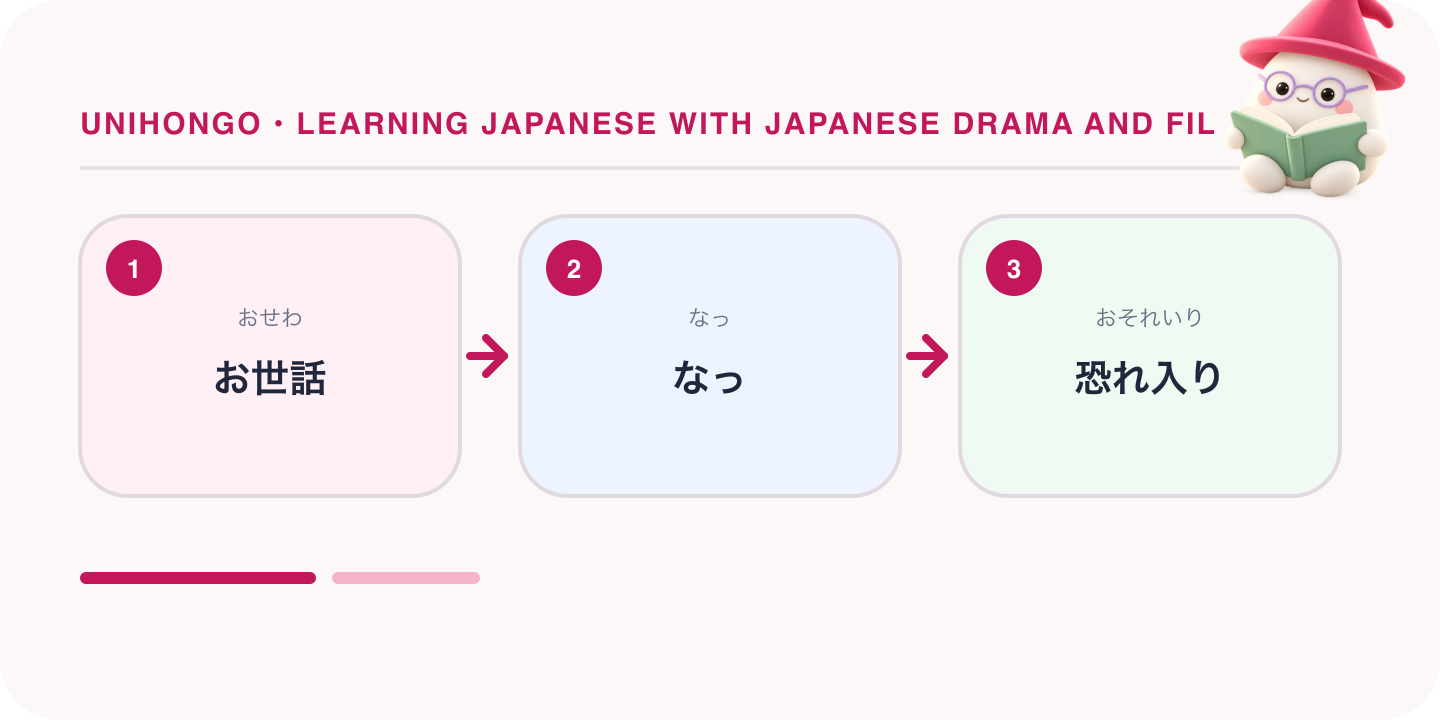
English subtitles translate function, not structure. A line rendered as thanks for everything might be お世話になっております, which is a fixed business greeting with almost no gratitude in it. Japanese subtitles are more useful for study, but they are also condensed to fit the screen and sometimes drop particles or soften rough speech, so treat them as a transcript with edits rather than a perfect record.
| Japanese | Romaji | Meaning |
|---|---|---|
| お世話になっております。 | Osewa ni natte orimasu. | Thank you for your continued support. (standard business greeting) |
| 恐れ入りますが、少々お待ちいただけますか? | Osoreirimasu ga, shōshō omachi itadakemasu ka? | I am sorry to trouble you, but could you wait a moment? |
| 失礼ですが、どちら様でしょうか? | Shitsurei desu ga, dochira-sama deshō ka? | Excuse me, may I ask who you are? |
| お手数をおかけします。 | Otesū o okake shimasu. | Sorry for the trouble I am causing you. |
Lines like these are almost invisible in translation because English has no equivalent ritual. They are also the highest-value phrases in any workplace drama, since they recur in every episode and in every office. When a subtitle looks strangely bland next to a long Japanese line, that is usually the signal that you have found one.
The lines that repeat across every show
| Japanese | Romaji | Meaning |
|---|---|---|
| お疲れさまです。 | Otsukaresama desu. | Thanks for your work. / Hello. (at work) |
| ちょっといいですか? | Chotto ii desu ka? | Do you have a moment? |
| 大丈夫ですか? | Daijōbu desu ka? | Are you all right? |
| どういうことですか? | Dō iu koto desu ka? | What do you mean by that? |
| そういうことか。 | Sō iu koto ka. | So that is what it was. (casual, to oneself) |
| まさか。 | Masaka. | You cannot be serious. |
| しょうがないですね。 | Shō ga nai desu ne. | There is nothing to be done about it. |
| とりあえず、座ってください。 | Toriaezu, suwatte kudasai. | Please have a seat for now. |
| 話があるんですが。 | Hanashi ga aru n desu ga. | There is something I need to discuss. |
| また連絡します。 | Mata renraku shimasu. | I will be in touch again. |
Keep a running list of lines you have now heard in three different shows. Repetition across sources is the best evidence that an expression is genuinely common rather than a writer's habit, and it costs you nothing to notice. These ten will appear within your first few episodes, and each one earns its place because it works in your life as well as on screen.
Watch one character change register
| Japanese | Romaji | Meaning |
|---|---|---|
| 申し訳ありません、遅れます。 | Mōshiwake arimasen, okuremasu. | I am very sorry, I will be late. (to a manager) |
| ごめん、ちょっと遅れる。 | Gomen, chotto okureru. | Sorry, I will be a bit late. (to a friend) |
| 承知しました。 | Shōchi shimashita. | Understood. (to a superior) |
| わかった。 | Wakatta. | Got it. (to a friend) |
| 少しお時間よろしいでしょうか? | Sukoshi ojikan yoroshii deshō ka? | Might I have a moment of your time? |
| ちょっと話せる? | Chotto hanaseru? | Can we talk for a second? |
| お先に失礼します。 | Osaki ni shitsurei shimasu. | Excuse me for leaving before you. |
| じゃあ、また明日。 | Jā, mata ashita. | Right, see you tomorrow. |
Follow one character through a single episode and mark every time the person they are speaking to changes. The same intention, arriving late or asking for a moment, comes out in a different length, a different verb form, and a different tone of voice. No grammar table can teach this, because it is about distance rather than correctness.
Shadowing pauses and intonation
Shadowing means speaking along with the actor, roughly half a beat behind, copying delivery rather than reading a script. Start with the subtitle visible, then remove it once the words are secure, because the goal is your mouth matching their mouth. Keep your own voice; you are copying timing, pitch movement, and pauses, not impersonating a person of a different age or gender.
Pay particular attention to the short reactions. Learners tend to shadow the long sentences and skip the fillers, but the fillers are what make a conversation sound alive, and they buy you thinking time when you speak. Getting そうなんですね to land with the right fall in pitch is worth more than perfecting one complicated sentence you may never need.
| Japanese | Romaji | Meaning |
|---|---|---|
| え、本当ですか? | E, hontō desu ka? | Wait, really? |
| そうなんですね。 | Sō nan desu ne. | Oh, I see. |
| ですよね。 | Desu yo ne. | Right, exactly. |
| そうですね、ちょっと難しいですね。 | Sō desu ne, chotto muzukashii desu ne. | Well, that would be a little difficult. (soft refusal) |
| すみません、もう一度お願いします。 | Sumimasen, mō ichido onegai shimasu. | Sorry, could you say that once more? |
| ちょっと考えさせてください。 | Chotto kangaesasete kudasai. | Please let me think about it for a moment. |
Turn the scene into speech
The three passes end with your mouth moving, but shadowing is still imitation. The step that converts a scene into ability is producing the same content without the model. Close the screen and retell the scene in three sentences: who wanted what, what the other person said, and how it ended. Then change one variable, so the apology becomes yours and the meeting becomes your meeting.
Then play both parts. Say the first character's line, answer as the second, and keep going past the point where the script stopped. Improvising two turns beyond the scene is where you discover which words you actually own. Anything you reach for and cannot find goes on tomorrow's list, which comes from your own attempts rather than a book.
Talk about what you watched
| Japanese | Romaji | Meaning |
|---|---|---|
| 昨日のドラマ、見ましたか? | Kinō no dorama, mimashita ka? | Did you watch yesterday's drama? |
| はい、見ました。すごく面白かったです。 | Hai, mimashita. Sugoku omoshirokatta desu. | Yes, I did. It was really interesting. |
| どんな話ですか? | Donna hanashi desu ka? | What kind of story is it? |
| 会社で働く人たちの話です。 | Kaisha de hataraku hitotachi no hanashi desu. | It is about people working at a company. |
| 一番好きな場面はどこですか? | Ichiban suki na bamen wa doko desu ka? | Which scene do you like best? |
| 主人公が上司に謝る場面です。 | Shujinkō ga jōshi ni ayamaru bamen desu. | The scene where the main character apologises to the boss. |
Summarising a plot is genuinely difficult, because it demands past tense, sequencing, and relative clauses at conversational speed. That is precisely why it is good practice, and why it is the single most common small-talk topic you will be handed. Prepare three sentences about whatever you are currently watching and you will have an answer ready every time someone asks.
A weekly viewing routine
- Watch freely for pleasure on most evenings, subtitles in whichever language keeps you watching.
- Note two timestamps a week where the dialogue felt useful rather than dramatic.
- Three times a week, run one of those scenes through the three passes, twenty minutes each.
- Keep no more than five lines per scene, chosen for usefulness rather than for how good they sounded.
- Once a week, speak: retell a scene, play both parts, and use your five lines with changed details.
- At the end of the month, reread the list and delete anything you have not once wanted to say.
Notice that the viewing is the easy half and the speaking is the half that gets skipped. Input builds recognition, and recognition alone produces the familiar experience of understanding a whole episode and then freezing at a counter. Put the spoken step in your calendar with a time attached.