

The four-part shape of a Japanese card
Japanese letters, even very short ones, move in a fixed order: a greeting that looks outward at the season or the weather, then the writer's news, then a turn back towards the reader, and finally a closing wish. On a postcard each part is a sentence or two. This order matters more than any single phrase: a card that opens with I went to Kyoto reads as abrupt; one that opens with the autumn leaves are beautiful here reads as warm.
The register depends on the reader. To a friend of your own age you can use plain form with soft endings, and the greeting can be as simple as genki? To a host family, a teacher or anyone older, use desu and masu throughout and the slightly more formal set phrases in this guide. When unsure, polite form is always safe on a card.
| Japanese | Romaji | Meaning |
|---|---|---|
| 田中さんへ | Tanaka-san e | Dear Tanaka-san (the opening line) |
| お元気ですか。 | O-genki desu ka. | How are you? |
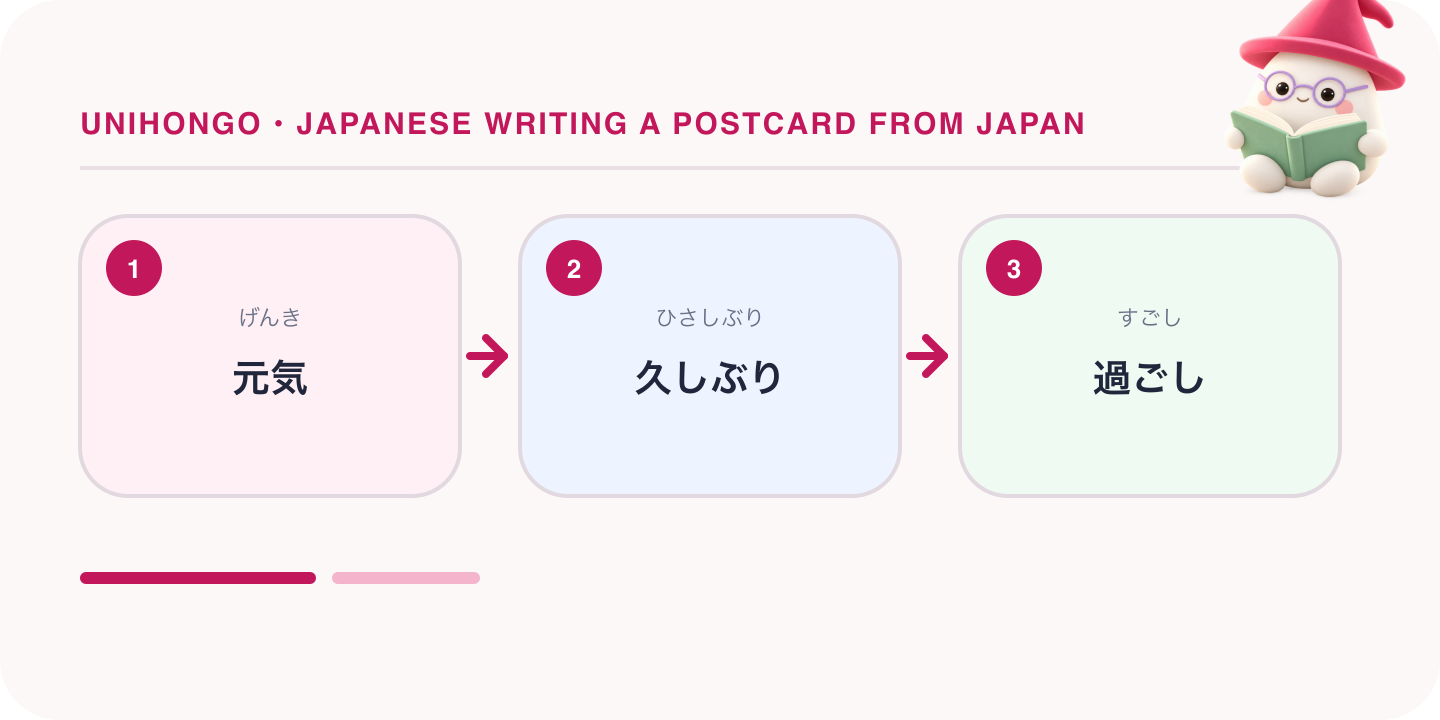
| 元気?久しぶり! | Genki? Hisashiburi! | How are you? Long time no see! (to a friend) |
| 私は元気に過ごしています。 | Watashi wa genki ni sugoshite imasu. | I'm doing well. |
| 皆さんお変わりありませんか。 | Minasan o-kawari arimasen ka. | Is everyone keeping well? (to a family) |
| ゆかりより | Yukari yori | From Yukari (the sign-off) |
Seasonal openers for every part of the year
Japanese letter writing has a whole vocabulary of seasonal greetings, kisetsu no aisatsu, and a postcard needs only one line of it. The pattern is: a comment on the season, then ga, then a question or wish for the reader. A plain description of the weather where you are does the job and sounds more personal on a card than the classical set phrases.
Pick the sentence that matches the month you are writing in, not the one you like best. Japanese readers notice a cherry-blossom opener sent in July.
| Season | Reading | Opening line |
|---|---|---|
| 春 (3-4月) | haru | Sakura ga kirei na kisetsu ni narimashita ne. The cherry-blossom season has arrived. |
| 初夏 (5-6月) | shoka | Sawayaka na kisetsu desu ne. It's a fresh, pleasant season. |
| 梅雨 (6-7月) | tsuyu | Ame no hi ga tsuzuite imasu ga, o-genki desu ka. Rainy days continue; how are you? |
| 夏 (7-8月) | natsu | Atsui hi ga tsuzuite imasu ne. The hot days go on and on. |
| 秋 (9-11月) | aki | Sukoshi zutsu suzushiku natte kimashita ne. It's gradually getting cooler. |
| 紅葉 (11月) | kōyō | Momiji ga totemo kirei desu. The autumn leaves are beautiful. |
| 冬 (12-2月) | fuyu | Samui hi ga tsuzuite imasu ga, o-kawari arimasen ka. The cold days go on; are you keeping well? |
| 年末 | nenmatsu | Kotoshi mo nokori wazuka desu ne. Only a little of the year is left. |
New Year cards, nengajō, have their own fixed phrases, above all akemashite omedetō gozaimasu, and are best treated as a separate genre. For an ordinary postcard in January, a simple samui hi ga tsuzuite imasu is enough.
Describing your trip in a few lines
The middle of the card is the report, and the temptation is to write too much. Two or three sentences with one concrete detail beat a list of everything you did. Say where you are or were, one thing you did, and one small reaction: a taste, a view, a surprise. The past tense with -mashita, and -te forms to chain two actions, are all the grammar you need.
For a card to a host family after you have gone home, the report changes shape: say you arrived safely, buji ni kaerimashita, mention one memory from the stay, and say what you have been doing since. Naming a dish they cooked or a place they took you is the detail they will treasure.
| Japanese | Romaji | Meaning |
|---|---|---|
| 今、京都に来ています。 | Ima, Kyōto ni kite imasu. | I'm in Kyoto right now. |
| 昨日は嵐山に行って、紅葉を見ました。 | Kinō wa Arashiyama ni itte, kōyō o mimashita. | Yesterday I went to Arashiyama and saw the autumn leaves. |
| 湯豆腐がとてもおいしかったです。 | Yudōfu ga totemo oishikatta desu. | The yudōfu was delicious. |
| 毎日たくさん歩いて、少し疲れましたが楽しいです。 | Mainichi takusan aruite, sukoshi tsukaremashita ga tanoshii desu. | I walk a lot every day and I'm a bit tired, but it's fun. |
| 無事に帰りました。 | Buji ni kaerimashita. | I got home safely. |
| お母さんの作ってくれたカレーが忘れられません。 | Okāsan no tsukutte kureta karē ga wasureraremasen. | I can't forget the curry you made for me, Okāsan. |
| 日本のことをよく思い出します。 | Nihon no koto o yoku omoidashimasu. | I often think about Japan. |
Turning to the reader and closing
After your news, one line turns back to the reader. To a friend, this can be a question: sochira wa dō? how are things there? To a family, it is a wish for their health, especially with the season: samui node, o-karada ni ki o tsukete kudasai, it's cold, so take care of yourselves.
The closing looks forward: to meeting again, to writing again, or to their reply. Mata aeru hi o tanoshimi ni shite imasu is the standard warm line to a host family. To a friend, mata ne or kondo issho ni ikō, let's go together next time, is enough. Then write your name.
| Japanese | Romaji | Meaning |
|---|---|---|
| そちらはどうですか。 | Sochira wa dō desu ka. | How are things where you are? |
| 寒いので、お体に気をつけてください。 | Samui node, o-karada ni ki o tsukete kudasai. | It's cold, so please take care of yourselves. |
| また会える日を楽しみにしています。 | Mata aeru hi o tanoshimi ni shite imasu. | I look forward to the day we can meet again. |
| また手紙を書きます。 | Mata tegami o kakimasu. | I'll write again. |
| 皆さんによろしくお伝えください。 | Minasan ni yoroshiku o-tsutae kudasai. | Please give my regards to everyone. |
| 今度は一緒に行こうね。 | Kondo wa issho ni ikō ne. | Next time let's go together. |
A full model postcard to a host family
Here is a complete card from a learner travelling in Japan after a homestay, written in polite form. It is eight lines, fits the message half of a picture postcard, and follows the four-part shape. Swap the place, the season and the memory and it becomes yours.
| Japanese | Romaji | Meaning |
|---|---|---|
| 山田様 | Yamada-sama | Dear Yamada family |
| 少しずつ涼しくなってきましたね。お元気ですか。 | Sukoshi zutsu suzushiku natte kimashita ne. O-genki desu ka. | It's gradually getting cooler. How are you? |
| 先週はお世話になり、本当にありがとうございました。 | Senshū wa o-sewa ni nari, hontō ni arigatō gozaimashita. | Thank you so much for looking after me last week. |
| 今は金沢に来ています。 | Ima wa Kanazawa ni kite imasu. | I'm in Kanazawa now. |
| 兼六園を散歩して、おいしい海鮮丼を食べました。 | Kenrokuen o sanpo shite, oishii kaisendon o tabemashita. | I walked around Kenrokuen and ate a delicious seafood rice bowl. |
| 一緒に作ったおにぎりの味が忘れられません。 | Issho ni tsukutta onigiri no aji ga wasureraremasen. | I can't forget the taste of the onigiri we made together. |
| 季節の変わり目ですので、お体に気をつけてください。 | Kisetsu no kawarime desu node, o-karada ni ki o tsukete kudasai. | The season is changing, so please take care of yourselves. |
| また会える日を楽しみにしています。エマより | Mata aeru hi o tanoshimi ni shite imasu. Ema yori | I look forward to seeing you again. From Emma |
Sentence patterns to reuse
These frames cover almost any card. Fill the blanks with the season, the place and one detail.
- X ga tsuzuite imasu ga, o-genki desu ka: X (hot days, rain, cold) continues; how are you?
- Ima, X ni kite imasu: I'm in X now
- X ni itte, Y o shimashita: I went to X and did Y
- X ga totemo oishikatta desu: X was delicious
- X ga wasureraremasen: I can't forget X
- X node, o-karada ni ki o tsukete kudasai: because of X, take care of yourselves
- Mata X o tanoshimi ni shite imasu: I look forward to X (meeting, your reply)
- X ni yoroshiku o-tsutae kudasai: please give my regards to X
Keep sentences short and finish each one. A half-finished long sentence in a learner's handwriting is hard for the reader to rescue.
Addressing the card, vertical and horizontal writing
On a standard Japanese postcard the front has a row of boxes for the seven-digit postcode, yūbin bangō, at the top right. The recipient's address goes below it, written from the largest unit to the smallest: prefecture, city, ward, district, block numbers, building and room. The name follows, larger than the address, with sama after it; for a whole household you can write the surname followed by go-ikka sama, the whole family. Your own address and name go in smaller writing on the lower left, and the stamp in the top left. A picture postcard with a divided back puts the address on the right half and the message on the left.
Vertical writing, tategaki, runs top to bottom and right to left, and is the traditional choice for letters and New Year cards. Horizontal writing, yokogaki, runs left to right like English and is fine for picture postcards and casual cards. Choose one direction and use it for both address and message. Sending from abroad, write the country name in English and the rest in Japanese; the local post office only needs the word JAPAN.
| Japanese | Romaji | Meaning |
|---|---|---|
| 東京都渋谷区神宮前一丁目二番三号 | Tōkyō-to Shibuya-ku Jingūmae itchōme niban sangō | 1-2-3 Jingūmae, Shibuya-ku, Tokyo (largest unit first) |
| 山田太郎様 | Yamada Tarō sama | Mr Tarō Yamada (recipient's name) |
| 山田御一家様 | Yamada go-ikka sama | The Yamada family |
| 切手はここに貼ります。 | Kitte wa koko ni harimasu. | The stamp goes here. |
Mistakes to avoid
The most common mistake is skipping the seasonal line and starting with yourself; it is not rude, but it reads as foreign. The second is using casual plain form to a host family's parents because you were close during the stay: a card is more formal than conversation, and desu and masu show respect without distance. The third is writing the address with the smallest unit first, the English way, which slows delivery and confuses the sorter.
Watch spelling in handwriting: a missing dakuten turns de into te, and a small tsu written full size changes the word. Do not use sama for yourself, only for the reader. Avoid the formal letter openers haikei and keigu on a postcard; they belong to full letters and look stiff on a picture of a temple. Finally, write legibly rather than beautifully.
| Japanese | Romaji | Meaning |
|---|---|---|
| 京都に行った。すごかった。 | Kyōto ni itta. Sugokatta. | Went to Kyoto. It was amazing. (too abrupt and casual for a host family) |
| 京都に行きました。お寺がとても美しかったです。 | Kyōto ni ikimashita. O-tera ga totemo utsukushikatta desu. | I went to Kyoto. The temples were very beautiful. (polite and complete) |
| 拝啓 | Haikei | Dear Sir or Madam (formal letter opener; not for postcards) |