

What changes between N5 and N4 vocabulary
At N5 the words name things you can point at. At N4 they name what you do with those things and how you feel about it. The nouns become activities and situations, such as sentaku, kaigi, yoyaku and keiken; the verbs multiply, and many of them come in pairs; and a whole new group of feeling words appears, ureshii, sabishii, shinpai and zannen, which need particular particles and particular subjects.
The test formats are the same as at N5, reading, orthography, context, paraphrase and usage, but the sentences are longer and the wrong answers are closer to the right one. A context question will offer katazukeru, naosu, kaeru and suteru for a sentence about a messy room, and all four are N4 words. That is why the topic approach matters more here: you need to know not just what a word means but which situation it belongs to.
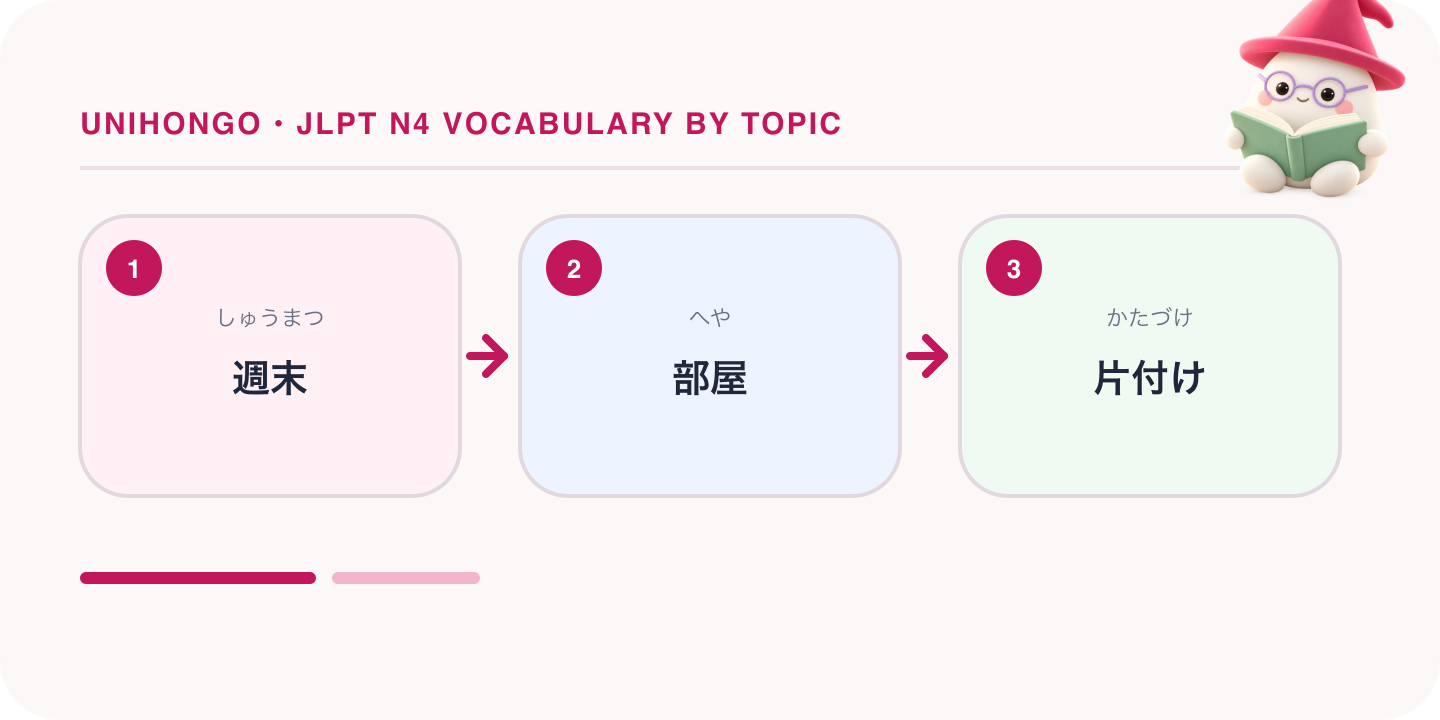
- Daily life: housework, routines, the neighbourhood and appliances
- Work and study: meetings, documents, deadlines and part-time jobs
- Travel: tickets, transfers, luggage and getting lost
- Feelings and opinions: emotions, moods and reactions
- Verb pairs: transitive and intransitive forms of the same action
Daily life: housework, routines and the neighbourhood
Household words are the easiest N4 group to practise because you do the actions every day. The chores are sōji, cleaning; sentaku, laundry; ryōri, cooking; and katazuke, tidying, each usable with suru. The verbs around them are hosu, to hang out to dry; suteru, to throw away; dasu, to put out, as in gomi o dasu; and shimau, to put away. Appliances include reizōko, the fridge; sentakuki, the washing machine; and eakon, the air conditioner.
The neighbourhood adds kinjo, the neighbourhood itself; ōya, the landlord; and the sign words aite iru and shimatte iru, open and closed, which are the intransitive verbs aku and shimaru in the te-iru form.
| Japanese | Romaji | Meaning |
|---|---|---|
| 週末に部屋を片付けました。 | Shūmatsu ni heya o katazukemashita. | I tidied my room at the weekend. |
| 洗濯物を干してから出かけます。 | Sentakumono o hoshite kara dekakemasu. | I'll hang out the washing and then go out. |
| ごみは火曜日と金曜日に出します。 | Gomi wa kayōbi to kin'yōbi ni dashimasu. | Rubbish goes out on Tuesdays and Fridays. |
| 近所のスーパーは夜十時まで開いています。 | Kinjo no sūpā wa yoru jū-ji made aite imasu. | The local supermarket is open until ten at night. |
| 冷蔵庫に何も入っていません。 | Reizōko ni nani mo haitte imasen. | There's nothing in the fridge. |
| 電気を消すのを忘れないでください。 | Denki o kesu no o wasurenaide kudasai. | Please don't forget to turn off the lights. |
Work and study words
Work vocabulary at N4 is the vocabulary of a first office job or a part-time job: kaigi, a meeting; shiryō, documents; shimekiri, a deadline; zangyō, overtime; arubaito, part-time work; and keiken, experience. The people are buchō, the department head; kachō, the section head; dōryō, a colleague; and okyakusan, a customer. The verbs are okuru, to send; setsumei suru, to explain; renraku suru, to contact; and tetsudau, to help.
Study words overlap with work: jugyō, a lesson; shiken, an exam; seiseki, results; and the verb pair oboeru and wasureru, to remember and to forget. A context question here often turns on a near-synonym, such as tsutaeru versus oshieru, both of which can translate as tell; tsutaeru passes a message, oshieru gives information or teaches.
| Japanese | Romaji | Meaning |
|---|---|---|
| 会議は午後二時からです。 | Kaigi wa gogo ni-ji kara desu. | The meeting is from two in the afternoon. |
| 部長に資料を送りました。 | Buchō ni shiryō o okurimashita. | I sent the documents to the department head. |
| アルバイトの経験がありますか。 | Arubaito no keiken ga arimasu ka. | Do you have part-time job experience? |
| 締め切りは来週の月曜日です。 | Shimekiri wa raishū no getsuyōbi desu. | The deadline is next Monday. |
| 説明がよく分からなかったので、もう一度聞きました。 | Setsumei ga yoku wakaranakatta node, mō ichido kikimashita. | I didn't quite understand the explanation, so I asked again. |
| 今日は残業しなければなりません。 | Kyō wa zangyō shinakereba narimasen. | I have to work overtime today. |
Travel and getting around
Travel words are where N4 vocabulary meets the real world most directly. Tickets and reservations bring kippu, yoyaku, shiteiseki, a reserved seat, and jiyūseki, an unreserved one. Movement brings norikaeru, to change trains; shuppatsu suru and tōchaku suru, to depart and arrive; and the intransitive todoku, to arrive for parcels. Luggage is nimotsu, and you azukeru it, leave it in someone's care, at a hotel or a locker.
Getting lost is its own small vocabulary: michi ni mayou, to lose your way; kankō annaijo, a tourist information office; and the direction words massugu, migi, hidari and kado, straight, right, left and corner. The station announcement words, tsugi, next, and mamonaku, shortly, appear in listening questions as often as in real stations.
| Japanese | Romaji | Meaning |
|---|---|---|
| 京都行きの切符を予約しました。 | Kyōto-yuki no kippu o yoyaku shimashita. | I booked a ticket to Kyoto. |
| 次の駅で乗り換えてください。 | Tsugi no eki de norikaete kudasai. | Please change at the next station. |
| ホテルに荷物を預けてもいいですか。 | Hoteru ni nimotsu o azukete mo ii desu ka. | May I leave my luggage at the hotel? |
| 道に迷ってしまいました。 | Michi ni mayotte shimaimashita. | I've got lost. |
| 観光案内所はどこですか。 | Kankō annaijo wa doko desu ka. | Where is the tourist information office? |
| 帰りの電車は何時に出発しますか。 | Kaeri no densha wa nan-ji ni shuppatsu shimasu ka. | What time does the return train leave? |
Feelings and opinions
Feeling words are new at N4 and they carry a grammatical catch: the i-adjective feelings, ureshii, kanashii, sabishii and kowai, describe the speaker's own feeling in the present, so kare wa kanashii desu is odd unless you soften it with sō or garu. The na-adjective feelings, shinpai, anshin, zannen and fuan, are more flexible, and several also work as suru verbs: shinpai suru, anshin suru, bikkuri suru.
The object of a feeling usually takes ga when the feeling is an adjective, kowai, and o when it is a suru verb, shinpai suru. That difference is tested in gap-fill questions, so the table below marks each word's part of speech.
| Japanese | Romaji | Meaning |
|---|---|---|
| 試験に合格して、とてもうれしいです。 | Shiken ni gōkaku shite, totemo ureshii desu. | I passed the exam and I'm very happy. |
| 一人で行くのは少し不安です。 | Hitori de iku no wa sukoshi fuan desu. | I'm a bit anxious about going alone. |
| 約束を忘れて、恥ずかしかったです。 | Yakusoku o wasurete, hazukashikatta desu. | I forgot the appointment and felt embarrassed. |
| 彼の話はいつも面白くて、飽きません。 | Kare no hanashi wa itsumo omoshirokute, akimasen. | His stories are always interesting and I never get bored. |
| Word | Reading | Meaning and type |
|---|---|---|
| うれしい | ureshii | happy, glad (i-adjective) |
| 悲しい | kanashii | sad (i-adjective) |
| 寂しい | sabishii | lonely (i-adjective) |
| 恥ずかしい | hazukashii | embarrassed (i-adjective) |
| 怖い | kowai | scared, scary (i-adjective) |
| 心配 | shinpai | worry (na-adjective, suru verb) |
| 安心 | anshin | relief (na-adjective, suru verb) |
| 残念 | zannen | a pity, regrettable (na-adjective) |
| 不安 | fuan | uneasy, anxious (na-adjective) |
| 楽しみ | tanoshimi | something to look forward to (noun) |
| びっくり | bikkuri | surprise (suru verb) |
| 気分 | kibun | mood, how you feel (noun) |
Transitive and intransitive pairs
The verb pairs are the single most reliable N4 topic. Each pair shares a root and a meaning; the transitive form, tadōshi, has an agent and an object marked with o, and the intransitive form, jidōshi, describes the change itself with ga. The endings follow patterns, -eru against -aru, -su against -ru, but the patterns have exceptions, so learn the pairs as pairs and check them in sentences.
The test uses them in two ways. A gap-fill gives you the sentence and asks which verb fits the particle, so mado ga ___ needs aku, not akeru. A usage question gives you the verb and asks which sentence uses it naturally, and the wrong options often have the right verb with the wrong particle.
| Japanese | Romaji | Meaning |
|---|---|---|
| 窓を開けてください。 | Mado o akete kudasai. | Please open the window. |
| 風で窓が開きました。 | Kaze de mado ga akimashita. | The window opened in the wind. |
| 誰かがパソコンを壊しました。 | Dareka ga pasokon o kowashimashita. | Somebody broke the computer. |
| パソコンが壊れています。 | Pasokon ga kowarete imasu. | The computer is broken. |
| Pair (transitive / intransitive) | Reading | Meaning |
|---|---|---|
| 開ける / 開く | akeru / aku | open something / open |
| 閉める / 閉まる | shimeru / shimaru | close something / close |
| つける / つく | tsukeru / tsuku | turn on / come on |
| 消す / 消える | kesu / kieru | turn off, erase / go out, vanish |
| 出す / 出る | dasu / deru | take out / come out, leave |
| 入れる / 入る | ireru / hairu | put in / go in, enter |
| 落とす / 落ちる | otosu / ochiru | drop / fall |
| 壊す / 壊れる | kowasu / kowareru | break something / break |
| 始める / 始まる | hajimeru / hajimaru | start something / start |
| 止める / 止まる | tomeru / tomaru | stop something / stop |
| 決める / 決まる | kimeru / kimaru | decide / be decided |
| 直す / 直る | naosu / naoru | fix / get fixed, recover |
A four-week plan for N4 words
Four weeks is enough to make the words in this guide active if you speak them every day. The plan below takes one topic a week and adds a daily monologue of about two minutes on that topic, which you then repeat with a partner asking questions. The verb pairs are spread across the whole month rather than crammed into one week, because they need time to settle.
- Week 1: daily life words, plus the first four verb pairs, described while you do the chores
- Week 2: work and study words, plus four more pairs, in a monologue about your job or course
- Week 3: travel words, plus the last four pairs, in a story about a real or imagined trip
- Week 4: feelings and opinions, then mixed conversations that pull in all four topics
Review is built in: each week's monologue naturally reuses the previous week's words, so by week four you are describing a trip you were anxious about, the meeting you had to reschedule and the fridge you came home to.
Mistakes that cost points at N4
The errors at N4 cluster around three things. First, verb pairs with the wrong particle: saifu ga otoshita is wrong because otosu is transitive and needs o. Second, feeling adjectives applied to other people without garu or sō, so imōto wa kangoshi ni naritai desu needs to become naritagatte imasu. Third, shimau and te-iru forms misread, so densha ga tomatte is taken as somebody stopping the train rather than the train stopping.
Each of the four sentences below uses one of those patterns correctly. Read them aloud, then change one element in each, the subject, the tense or the verb, and check that the particle still fits.
| Japanese | Romaji | Meaning |
|---|---|---|
| 財布を落としてしまいました。 | Saifu o otoshite shimaimashita. | I dropped my wallet. |
| 会議の時間が決まりました。 | Kaigi no jikan ga kimarimashita. | The meeting time has been decided. |
| 妹は看護師になりたがっています。 | Imōto wa kangoshi ni naritagatte imasu. | My younger sister wants to become a nurse. |
| 電車が止まって、遅刻しました。 | Densha ga tomatte, chikoku shimashita. | The train stopped and I was late. |