

Ask Mocchi for a Japanese Weak-Point Review That Stays Focused

A focused weak-point review begins with a decision you repeatedly miss, not a broad label such as bad at grammar. Give Mocchi one attempted answer, identify the clue or step that failed, and ask for a fresh exercise on that specific problem.

Mocchi narrows a broad Japanese weakness to one decision that can be explained and practiced
What you need to know

Ask Mocchi for a Japanese Weak-Point Review That Stays Focused

Mocchi can use learning context and practice results to suggest areas to revisit, but you can make the review more precise by describing where the difficulty appears. A particle problem after a motion verb differs from a tense problem in a diary. Keep the first target small, ask for a short explanation, and attempt a new example. Then decide whether the issue needs more practice or a different kind of support instead of repeating the same general lesson.

Show a real attempted answer or a clear example.

Name the weak decision as specifically as possible.

Use new details in the review exercise.

Change the practice when the diagnosis is wrong.

Replace a broad complaint with an observable event

Describe a sentence you could not understand or an answer you chose incorrectly. Explain what you thought the clue meant. This gives Mocchi a concrete starting point and makes it easier to distinguish a missing word from a misunderstood relationship. 'Particles are difficult' names a subject; 'I use a destination particle for an action location' identifies a decision you can test.

Keep the target connected to your goal. A repeated issue in messages you need to read may deserve attention before a rare expression you encountered once. Personalization should help you choose useful priorities rather than turn every possible mistake into an equally urgent lesson.

Use a contrast that reveals the missing clue

If the problem concerns where an activity happens, compare a simple action-location sentence with a destination sentence. Explain why the place has a different role. Ask Mocchi to vary the activity and location after the first pair so the review tests the relationship instead of familiarity with one corrected line.
A recurring mistake becomes a named clue and a fresh review question
A weak point is more useful when it describes a decision than when it labels an entire subject difficult.
JapaneseRomajiMeaning
店で買い物をします。Mise de kaimono o shimasu.I shop at the store.
店に行きます。Mise ni ikimasu.I go to the store.

Check the diagnosis when practice still feels random

If you understand the explanation but continue making unrelated errors, ask whether the review target is too broad or incorrectly identified. An unfamiliar verb or confusing question format can block a task that appears grammatical. Say which part you can explain and where you lose the thread. A better diagnosis can change the activity rather than simply add more of the same.

Use available memory as context, not an unquestionable verdict

A remembered weak point can make a new session more relevant, but it should remain open to correction. Tell Mocchi when a topic has become easier or when another difficulty matters more today. A useful tutor response changes the next task in light of that evidence instead of repeating a familiar label indefinitely.

Leave one concise clue for the next review

Finish by stating the decision and the clue in a short note. At a later visit, request another example before rereading the old explanation. This gives you a more independent check and helps you see whether the target remains useful. The review succeeds when it makes a previously unreliable choice clearer in new language, not only when the original question becomes easy to recognize.

Key points

A practical way to improve

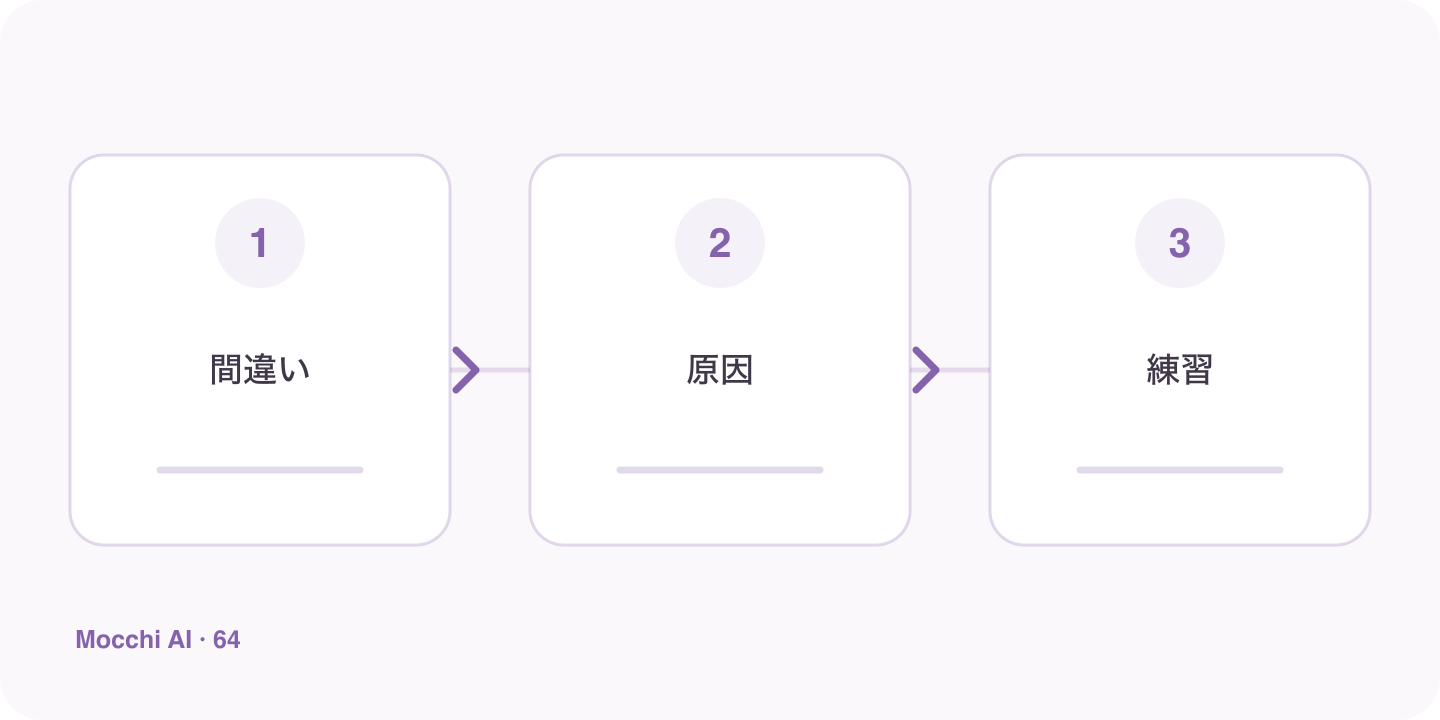
Choose one recurring error and tell Mocchi what you were trying to express. Ask which step failed and request a short contrast. Attempt two new examples without the original correction visible. If the same mistake returns, explain your reasoning and ask whether the issue is vocabulary, structure, or interpretation. Keep a concise note that can guide the next review session.

  1. 1

    Choose one clear goal

    Focus each session on a situation or skill you can actually use.

  2. 2

    Practice actively

    Say complete answers aloud instead of only reading or recognizing Japanese.

  3. 3

    Review and repeat

    Keep useful corrections and revisit the same skill until it feels natural.

FAQ

Frequently asked questions

Can Mocchi infer every weakness automatically?

No. Available practice and learning context can help, but they may not capture every difficulty. Add the situations where you still struggle and correct a suggested target that no longer fits.

What if my weak point is really an unknown word?

Learn the word in context before repeating a grammar drill. The right follow-up depends on which information was missing, not only on the category assigned to the original question.

How long should I stay on one weak point?

Use fresh attempts to decide. If the explanation is clear and new examples are reliable, move to related work with occasional review. If the same decision fails, simplify or change the support rather than merely increasing the number of questions.

Make the weak point small enough to practice

Use Mocchi's learning context alongside your own examples to choose a focused and testable review.