
What makes a video usable
Four features decide whether a video will teach you anything: one person speaking at a time, an everyday topic, Japanese text on screen, and a speed that leaves gaps between sentences. A single speaker facing the camera beats a panel of five funny people, because you hear a whole sentence without anyone talking over the ending, which in Japanese is where the grammar lives.
On-screen text matters more than learners expect. Japanese video culture leans heavily on captions burned into the picture and small labels naming a place or a dish. That text is written by the creator, so unlike an automatic caption it is usually correct, and it gives you the kanji for a word you have only heard.
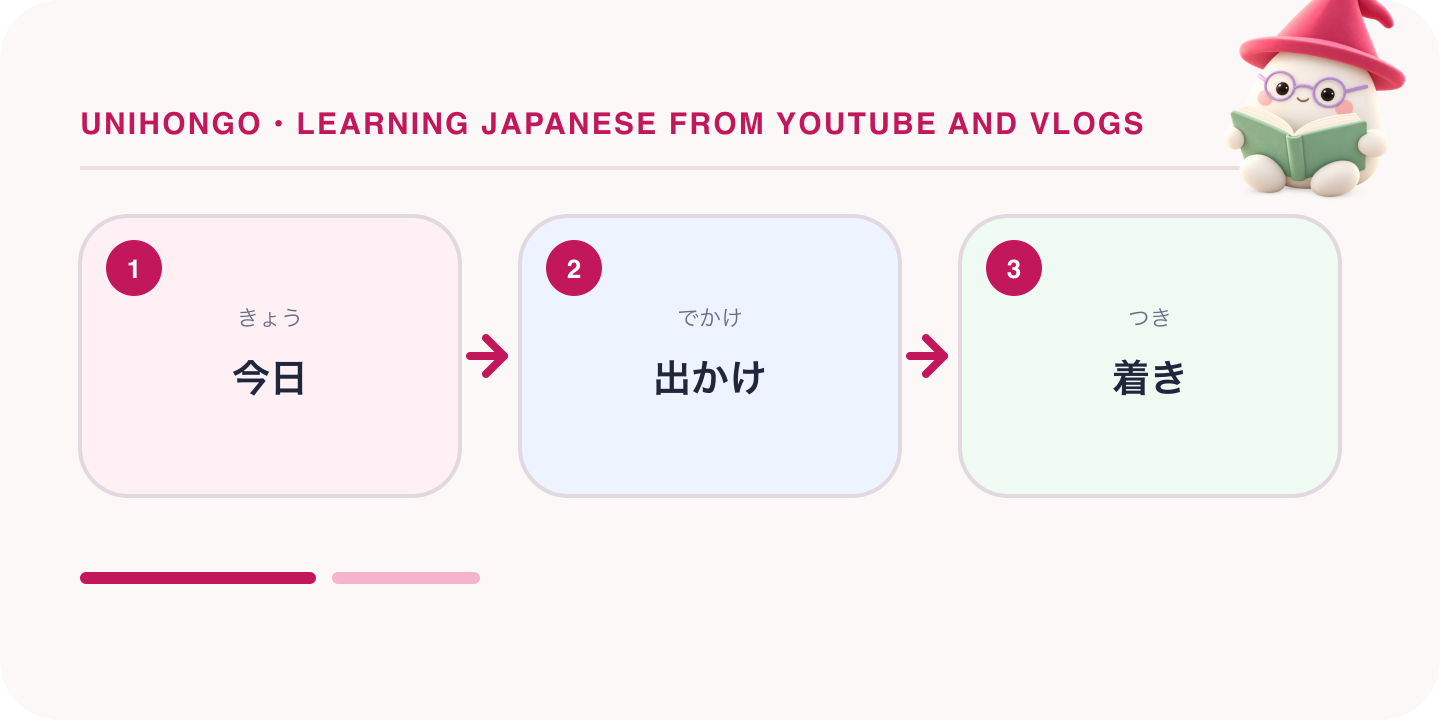
- One speaker, framed close to the camera, talking rather than performing.
- An everyday topic you could describe about your own life: a commute, a meal, an errand.
- Japanese text on screen, whether burned-in captions or handwritten labels.
- Episodes with a repeated structure, so the same opening and closing lines come back.
Entertaining but not teachable
The videos that hold your attention hardest are often the ones you learn least from. Fast comedy cuts every two seconds, so no sentence survives intact. Reaction videos hold a small bubble of real speech inside somebody else's content. Group chat shows overlap constantly, and the laughter that makes them enjoyable covers the sentence endings you need to hear.
Music-heavy travel montages are the clearest case. They look like immersion and contain almost no language: a few written place names, one line of narration a minute, and a soundtrack. You can watch forty minutes and finish with nothing you could say. This is not an argument against enjoying them, only against counting them as study time.
Video types by level and skill
| Video type | Suits | Skill it builds |
|---|---|---|
| Cooking or how-to | Beginner | Action verbs, sequence words, and quantities |
| Room tour or shopping haul | Beginner | Object names and simple descriptions |
| Daily routine vlog | Upper beginner | Everyday verbs, time expressions, and plans |
| Travel vlog with on-screen text | Upper beginner | Place names, directions, and reading speed |
| News read to camera | Intermediate | Formal vocabulary and clear articulation |
| Street interview | Intermediate | Question forms and short spoken answers |
| Two-person unscripted chat | Upper intermediate | Backchannels, interruption, and contractions |
| Gaming or reaction commentary | Advanced | Emotional speech and slang, with low transfer |
| Scripted skit or comedy | Advanced | Wordplay and deliberately exaggerated register |
Read the level column as a starting point rather than a rule. A cooking video is easier than its vocabulary suggests because the picture explains the verb, while friends chatting are harder because nothing is finished cleanly. If a type feels impossible, drop one row and return in a month.
The self-narration you will hear in a vlog
A vlogger talks to a camera that cannot answer, so they narrate what they are doing in short sentences, mostly in the present. That is convenient, because it is the same set of sentences you need to describe your own day. Most vloggers alternate between polite desu and masu forms aimed at the audience and casual forms when thinking aloud, so one speaker gives you both registers.
| Japanese | Romaji | Meaning |
|---|---|---|
| 今日は朝から出かけます。 | Kyō wa asa kara dekakemasu. | Today I am heading out from the morning. |
| 今、駅に着きました。 | Ima, eki ni tsukimashita. | I have just arrived at the station. |
| とりあえずコーヒーを買います。 | Toriaezu kōhī o kaimasu. | For now, I am going to buy a coffee. |
| ここでちょっと休憩します。 | Koko de chotto kyūkei shimasu. | I will take a short break here. |
| ちょっと寒いですね。 | Chotto samui desu ne. | It is a little cold, isn't it. |
| そろそろ行きましょうか。 | Sorosoro ikimashō ka. | Shall we get going soon? |
| 今日は何をしようかな。 | Kyō wa nani o shiyō kana. | What shall I do today, I wonder. (casual) |
| 今日はここまでです。 | Kyō wa koko made desu. | That is all for today. |
| 見てくれてありがとうございます。 | Mite kurete arigatō gozaimasu. | Thank you for watching. |
The mistake is carrying the casual thinking-aloud lines into conversation with a stranger. Kyō wa nani o shiyō kana is somebody muttering to themselves, and said to a shop assistant it lands strangely. Keep the polite lines for people and the casual ones for narrating your own day. A natural reply to sorosoro ikimashō ka is sō desu ne, ikimashō, so practise the answer too.
Cooking and how-to videos repeat themselves
How-to videos are the most forgiving material for a beginner because the picture carries the meaning. When a hand slices an onion while the voice says usuku kirimasu, you do not need to look anything up. The vocabulary repeats inside one video and across the genre, so ten recipes teach you the same core verbs and quantities from ten angles.
| Japanese | Romaji | Meaning |
|---|---|---|
| 材料はこちらです。 | Zairyō wa kochira desu. | Here are the ingredients. |
| 玉ねぎを薄く切ります。 | Tamanegi o usuku kirimasu. | Slice the onion thinly. |
| フライパンに油を入れます。 | Furaipan ni abura o iremasu. | Put oil into the frying pan. |
| 中火で五分ほど焼きます。 | Chūbi de go-fun hodo yakimasu. | Cook it over medium heat for about five minutes. |
| よく混ぜてください。 | Yoku mazete kudasai. | Please mix it well. |
| 塩を少し加えます。 | Shio o sukoshi kuwaemasu. | Add a little salt. |
| 最後に醤油を回しかけます。 | Saigo ni shōyu o mawashikakemasu. | At the end, drizzle soy sauce over it. |
| これで完成です。 | Kore de kansei desu. | And with that it is finished. |
Notice that the instructions use plain polite masu forms rather than commands: kirimasu, iremasu, yakimasu. Kudasai appears only for steps a viewer might get wrong, as in yoku mazete kudasai. Learners assume cooking Japanese is full of imperatives because English recipes are, but the presenter is narrating, not ordering you about.
Street interviews and unscripted chat
Street interviews are the closest thing on video to the conversation you will actually have. Someone asks a stranger a simple question, and the stranger hesitates, restarts, and fills the gap with sound. That imperfection is the value. Scripted dialogue gives you polished answers; an interview shows what a real person does when they need two seconds to think.
| Japanese | Romaji | Meaning |
|---|---|---|
| 少しお話を伺ってもいいですか。 | Sukoshi ohanashi o ukagatte mo ii desu ka. | May I ask you a few questions? |
| 今日はどちらから来ましたか。 | Kyō wa dochira kara kimashita ka. | Where have you come from today? |
| お仕事は何をされていますか。 | Oshigoto wa nani o sarete imasu ka. | What do you do for work? |
| 最近はまっていることはありますか。 | Saikin hamatte iru koto wa arimasu ka. | Is there anything you are into lately? |
| そうですね、難しい質問ですね。 | Sō desu ne, muzukashii shitsumon desu ne. | Well, that is a difficult question. |
| 一言で言うと、楽しかったです。 | Hitokoto de iu to, tanoshikatta desu. | In a word, it was fun. |
| なんて言えばいいんだろう。 | Nante ieba ii n darō. | How should I put it. (casual, thinking aloud) |
| ご協力ありがとうございました。 | Gokyōryoku arigatō gozaimashita. | Thank you for your cooperation. |
Answer the interviewer yourself before the stranger does. Pause after each question, reply out loud, then compare. Your answer will usually be grammatically fine and three times too long. Real spoken answers are short, and they lean on small stalling phrases such as sō desu ne to buy thinking time.
What automatic captions get wrong
Automatic Japanese captions are useful for one thing: showing you where the word boundaries fall in a stream of sound you could not divide by ear. They are unreliable for nearly everything else. The system guesses from sound alone, so it picks the wrong kanji for a homophone, invents plausible words in noisy scenes, and drops the short particles that decide who did what.
Treat a caption as a first draft you are proofreading. If a line reads strangely, it is far more likely that the caption is wrong than that you have found an unusual grammar point. Check anything you intend to memorise in a dictionary, and prefer creator-written captions or burned-in on-screen text where the video offers them.
- Wrong kanji for homophones, so a bridge appears where chopsticks were meant.
- Numbers and counters mangled, especially prices and dates spoken quickly.
- Missing particles, which makes a correct sentence look ungrammatical.
- No punctuation, hiding where one sentence ended and the next began.
Mine two minutes instead of watching an hour
An hour of passive viewing produces a warm feeling and very little language. Two minutes worked properly produces four sentences you can say. Choose the segment for usefulness rather than for interest: the part where the speaker orders something or explains a plan is worth more than the drone shot set to music.
- Pick a two-minute segment where one person is speaking to the camera.
- Watch once with no captions and write down what you think happened.
- Watch again with Japanese captions and mark only the lines that block meaning.
- Look up at most five items, choosing the ones you could reuse this week.
- Shadow the segment twice, matching the pauses rather than chasing the accent.
- Close the video and retell those two minutes in your own words, out loud.
- Write the four sentences you want to keep and change one detail in each.
Narrate your own day like a vlogger
The strongest exercise this medium offers is imitation of the format, not of the vocabulary. Point a phone at yourself, or talk to an empty room, and do what the vlogger does: say where you are, what you are about to do, and what you made of it afterwards. It feels self-conscious for three days and then becomes the easiest practice you have.
Keep it short and structurally identical each time so that you are practising retrieval rather than composition. Three sentences in the morning about the plan, three in the evening about what happened. Reporting forces you into past forms while planning keeps you in present and intention forms, and that gap is where the useful language sits.
| Japanese | Romaji | Meaning |
|---|---|---|
| 今から昼ご飯を作ります。 | Ima kara hirugohan o tsukurimasu. | I am going to make lunch now. |
| これから買い物に行きます。 | Kore kara kaimono ni ikimasu. | I am off to do some shopping. |
| 明日は早く起きるつもりです。 | Ashita wa hayaku okiru tsumori desu. | I intend to get up early tomorrow. |
| 今日は仕事が早く終わりました。 | Kyō wa shigoto ga hayaku owarimashita. | Work finished early today. |
| 昨日はあまり寝られませんでした。 | Kinō wa amari neraremasen deshita. | I could not sleep much last night. |
| 今日はけっこう歩きました。 | Kyō wa kekkō arukimashita. | I walked quite a lot today. |
| 家に帰ったら、洗濯をします。 | Ie ni kaettara, sentaku o shimasu. | When I get home, I will do the laundry. |
The comfortable channel trap
There comes a point with any channel where you understand almost everything, and that feels like an achievement rather than a warning. It is a warning. A speaker whose vocabulary, topics, and speed you have absorbed is no longer teaching you, and the comprehension you enjoy is the sound of a plateau. Comfort is a signal to add difficulty.
The fix is not to abandon the channel. Keep one comfortable source for rhythm and enjoyment, and add one that is slightly too hard, where you catch perhaps half. Rotate the hard slot every few weeks, because the second video from a new speaker is always easier than the first.
A weekly routine that includes speaking
- Two evenings: one two-minute mining session each, with the retell step done aloud.
- Every morning: three narrated sentences about the day ahead, with no notes.
- Every evening: three sentences about what actually happened, in past forms.
- Once a week: a live conversation where you deliberately use four mined phrases.
- Monthly: replace one source, keeping the total number of channels small.
Input alone builds recognition, and recognition is where most video learners stop. The output steps here are short on purpose, because a five-minute habit you keep beats an hour you plan and never schedule. Watching is the easy half; the retell is the half that changes what you can say.