
What manga does better than other input
The panel does work that a textbook sentence cannot. Before you read a single character you already know who is speaking, whether they are annoyed, and where they are standing. That context turns an unknown word into a guessable word, which is the condition under which reading actually builds vocabulary rather than draining you into a dictionary.
The lines are also short. Spoken Japanese in a speech bubble rarely runs past a dozen syllables, so you meet complete, natural utterances instead of the long written sentences that dominate reading textbooks. Add furigana, which many titles print over most or all kanji, and you can read material two or three levels above your kanji knowledge without stalling on every line.
Where manga quietly misleads you
- Blunt speech is the default for many characters, so polite forms can be almost absent for whole volumes.
- Invented vocabulary in fantasy and battle titles looks like Japanese but transfers to nothing outside the story.
- Historical and period series use endings that sound theatrical or comic in modern conversation.
- Gendered speech is exaggerated for characterisation, which teaches stereotypes rather than how people actually talk.
- Sound effects are drawn, not typeset, and many have no dictionary entry at all.
- Text is compressed for space, so particles and subjects vanish in ways that a learner cannot yet reconstruct.
None of this is a reason to stop reading. It is a reason to give manga one job: rich, motivating input plus a supply of phrases to convert. The failure mode is not reading manga; it is reading manga and assuming that the lines are ready to use.
Choose your first title by register, not by fame
| Manga type | Register you get | Transfer to real life |
|---|---|---|
| Slice of life and family | Ordinary casual speech with some polite forms | High, for friends and neighbours |
| School stories | Teen casual speech, club and classroom words | Medium, adult settings differ |
| Work and cooking | Keigo, phone calls, customer language | High, for work and service situations |
| Sports | Shouted encouragement and commands | Low outside the sport itself |
| Battle and fantasy | Invented terms, rough or archaic speech | Low, useful mainly for reading stamina |
| Historical | Period endings and old forms of address | Very low for modern conversation |
Difficulty is not only kanji density. A gentle four-panel comedy can be harder than a workplace story because puns and wordplay depend on knowledge you do not have yet. Read three pages in a shop or a sample before committing, and ask one question: if I copied ten lines from this page, would they be usable with a colleague, a shop assistant, or nobody at all.
A page-level method that fits ten minutes
- Read the whole page once at natural speed and let the pictures carry anything you miss.
- Say what you think happened in one sentence, out loud, before checking anything.
- Choose exactly one word or ending per page to look up, the one that blocks the most meaning.
- Reread the page aloud, in character, at something close to speaking speed.
- Copy two lines into a notebook with the speaker and the listener written beside them.
- Rewrite those two lines in polite Japanese and say both versions back to back.
Questions to ask before you copy a line
| Japanese | Romaji | Meaning |
|---|---|---|
| この人は誰に話していますか? | Kono hito wa dare ni hanashite imasu ka? | Who is this person speaking to? |
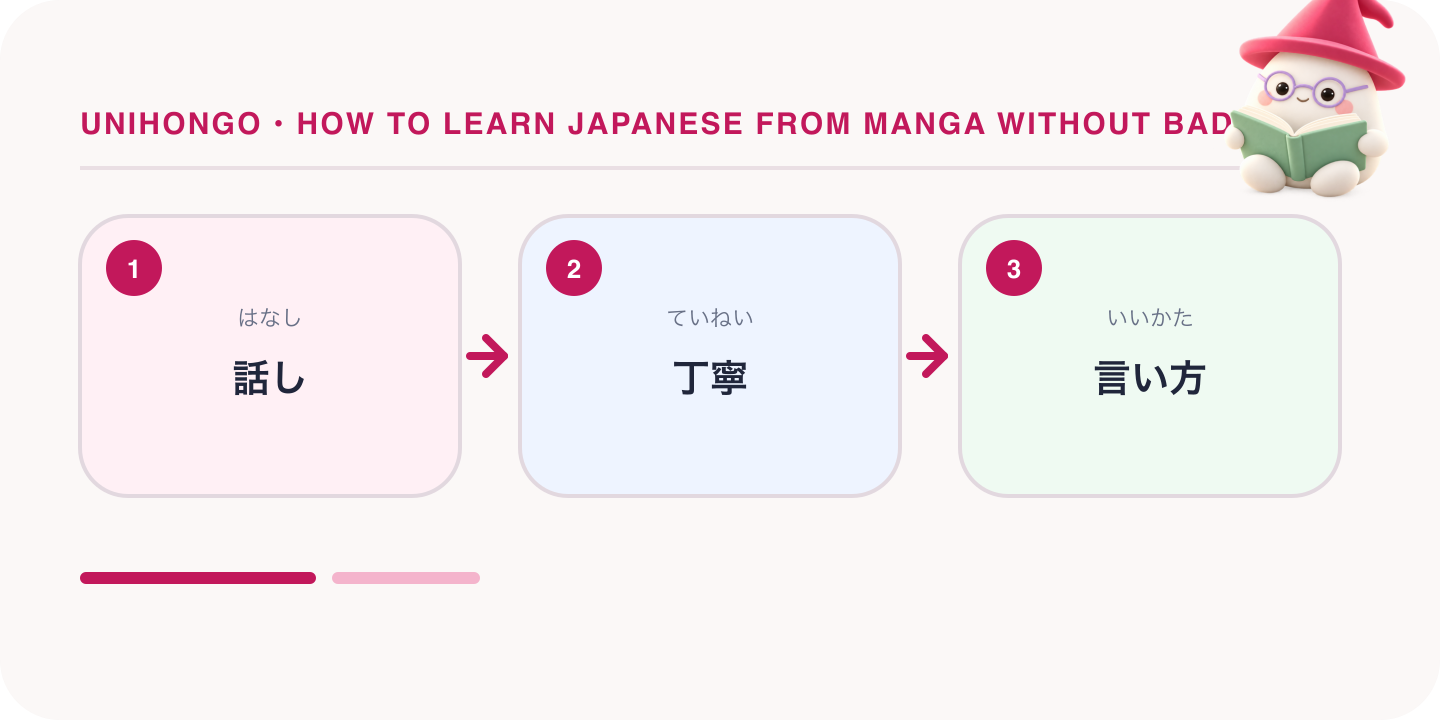
| これは丁寧な言い方ですか? | Kore wa teinei na iikata desu ka? | Is this a polite way of saying it? |
| 自分ならどう言いますか? | Jibun nara dō iimasu ka? | How would I say this myself? |
| この言葉は仕事で使えますか? | Kono kotoba wa shigoto de tsukaemasu ka? | Can I use this expression at work? |
Ask these four questions in Japanese, aloud, while you look at the panel. Saying them turns passive reading into a register check that will still be running in your head a year from now. The second question is the one that saves you, because most manga lines fail it.
Casual manga forms and what to say instead
| Manga form | What it is | Say this instead |
|---|---|---|
| 〜てる teru | Contracted 〜ている | 〜ています te imasu |
| 〜とく toku | Contracted 〜ておく | 〜ておきます te okimasu |
| 〜ちゃう chau | Contracted 〜てしまう | 〜てしまいます te shimaimasu |
| 〜なきゃ nakya | Shortened 'have to' | 〜なければなりません nakereba narimasen |
| わかんない wakannai | Casual 'I do not know' | わかりません wakarimasen |
| すげえ sugē | Rough 'amazing' | すごいですね sugoi desu ne |
| うめえ umē | Rough 'delicious' | おいしいです oishii desu |
| 〜だろ daro | Blunt tag 'right?' | 〜でしょう deshō |
| 〜じゃん jan | Casual confirmation | 〜ですよね desu yo ne |
| 〜てくれ te kure | Blunt request | 〜てください te kudasai |
| 〜ろ imperative | Direct command | 〜てもらえますか te moraemasu ka |
| 俺 ore / お前 omae | Rough self and other reference | 私 watashi, name plus さん san |
Read the left column, say the right column. The point is not that the casual forms are wrong; they are correct among close friends and you need to understand them instantly. The point is that recognition and production should be separated on purpose. Understand the whole left column, and keep the right column as the version that leaves your mouth until someone has clearly invited you to relax.
Rewrite a rough line into something polite
| Japanese | Romaji | Meaning |
|---|---|---|
| 早く来いよ。 | Hayaku koi yo. | Get over here, hurry up. (blunt) |
| 早く来てください。 | Hayaku kite kudasai. | Please come quickly. |
| ちょっと待てよ。 | Chotto mate yo. | Hang on a second. (blunt) |
| 少々お待ちください。 | Shōshō omachi kudasai. | Please wait a moment. (polite) |
| マジで? | Maji de? | Seriously? (very casual) |
| 本当ですか? | Hontō desu ka? | Really? |
| 知らねえよ。 | Shiranē yo. | How should I know? (rough) |
| すみません、わかりません。 | Sumimasen, wakarimasen. | Sorry, I do not know. |
Work in pairs like this and the conversion becomes automatic. Notice that the polite version is rarely a translation of the casual one: 知らねえよ carries irritation that すみません、わかりません deliberately removes, because the polite version has a different social job. If someone answers your polite question with そうですね or ちょっと待ってくださいね, that is the reply you should expect, and it is worth rehearsing too.
Contractions you will meet on every page
| Japanese | Romaji | Meaning |
|---|---|---|
| 今、何してるの? | Ima, nani shiteru no? | What are you doing right now? (casual) |
| 今、何をしていますか? | Ima, nani o shite imasu ka? | What are you doing right now? (polite) |
| 宿題やっとくね。 | Shukudai yattoku ne. | I will get the homework done in advance. (casual) |
| 宿題をやっておきます。 | Shukudai o yatte okimasu. | I will do the homework in advance. |
| 電車、行っちゃった。 | Densha, itchatta. | The train has gone. (casual, with regret) |
| 電車が行ってしまいました。 | Densha ga itte shimaimashita. | The train has already left. |
| もう帰らなきゃ。 | Mō kaeranakya. | I have to head home now. (casual) |
| もう帰らなければなりません。 | Mō kaeranakereba narimasen. | I have to go home now. |
Say each pair one after the other until the polite form arrives as fast as the casual one. Contractions are where manga earns its place: a textbook will show you 〜ておく and a speech bubble will show you 〜とく, and only one of those is what you will actually hear. Learning both directions means you can follow a friend and still answer a manager correctly.
Sound effects are vocabulary, not noise
Hand-drawn effects fall into two groups. Some are purely graphic, painted across a panel to show impact, and you can read past them. Others are mimetic words that live in ordinary speech, describing textures, states, and feelings that Japanese prefers to express with sound rather than adjectives. Those are worth collecting, because a learner who uses two or three of them naturally sounds noticeably less translated.
| Japanese | Romaji | Meaning |
|---|---|---|
| 心臓がドキドキします。 | Shinzō ga dokidoki shimasu. | My heart is pounding. |
| 明日が楽しみでワクワクします。 | Ashita ga tanoshimi de wakuwaku shimasu. | I am excited about tomorrow. |
| お腹がぺこぺこです。 | Onaka ga pekopeko desu. | I am starving. |
| 雨がざあざあ降っています。 | Ame ga zāzā futte imasu. | The rain is pouring down. |
| ドアがバタンと閉まりました。 | Doa ga batan to shimarimashita. | The door slammed shut. |
| 部屋がしーんと静かになりました。 | Heya ga shīn to shizuka ni narimashita. | The room went completely silent. |
Talk about what you read
| Japanese | Romaji | Meaning |
|---|---|---|
| 最近、どんな漫画を読んでいますか? | Saikin, donna manga o yonde imasu ka? | What manga are you reading lately? |
| 今、少女漫画にはまっています。 | Ima, shōjo manga ni hamatte imasu. | I am hooked on shōjo manga at the moment. |
| どんなところが面白いですか? | Donna tokoro ga omoshiroi desu ka? | What part of it do you find interesting? |
| 会話が自然なところが好きです。 | Kaiwa ga shizen na tokoro ga suki desu. | I like that the dialogue sounds natural. |
| おすすめの漫画はありますか? | Osusume no manga wa arimasu ka? | Is there a manga you would recommend? |
| 初心者ならふりがな付きのものがいいですよ。 | Shoshinsha nara furigana-tsuki no mono ga ii desu yo. | If you are a beginner, one with furigana is good. |
This is the output step, and it is the one most readers skip. Summarising a chapter forces you to choose verbs, sequence events, and manage past tense in real time, none of which reading requires. Expect the follow-up question どんな話ですか, and prepare a three-sentence answer before you need it, because a plot summary is much harder to improvise than it looks.
A weekly manga routine that ends in speech
Read for pleasure most days, at whatever speed keeps you turning pages. On two days, slow down and apply the page method to a single page, ending with two mined lines and their polite rewrites. On one day, take those lines into a conversation and use them with the details changed, so the phrase leaves the story and enters your own life.
Keep the notebook small. Five converted lines a week is sixty a quarter, and sixty usable sentences said aloud will move your speaking further than a thousand recognised ones. Input builds recognition; only the rewriting and the saying build the ability to produce Japanese when someone is waiting for you to answer.
- Days one to five: read freely, no dictionary, no notes.
- Two of those days: one page studied, two lines mined and rewritten.
- One day: speak about the chapter and use the rewritten lines with new details.
- End of week: reread last week's lines aloud and delete any you would never say.