
Check That a Mocchi Japanese Rewrite Still Says What You Mean

Before accepting a fluent Japanese rewrite, check that it preserves who did what, when, and with how much certainty. Ask Mocchi to explain any meaning change and keep improvements that serve your intention rather than quietly replacing the message.

Mocchi compares a Japanese draft and revision against the learner's intended participants, time, and claim
What you need to know

Check That a Mocchi Japanese Rewrite Still Says What You Mean

AI feedback can make a sentence smoother while adding a reason, changing a request, or strengthening an opinion. That is not always what you wanted. Start with a short statement of your intention and compare the draft and revision against it. This is especially useful when the original is ambiguous or when you are learning a form that expresses possibility, politeness, or a specific participant relationship. A small meaning audit makes the rewrite a learning tool instead of an answer to accept automatically.

State the intended message before reviewing the rewrite.

Check participants, action, time, and certainty.

Separate optional additions from necessary corrections.

Ask for a smaller revision when the meaning drifts.

Write the intention beside the original

A short familiar-language explanation can establish what the Japanese should express. It does not need to be a polished source paragraph for translation. Name the event, participants, and relationship that matter. Tell Mocchi which part of your Japanese feels uncertain so the revision can focus on that point instead of inventing a different way to tell the whole story.

Keep private details out of the example when they do not affect the language. Fictional names and circumstances can preserve the same grammatical problem. The intention check works just as well when the scene is invented.

Compare certainty before accepting the smoother wording

行けるかもしれません expresses that you may be able to go. 行けます expresses that you can go. Replacing the first with the second can make the sentence more direct while changing the commitment. Ask Mocchi to preserve the uncertainty if it is part of your intention, then explain any optional alternative as a different message rather than a simple correction.
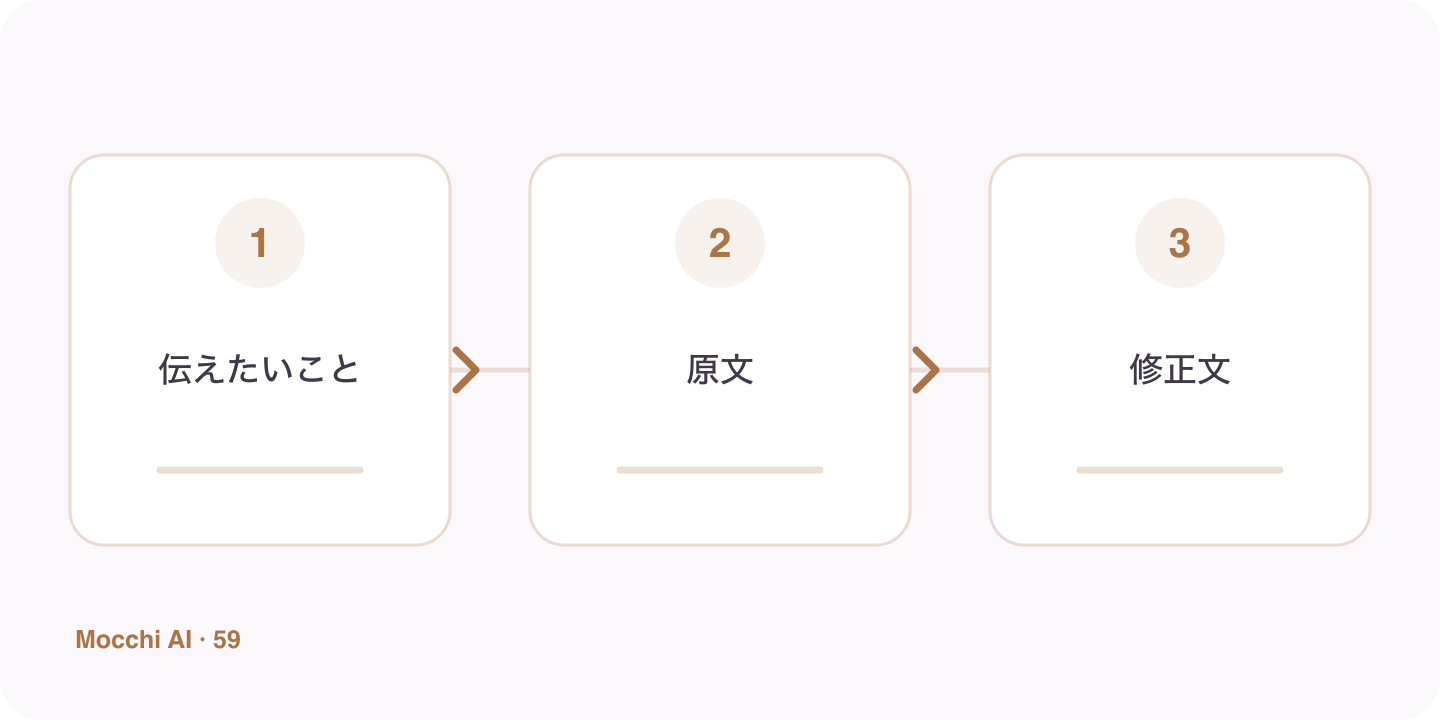
The intended message is checked against an original draft and a revised version before accepting the rewrite
Fluency is useful only when the revised sentence still expresses the message you intended.
JapaneseRomajiMeaning
明日は行けるかもしれません。Ashita wa ikeru kamo shiremasen.I may be able to go tomorrow.
明日は行けます。Ashita wa ikemasu.I can go tomorrow.

Check participants and time as separate items

Read who performs the action and who receives or experiences it. Then check the time relationship. A sentence can become grammatical by changing either of these, yet fail to preserve your intended event. Ask for a plain explanation of the revised roles and timing before deciding that the edit solved the original problem.

Keep additions optional and visible

A rewrite may add an apology, reason, compliment, or commitment. Those additions can be useful in an example, but they should not be mistaken for information you supplied. Ask Mocchi to label optional additions and make a minimal version without them. This is particularly important when a polite message could accidentally promise an action or deadline you did not intend.

Use the correction in another sentence

Once the meaning is stable, identify the main language decision and practice it in a new message. This moves you beyond comparing two versions of one draft. If the same ambiguity returns, make it a focused review target and ask for a simpler contrast. Mocchi's personalized support should help you gain control of the decision, not only produce a polished sentence that remains difficult to adapt.

Key points

A practical way to improve

Write a short Japanese message and describe its intended meaning in a familiar language. Ask Mocchi for a minimal correction, then compare the two versions for participants, event, time, and claim strength. Identify any added detail and decide whether you intended it. Request a revised version that preserves the message, then make a new sentence using the main correction yourself.

  1. 1

    Choose one clear goal

    Focus each session on a situation or skill you can actually use.

  2. 2

    Practice actively

    Say complete answers aloud instead of only reading or recognizing Japanese.

  3. 3

    Review and repeat

    Keep useful corrections and revisit the same skill until it feels natural.

FAQ

Frequently asked questions

Can a more natural sentence still be the wrong rewrite?

Yes. It may express a different event, degree of certainty, or request. Naturalness is useful, but it does not replace checking whether the sentence says what you meant.

Should I ask for a minimal correction?

That is often a useful first step because it makes the important changes visible. You can request a more polished alternative afterward and compare its additional choices separately.

What if I cannot judge the revised Japanese independently?

State your intended meaning plainly and ask for an explanation of the changes. Use a trusted reference or knowledgeable person for consequential wording that remains uncertain, rather than relying only on a fluent back-translation.

Keep control of the message while improving the Japanese

Use Mocchi to explain the revision and preserve your intention before accepting a more polished version.