
What 15 minutes a day can and cannot achieve
Fifteen minutes a day adds up to roughly seven and a half hours a month and about ninety hours a year. That is a genuine amount of study, but it is small beside the hundreds of hours most estimates attach to even the lower JLPT levels. The honest framing is this: you will make real, visible progress, and you will not become fluent in a year. Anyone promising otherwise is selling the calendar, not the language.
Progress also depends on what fills the minutes. Ninety hours of grammar videos produces a learner who recognises a great deal and can say very little. Ninety hours that are mostly spoken output, with corrections reviewed the next day, produces someone who can hold a short conversation about their own life. Treat the ranges below as ranges: learners with prior kanji knowledge or extra listening tend to move faster.
- After 3 months: kana read comfortably, a few hundred words, a self-introduction, and simple present and past sentences about your day.
- After 6 months: short exchanges in a café or shop, basic questions about plans and preferences, and a first pass through N5-range grammar.
- After 12 months: a sustained simple conversation about daily life with a patient partner, most N5 grammar, and the first N4 patterns if you also read.
Why short daily beats long weekly
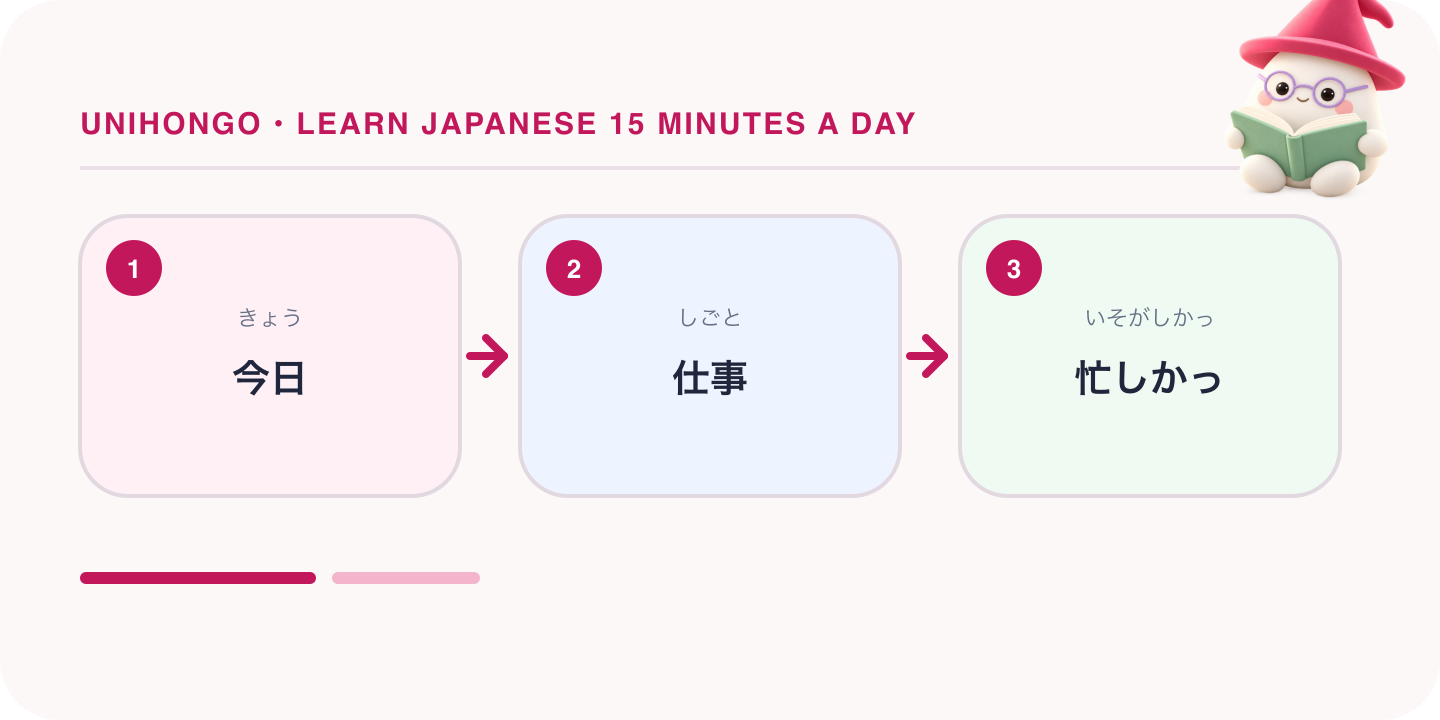
The same ninety minutes spread over six days does more than ninety minutes on Sunday. Memory research consistently favours spaced retrieval over massed practice, and speaking adds a second reason: it is a motor skill as much as a knowledge one. Six short attempts at kinou wa shigoto ga isogashikatta desu keep the sentence retrievable; one long attempt leaves it fading by midweek. The daily version is also more robust. A two-hour Saturday session competes with family, errands, and tiredness, and once it is skipped twice the plan quietly ends. A fifteen-minute slot fits before almost anything, so it survives bad weeks. Consistency is not a personality trait here; it is a consequence of choosing a size you can defend.
The 15-minute template, minute by minute
The template keeps most of the time on production. Reading about Japanese feels productive and is far easier than speaking it, which is exactly why it should be rationed. If you use an AI tutor for the speaking block, give it one situation and one language target, then answer aloud before reading any suggestion. If you prefer shadowing, choose a short dialogue at your level and repeat it in time with the audio.
- Minutes 1 to 2, review: read yesterday's two saved corrections aloud and change one detail in each.
- Minutes 3 to 10, speaking: a roleplay mission with an AI tutor, or shadowing a dialogue, on today's focus.
- Minutes 11 to 13, corrections: read the session report or your recording, keep two corrections, say each improved sentence three times.
- Minutes 14 to 15, flashcards: review due cards only and add at most three words from today's speaking.
Rotate your focus across the week
Fifteen minutes cannot cover everything every day, so let the eight-minute speaking block change focus while the rest of the template stays the same. Rotation stops the routine from collapsing into one repeated scenario, and it quietly gives pronunciation and listening the attention they rarely receive in a busy schedule. If a day's focus does not suit your mood, swap two days rather than skipping one.
| Day | Focus | Speaking activity |
|---|---|---|
| Monday | Everyday conversation | Talk about your weekend and this week's plans |
| Tuesday | Pronunciation | Shadow Monday's corrected sentences with pronunciation coaching |
| Wednesday | Roleplay | One practical mission such as a café order or hotel check-in |
| Thursday | Repeat with variation | Redo Wednesday's mission with new details and fewer hints |
| Friday | Free talk | A topic you genuinely care about, at your own pace |
| Saturday | Listening | Hear a short dialogue twice, then summarise it aloud |
| Sunday | Review | Reread the week's corrections and retire the ones you now get right |
Attach the habit to something you already do
Willpower is a poor scheduler. The routine lasts when it is attached to an existing anchor, so the trigger is something you already do rather than a decision you must make each day. Coffee, the commute, and the ten minutes before bed are the anchors most adults can keep, and each suits a slightly different version of the session.
With coffee, the full template works well because your voice and attention are fresh. On a train or bus, speaking aloud is awkward, so swap the speaking block for shadowing under your breath and listening, then do the spoken part later. Before bed, keep it quieter: review corrections, run flashcards, and record one sentence about your day so tomorrow's session has something to correct.
Sentences to say about your own day
The easiest topic to speak about every day is the day itself. These sentences cover work, tiredness, plans, and the study habit you are building, so you can reuse them all week and simply change the details. Say each one aloud, then replace one word with something true about today. Within a fortnight they will surface without an English draft first.
| Japanese | Romaji | Meaning |
|---|---|---|
| 今日は仕事が忙しかったです。 | Kyō wa shigoto ga isogashikatta desu. | Work was busy today. |
| 朝、コーヒーを飲みながら日本語を勉強しました。 | Asa, kōhī o nominagara Nihongo o benkyō shimashita. | This morning I studied Japanese while drinking coffee. |
| 最近、日本語を毎日勉強しています。 | Saikin, Nihongo o mainichi benkyō shite imasu. | Recently I have been studying Japanese every day. |
| 週末は何をしますか。 | Shūmatsu wa nani o shimasu ka. | What are you doing at the weekend? |
| 電車の中で単語を復習しました。 | Densha no naka de tango o fukushū shimashita. | I reviewed vocabulary on the train. |
| 明日は友達と晩ご飯を食べます。 | Ashita wa tomodachi to bangohan o tabemasu. | Tomorrow I am having dinner with a friend. |
| 今日は疲れたので、早く寝ます。 | Kyō wa tsukareta node, hayaku nemasu. | I am tired today, so I will go to bed early. |
| 今週は少し忙しいですが、頑張ります。 | Konshū wa sukoshi isogashii desu ga, ganbarimasu. | This week is a little busy, but I will keep at it. |
What to do on a bad day: the 3-minute minimum
Some days the fifteen minutes will not happen. The mistake is treating that as a failed day and then a failed week. Decide in advance on a three-minute minimum: say yesterday's two corrections aloud, then one sentence about today, even if it is only kyou wa tsukaremashita. The point is not the learning value of three minutes; it is that the chain stays unbroken and the anchor keeps its meaning.
A minimum also removes the negotiation that kills habits. When the only options are the full session or nothing, tired people choose nothing. With a third option, they usually take it, and quite often three minutes become ten because starting was the hard part. Count the minimum as a real session and do not try to make it up the next day.
How to know it is working
Progress at fifteen minutes a day is real but slow enough to be invisible from one day to the next, so you need evidence that spans weeks. Session reports help here: compare the corrections from your first week with those from this week. If the same particle mistake has disappeared and the corrections now concern nuance rather than meaning, the routine is doing its job.
- You answer a familiar question without an internal English draft first.
- Old corrections have stopped appearing in new session reports.
- A repeated roleplay mission needs fewer hints than it did a month ago.
- You notice your own mistake a moment after making it.
Unihongo is built for this scale of practice: a short AI Sensei conversation, a roleplay mission, a session report with corrections, and flashcards. Whatever tool you use, the routine is the product. Fifteen honest minutes, attached to a fixed anchor and protected by a small minimum, will outlast every ambitious plan you have abandoned before.