
What buntai is and why it is decided first
Buntai means the style of your sentence endings, and Japanese treats it as a property of the whole document rather than of individual sentences. Before writing a single line, a Japanese writer settles one question: is this text addressed to a reader, or is it stating something into the world? An email, a letter, an announcement and most blog writing address a reader, so they take the desu-masu style. An essay, a report, a thesis, a news article and a dictionary entry state things, so they take the plain style built on da or dearu.
This is not the same decision as the spoken politeness question, though it uses the same forms. In speech you choose desu-masu or plain according to who is in front of you, and getting it wrong sounds rude. In writing there is nobody in front of you, so plain style carries no rudeness. A thesis written entirely in dearu style is not being blunt with its examiner; it is simply not addressing anyone. The other guide on polite versus casual Japanese covers the spoken half of this.
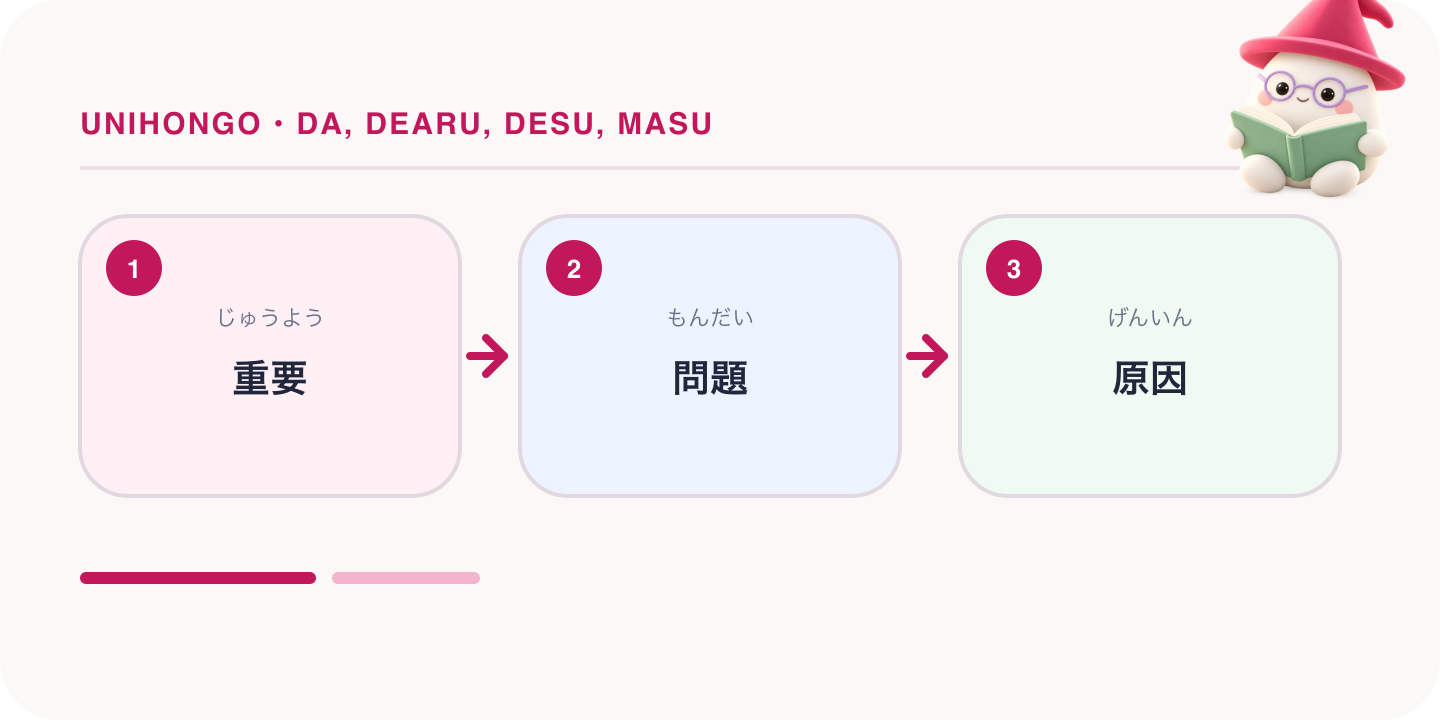
The same sentence in three styles
| Meaning | Desu-masu style | Da style | Dearu style |
|---|---|---|---|
| This is a problem | 問題です。 Mondai desu. | 問題だ。 Mondai da. | 問題である。 Mondai de aru. |
| Japanese is difficult | 日本語は難しいです。 Nihongo wa muzukashii desu. | 日本語は難しい。 Nihongo wa muzukashii. | 日本語は難しい。 Nihongo wa muzukashii. |
| I will go tomorrow | 明日行きます。 Ashita ikimasu. | 明日行く。 Ashita iku. | 明日行く。 Ashita iku. |
| It is not a problem | 問題ではありません。 Mondai de wa arimasen. | 問題じゃない。 Mondai ja nai. | 問題ではない。 Mondai de wa nai. |
| It was a problem | 問題でした。 Mondai deshita. | 問題だった。 Mondai datta. | 問題であった。 Mondai de atta. |
| It is probably true | 本当でしょう。 Hontō deshō. | 本当だろう。 Hontō darō. | 本当であろう。 Hontō de arō. |
| It is convenient | 便利です。 Benri desu. | 便利だ。 Benri da. | 便利である。 Benri de aru. |
| It was not convenient | 便利ではありませんでした。 Benri de wa arimasen deshita. | 便利じゃなかった。 Benri ja nakatta. | 便利ではなかった。 Benri de wa nakatta. |
Two things stand out. Verbs and i-adjectives look identical in da style and dearu style, because both simply use the plain form; the styles only diverge where a noun or na-adjective needs a copula. And da style tolerates the contracted ja nai, while dearu style always writes de wa nai in full. That single contraction is a reliable giveaway of an unedited text.
Nouns, na-adjectives and the copula
The copula is where the three styles actually differ, so learn this column and the rest follows. Desu becomes da or de aru; deshita becomes datta or de atta; deshō becomes darō or de arō. Na-adjectives behave exactly like nouns here, which is why shizuka desu becomes shizuka da and shizuka de aru. In dearu style, many writers also use de aru only where the sentence needs a copula and otherwise leave verbs and adjectives bare, so a dearu-style page is not full of de aru endings.
| Japanese | Romaji | Meaning |
|---|---|---|
| これは重要な問題です。 | Kore wa jūyō na mondai desu. | This is an important problem. (desu-masu) |
| これは重要な問題である。 | Kore wa jūyō na mondai de aru. | This is an important problem. (dearu) |
| 原因は明らかではない。 | Gen'in wa akiraka de wa nai. | The cause is not clear. (dearu) |
| 結果は予想どおりであった。 | Kekka wa yosō dōri de atta. | The result was as expected. (dearu) |
| その説明は十分ではなかった。 | Sono setsumei wa jūbun de wa nakatta. | That explanation was not sufficient. (dearu) |
| 今日は静かだ。 | Kyō wa shizuka da. | It is quiet today. (da, diary style) |
| この方法が有効だろう。 | Kono hōhō ga yūkō darō. | This method is probably effective. (da) |
| これは偶然ではないだろうか。 | Kore wa gūzen de wa nai darō ka. | Might this not be a coincidence? (dearu) |
Verbs and negatives across the styles
Verbs are the easy part: strip the masu ending and use the dictionary form, and both plain styles are satisfied at once. The negatives are where beginners slip, because the polite negative has two shapes and the plain one has spoken contractions that written style will not accept. Arimasen becomes nai; te imasen becomes te inai; and the spoken shortening te ru must be restored to te iru before it goes anywhere near a report.
| Function | Desu-masu | Plain (da or dearu) | Watch out for |
|---|---|---|---|
| Present | 書きます Kakimasu | 書く Kaku | Use the dictionary form, not the stem |
| Negative | 書きません Kakimasen | 書かない Kakanai | Not the spoken kakan |
| Past | 書きました Kakimashita | 書いた Kaita | Check the ta-form sound change |
| Past negative | 書きませんでした Kakimasen deshita | 書かなかった Kakanakatta | Two negatives, one ending |
| Progressive | 書いています Kaite imasu | 書いている Kaite iru | Never write kaite ru |
| Existence | あります Arimasu | ある Aru | Nai is the negative, not aranai |
| Volitional | 書きましょう Kakimashō | 書こう Kakō | Rare in reports; use suru beki da |
| Ability | 書けます Kakemasu | 書ける Kakeru | Kakareru is the passive, not the potential |
One more written-register habit worth knowing: formal reports and business documents often replace te iru with te ori, as in kentō shite ori, and te kara with go. These belong to the humble written register rather than to plain style itself, so treat them as an extra layer you add on top of a desu-masu document, not as a rule of dearu style.
Connectives that belong to written Japanese
Spoken connectives sound out of place in written style, and swapping them is one of the fastest upgrades you can make to a draft. Demo, dakara, datte and ja are conversational; shikashi, shitagatte, sono tame and de wa are their written counterparts. The written set is also more precise: mata adds a parallel point, sara ni escalates, tsumari restates, tadashi adds a condition, and ippō introduces a contrasting side.
| Spoken | Written | Job in the paragraph |
|---|---|---|
| でも Demo | しかし Shikashi | Turns against the previous sentence |
| だから Dakara | したがって Shitagatte | Draws a conclusion from evidence |
| それで Sore de | そのため Sono tame | States a consequence |
| それに Sore ni | また Mata | Adds a parallel point |
| もっと言うと Motto iu to | さらに Sara ni | Escalates to a stronger point |
| つまりね Tsumari ne | つまり Tsumari | Restates in clearer terms |
| けど Kedo | ただし Tadashi | Adds a qualification or exception |
| 逆に Gyaku ni | 一方 Ippō | Presents the other side |
| ちなみに Chinami ni | なお Nao | Adds a side note at the end |
Vocabulary shifts with the connectives. Totemo becomes hijō ni, sugoku becomes kiwamete, takusan becomes ōku no, chotto becomes yaya, and iroiro na becomes samazama na. You are not making the text harder; you are removing the traces of a speaking voice.
What written style removes
- Sentence-final particles: ne, yo, na, wa, kana and zo all disappear from formal writing.
- Contractions: ja nai becomes de wa nai, te ru becomes te iru, nakya becomes nakereba naranai.
- The explanatory n da: n desu and n da become no de aru, or are simply cut.
- Hedging fillers: nanka, chotto, yappari and maa carry no information on a page.
- Direct address: anata is usually dropped, since a report does not speak to a person.
- Question marks after plain questions: written Japanese commonly ends with ka and a full stop.
Removing final particles is the hardest habit for learners who built their Japanese through conversation, because ne and yo feel like politeness. In writing they read as chatter. The written equivalent of that softening is a hedged predicate instead: to kangaerareru for it can be considered, no de wa nai ka for is it not the case that, and to iwareru for it is said that.
Converting a spoken paragraph line by line
Here is the method in one worked example. Take a spoken sentence, then apply four passes in order: fix the ending, remove the particles and contractions, replace the connective, and lift the vocabulary. Doing them in that order stops you from rewriting the meaning by accident. Each pair below shows the same content spoken and then written in dearu style.
| Japanese | Romaji | Meaning |
|---|---|---|
| 最近、日本語の勉強を始めたんだけど、けっこう難しいね。 | Saikin, Nihongo no benkyō o hajimeta n da kedo, kekkō muzukashii ne. | Spoken: I recently started studying Japanese, and it is pretty hard. |
| 近年、日本語学習を始めたが、その難度は高い。 | Kinnen, Nihongo gakushū o hajimeta ga, sono nando wa takai. | Written: Study of Japanese was begun recently, and its difficulty is high. |
| でも、毎日やってるから、少しずつ慣れてきたよ。 | Demo, mainichi yatte ru kara, sukoshi zutsu narete kita yo. | Spoken: But I do it every day, so I have gradually got used to it. |
| しかし、毎日継続しているため、徐々に慣れてきた。 | Shikashi, mainichi keizoku shite iru tame, jojo ni narete kita. | Written: However, because it is continued daily, familiarity has gradually increased. |
| それに、話す練習もしたほうがいいと思うんだ。 | Sore ni, hanasu renshū mo shita hō ga ii to omou n da. | Spoken: Also, I think it is better to practise speaking too. |
| また、会話の練習も行うべきである。 | Mata, kaiwa no renshū mo okonau beki de aru. | Written: Furthermore, speaking practice should also be carried out. |
| やっぱり、聞くだけじゃ話せるようにならないよね。 | Yappari, kiku dake ja hanaseru yō ni naranai yo ne. | Spoken: As expected, just listening does not make you able to speak. |
| 聴解のみでは発話能力は身につかない。 | Chōkai nomi de wa hatsuwa nōryoku wa mi ni tsukanai. | Written: Listening alone does not develop speaking ability. |
| だから、来年は試験を受けようと思ってる。 | Dakara, rainen wa shiken o ukeyō to omotte ru. | Spoken: So I am thinking of taking the exam next year. |
| したがって、来年度に受験する予定である。 | Shitagatte, rainendo ni juken suru yotei de aru. | Written: Therefore, the plan is to sit the examination next year. |
Notice what the written version gained and lost. It gained precision, nominalised vocabulary such as gakushū and hatsuwa nōryoku, and connectives that mark logical relationships. It lost warmth, the speaker's presence and every trace of the listener. That trade is the whole point of buntai, and it is why a well-written report often sounds cold when read aloud.
Where each style actually belongs
| Text type | Usual style | Note |
|---|---|---|
| Email to a colleague | Desu-masu | Commonly the safe default at work |
| Letter or greeting card | Desu-masu | Fixed openings assume this style |
| Blog post or product page | Desu-masu | Addressed to a reader |
| University essay or thesis | Dearu | Da alone can read as too light |
| Company report or minutes | Dearu | Some firms prefer desu-masu; check the template |
| News article | Da or dearu | Headlines drop the copula entirely |
| Dictionary or reference entry | Dearu | No reader is being addressed |
| Diary or personal notes | Da | Dearu would feel stiff for private notes |
| Job application statement | Desu-masu | Practice varies; follow the employer's form |
Conventions differ by company, university and publisher, so when a template or a supervisor's example exists, copy its style rather than reasoning from first principles. The rule that never varies is internal consistency: whichever style the document opens with, it closes with.
Catching a style mix before anyone else does
Style drift almost always happens in the same three places. The first is the opening and closing lines, where polite formulas leak into a plain-style text. The second is a sentence you found difficult, where you fell back on the form you know best. The third is a bulleted list, where writers often switch to noun endings without deciding whether the whole list does so.
- Read only the last two characters of every sentence, top to bottom, ignoring the content.
- In a desu-masu document, every final should read masu, desu, mashita, masen or deshō.
- In a plain document, every final should read a verb, an i-adjective, da, de aru or datta.
- Check bullet lists separately and make them all noun endings or all sentences, not both.
- Search your draft for ja nai, te ru, n desu and ne to catch spoken leftovers in one pass.
- Read the first and last paragraph again last; they drift most because they are written first and in a hurry.
Saying it when you hand the text over
Written style is only half the task. You still have to talk about the document you wrote, and those spoken lines go back to desu-masu, because now there is a person in front of you. These are the sentences you say when you email a draft, hand over a printed report, or ask a colleague which style your workplace prefers.
| Japanese | Romaji | Meaning |
|---|---|---|
| 報告書の下書きをお送りします。 | Hōkokusho no shitagaki o o-okuri shimasu. | I will send you the draft of the report. |
| 文体はである調で書きました。 | Buntai wa de aru chō de kakimashita. | I wrote it in the dearu style. |
| ですます調のほうがよろしいでしょうか。 | Desu-masu chō no hō ga yoroshii deshō ka. | Would the desu-masu style be preferable? |
| 社内の書式はありますか。 | Shanai no shoshiki wa arimasu ka? | Is there an in-house format? |
| 文体が混ざっていないか、見ていただけますか。 | Buntai ga mazatte inai ka, mite itadakemasu ka? | Could you check whether the styles are mixed? |
| 表現が硬すぎるかもしれません。 | Hyōgen ga katasugiru kamo shiremasen. | The wording may be too stiff. |
| もう少しやわらかくしたほうがいいですか。 | Mō sukoshi yawarakaku shita hō ga ii desu ka? | Should I make it a little softer? |
| 結論の部分だけ確認をお願いします。 | Ketsuron no bubun dake kakunin o onegai shimasu. | Please check just the conclusion section. |
| 明日までに直します。 | Ashita made ni naoshimasu. | I will correct it by tomorrow. |
| ご指摘ありがとうございます。 | Go-shiteki arigatō gozaimasu. | Thank you for pointing that out. |
| この一文だけ、ですます調が残っていました。 | Kono ichibun dake, desu-masu chō ga nokotte imashita. | Only this one sentence still had the desu-masu style. |
| 最終版を共有いたします。 | Saishūban o kyōyū itashimasu. | I will share the final version. |
A likely reply when you ask about style is Kono shorui wa de aru chō de onegaishimasu, meaning please use dearu style for this document, or Shanai bunsho wa desu-masu desu, meaning in-house documents use desu-masu. Both are short, fast and easy to miss, so practise hearing them as much as saying your own question.
A short drill that fixes buntai for good
- Pick five sentences you already say fluently and write each one in all three styles.
- Rewrite one paragraph of a Japanese news article into desu-masu, then back again.
- Keep a diary in da style for a week; it trains plain endings without any politeness anxiety.
- Write one paragraph about your work in dearu style and count how many de aru you actually needed.
- Copy the connective table onto a card and force yourself to use three written connectives per paragraph.
- Before sending anything, do the last-two-characters scan; it takes under a minute.
After a week of this, the choice stops being a grammar question and becomes a reflex tied to the document type. You will open a blank page, notice that it is an email rather than a report, and your fingers will produce masu endings before you have consciously decided anything. That is the point at which buntai is learned.