
Taking a mock test is not the same as using one
The common pattern is to sit a practice paper on a Sunday, mark it, feel briefly encouraged or discouraged, and change nothing about the study week. That is taking a mock test. Using one means the paper generates a list of specific, named problems, and the next week is built from that list rather than from the next chapter of a textbook.
It matters because the JLPT is multiple choice across language knowledge, reading, and listening, so a wrong answer hides its cause. Two learners lose the same mark for different reasons, and the study that fixes one does nothing for the other. The cause is only recoverable while the question is fresh.
Sit it under exam conditions or the score means nothing
Exam conditions are not fussiness. Reading under a clock is a different skill from reading at leisure, and the listening section allows no replays, so practice with a pause button trains something the exam will not accept. Allow yourself small comforts during the paper and you cannot tell later whether a miss came from weak knowledge or from a condition you will not have on the day.
- One sitting, in section order, with only the breaks the real paper gives you.
- Phone away, dictionary closed, no lookups until the whole paper is finished.
- Play the listening audio once, at normal speed, without pausing or rewinding.
- Mark answers on a printed answer sheet so the transfer step is practised too.
- Write the clock time next to each section as you finish it, before you check anything.
Read the instructions aloud before you time yourself
The instruction lines on a JLPT paper are fixed and formal, and every second spent decoding them is a second not spent on the question. Read the standard stems aloud in the days before a mock until each registers as one shape rather than a sentence to be parsed. Listening instructions matter most, because they are spoken once and set up how the section works.
| Japanese | Romaji | Meaning |
|---|---|---|
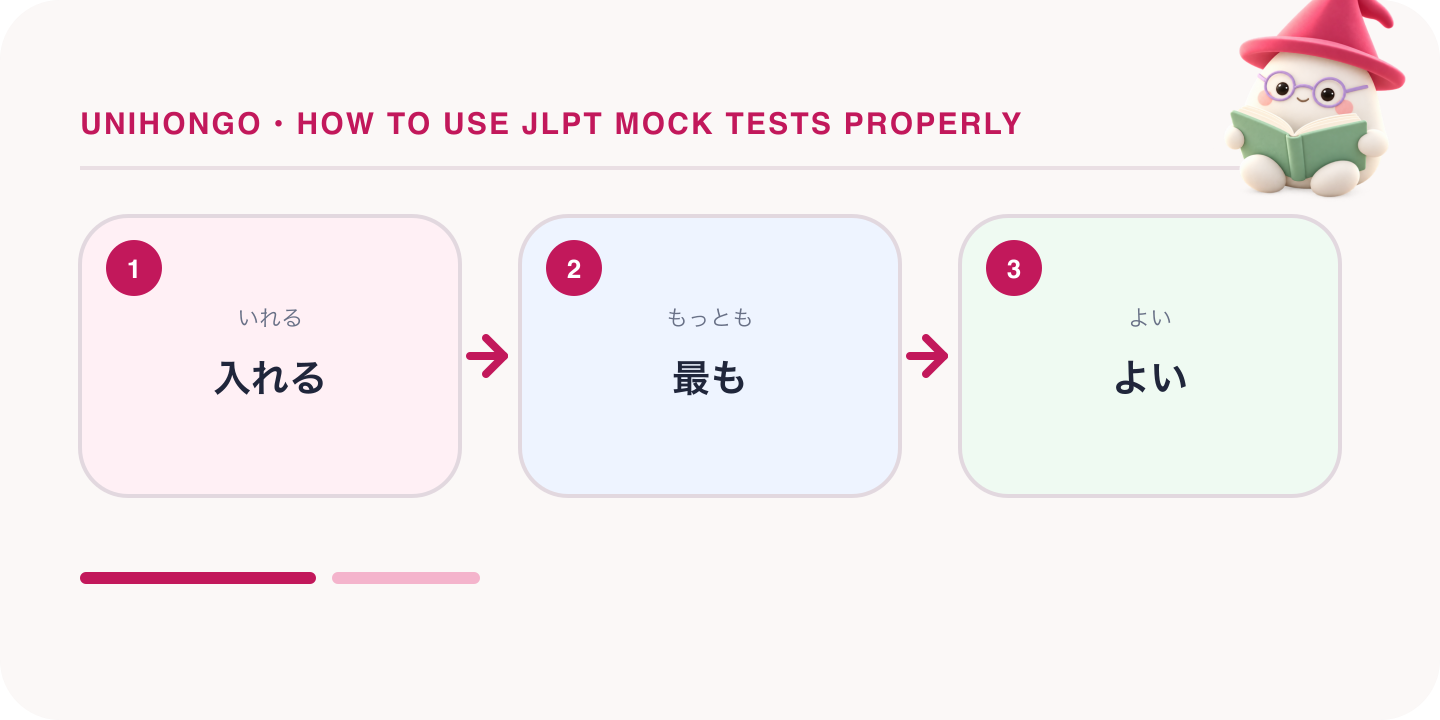
| 次の文の( )に入れるのに最もよいものを、一つ選びなさい。 | Tsugi no bun no ( ) ni ireru no ni mottomo yoi mono o, hitotsu erabinasai. | Choose the one best item to put in the blank in the following sentence. |
| __の言葉の読み方として最もよいものを選びなさい。 | __ no kotoba no yomikata to shite mottomo yoi mono o erabinasai. | Choose the best reading for the underlined word. |
| 次の文章を読んで、質問に答えなさい。 | Tsugi no bunshō o yonde, shitsumon ni kotaenasai. | Read the following passage and answer the questions. |
| 答えは解答用紙にマークしてください。 | Kotae wa kaitō yōshi ni māku shite kudasai. | Mark your answers on the answer sheet. |
| では、始めます。 | Dewa, hajimemasu. | Now we will begin. |
| 話を聞いて、正しい答えを一つ選んでください。 | Hanashi o kiite, tadashii kotae o hitotsu erande kudasai. | Listen to the conversation and choose the one correct answer. |
| まず質問を聞いてください。 | Mazu shitsumon o kiite kudasai. | First, listen to the question. |
| それから話を聞いて、答えを選んでください。 | Sorekara hanashi o kiite, kotae o erande kudasai. | Then listen to the talk and choose your answer. |
The five ways to get a question wrong
| Error type | What it looks like in review | The fix that actually works |
|---|---|---|
| Unknown word | The sentence reads cleanly except for one blank space where a word should be | Rewrite the word inside a full sentence of your own and say it aloud that day, again after three days, and again a week later |
| Unknown grammar | You recognise every word but cannot say what the ending or the connector is doing | Write the pattern with its function in one line, then produce four original sentences with it aloud before the next study session |
| Misread question | You knew the material and answered a question that was not the one asked | Underline the interrogative word and every negative, then paraphrase the question in your own words before you look at the options |
| Ran out of time | The final block is blank, guessed, or answered in a rush you can still remember | Set a per-block time target, practise that block against a stricter clock, and rehearse skipping and returning instead of fighting one question |
| Careless slip | You knew the answer, or changed a correct one, or marked the wrong row | Slow the marking step: read the option you chose back against the question stem, and mark in fixed groups rather than one at a time |
Every wrong answer gets exactly one label, chosen the same day while you still remember what happened in your head. Guessing correctly counts as an error too, and it usually belongs under unknown word or unknown grammar; a lucky mark that you do not log is a hole you will fall into again on the real paper.
Then count the labels. A page dominated by unknown words is a vocabulary project. A page dominated by misread questions and careless slips is not a knowledge problem at all, and more study hours will not touch it. Learners who skip the classification step default to studying more vocabulary, because it feels like progress, whatever the paper actually said.
Re-do the questions without the options
Multiple choice lets you recognise an answer without being able to produce one, and that gap is exactly where the JLPT stops measuring and real Japanese begins. So after marking, cover the four options and solve every missed question again from the stem alone: say what belongs in the grammar blank, and answer the reading question in your own words before checking which option matches.
This second pass sorts your errors honestly. If the answer arrives once the options are gone, the problem was the distractors and your reading procedure, not your knowledge. If nothing comes, you did not know it, and the item goes on the study list.
Turn missed vocabulary into spoken sentences
A word logged as a list entry stays a list entry. A word logged inside a sentence you have said aloud is available when you need it. For every unknown word from the mock, write one sentence about your own life or work, check it, then say it until it runs smoothly. The examples below show the shape to aim for: ordinary, complete, and usable today.
| Japanese | Romaji | Meaning |
|---|---|---|
| 締め切りに何とか間に合いました。 | Shimekiri ni nantoka maniaimashita. | I somehow made the deadline. |
| 会議の資料を準備しておきます。 | Kaigi no shiryō o junbi shite okimasu. | I will prepare the meeting materials in advance. |
| 天気予報によると、明日は雨だそうです。 | Tenki yohō ni yoru to, ashita wa ame da sō desu. | According to the forecast, it will rain tomorrow. |
| 事故のせいで電車が遅れました。 | Jiko no sei de densha ga okuremashita. | The train was delayed because of an accident. |
| 説明が分かりにくかったので、もう一度聞きました。 | Setsumei ga wakarinikukatta node, mō ichido kikimashita. | The explanation was hard to follow, so I asked again. |
| 練習すればするほど、自然になります。 | Renshū sureba suru hodo, shizen ni narimasu. | The more you practise, the more natural it becomes. |
Shadow the listening script instead of replaying it
Replaying a listening item until you finally catch it trains patience, not hearing. Listen once as in the exam, then open the script, find the exact words you missed, and shadow the passage aloud until your mouth produces it at the speed it was spoken. Sounds you can say are far easier to catch, because you already know what they feel like.
| Japanese | Romaji | Meaning |
|---|---|---|
| 次の電車は三番線から発車します。 | Tsugi no densha wa sanbansen kara hassha shimasu. | The next train departs from platform three. |
| 恐れ入りますが、こちらでお待ちください。 | Osoreirimasu ga, kochira de omachi kudasai. | Excuse me, please wait over here. |
| 会議は三時からに変更になりました。 | Kaigi wa san-ji kara ni henkō ni narimashita. | The meeting has been moved to three o'clock. |
| 受付で名前を書いてから、二階へお上がりください。 | Uketsuke de namae o kaite kara, ni-kai e o-agari kudasai. | Please write your name at reception, then go up to the second floor. |
| ただいまの放送をもう一度繰り返します。 | Tadaima no hōsō o mō ichido kurikaeshimasu. | We will repeat the announcement just made. |
| 申し訳ございませんが、本日は満席です。 | Mōshiwake gozaimasen ga, honjitsu wa manseki desu. | I am very sorry, but we are fully booked today. |
Say your mistakes out loud
Explaining an error forces you to name it, and naming it is what stops it repeating. Do the explanation in Japanese where you can, because it recycles the grammar you are studying and turns review into speaking time. These lines are deliberately plain: the goal is to describe your own thinking, not to sound impressive.
| Japanese | Romaji | Meaning |
|---|---|---|
| どうしてこの答えを選びましたか。 | Dōshite kono kotae o erabimashita ka? | Why did I choose this answer? |
| この言葉の意味が分かりませんでした。 | Kono kotoba no imi ga wakarimasen deshita. | I did not know the meaning of this word. |
| 文法は分かりましたが、質問を読み間違えました。 | Bunpō wa wakarimashita ga, shitsumon o yomimachigaemashita. | I understood the grammar, but I misread the question. |
| 時間が足りなくて、最後まで読めませんでした。 | Jikan ga tarinakute, saigo made yomemasen deshita. | I ran out of time and could not read to the end. |
| うっかりミスなので、次はゆっくり確認します。 | Ukkari misu na node, tsugi wa yukkuri kakunin shimasu. | It was a careless slip, so next time I will check slowly. |
| 正しい答えはこちらです。理由はこの言い方が理由を表すからです。 | Tadashii kotae wa kochira desu. Riyū wa kono iikata ga riyū o arawasu kara desu. | This is the correct answer, because this expression indicates a reason. |
| 同じ間違いをもうしません。 | Onaji machigai o mō shimasen. | I will not make the same mistake again. |
Why a rising score can hide a stalled skill
Mock scores rise for two very different reasons. One is that you know more Japanese. The other is that you have learned the paper: how the distractors are built, where the answer to a reading question usually sits, which grammar patterns keep reappearing. The second kind of improvement is real and worth having, but it is narrow, and it stops at the edge of the exam hall.
That is why a learner can move up a level on paper while their speaking has not changed. The JLPT is a recognition test: it never asks you to produce a sentence, so no practice paper will tell you that you cannot hold a five-minute conversation. Check that separately. Once a month, talk for ten minutes about an ordinary topic and see whether the grammar you are drilling comes out unprompted.
How often to sit a full mock
Full papers are expensive in time and attention, and their value comes from the review, so the interval should be however long it takes to work through the last log. For most learners studying steadily that lands at roughly one full paper every three or four weeks, with single sections in between. Sitting a paper before you have reviewed the last one is just collecting scores.
- One early mock as soon as you commit to a level, to map the gap rather than to judge it.
- A full paper every three or four weeks once you are studying regularly.
- Single timed sections in the weeks between, aimed at whatever the log says is worst.
- A listening-only run most weeks, since that section rewards frequent short exposure.
- Keep at least one completely unseen paper in reserve for the final mock.
The last mock before the exam
The final mock has a different job from all the others. It is not for learning material, because there is no longer time to absorb anything new. Sit it about a week out, on an unseen paper, at the right time of day, and treat what happens as information about logistics and stamina rather than as a verdict on your Japanese.
| Japanese | Romaji | Meaning |
|---|---|---|
| 受験票を机の上に置いてください。 | Juken-hyō o tsukue no ue ni oite kudasai. | Please place your test voucher on the desk. |
| 携帯電話の電源を切ってください。 | Keitai denwa no dengen o kitte kudasai. | Please switch off your mobile phone. |
| 鉛筆と消しゴムを用意してください。 | Enpitsu to keshigomu o yōi shite kudasai. | Please have a pencil and an eraser ready. |
| それでは、試験を始めます。 | Soredewa, shiken o hajimemasu. | Now then, we will begin the test. |
| やめてください。鉛筆を置いてください。 | Yamete kudasai. Enpitsu o oite kudasai. | Please stop. Please put your pencil down. |
- Use a paper you have never seen, so the result is not inflated by memory.
- Rehearse the whole day: wake time, meal, travel time, and what you carry.
- Confirm the current exam-day rules and materials on the official JLPT site beforehand.
- Review only the errors that can be fixed by a procedure, not by new knowledge.
- Spend the final week on high-frequency items and on speaking, not on rare vocabulary.