

The casual written style of a caption
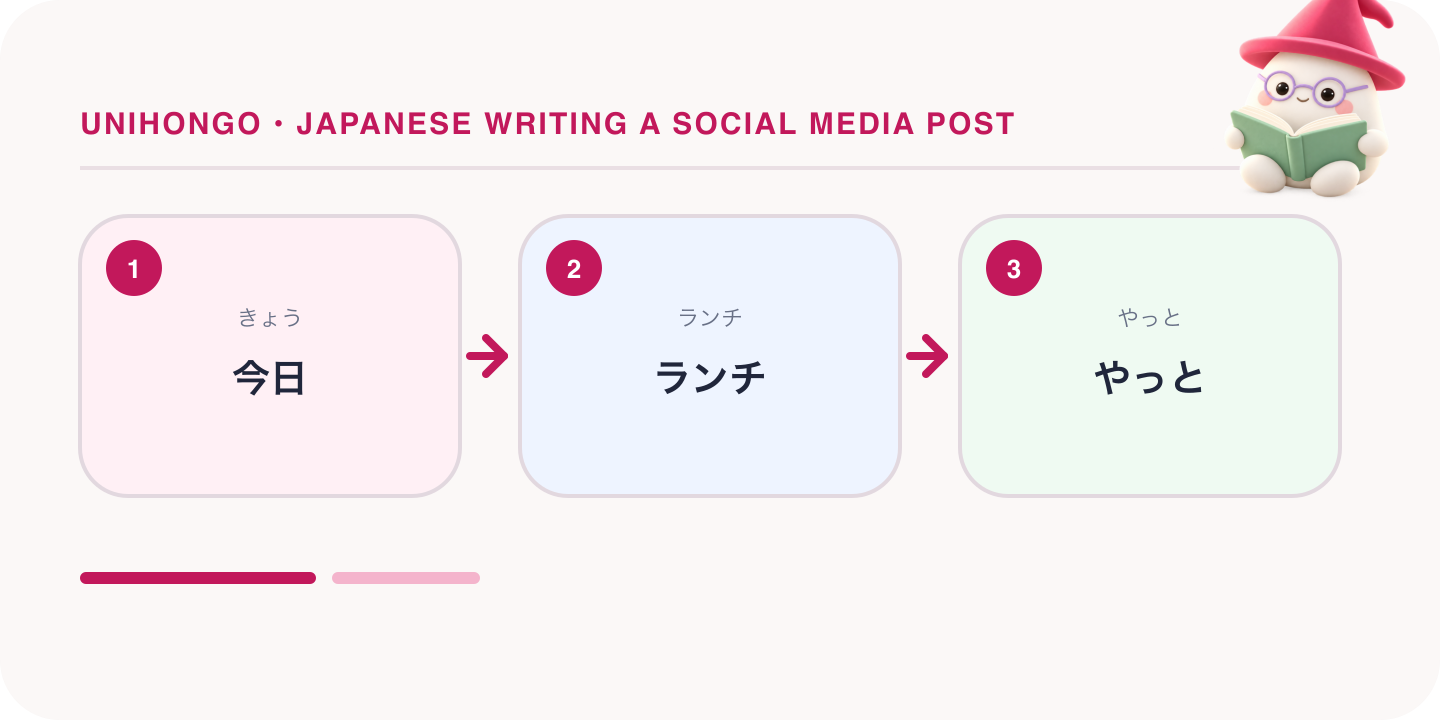
Captions are written in plain form, but a specific, softened plain form. Sentences often end in a noun with nothing after it, in a particle like ne or na, or in a trailing form like kana, I wonder, or shita, I did it. Full stops are rare; line breaks and emoji do the job instead. Subjects are almost always dropped, and so are particles: kyō ranchi, today lunch, is a complete caption.
Stretching a sound with ー or a small kana adds warmth: oishii becomes oishiiii or oishī, sugoi becomes sugoi na, and yatta becomes yattā. This is casual and cheerful, not childish, as long as you do it once or twice. Slang you will see everywhere includes yabai, amazing or awful depending on tone; kawaii, cute; and shiawase, blissfully happy, used for food and days off. Written laughter is a w or a string of them, from the first letter of warau; kusa, grass, is a newer term for the same thing because a row of w looks like grass.
| Japanese | Romaji | Meaning |
|---|---|---|
| 今日のランチ。 | Kyō no ranchi. | Today's lunch. |
| やっと週末〜 | Yatto shūmatsu. | Finally the weekend. |
| 久しぶりの海。最高だった。 | Hisashiburi no umi. Saikō datta. | The sea for the first time in ages. It was the best. |
| これ、めちゃくちゃおいしかった。 | Kore, mechakucha oishikatta. | This was incredibly delicious. |
| 幸せすぎる。 | Shiawase sugiru. | Too happy for words. |
| また行きたいな。 | Mata ikitai na. | I want to go again. |
| 今日も一日お疲れ様でした。 | Kyō mo ichinichi otsukaresama deshita. | Another day done, well done everyone. |
Hashtags the Japanese way
Japanese hashtags are written as hasshutagu and follow the caption, often after a blank line. They are nouns and set phrases, never sentences: the place, the dish, the shop type, the season, a mood word. Because Japanese has no spaces, one tag can be a whole phrase, and long descriptive tags are normal. A food post might carry the dish name, the city plus gurume, meaning good eating, and a phrase like kafe meguri, café hopping. Travel posts use place names, tabi, travel, and kokunai ryokō, domestic travel. Pet posts use the animal, its breed and phrases like nekosuta guramu, a blend of neko and the platform name.
Community tags are a habit you can borrow. Tags such as tsunagaritai, I want to connect, with a topic in front of it, or the equivalent of people who like something, invite others with the same interest. Older phrases like kyō no kōde, today's outfit, and ohiru gohan, lunch, still work. Do not translate English tags word for word; look at what Japanese posters use under a similar photo and pick from those.
- カフェ巡り (kafe meguri): café hopping
- 東京グルメ (Tōkyō gurume): Tokyo food finds
- おうちごはん (ouchi gohan): home cooking
- 今日のコーデ (kyō no kōde): today's outfit
- 猫のいる暮らし (neko no iru kurashi): life with a cat
- 犬のいる生活 (inu no iru seikatsu): life with a dog
- 国内旅行 (kokunai ryokō): domestic travel
- 紅葉狩り (momijigari): autumn-leaf viewing
- 写真好きな人と繋がりたい (shashin-zuki na hito to tsunagaritai): want to connect with photo lovers
Five to ten tags is typical on photo platforms; on short-text platforms most people use one or two, or none. Tags in both Japanese and English are fine if you want readers from both sides.
Emoji, kaomoji and small punctuation habits
Emoji were born in Japan and are used naturally, but usually one or two per line rather than a row. A sparkle marks something special, a droplet marks embarrassment or effort, and a bowing person marks thanks or apology. Kaomoji, faces made from characters, are older and still common: (^^) for a smile, (^^;) for an awkward smile, (T_T) for tears, (>_<) for a wince. Many phones offer them in the keyboard, so you do not need to memorise them.
Other habits: the wave dash 〜 stretches a word or softens a sentence end; the triple dot ellipsis marks trailing off; a single exclamation mark is fine, but Japanese users put them after short bursts rather than every sentence. The question mark appears after a noun or particle on its own, as in dō kana? A full stop is often left off the last line entirely.
| Japanese | Romaji | Meaning |
|---|---|---|
| ついに買っちゃった(^^;) | Tsui ni katchatta. | I finally bought it (awkward smile). |
| 雨で中止に…(T_T) | Ame de chūshi ni. | Cancelled because of rain (tears). |
| 今日はここまで〜 | Kyō wa koko made. | That's it for today. |
| みんなありがとう! | Minna arigatō! | Thanks, everyone! |
| また明日〜! | Mata ashita! | See you tomorrow! |
What Japanese users write about food, travel and pets
Food captions name the dish and the shop, often add one taste word, and frequently say the wait or the price felt worth it. Words like zeppin, exquisite; mocchiri, pleasantly chewy; and shinsen, fresh, appear constantly, and a photo of a limited item comes with gentei, limited edition, or kisetsu gentei, seasonal. Home cooking posts use kyō no bangohan, tonight's dinner, and list the dishes.
Travel captions lean on the weather, the season and a feeling: kaze ga kimochi ii, the breeze feels good; keshiki ga saikō, the view is the best; iyasareta, I felt healed. Shrines and temples get sanpai, a visit to pray, and goshuin, the stamps collected there. Pet posts are the most playful. Owners write in the pet's voice, add nyan or wan as a cat or dog verbal tic, use sama or chan after the pet's name, and describe the pose: henohenomoheji face, loaf shape, kaomoji-worthy stretching. Ordinary days are celebrated: kyō mo kawaii, cute again today, is a complete caption.
| Japanese | Romaji | Meaning |
|---|---|---|
| 季節限定の栗パフェ。並んだ甲斐があった。 | Kisetsu gentei no kuri pafe. Naranda kai ga atta. | The seasonal chestnut parfait. Worth the queue. |
| 今日の晩ごはんは肉じゃがと味噌汁。 | Kyō no bangohan wa nikujaga to misoshiru. | Tonight's dinner is nikujaga and miso soup. |
| 京都、二日目。風が気持ちいい。 | Kyōto, futsuka-me. Kaze ga kimochi ii. | Kyoto, day two. The breeze feels good. |
| 温泉で癒された〜 | Onsen de iyasareta. | Felt healed at the hot spring. |
| 御朱印いただきました。 | Goshuin itadakimashita. | I received the temple stamp. |
| 今日もかわいい。 | Kyō mo kawaii. | Cute again today. |
| おやつ待ちのポーズにゃん。 | Oyatsu machi no pōzu nyan. | Waiting-for-a-snack pose, meow. |
| 散歩から帰りたくないワン。 | Sanpo kara kaeritakunai wan. | Don't want to go home from the walk, woof. |
Replying to comments
Replies keep the same warmth but usually a step more polite than the caption, because a comment from someone you do not know deserves a thank-you. The core is a short arigatō gozaimasu plus one thing: an answer to their question, a small detail, or a question back. Komento arigatō gozaimasu, thank you for the comment, is the standard opener. If a friend comments casually, drop to casual: arigatō, ne, and an emoji.
A useful habit is to acknowledge what they said before adding your own line: sō nan desu, that's right; desu yo ne, isn't it just. To recommend, use zehi, by all means: zehi itte mite kudasai, do go and try it. To close a thread politely, mata yoroshiku onegai shimasu, or simply a bow emoji, is enough.
| Japanese | Romaji | Meaning |
|---|---|---|
| コメントありがとうございます! | Komento arigatō gozaimasu! | Thank you for the comment! |
| そうなんです、ここのケーキが本当においしくて。 | Sō nan desu, koko no kēki ga hontō ni oishikute. | That's right, the cake here is really good. |
| ぜひ行ってみてください。 | Zehi itte mite kudasai. | Do go and try it. |
| 駅から歩いて五分くらいですよ。 | Eki kara aruite gofun kurai desu yo. | It's about five minutes' walk from the station. |
| 嬉しいです、ありがとう〜 | Ureshii desu, arigatō. | That makes me happy, thanks. |
| また一緒に行こうね。 | Mata issho ni ikō ne. | Let's go together again. |
| フォローありがとうございます。よろしくお願いします。 | Forō arigatō gozaimasu. Yoroshiku onegai shimasu. | Thanks for the follow. Nice to meet you. |
Social media vocabulary
Most platform words are katakana loans, but a few native words appear in every feed and are worth knowing so you can read replies and notifications.
| Word | Reading | Meaning |
|---|---|---|
| 投稿 | tōkō | post (noun and verb stem) |
| いいね | iine | a like |
| フォロー | forō | follow |
| フォロワー | forowā | follower |
| コメント | komento | comment |
| 返信 | henshin | reply |
| ハッシュタグ | hasshutagu | hashtag |
| ストーリー | sutōrī | story |
| 映え | bae | photogenic, looks good in a photo |
| 自撮り | jidori | selfie |
| 拡散 | kakusan | sharing widely, going round |
| バズる | bazuru | to go viral |
| 既読 | kidoku | read receipt |
| フォロバ | foroba | follow back |
Bae comes from the verb haeru, to look striking, and gave rise to the phrase Insuta-bae, Instagrammable. Bazuru is a verb built from buzz; you will see bazutta, it went viral.
Model captions to copy
Three short captions, each followed by the hashtags you would add on the next line (the hash symbol is left out here; add one before each tag). Copy the structure and swap the nouns.
| Japanese | Romaji | Meaning |
|---|---|---|
| 念願のラーメン屋さん。スープが濃厚で最高。 | Nengan no rāmen-ya-san. Sūpu ga nōkō de saikō. | The ramen place I've wanted to try forever. Rich soup, the best. |
| タグ:ラーメン、東京グルメ、ラーメン巡り | Tagu: rāmen, Tōkyō gurume, rāmen meguri | Tags: ramen, Tokyo food, ramen hopping |
| 初めての金沢。雨だったけど、それも風情。 | Hajimete no Kanazawa. Ame datta kedo, sore mo fuzei. | First time in Kanazawa. It rained, but that had its own charm. |
| タグ:金沢、国内旅行、雨の日 | Tagu: Kanazawa, kokunai ryokō, ame no hi | Tags: Kanazawa, domestic travel, rainy day |
| 新しいベッド、気に入ったみたい。 | Atarashii beddo, ki ni itta mitai. | Looks like she's taken to the new bed. |
| タグ:猫のいる暮らし、保護猫 | Tagu: neko no iru kurashi, hogo neko | Tags: life with a cat, rescue cat |
Habits that make a caption look translated
The clearest sign of a translated caption is a full sentence with a subject and a full stop where a Japanese user would write a fragment: watashi wa kyō rāmen o tabemashita reads like a textbook, while kyō wa rāmen reads like a caption. Second is a run of adjectives, totemo subarashii keshiki, where one strong word like zekkei, a superb view, does the job. Third is English punctuation habits: multiple exclamation marks, a full stop after every line, and no line breaks.
Fourth is over-formal thanks. Arigatō gozaimashita in a caption to nobody in particular is odd; save the past-tense thanks for a reply to a specific person or an event that has ended. Fifth is using slang you have not seen used. Yabai and kusa are fine among friends but look forced on a polite account. When in doubt, read ten captions under the same hashtag and copy the rhythm rather than the words.
| Japanese | Romaji | Meaning |
|---|---|---|
| 私は今日ラーメンを食べました。 | Watashi wa kyō rāmen o tabemashita. | I ate ramen today. (textbook, not caption) |
| 今日はラーメン。 | Kyō wa rāmen. | Ramen today. (caption) |
| とても素晴らしい景色でした。 | Totemo subarashii keshiki deshita. | It was a very wonderful view. (flat) |
| 絶景。 | Zekkei. | A superb view. (one strong word) |