

Why N3 vocabulary feels different
Up to N4, most words name something you can see or do: a fridge, a ticket, a meeting. At N3 the words name relations between things. Eikyō, influence, has no picture. Keikō, tendency, describes a pattern across many events. Jōken, condition, only makes sense in relation to a promise or a deal. Each has a small set of verbs and particles it prefers.
The second change is the register. N3 sentences move freely between polite and plain forms, and the vocabulary follows: a reading passage might say kekka to shite, as a result, where a conversation would say dakara. Paraphrase questions live exactly here.
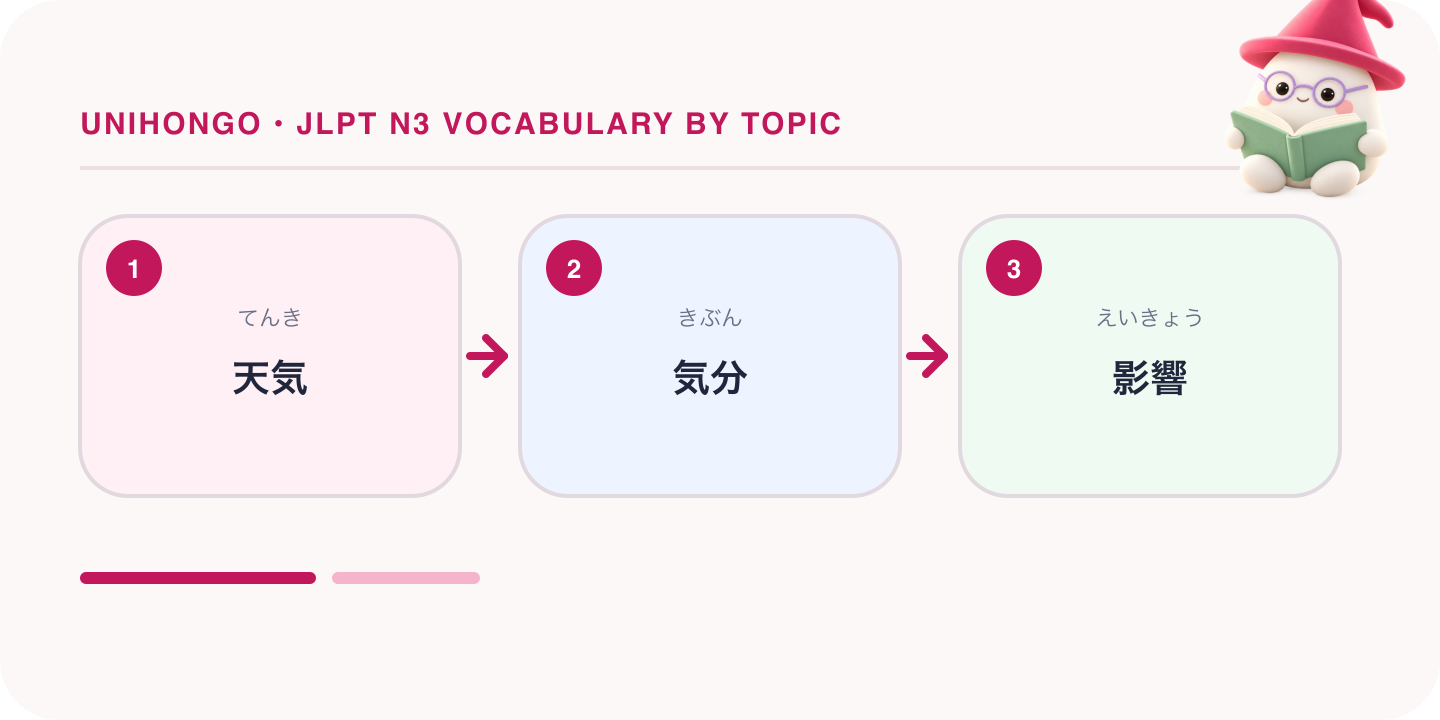
- Abstract nouns: causes, results, tendencies, conditions, attitudes
- Suru verbs: confirm, report, cancel, complete, exercise, travel for work
- Adverbs: certainty, degree, timing, and the speaker's attitude
- Set expressions: idioms with kuchi, te, kao and me, plus workplace phrases
- Verbs of change: increase, decrease, continue, compare, admit
Abstract nouns and the verbs they take
The twelve nouns below appear across N3-style reading passages, listening scripts and vocabulary items. Each is a two-kanji compound, so the reading questions test them as well, and the on-readings need care: gen'in has a syllable break between gen and in, keikō is not keiko, and jōkyō and jōken share their first kanji but not their meaning.
| Japanese | Romaji | Meaning |
|---|---|---|
| 天気は人の気分に影響を与えます。 | Tenki wa hito no kibun ni eikyō o ataemasu. | The weather affects people's moods. |
| 事故の原因はまだ分かっていません。 | Jiko no gen'in wa mada wakatte imasen. | The cause of the accident is not yet known. |
| 彼の意見に賛成です。 | Kare no iken ni sansei desu. | I agree with his opinion. |
| 最近、自転車で通勤する人が増える傾向があります。 | Saikin, jitensha de tsūkin suru hito ga fueru keikō ga arimasu. | Recently there's a tendency for more people to cycle to work. |
| Word | Reading | Meaning and common partner |
|---|---|---|
| 影響 | eikyō | influence; eikyō o ataeru, o ukeru |
| 経験 | keiken | experience; keiken ga aru, o tsumu |
| 意見 | iken | opinion; iken o iu, ni sansei suru |
| 結果 | kekka | result; kekka ga deru, kekka to shite |
| 原因 | gen'in | cause; gen'in o shiraberu, ni naru |
| 目的 | mokuteki | purpose; mokuteki wa, no tame ni |
| 状況 | jōkyō | situation; jōkyō ga kawaru, o setsumei suru |
| 関係 | kankei | relationship; kankei ga aru, to kankei nai |
| 傾向 | keikō | tendency; keikō ga aru, ga tsuyoi |
| 印象 | inshō | impression; inshō ga ii, o ukeru |
| 条件 | jōken | condition; jōken ni au, o dasu |
| 態度 | taido | attitude; taido ga warui, o toru |
Suru verbs for work and daily life
A large share of N3 verbs are a two-kanji noun plus suru. They sound formal in English, confirm, report, suspend, but in Japanese they are ordinary workplace and daily words: kakunin suru is what you do before sending an email, hōkoku suru is what you do after a meeting, and chūshi suru is what happens to a picnic when it rains. Others cover life outside work: undō suru, shutchō suru, kansei suru and sōdan suru.
The trap is the noun form. Each of these can appear without suru, as chūshi ni naru, the event is cancelled, or kakunin ga hitsuyō da, confirmation is needed, and the usage questions offer both. Learn the noun with ni naru and with ga aru or ga hitsuyō as well as with suru, and note which verbs take o for the object and which take ni for the person, as in buchō ni hōkoku suru.
| Japanese | Romaji | Meaning |
|---|---|---|
| 来月、大阪に出張します。 | Raigetsu, Ōsaka ni shutchō shimasu. | I'm going on a business trip to Osaka next month. |
| 駅前に新しいビルが完成しました。 | Ekimae ni atarashii biru ga kansei shimashita. | A new building has been completed in front of the station. |
| 会議の内容を部長に報告しました。 | Kaigi no naiyō o buchō ni hōkoku shimashita. | I reported the content of the meeting to the department head. |
| 薬の使い方を医者に確認しました。 | Kusuri no tsukaikata o isha ni kakunin shimashita. | I checked how to take the medicine with the doctor. |
| 台風のため、イベントは中止になりました。 | Taifū no tame, ibento wa chūshi ni narimashita. | The event was cancelled because of the typhoon. |
| 彼は週に三回、ジムで運動しています。 | Kare wa shū ni sankai, jimu de undō shite imasu. | He exercises at the gym three times a week. |
Adverbs and the sentence shapes they need
Adverbs are the hardest N3 words to learn from a list, because their meaning is a nuance rather than a thing. Kanarazu means without fail, but what that really tells you is that the sentence is a strong promise, order or certainty. Betsu ni means not particularly, and it needs a negative verb after it. Kekkyoku means in the end, and it implies that events took a turn. The table gives the sentence shape each adverb demands, which is what the usage questions actually test.
| Japanese | Romaji | Meaning |
|---|---|---|
| 明日は必ず来てください。 | Ashita wa kanarazu kite kudasai. | Please be sure to come tomorrow. |
| 結局、雨で試合は延期になりました。 | Kekkyoku, ame de shiai wa enki ni narimashita. | In the end the match was postponed because of rain. |
| 試験は案外簡単でした。 | Shiken wa angai kantan deshita. | The exam was unexpectedly easy. |
| 突然、電気が消えました。 | Totsuzen, denki ga kiemashita. | Suddenly the lights went out. |
| Adverb | Reading | Meaning and sentence shape |
|---|---|---|
| 必ず | kanarazu | without fail; with a promise, an order or a certainty |
| ほとんど | hotondo | almost, mostly; with a negative it means hardly |
| たとえ | tatoe | even if; followed by te mo |
| 相当 | sōtō | considerably; before an adjective or verb |
| 徐々に | jojo ni | gradually; with a verb of change |
| ずいぶん | zuibun | quite, a lot; with a change or a surprise |
| 結局 | kekkyoku | in the end; after a story that took a turn |
| 突然 | totsuzen | suddenly; before an unexpected event |
| 別に | betsu ni | not particularly; needs a negative |
| どうしても | dōshitemo | no matter what; with a wish or an impossibility |
| 案外 | angai | unexpectedly; with a result that surprised you |
| まるで | maru de | just like; followed by yō da or mitai da |
Set expressions and idioms
N3 introduces the body-part idioms that Japanese uses in place of many single adjectives. Kuchi ga katai, a hard mouth, means discreet. Kao ga hiroi, a wide face, means well connected. Te ga hanasenai, cannot let go of the hands, means too busy to stop. Me o tōsu, pass the eyes over, means to look through a document. Paraphrase questions ask you to match one to its plain meaning.
Alongside them sit the workplace set phrases that every N3 learner should be able to say without thinking: enryo naku, without hesitation; sekinin o motte, taking responsibility; ki ni naru, to be on your mind; and anshin shite, with peace of mind. Learn each as a whole phrase with its particle.
| Japanese | Romaji | Meaning |
|---|---|---|
| 気になることがあれば、遠慮なく言ってください。 | Ki ni naru koto ga areba, enryo naku itte kudasai. | If anything bothers you, please say so without hesitation. |
| 彼は口が堅いので、安心して相談できます。 | Kare wa kuchi ga katai node, anshin shite sōdan dekimasu. | He can keep a secret, so you can consult him with peace of mind. |
| 忙しくて手が離せません。 | Isogashikute te ga hanasemasen. | I'm busy and can't get away. |
| この件は私が責任を持って対応します。 | Kono ken wa watashi ga sekinin o motte taiō shimasu. | I will take responsibility for handling this matter. |
| 顔が広い人に頼むのが一番早いです。 | Kao ga hiroi hito ni tanomu no ga ichiban hayai desu. | Asking someone well-connected is the fastest way. |
| 資料に目を通しておいてください。 | Shiryō ni me o tōshite oite kudasai. | Please look through the documents in advance. |
Verbs of change that carry reading passages
Reading passages at N3 are often short opinion pieces about society, and they run on a small set of verbs: fueru and heru, to increase and decrease; agaru and sagaru, to rise and fall; kawaru, to change; tsuzuku, to continue; kuraberu, to compare; tsutaeru, to convey; and mitomeru, to admit or recognise.
They also pair naturally with the adverbs above: jojo ni fueru, gradually increase; kyū ni kawaru, change suddenly; zutto tsuzuku, continue the whole time. Say the sentences below, then swap in subjects from your own life.
| Japanese | Romaji | Meaning |
|---|---|---|
| 物価が上がって、生活が大変になりました。 | Bukka ga agatte, seikatsu ga taihen ni narimashita. | Prices have risen and life has become hard. |
| 去年と比べて、観光客が減りました。 | Kyonen to kurabete, kankōkyaku ga herimashita. | Compared with last year, tourist numbers have fallen. |
| 会議の結果を全員に伝えてください。 | Kaigi no kekka o zen'in ni tsutaete kudasai. | Please tell everyone the result of the meeting. |
| この習慣は昔から続いています。 | Kono shūkan wa mukashi kara tsuzuite imasu. | This custom has continued since long ago. |
| 自分の間違いを認めるのは難しいです。 | Jibun no machigai o mitomeru no wa muzukashii desu. | Admitting your own mistakes is difficult. |
| 状況が変わったら、すぐ連絡します。 | Jōkyō ga kawattara, sugu renraku shimasu. | If the situation changes, I'll contact you right away. |
How to learn N3 words in context
The method has three steps and takes about twenty minutes a day. First, meet the word in a real sentence, from a short article, a listening script or one of the tables above, and copy the whole phrase, not the word. Second, write one sentence of your own with the same phrase and say it aloud, changing only the subject or the situation. Third, use it in a conversation within a day.
Two habits make the method work. Keep a running list of phrases rather than words, so eikyō o ataeru is the entry, not eikyō. And review by producing, not by recognising: cover the Japanese, read the English, and say the sentence.
- Copy the phrase with its particle and partner verb, never the bare word
- Write one sentence of your own with the phrase and say it aloud
- Use the phrase in a real conversation within twenty-four hours
- Review by producing the Japanese from the English, not the other way round
- Read one short Japanese article a day and mark the phrases you already know
Mistakes with near-synonyms
Most lost N3 points come from choosing a word that translates correctly but does not fit. Learners write wakaru where the passage needs rikai suru, taisetsu where the sentence needs jūyō, and owari where kekka is meant. Paraphrase questions exploit this, offering the everyday word as a distractor for the formal one.
The four sentences below each use the more precise N3 word where a lower-level word would have sounded slightly off. Say what the lower-level alternative would have been and why the N3 word fits better.
| Japanese | Romaji | Meaning |
|---|---|---|
| 説明を聞いて、やっと理解できました。 | Setsumei o kiite, yatto rikai dekimashita. | Having heard the explanation, I finally understood. |
| 彼女の意見を尊重します。 | Kanojo no iken o sonchō shimasu. | I respect her opinion. |
| 結果より過程が大切だと思います。 | Kekka yori katei ga taisetsu da to omoimasu. | I think the process matters more than the result. |
| 新しい環境にだんだん慣れてきました。 | Atarashii kankyō ni dandan narete kimashita. | I've gradually got used to the new environment. |